 HOME
HOME




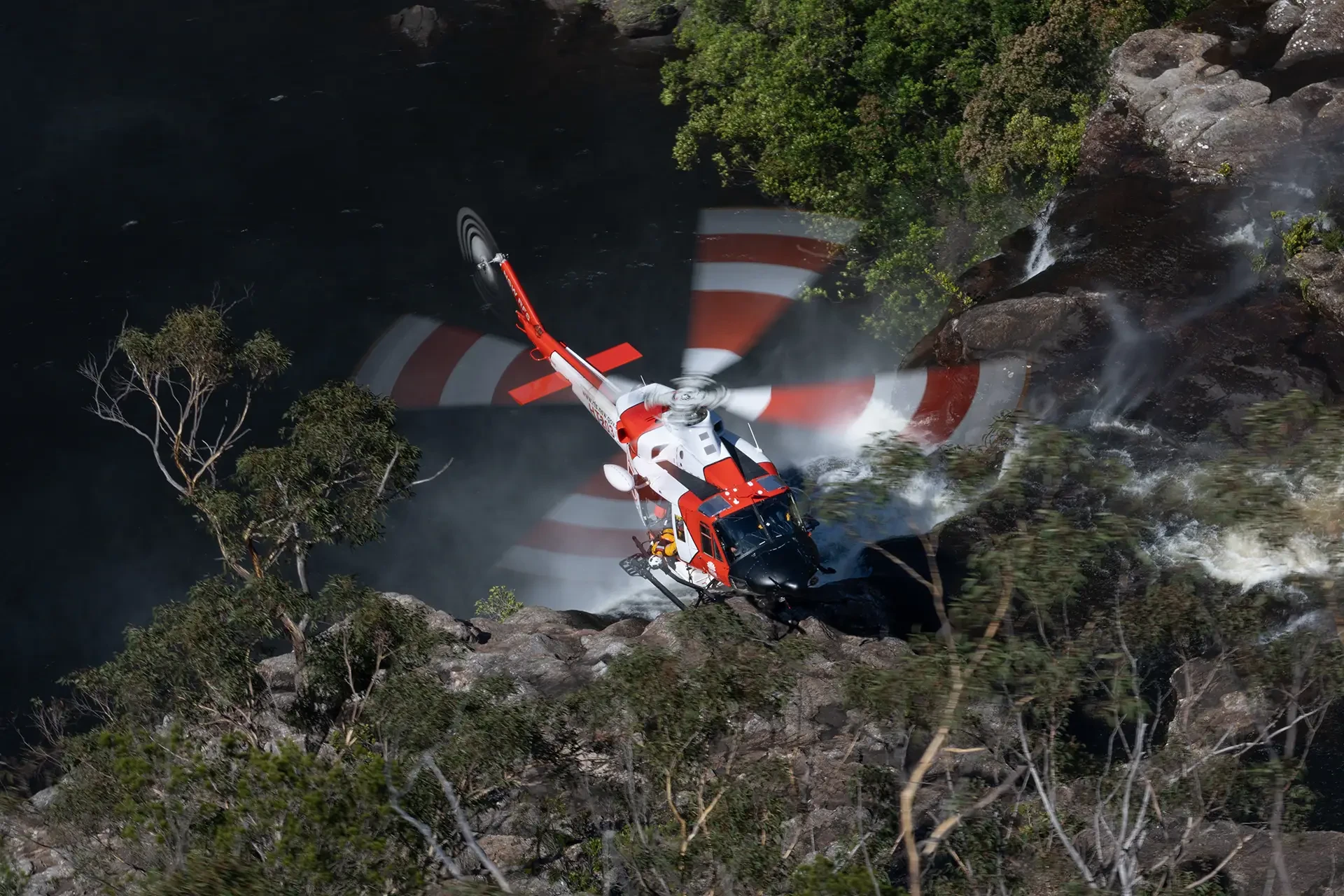
The tree trunk was still smoking when the team arrived. It had been struck by lightning during a severe storm the day before. Now, three firefighters in yellow shirts and heavy packs work quickly with chainsaws, Pulaskis, and rake-hoes, breaking the tree apart, exposing the cinders contained within, and begin snuffing out the heat with only the bare earth around them. There is no hose line, no engine, no tanker; just muscle, tools, and years of practised techniques.
This is dry firefighting at its most elemental: digging, scraping, and cutting a fire off from more fuel before it can grow and spread. Once the last embers are contained, the team radios their pilot. Minutes later, a Bell 412 hovers overhead, and one by one, the firefighters are winched back into the machine, leaving behind a cooling, freshly fallen tree, a scar of churned earth, and the quiet satisfaction that another potential fire has been stopped before it ever began.
For the New South Wales Rural Fire Service (NSW RFS) Remote Area Firefighting Teams (RAFT) and their specialized Rapid Aerial Response Teams (RART), this is the job: go into the wilderness where trucks can’t, armed with hand tools, experience, and grit; to stop the fires before they really get started. “It’s about early detection and rapid intervention,” explains Tova Gallagher, the program’s Aviation Coordinator (Rotary Wing). “That’s the way you stop a small ignition from becoming the next campaign fire.”
Getting Remote
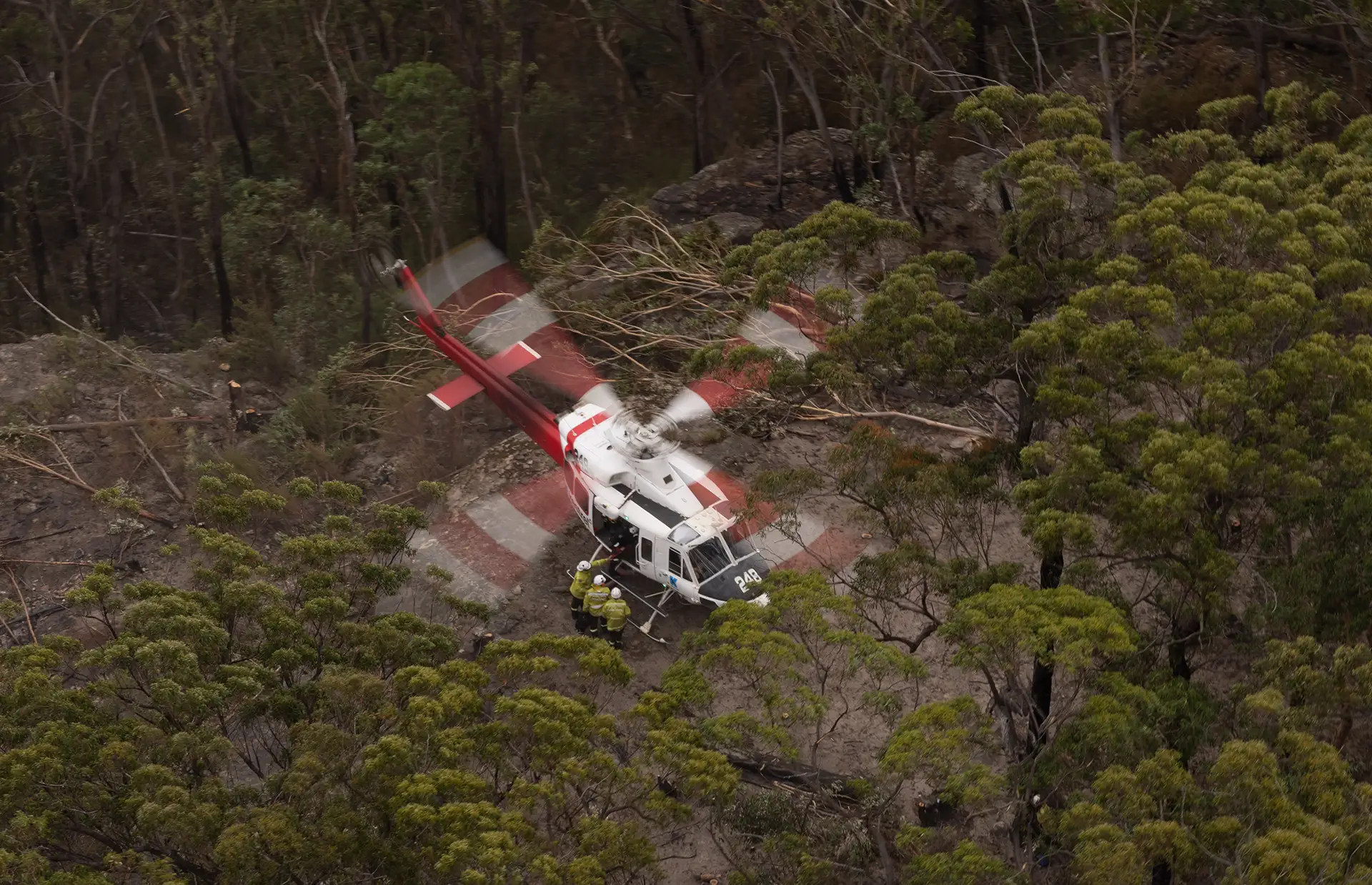
The essence of RAFT is simple: go where no truck can. Remote area firefighters are trained to operate far from the comforts of access roads, water points, and heavy machinery. Some deployments begin with long hikes or boat trips, but when speed is critical, helicopters define the role.
“Remote area firefighters can get in and out in many ways; by boat, by trail, even by bike,” Gallagher explains. “But what sets RAFT apart is our aviation capability. We’re trained for helicopter insertion, which means we can be where we need to be in minutes rather than hours.”
Rapid Aerial Response Teams are RAFT-qualified members drawn from within the pool of RAFT firefighters, who are stood up from the ready roster for immediate action after lightning storms. When weather data shows a high chance of ignition, these RART crews are prepositioned at airbases close to the strike zone, ready to move at the first report.
“On those days, the aircraft are ready, the crews are ready, and we’re waiting for smoke,” Gallagher says. “It’s a proactive tool. Rather than waiting for a fire to take hold, we’re already moving to investigate where we expect it to begin.”
Helicopters: Lifeline Above
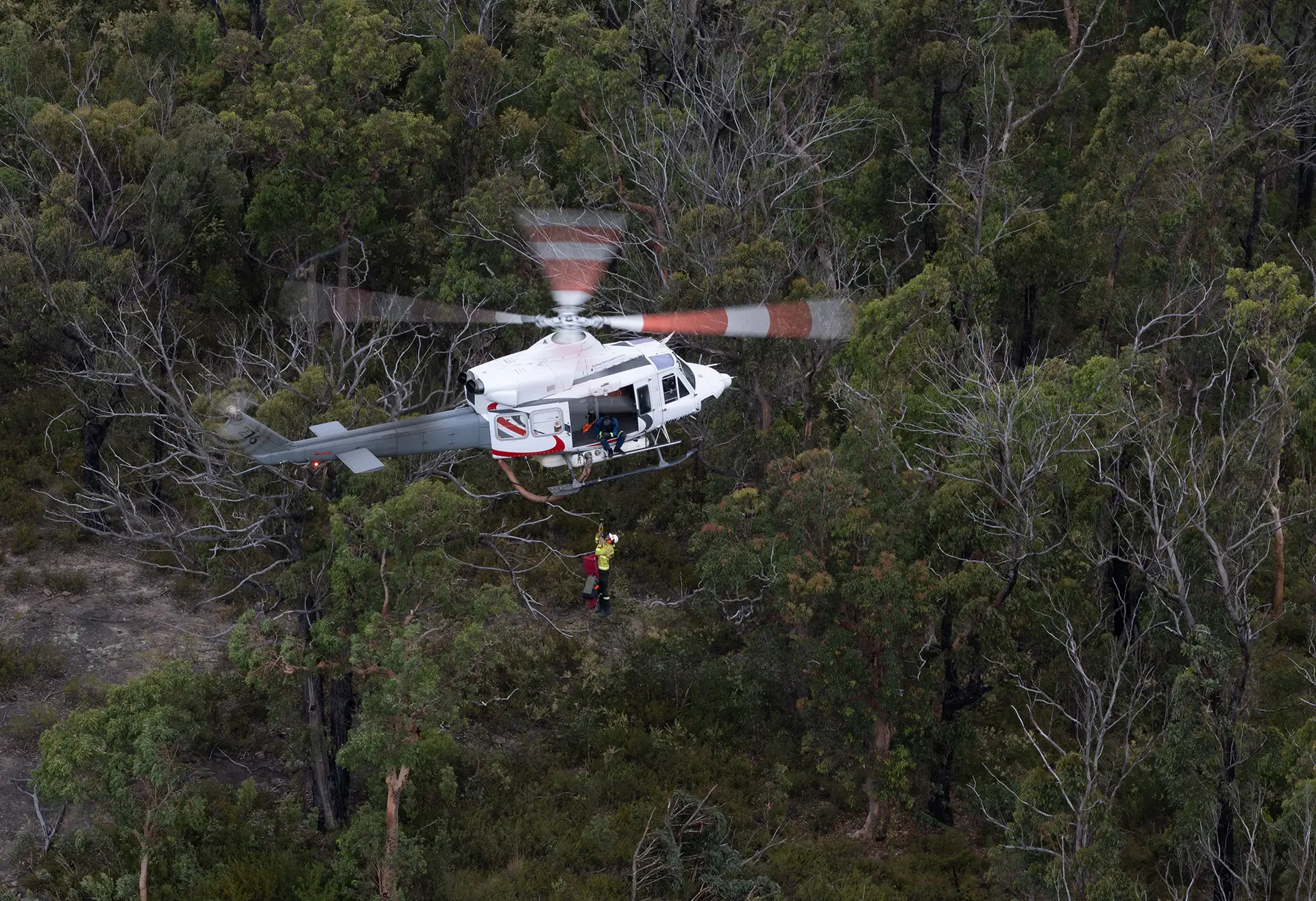
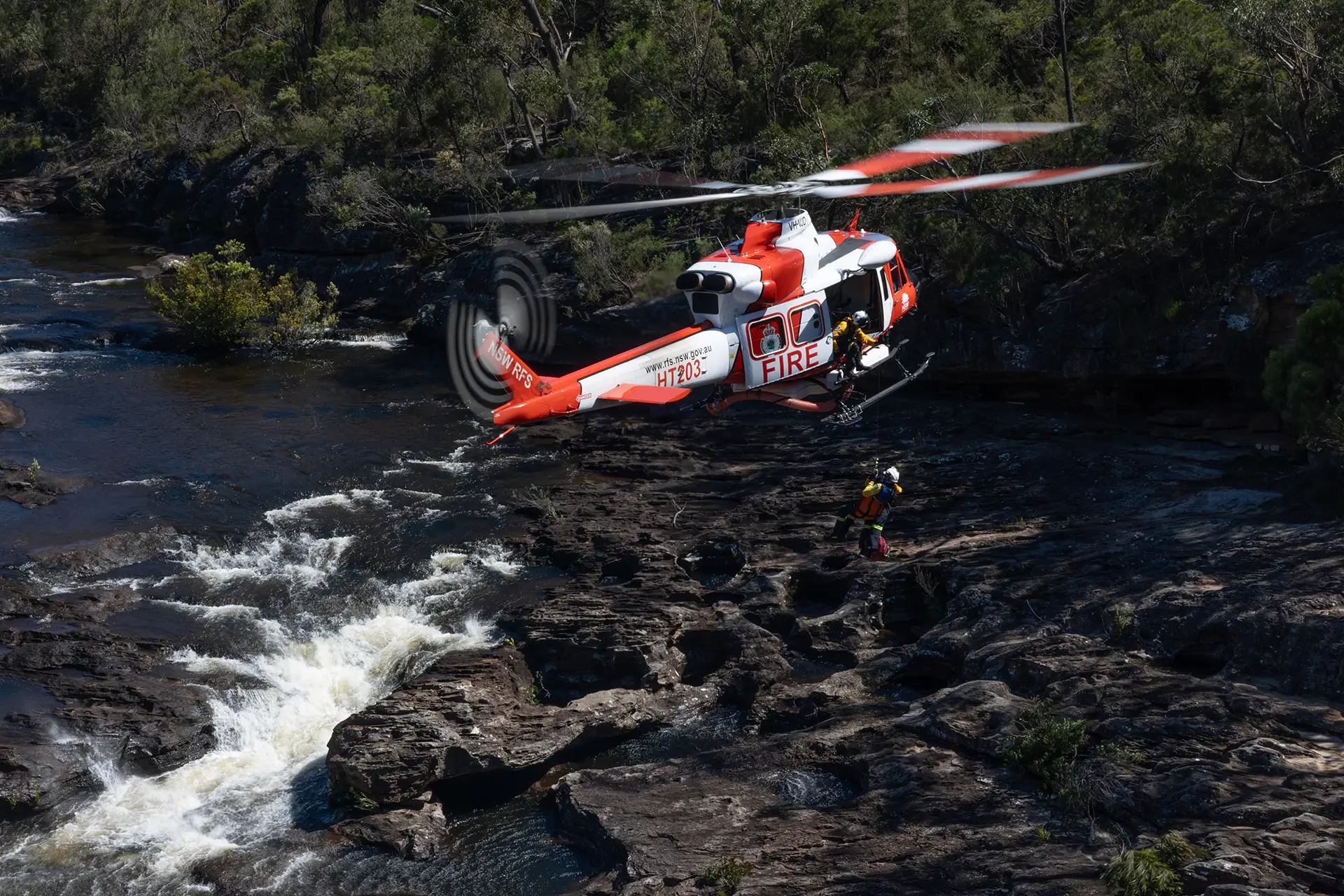
The helicopter is more than transport; it is the axis around which the system spins. Insertions follow a hierarchy of safety: land if possible, hover if safe, and winch if necessary.
“Our preference is always a landing,” Gallagher explains. “If we can put the aircraft down on a rock shelf or a clearing, that’s ideal. If not, we look at a hover exit. And if neither is possible, then we winch. But sometimes, particularly in canyon country, a short winch is actually safer than trying to hover.”
Once RART crews are on the ground, the aircraft shifts roles, supporting the RART team with bucket work when possible, such as bucketing water or, if needed, resupplying. Increasingly, when available, Bell 412s fitted with FLIR systems and operators add an intelligence layer.
“The 412s are a game changer,” Gallagher says. “They can lift more, fly further, and with FLIR onboard, we can detect hotspots that aren’t visible to the naked eye. It means we can put people in exactly where they’re needed, often reducing the time spent searching for hot spots.”
Racing the Spark
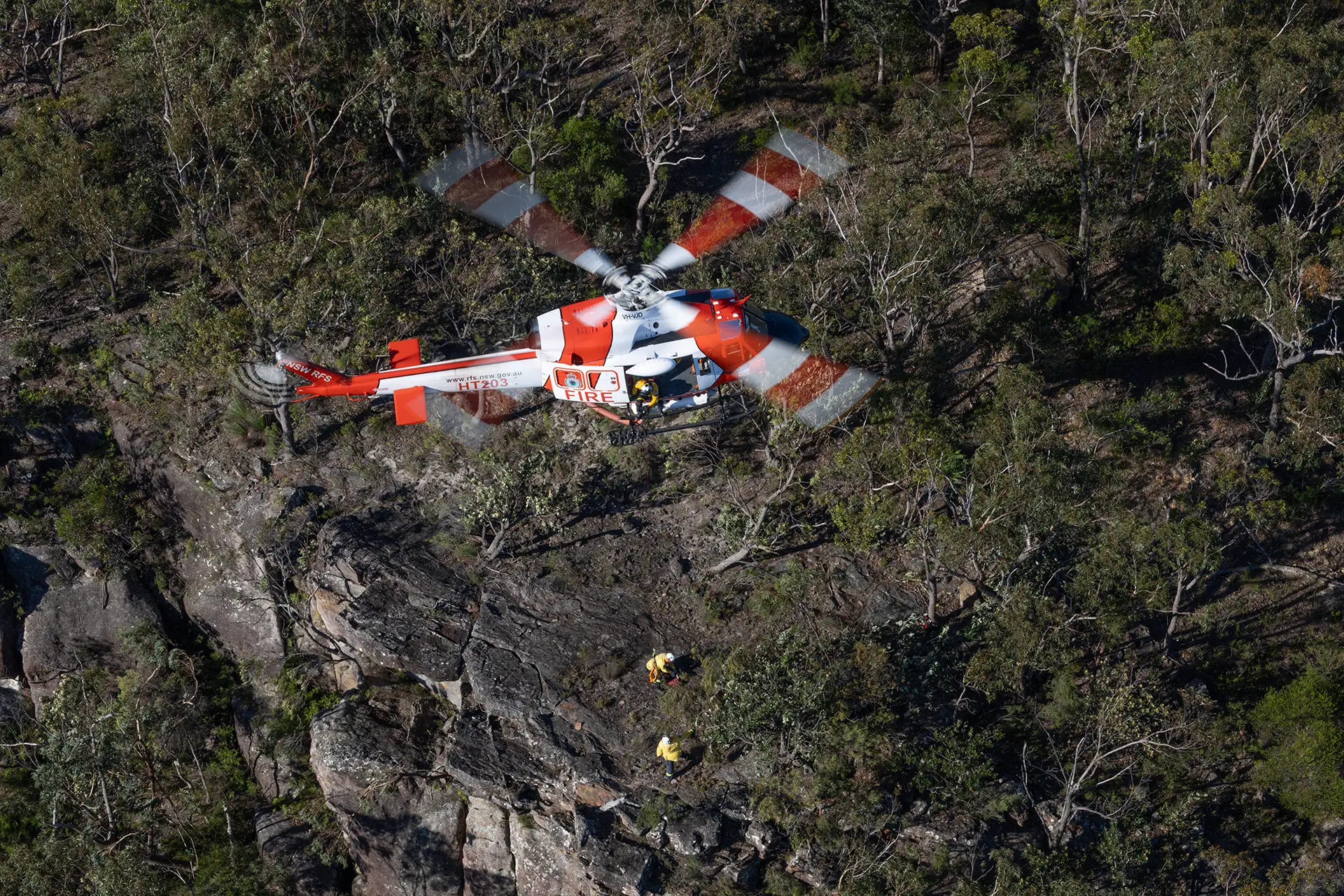
Where RART differs from the rest of RAFT is in speed. Responding within minutes rather than hours, RART crews exist to chase ignitions in some of the most remote locations before they grow. “The moment there’s a fire report or smoke sighting, we’re airborne,” Gallagher says. “We get in first, gather intelligence, evaluate the situation, and, if it’s safe and effective, attack before it escalates.”
Typically, RART crews of three to five insert when the Fire Behavior Index is below 40, a threshold that ensures a small team can be effective and safe. “We’re not sending RART teams into spots during extreme fire danger conditions,” Gallagher explains. “It’s about using that window to prevent escalation.”
Gallagher recalls the 2019 season vividly. “After a major lightning band came through, RART crews were everywhere, leapfrogging through the bush, putting out hotspots as quickly as we could. We contained a lot of fires that day, but it only takes one to get away. One became the Gospers Mountain fire on the outskirts of Sydney.”
For these team members, flying over the bush to look for small fires to fight by hand is the culmination of years of experience, training, dedication, and a true love of the craft.
Training, Standards, and Fitness
Becoming a RAFT member is not just about enthusiasm; it’s about volunteering to meet rigorous standards of training and readiness and proving them year after year. The pathway is structured and uncompromising. It begins with Basic Firefighter, followed by Advanced Firefighter, then Remote Area Operations, and finally, for those who move into RART, the Helicopter Insertion Techniques course, commonly referred to as HIT.
“None of us get to shortcut the system,” Gallagher explains. “You do every step, building years of experience along the way.” While age is not a direct factor, as some team members are in their 60’s and 70’s, fitness and comfort in the austere environment are everything.
Every RAFT firefighter must complete the arduous pack test: carrying a 20-kilogram load over 4.83 kilometers in less than 45 minutes. It sounds simple, but Gallagher is quick to point out that the test is designed to expose weaknesses. “It’s a test that doesn’t care how tough you think you are. If you can’t carry the weight, or you don’t prepare, you won’t make the time. And that’s exactly the point. We need to know people can do it when it matters.”
The pack test is only part of it. Every two years, members complete a medical that focuses on musculoskeletal and cardiovascular fitness. Recurrency training keeps skills sharp. HIT refresher courses every 14 months, rescue training for those qualified, and helicopter safety drills as required.
And all of this sits on top of their core, usual firefighting duties. “Every RAFT firefighter is a brigade member first,” Gallagher explains. “They still turn out to local incidents, maintain their competencies, and do everything any other volunteer does. RAFT and RART are an extra layer of commitment. You’re doing all that work and then choosing to take on even more.”
For Gallagher, that’s part of what makes the capability so strong. “These people aren’t specialists who live apart from the service, they’re embedded in their brigades, and then they volunteer to take on this extra responsibility. It means they bring both the local knowledge of their patch and the advanced training of RAFT. That combination is powerful.”
For those who choose to progress beyond RAFT and into the RART program, the pathway is both demanding and deliberate. When a firefighter reaches this point, they have already proven their skill and resilience in remote country and demonstrated they can operate safely under pressure. The next step is to take that experience into the helicopter environment.
Helicopter Insertion Techniques (HIT)
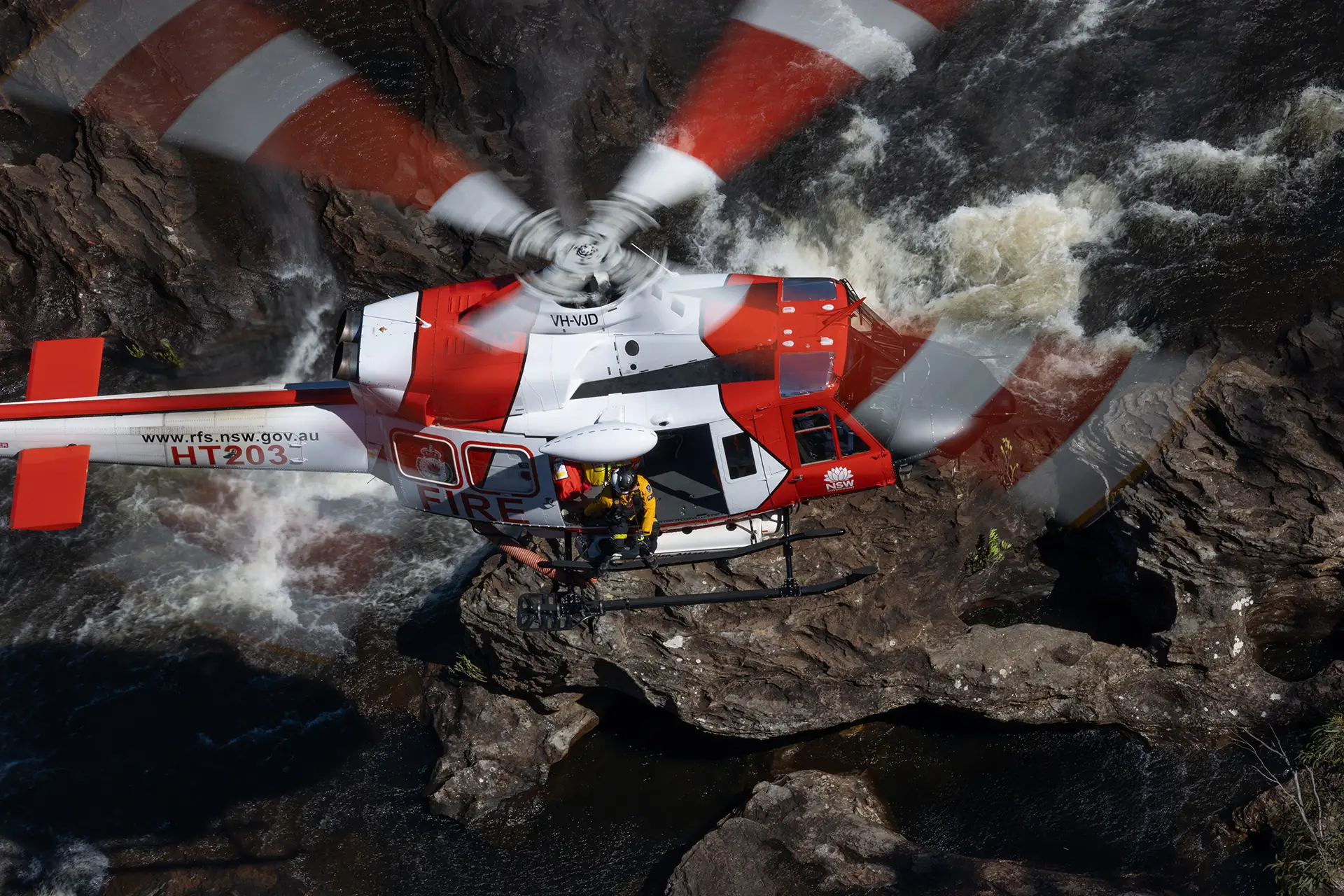
By the time a firefighter reaches the Helicopter Insertion Techniques course, they have already proven they can operate safely and effectively in remote country. HIT is where aviation and ground skills converge, and the training is deliberately intense.
“The helicopter environment is unforgiving,” Gallagher says. “HIT is about making sure we can insert safely, under pressure, and in conditions that aren’t ideal. The course takes everything you’ve learned on the ground and adds the complexity of rotor wash, noise, and the risks of working under a machine.”
The program follows a clear progression. It begins with online modules that cover theory, aircraft safety, communications, and risk awareness. From there, trainees progress to simulation training, which includes static cabin and winch rigs, where they rehearse clipping in and out, handling packs and tools, and coordinating hand signals as a team. Only once those fundamentals are mastered do they progress to live helicopter training, where the full noise, rotor wash, and intensity of the real environment test both precision and discipline.
The training covers all three insertion methods: landings, hovers, and winches, and the procedures that support them. Firefighters practice moving quickly and confidently on and off the skids, assessing landing zones, and controlling movement under the rotor wash.
“It’s not just about the physical side,” Gallagher adds. “It’s about discipline. Everyone has to move with absolute precision around the aircraft. In remote country, we don’t have the luxury of mistakes. HIT instills that mindset.”
Once qualified, members must refresh every 14 months. “We won’t put anyone on a helicopter who isn’t current,” Gallagher says.
Aviation Rescue Crew Officers
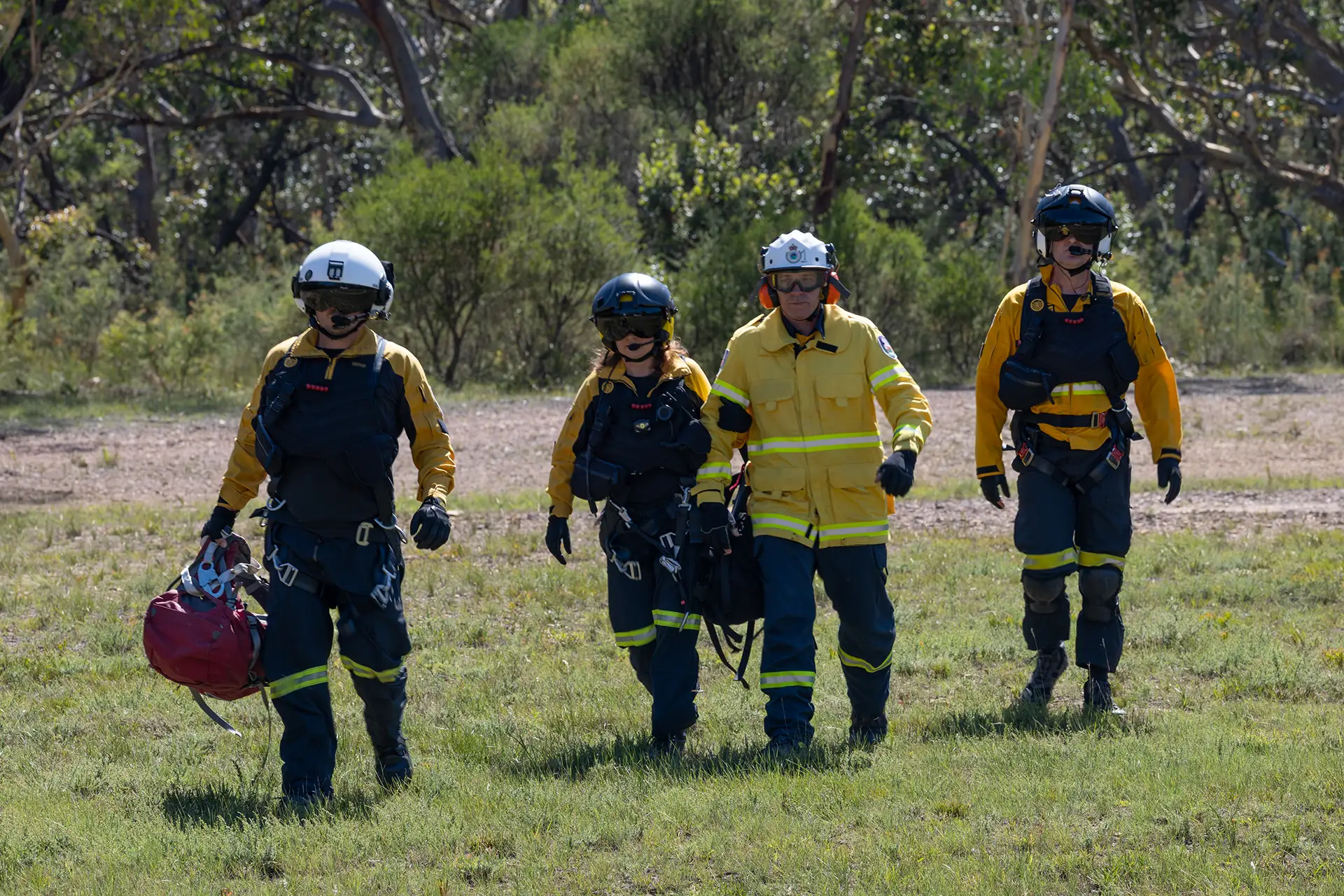
For some, HIT is only the beginning. Those who wish to progress further can train as Aviation Rescue Crew Officers: the specialists who go down the wire, manage rescues, and handle the most technical aerial tasks.
“They complete a full Certificate III in Aviation Rescue Crew,” Gallagher explains. “It’s nine months of face-to-face training, and it’s demanding from start to finish. You’re covering everything from down-the-wire operations to sling loads, rescue techniques, navigation, and working as part of an airborne crew.”
The training is immersive. Trainees spend weeks in helicopters practising winches in rugged terrain, working closely with pilots and Air Crew Officers, and building confidence in some of the most unforgiving conditions. Classroom work covers navigation, aviation safety, and human factors, while field components include survival, patient handling, and advanced communications.
“By the end of it, they’re not just firefighters anymore,” Gallagher says. “They’re aircrew. They think like part of the helicopter team, and that’s critical when you’re working in complex missions.”
Currently, there are approximately 250 RAFT members in New South Wales who hold HIT qualifications, with around 44 having advanced to the role of Rescue Crew Officers. Gallagher is clear that the Rescue Crew capability isn’t about prestige but operational need. “It gives us flexibility,” she says. “The pilot knows that if there’s a Rescue Crew Officer on board, they can handle more scenarios. That might mean winch rescue or managing a sling load into terrain too steep for a landing. It’s about giving the aircraft and the team more options.”
Perseverance: Breaking Barriers in RAFT
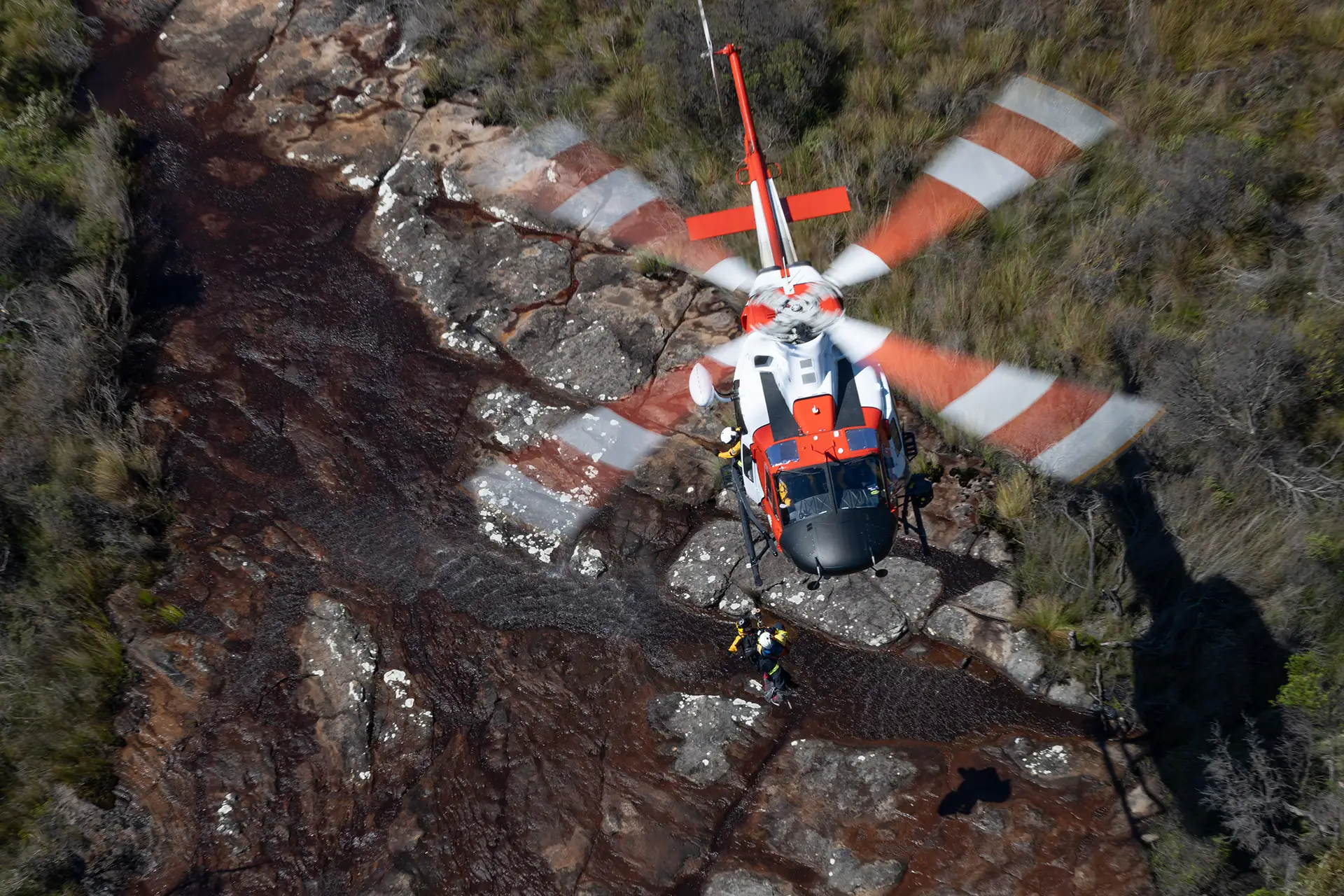
Gallagher’s own journey into RAFT began with curiosity and a simple question. “I was an Advanced Firefighter, and I saw my training officer get in a helicopter to fly a hazard reduction burn we were doing. He came back and I said, ‘Hey Ralph, how do I get in one of those?’”
What followed was persistence in the face of resistance. “When I started, there was some outright hostility towards women in RAFT,” she recalls. “It wasn’t subtle at all; it was people trying to prove I couldn’t keep up, that I didn’t belong.”
She credits her mentors for steering her through those early years. “Craig Burley was one. Ralph Clark was another. Ralph sat me down and told me the pathway: Advanced Firefighter, Remote Area Ops, and HIT. He didn’t sugarcoat it, but he showed me the way. That made all the difference.”
Her determination was tested not just on the training ground but at home. “I trained for my first arduous pack test with my toddler on my back,” she says. “Every walk, every hill, every kick in the kidney, every bit of pain, I embraced because I wanted it. I wasn’t going to let anyone say I hadn’t earned my place.”
Today, women make up about ten per cent of RAFT. It’s still a small proportion, and Gallagher acknowledges that cultural hurdles remain. “At brigade level, it can still be harder for women to get through Advanced Firefighter training or to be supported into RAFT. But if you can meet the standards, you’re in. That’s the rule. And once you’re in, you’re treated as any other RAFTie, not as a female RAFTie.”
For Gallagher, progress is gradual but undeniable. “The culture is changing,” she says. “There are more of us now, and the more people see women in harnesses, carrying packs, working fires, the more normal it becomes. That’s how we build the next generation.”
On the Campaign Fires
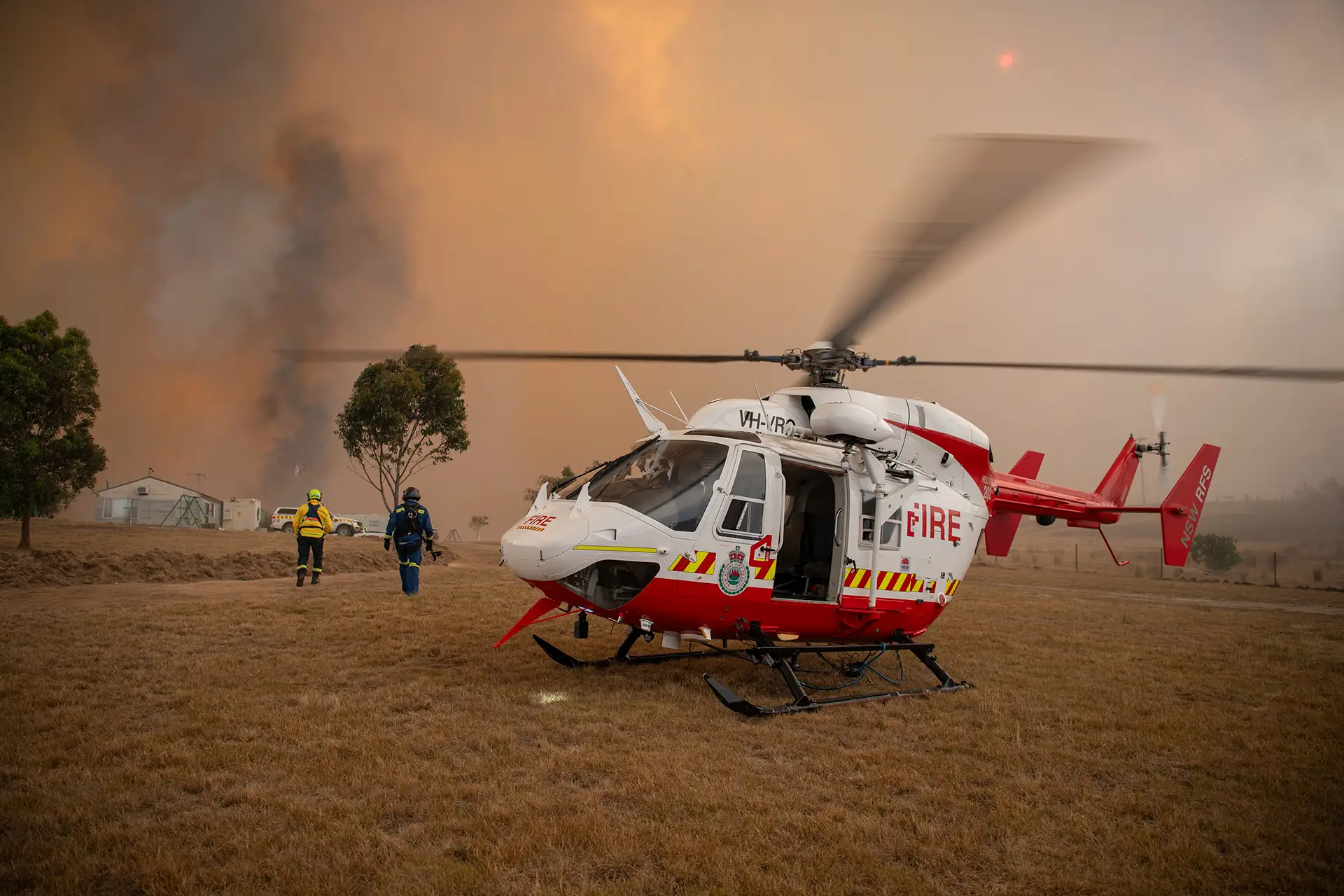
On major campaign fires, RAFT and RART teams become the quiet but vital element of containment. Where heavy equipment and engines can’t reach, the RAFTies go in, often inserted by helicopter in leapfrog fashion to deal with hot spots, check edges, and secure the ground.
Though they are often supported by bucket drops from the helicopter, “a lot of what we do is dry firefighting,” Gallagher explains. “That means no water. We’re digging out ash pits, cutting dirt containment lines, scraping, chopping, and exposing hot spots. You might open up an ash pit, and it’s sitting at 350 degrees inside. Once you break it open and let it breathe, it drops quickly—sometimes to 80 degrees in just a few minutes. That’s how containment works.”
The arrival of FLIR has also changed the way these missions unfold. With a systems operator on board, helicopters can fly the fire edge at night or in poor visibility, pinpointing hotspots invisible to the naked eye. Those coordinates are passed to RAFT crews, who then hike or are winched in. “FLIR guides us to exactly where we need to be,” Gallagher says. “It’s efficient, and it means the aircraft is multiplying our effectiveness on the ground, but you still have to have boots on the ground.”
The Gospers Mountain fire underscored this role. After lightning ignitions multiplied, RAFT crews were moved across the Wollemi in helicopters, each team leapfrogging the next. “It was massive country—steep, remote, unforgiving,” Gallagher recalls. “The only way to declare sections contained was to put boots on the ground. You can fly it, you can scan it, but until someone has walked the line to get the actual feel of the conditions, you can’t sign it off.”
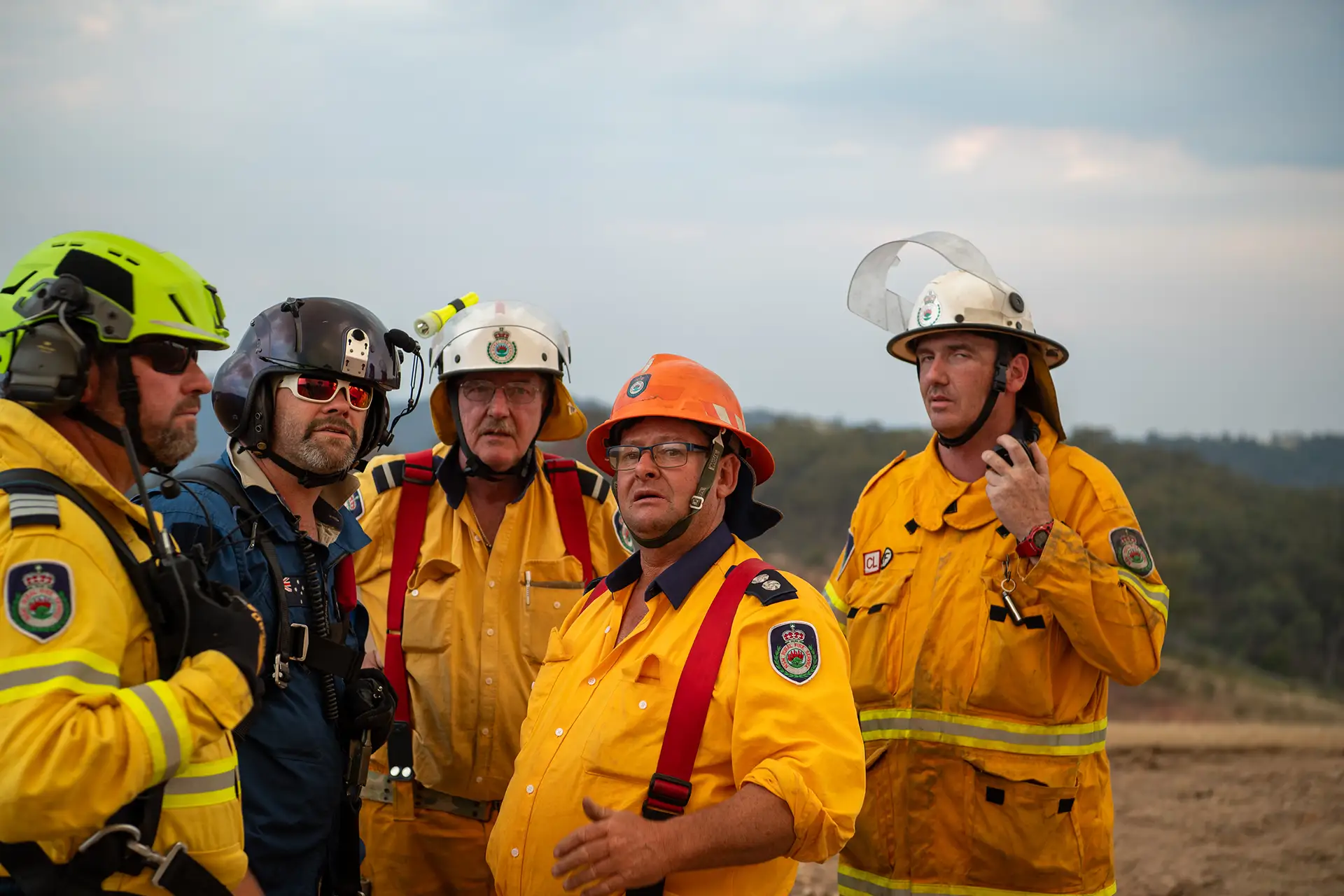
For the pilots who flew them in, those missions were among the most demanding of the season—tight landings on rock shelves, hover exits into narrow gullies, and long hours supporting small teams with sling loads and water drops. For the RAFT teams, it was a test of elemental firefighting: fire, earth, hand tools, and endurance.
Interagency and International Work
State borders do not confine RAFT and RART resources. Teams are often composites drawn from different agencies, bringing together RFS volunteers, National Parks staff, ACT crews, and interstate firefighters into a single unit. The common denominator is the training; everyone works to the same standard, which allows seamless integration in the field. Cooperation is visible every day. “At the State Air Desk, RFS and National Parks sit next to each other,” Gallagher says. “When the call comes, it doesn’t matter what badge you wear, we’re one team.”
Their capabilities and experience are also frequently sought after from locations abroad. “We’ve been supporting Tasmania for many years,” Gallagher says. “We often deploy to the USA, and right now we’re in Canada working fires. Sometimes we winch, sometimes not, depending on the request. But the skills are the same: remote survival, navigation, endurance.”
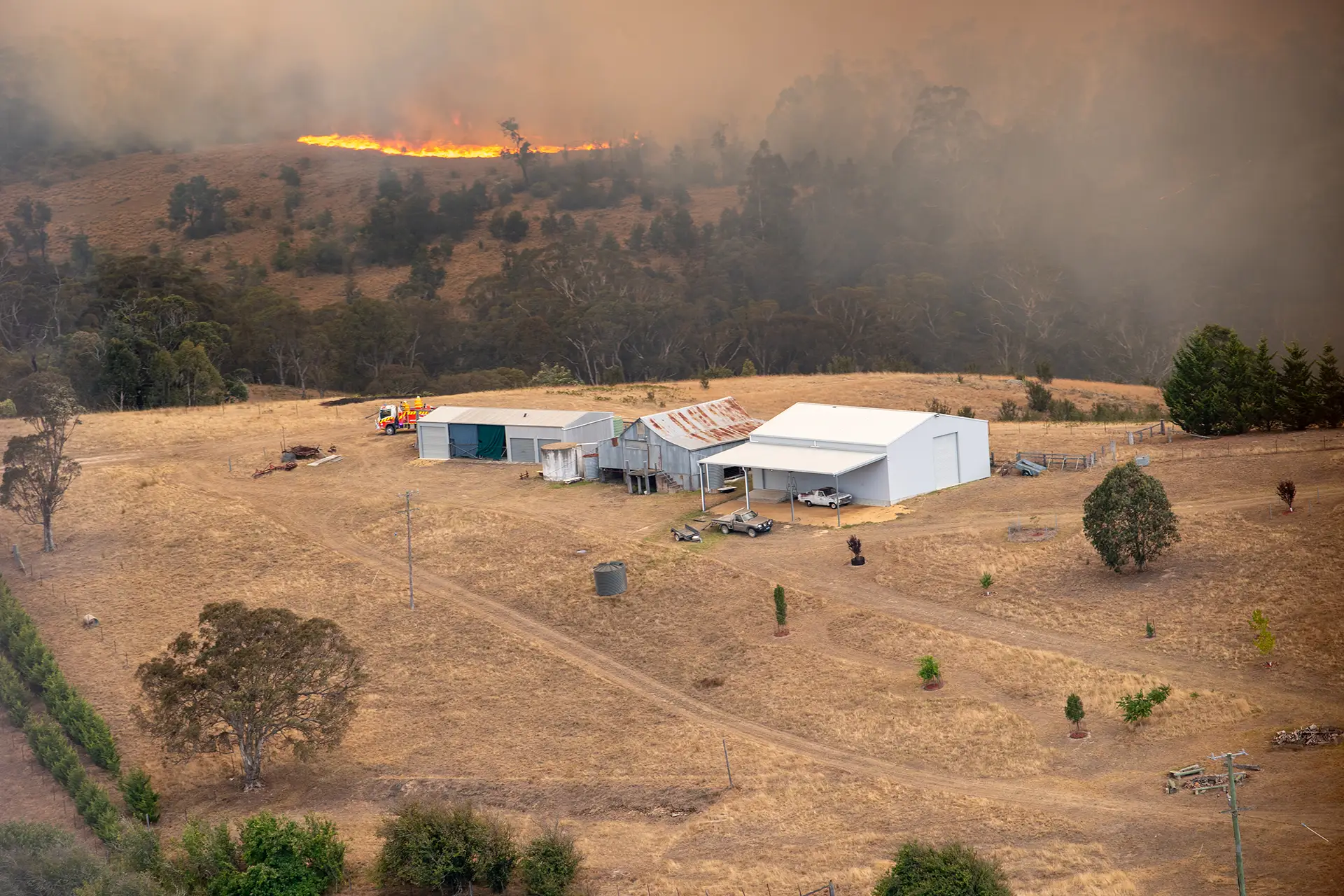
This adaptability is central to the program’s success. Whether it’s a rocky ridge in the Blue Mountains or a conifer forest in North America, the fundamentals don’t change. “If you can operate in remote, rugged country here, those skills transfer anywhere,” Gallagher explains.
Looking Forward
The evolution of technology and aircraft will continue to shape RAFT and RART. Larger machines, such as the Bell 412, provide extra lift and crew capacity, while FLIR cameras enhance intelligence, accelerate detection, and reduce risk for crews on the ground. These advancements expand the toolbox, but they don’t replace the fundamentals.
For Gallagher, the future is less about dramatic change or the next new thing; it’s more about steady growth, more qualified members, more rescue crew capability, and continued interagency cooperation at home and abroad. Technology helps, but it’s the people who make the program a success.
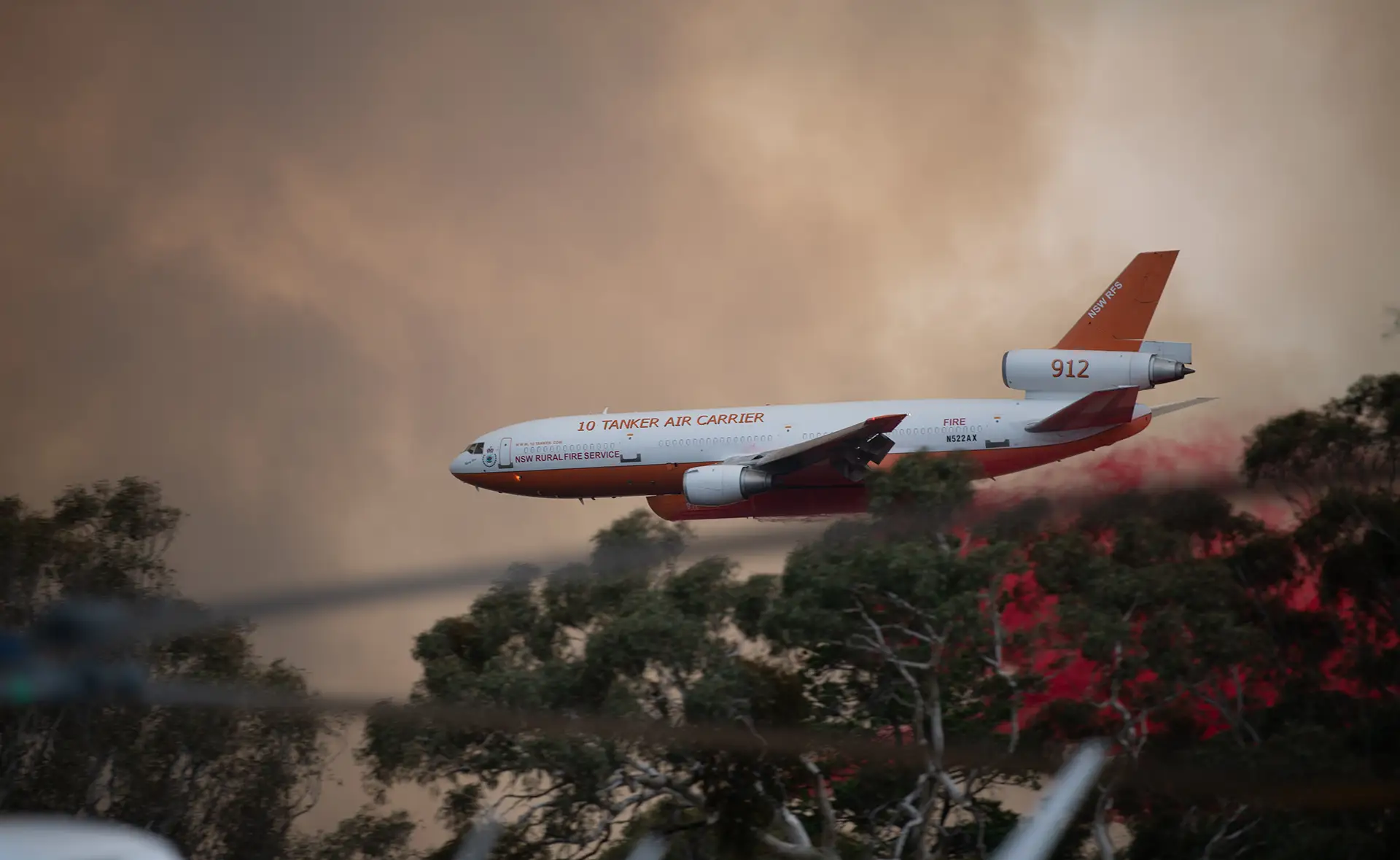
“At its heart, RAFT and RART are about people,” Gallagher says. “Fit, trained, committed volunteers and staff who are willing to do the hard work in the hardest places, preventing larger fires. That’s what keeps communities safe.”