 HOME
HOME




In 1911, the Western Forestry and Conservation Association was the first fire protective association to seriously consider the use of airplanes for spotting fires. A contract, signed with the Glenn Curtiss Aeroplane Company for a trial, was cancelled when it was thought to be “too visionary.”
William E. Boeing, president of the Northwest Aero Club, wrote an article for the November 1916 edition of the lumber trade journal, The Timberman, in which he provided a detailed study of the use of airplanes for fire patrols. Already in the lumber business, he founded the Pacific Airplane Co. in 1916, and in June of that year the Boeing Model 1 made its first flight.
Boeing based his idea on the use of airplanes to spot gun emplacements and troop movements in Europe. He said finding the fires would be easier than determining and reporting the exact location. Boeing considered the use of wireless equipment to report fines but rejected it as too complicated and thought a pilot could just land and make the report.
That article prompted a discussion by foresters regarding the feasibility of using Army pilots to spot fires, but the entry into World War I
five months later ended implementation of the idea.
In 1919, Coert du Bois, the Regional Forester for the California District of the U.S. Forest Service, needed a way to quickly spot forest fires in the millions of acres of forest lands under his purview. Major Henry “Hap” Arnold, the recently assigned Air Officer of the Army’s Western Department based at the Presidio of San Francisco, needed a way to keep his pilots flying. A chance meeting of the two men in a San Francisco restaurant provided solutions to both problems when Arnold suggested using his pilots to provide aerial fire patrols over the forests of California.
The Airplane Forest Fire Patrol began in California on June 1, 1919, bringing De Bois and Arnold’s idea to fruition. Five Curtiss JN-4 Jenny airplanes from the Air Service of the War Department flew carefully planned daily routes, covering more than 92,000 miles by the end of August. In mid-August, the fleet was upgraded to De Haviland DH-4 planes with more powerful engines and increased range. They located and reported 118 fires, 23 of them before the Forest Service was aware of their existence.
After the fire season, Arnold wrote that, although the fleet was subjected to flying 3,000 miles per day, the aircraft held up very well under the conditions to which they were subjected. He noted that even the best airplanes built during the War had a life expectancy of only three months but the fire patrol showed they were much more robust.
Expanding the forest patrol by 1921, Maj. Arnold organized a fleet of 87 wireless telegraph-equipped DeHavilland DH-4B biplanes based throughout the western United States. Twenty-nine patrol squadrons operated from the main base at Mather Field in Sacramento and from other bases ranging from Helena, Montana, in the north, to Riverside, California, in the south. Each base and the headquarters for each National Forest had a wireless receiving station. Prior to the addition of wireless equipment, pilots reported fires by releasing carrier pigeons, dropping a message with a small parachute, or by landing to use a telephone or send a telegram.
Funding for the Army’s participation in the project ended in 1923. By then, Arnold had transferred to Rockwell Field in Coronado, near San Diego, California, and du Bois had left the Forest Service. Lumber companies provided some funding to continue the patrols using commercial pilots. The Secretary of War suggested that employing commercial pilots should remain the case. Thus, as the use of airplanes to spot fires became more common, the bulk of them were flown by private contractors.
In the succeeding years airplanes were used to deliver equipment by parachute, to provide aerial reconnaissance of fires, and to deploy smokejumpers, but the ability to drop water on a fire remained the Holy Grail for foresters.
A variety of creative methods were tried to solve this problem. In 1930, the fire chief in Region 6 near Spokane, Washington, pushed water filled wooden beer kegs out of a Ford Tri-Motor. In 1931, C. J. “Red” Jensen attached two water-tight containers to the fuselage of a Hispano-Suiza biplane and made a pair of drops on a fire east of Oroville, California, although there is no known documentation of him doing so.
From 1936 to 1939, the Forest Service conducted tests in California, dropping enclosed containers with different powders including finely
ground clay, talc and cement. Tests conducted by dropping ten-gallon cans filled with a chemical extinguisher were also ineffective.
A theoretical study by the University of California Physics Department said the slip stream caused by the wind and forward motion of the aircraft would break up the column of water making it ineffective. Taken as fact, without real world testing, it would be ten years before water was tried again.
In 1944, Canadian pilot Carl Crossley tried dropping water from a 45-gallon tank installed in the front cockpit a Fairchild KR-34 biplane and then from floats on a C-64 Norseman, but both produced an ineffective fine mist.
During the decade following World War II, the following tests were conducted on the feasibility of dropping water and/or retardant on fires:
1947. U.S. Forest Service and Army Air Forces dropped water-filled 165-gallon fuel tanks with an air burst fuse from a Boeing B-29 Superfortress bomber and unfused wing tanks designed to burst on impact from a Republic P-47 Thunderbolt fighter. Test drops were made on fires in Montana. The plan for full deployment of both types of aircraft in 1948 were scrapped due to budget and the Air Force’s transition to jet-powered aircraft.
1947. Similar tests by the Royal Australian Air Force concluded drops would only be effective on very small fires.
1950. After tests the previous year, Canada’s Ontario Department of Lands dropped water bombs consisting of 3.5-gallon paper bags lined with asphalt from a DeHavilland Beaver on a fire near Sault Ste. Marie. The next year they used eight plasticized bags to cover a 10-foot by 90-foot area of ground. Other tests in Canada used water carried in the pontoons of float planes but they did not deliver an effective amount of liquid.
1953. A Douglas Aircraft test crew decided to dump the 1,300 gallons of ballast they were carrying in a DC-7 over a runway at Southern California’s Palm Springs Airport. The coverage of the water led to tests by Douglas at various altitudes and rates of speed.
1954. Major Warren Schroeder, USMC, dropped a napalm tank filled with chemical foam and with glass plates and electronic detonators on the ends from a Douglas AD-2 Skyraider at MCAS El Toro, also in Southern California.
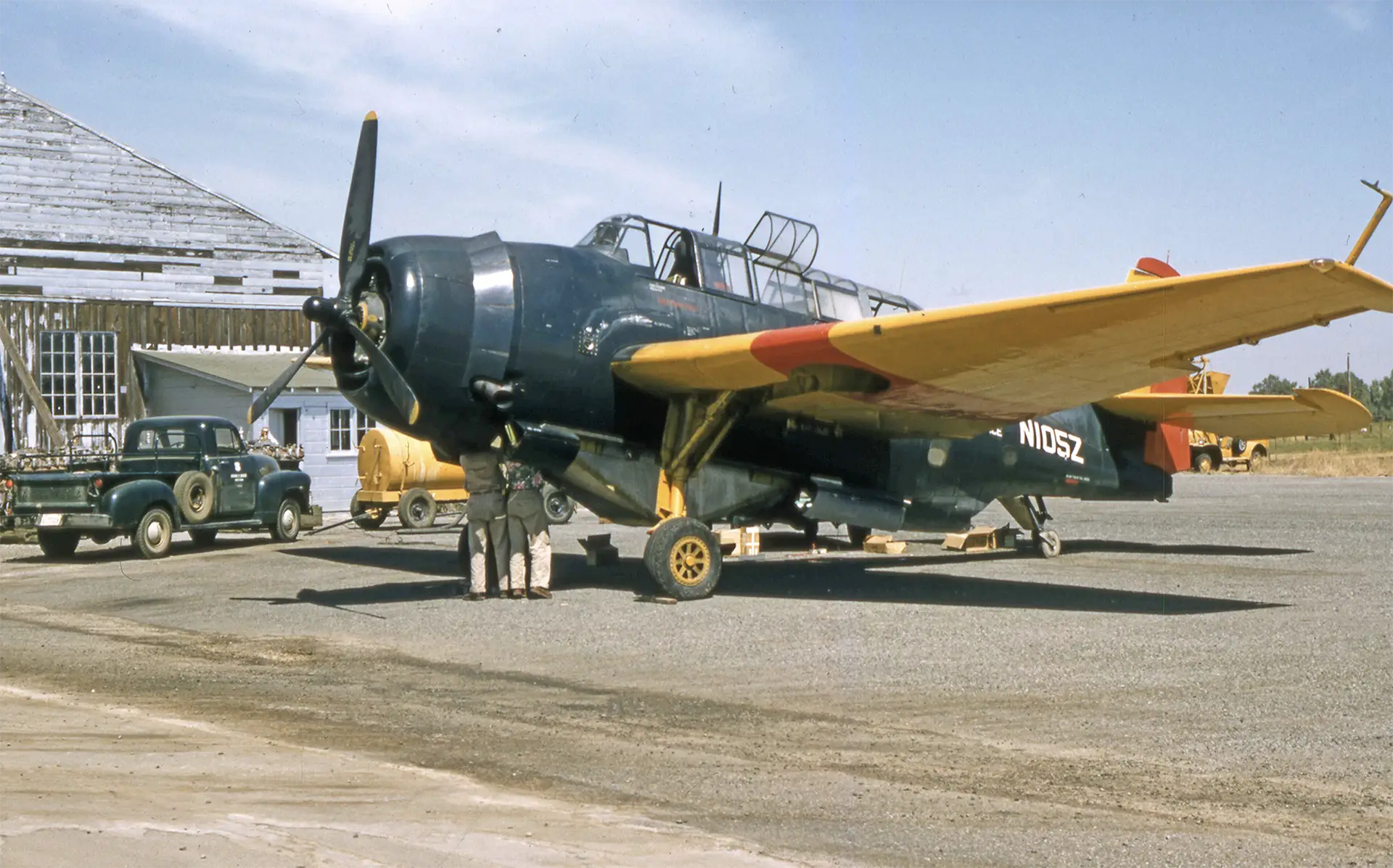
1954. Operation Firestop was a year-long test program conducted by a variety of government agencies at Camp Pendleton with the goal to test every idea and type of equipment to fight fires. One series of tests were flown by stunt pilot Paul Mantz in a TBM Avenger torpedo plane equipped with two 300-gallon water tanks. The success of the tests led Mantz to two operational water drops on the Jamison Fire near Lake Elsinore in September of that year.
In June 1955, Operation Firestop released a report on the feasibility of aerial firefighting. The report rejected the idea of the use of
containers such as bags and tanks and noted that only the free fall of water would be effective. Based on the successful test drops from
the TBM, the report suggested that more work was needed in tactics, training, safety, and logistics.
At a regional meeting of Forest Service fire control officers in 1955, in Redding, California, Neal Rahm, the superintendent of the Modoc National Forest suggesting using the agricultural spray planes working in the northeast part of California. Also in attendance at that meeting was Joseph Ely, the fire control officer of the Mendocino National Forest, headquartered in Willows. Ely thought that idea could work in the north Sacramento Valley where many ag planes were used to seed rice fields. Ely received approval from his boss, Robert Dasmann, superintendent of the Mendocino National Forest, to take the next step.
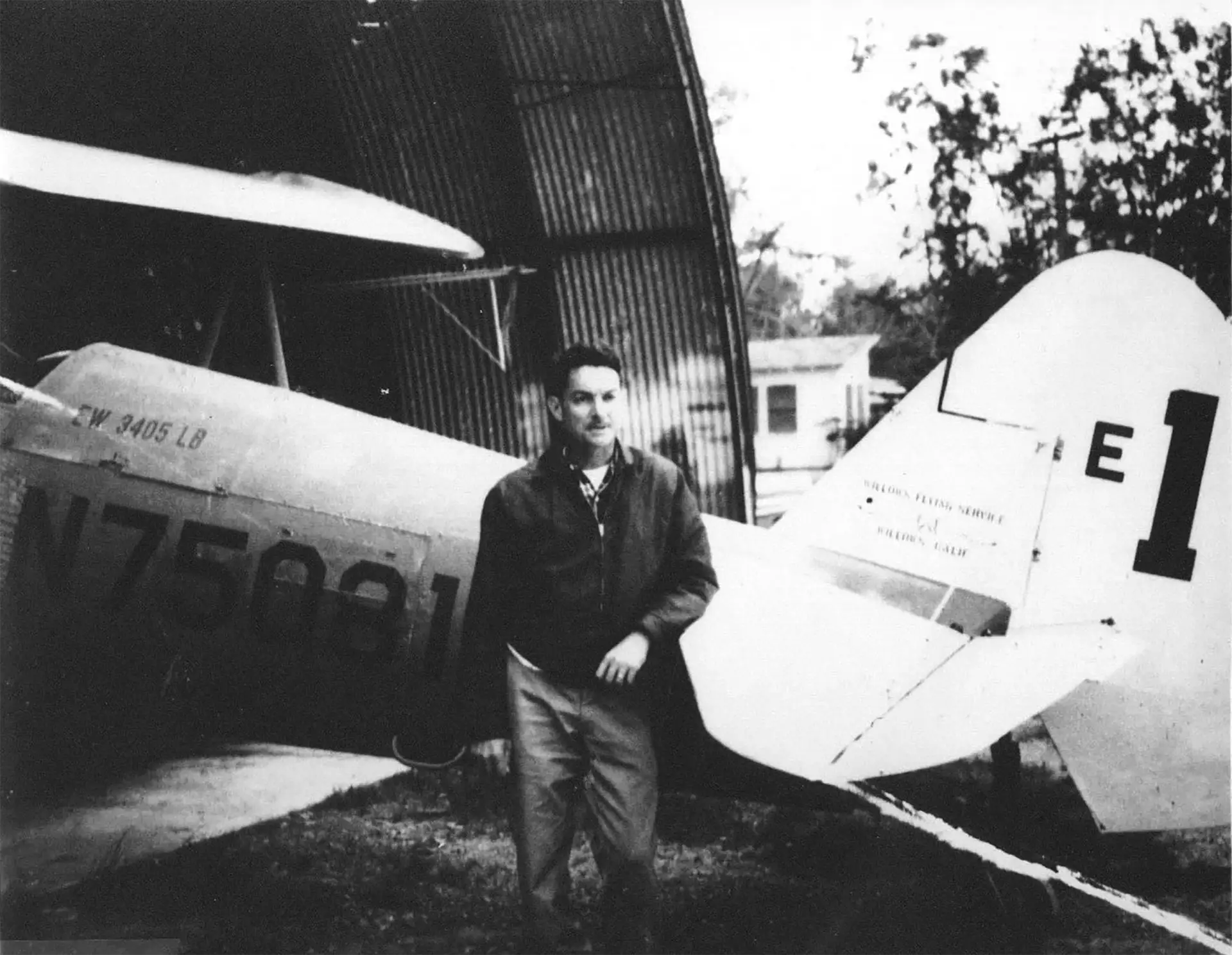
Ely asked local ag pilot Floyd Nolta, a partner with his brothers Vance and Dale in the Willows Flying Service, if he could devise a method
of dropping water from an ag plane. In 1929, Nolta developed a method of dropping rice seed from his Jenny biplane making him the first to
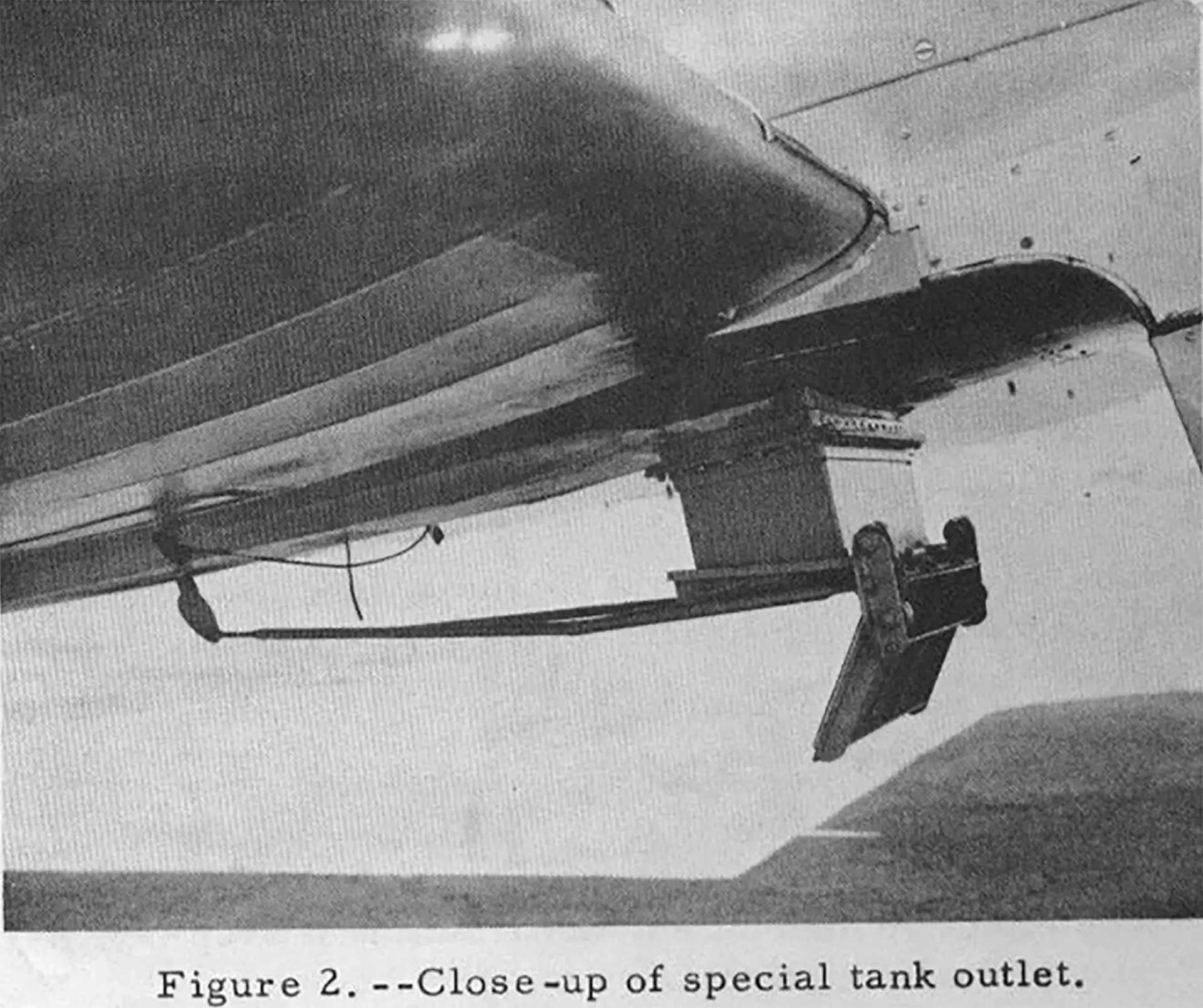
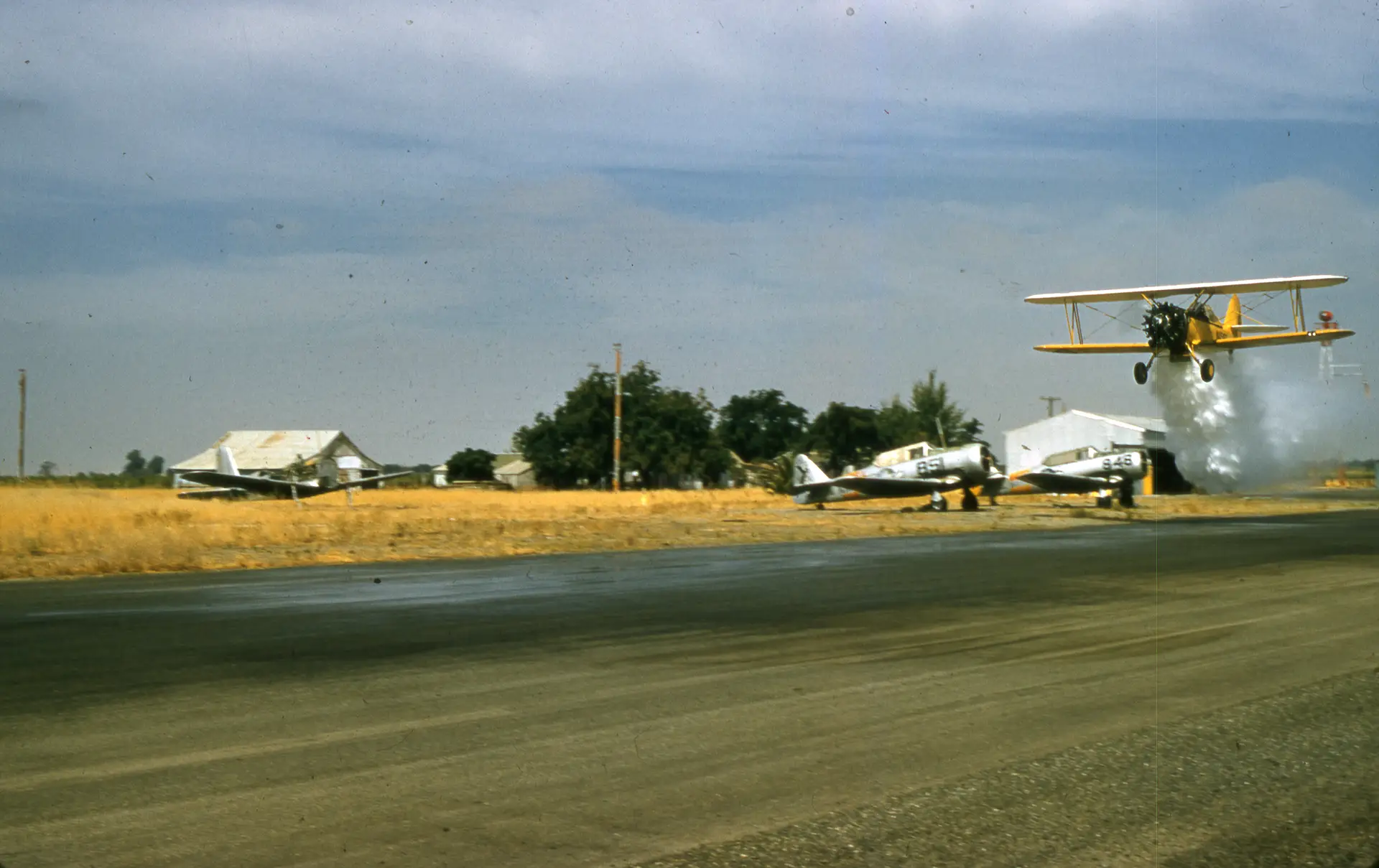
do so in the Sacramento Valley. Within a week, Nolta cut a hole in the bottom of the fuselage of his Stearman PT-17 biplane and added a
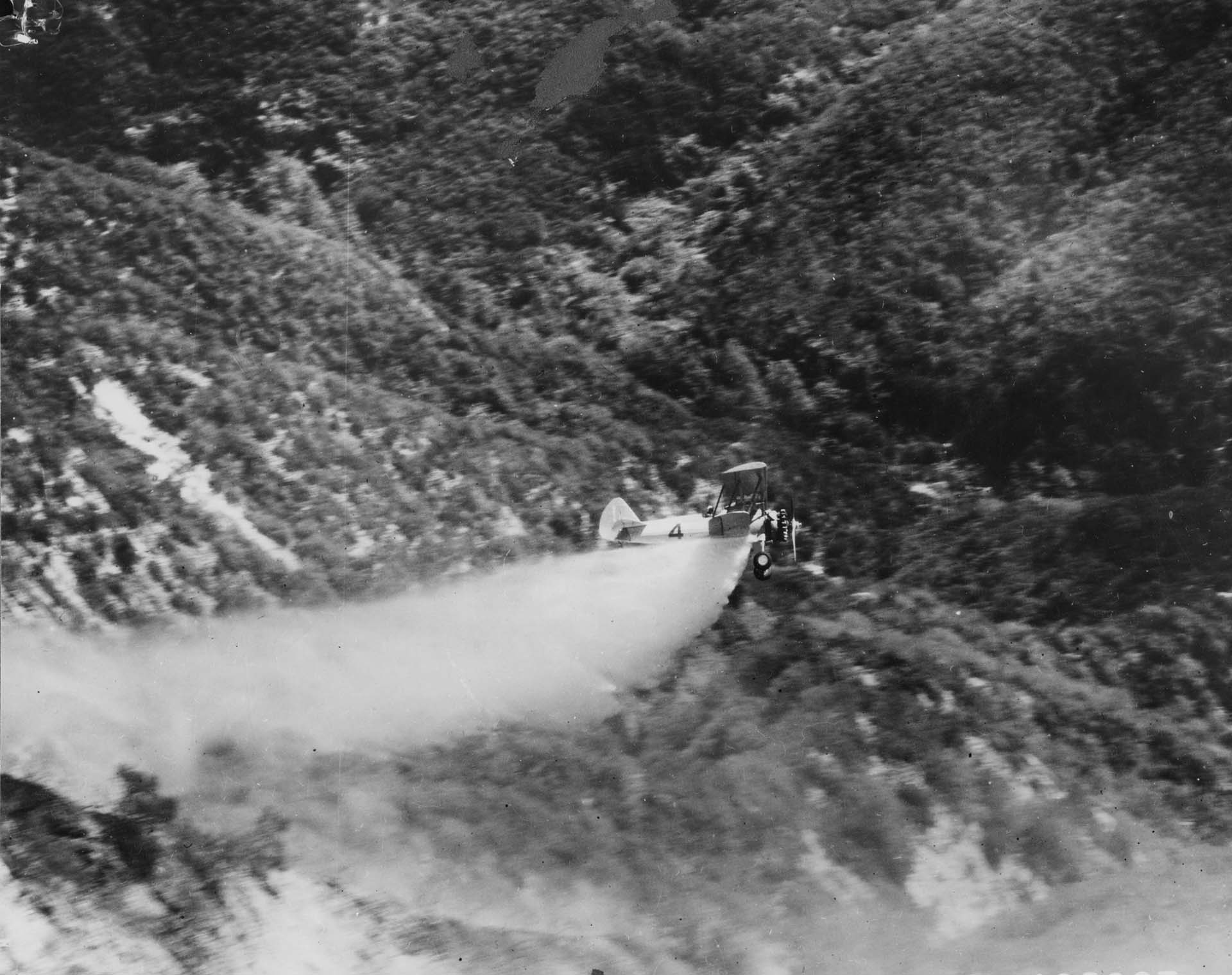
one-foot square hinged gate, controlled by a pull rope, to the 160-gallon spray tank. On July 23, 1955, a strip of grass was ignited as
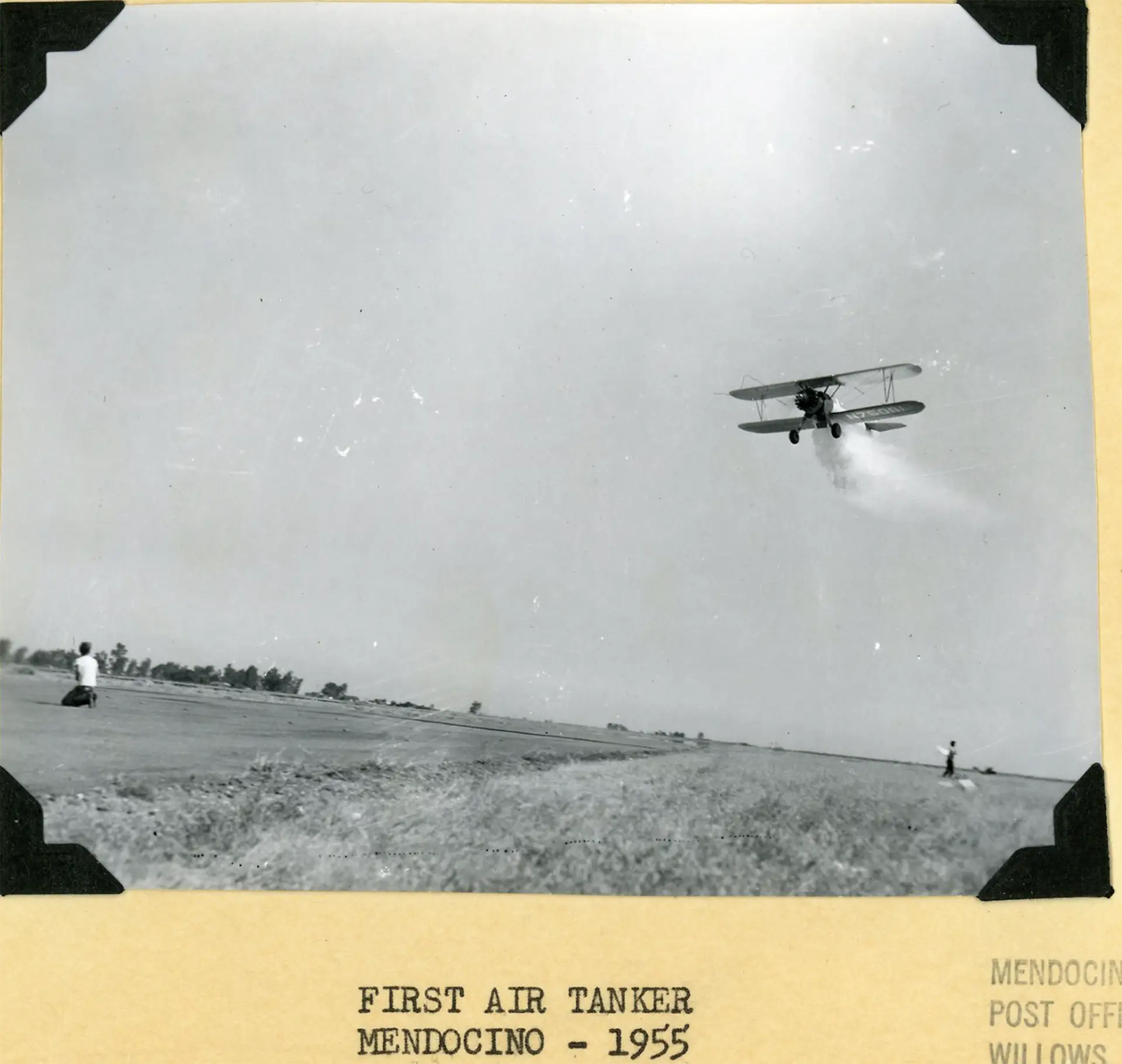
Vance Nolta flew over it, released the water, and extinguished the flames. Ely later wrote, “We were in business.”
On the same day a Piper Super Cub with a 100-gallon tank and twelve spray nozzles assisted in controlling a fire in the Wenatchee National Forest in Washington State.
Had Ely stopped at that point he would have progressed as far as any of the others, but he took the next step of having Vance Nolta do six water drops on August 13, on the Mendenhall fire giving ground crews the opportunity to build a line and prevent the spread into heavy timber.
The John David Place fire on August 15, was at the bottom of a deep box canyon. Vance Nolta made four 120-gallon drops, cooling a corner of the fire so the ground crew could close the line. On the initial attack a water tanker and aviation gasoline were dispatched to a small airport near the fire to shorten the time it took Nolta to refill and make the next drop. A reconnaissance plane, in communication with the ground and the refill airport, coordinated the air and ground resources.
.jpg)
The John David Place fire was in a part of the Mendocino National Forest near the New Tribes Mission. In 1953, a Forest Service ranger and twelve men from that mission, were killed fighting the Rattlesnake Fire in the Mendocino Forest. Joe Ely was on another fire in Southern California at the time of the Rattlesnake Fire. According to his son, Frank, Joe was moved by the loss of the men to find ways to make fighting fires safer. The worst loss of life in the history of the Forest Service was also a major impetus to conduct Operation Firestop.
In speaking to the Willows Daily Journal, Joe Ely said that a 160-gallon drop covered an area of 50 feet by 300 feet. (The 600-gallon drop from Mantz’s TBM during Operation Firestop covered 90 feet by 270 feet.) Ely said he hoped to use the Nolta fleet on future fires, and although prefacing his remarks as “visionary,” he saw a future possibility of a squadron of tankers fighting forest fires, with the lead plane in contact with firefighters on the ground by radio. This was the first time an airborne controller was mentioned.
Ely spent two days conducting a series of tests at the Willows Airport and at the Elk Creek Butte Lookout to calibrate the amount of water and retardant to hit the ground at various speeds and altitudes, both into the wind and in a crosswind. Ely’s then 13-year-old daughter, Brenda, recalled collecting the tuna cans her father set out on runways to catch the liquids. Ely, assisted in these tests by the Forest Service, the California Division of Forestry (CDF) and the Willows Flying Service, published a report in October 1955 to the Forest Service of what had been achieved that summer.
A. A. Brown, chief of the Forest Service Division of Forest Fire Research, published an article in a January 1956 USFS Fire Control Notes on the prospects of fighting fires from the air. He not only failed to mention Joe Ely’s accomplishments but wrote that to use airplanes to slow the early spread of fire, “a systematic research and development program including a series of extinguishment tests, will be necessary.” Regarding Operation Firestop he wrote, “Few of the new things tried could be developed to a point where they could be applied directly by fire agencies. Much further research and development is needed. It will be costly.”
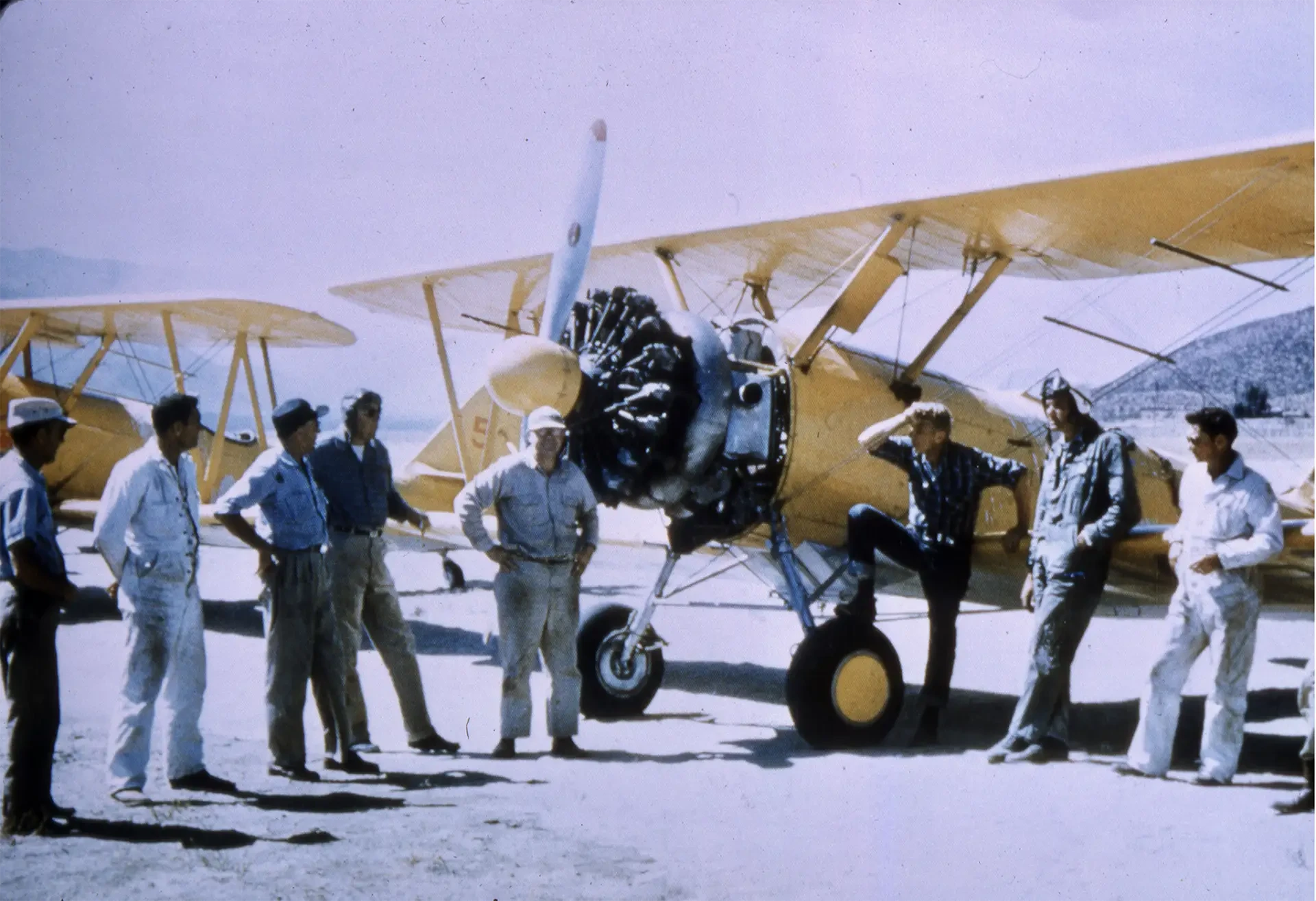
Joe Ely was not slowed by Brown’s bureaucratic malaise. Ely published a second, more detailed article in the USFS Fire Control Notes in April 1956 outlining the comparison between water and sodium borate. He obtained $4,000 in standby pay from the Forest Service Region 5 headquarters, recruited nine agricultural pilots from the Willows area, along with their Stearman and N3N biplanes, to form the Mendocino Air Tanker Squad. In July, Ely sent a letter to the sixteen other national forests in California, as well as to the California Division of Forestry, stating that seven air tankers and a lead plane for an observer are available to anyone who needs them. This was the first use of a lead plane, which became known as the “bird dog” or “Drop Co.”
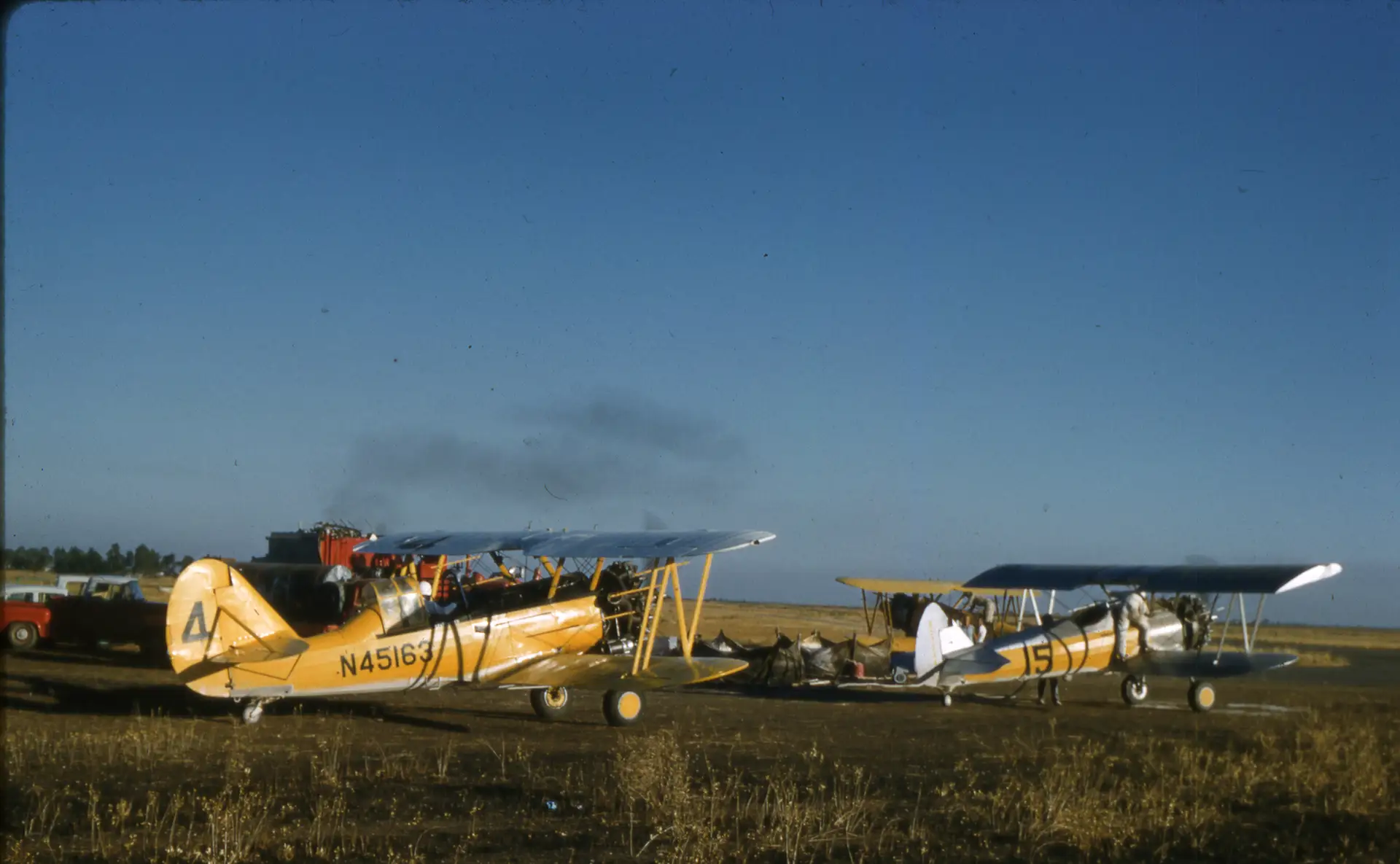
The squad fought 25 fires that summer throughout California, releasing more than 150,000 gallons of water and sodium calcium borate in 1,387 drops. Although borate was only used as a retardant for a short time, the name “borate bombers,” stuck.
To establish parameters for the new tool, they were used in as many situations as possible in the trial-and-error operation. The planes were a deciding factor in extinguishing 20 of those fires. The five fires where they were of no help still provided useful information. Operational problems such as supply and loading, coordination with ground forces, and air traffic control were all identified that first year.
Multiple agencies met at the Willows Airport in October 1956, to conduct tests to determine the optimum altitude, speed, wind and gate size for the borate slurry and to evaluate radio communications.
Joe Ely, along with others, published a report in Fire Control Notes in July 1957, on how airplanes can be used, and when they cannot be used, to fight fires and to set a standard for pilot qualifications.
In 1957, the Mendocino unit grew as six more ag pilots wanted in on the action. They were used in 100 fires, a four-fold increase from the previous year. The contracted pilots were paid $60/hour ($695/hour in 2025 dollars) while on a fire. While other agencies continued to conduct tests, the Mendocino Air Tanker Squad remained the only organized unit in the country. That year the Forest Service purchased eight surplus TBM-3U torpedo bombers capable of carrying 600 gallons from the U.S. Navy.
It wasn’t until 1958, when other squads, including the CDF, were formed to make air tankers readily available. At the Columbia Airport in the Central Sierra Mountains district of the CDF, Mrs. Robert Waldron, the wife of a Stearman pilot, was the pilot of the Cessna 180 observation plane making her the first woman known to be involved in aerial firefighting.
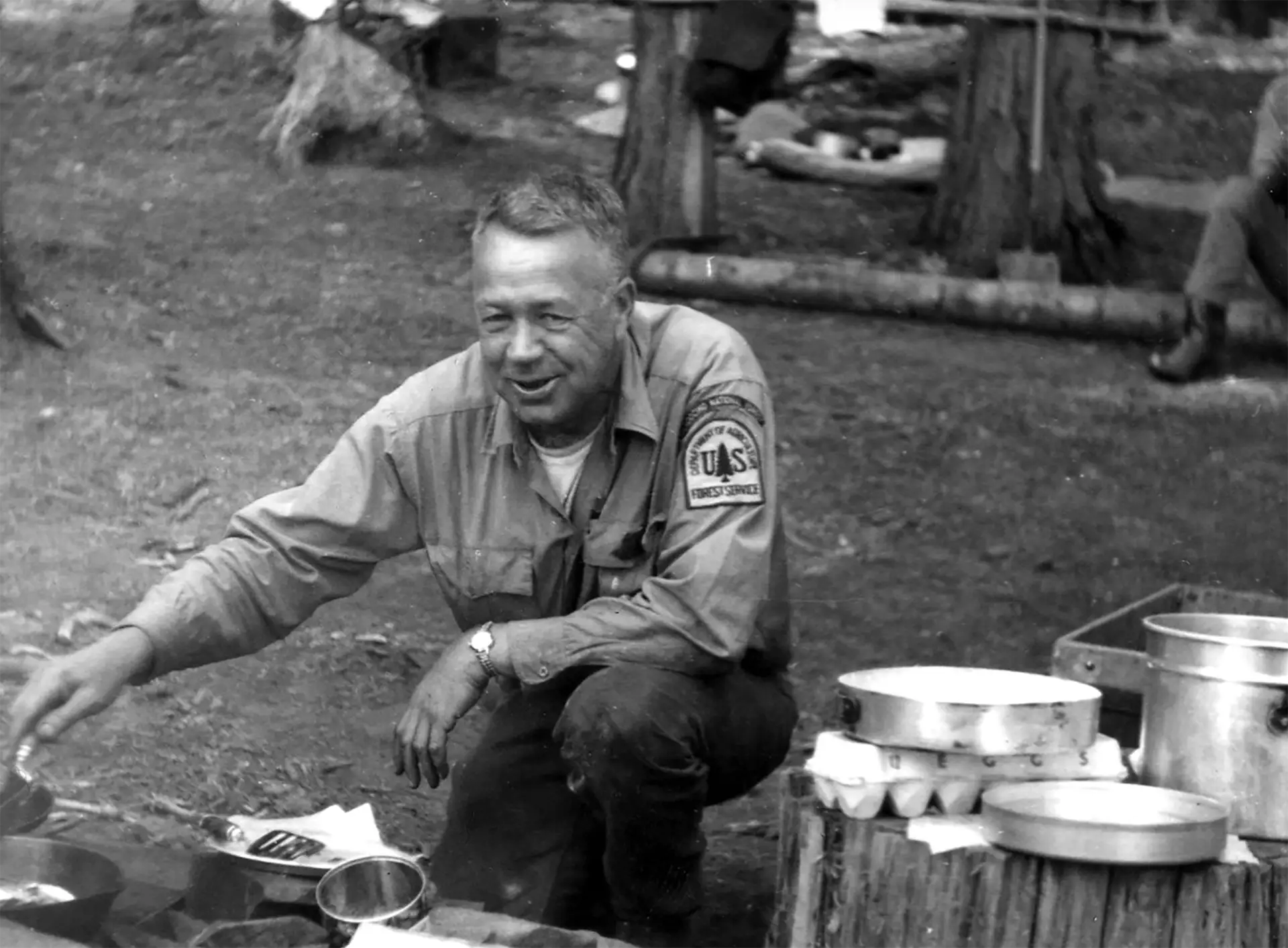
In an article published in 1983, Joe Ely wrote, “I had my own dream. I wanted to accomplish something worthwhile – leave the world a little better than I found it.” Ely did not operate on his own, and he always gave credit to others around him, but 70 years of water and retardant drops all over the world are the legacy that Joseph Bolles Ely did, indeed, make the world more than a little better.
Author’s Note: In 2023 the Willows-Glenn County Airport was added to the National Register of Historic Places in recognition as the base of the first air tanker squad and as the location of testing the processes used in aerial firefighting.