 HOME
HOME




As the world focuses on the ongoing conflict in the Persian Gulf, it would be easy to think that the grey zone is something that the west no longer needs to contend with. Unfortunately nothing could be further from the truth. As great powers continue to flex their military might, options for SF to impose costs on our enemies and tip the balance in our favour are increasing. By exploiting the grey zone for our advantage SF can turn what has been a weakness into a strength.
For many operators, when they think back to their first operation, they will recall what it was like to first arrive in an operational theatre. For most over the past thirty years, that has meant the heat, the smell, the fatigue from the deployment, and the sense of being far from home. For those who fought in the global war on terror, they were likely wearing a uniform, and their operation was acknowledged by their government.
But what if this wasn’t the case?
What if when an operator arrived in theatre the deployment was deniable and the government would refuse to confirm involvement in the conflict if challenged? This article addresses how SF can evolve to meet the demands of fighting and operating in the grey zone, while balancing the need for mastery in conventional combat. To begin we must first define what the grey zone is and why it presents a challenge to SF. We will then identify some opportunities that exist for SF, before concluding by discussing how forces must balance capabilities for the future. Before we continue, we first need to understand what the grey zone is.
What exactly is the grey zone?
Is it hybrid warfare, unrestricted warfare or is it something new entirely? To save the reader time and confusion the BLUF (Bottom Line Up Front) is that hybrid warfare and grey zone operations are two different things. An easy way to understand it is this: If conflict is a spectrum with intensity being the scale, on the left you’d have peace and on the right, you’d have war. The grey zone is the competitive space between these two poles. In this space states (or nonstate actors) can pursue objectives by conducting activities that fall short of open armed conflict. Activities conducted in the grey zone go beyond normal peaceful competition but fall short of warfare. This area is hard to define practically, and it isn’t defined legally, making it inherently ambiguous. For western democracies this poses a unique challenge as to define the grey zone you would first need to define where peace ends and war begins, something that policy makers cannot agree on either legally or practically.
Hybrid war on the other hand, is a way of warfare which combines conventional warfare with unconventional activities to offset conventional military strength. A standout hybrid warfare practitioner is Ukraine which supports its smaller traditional military through asymmetric tactics, informational warfare, diplomatic efforts and international support. By synchronising these unconventional activities, they have made up for their lack of conventional military strength in relation to Russia. The takeaway point for SF is that SF should be most concerned with grey zone operations and how they can impose costs on their adversaries, below the level of open warfare, and inside a legally ambiguous space.
Why the grey zone presents a challenge
Due to the legally ambiguous nature of the grey zone, it is difficult for governments to task forces to operate outside the normal frameworks they have used for decades. When many of us deployed to Afghanistan, Iraq, southeast Asia or Africa, it was likely the case that a robust structure surrounded the mission we were executing, complete with governmental mandates or an equivalent passed by the administration of the day. These things provided agency to deployed forces and while protected in their detail they were not state secrets. The problem with the grey zone is that more likely than not, major facets of the usual framework simply don’t exist, or if they do exist, they will be heavily protected due to their sensitivity. Therefore, to direct a force to operate in a sensitive environment against an adversary you’re not technically at war with, but are competing against, carries additional political risk for the country. This paradigm makes it difficult for western states to operate in the grey zone, as not only do they have to limit their attribution with their adversary, but they also must limit attribution with their own public. The requirement for transparency is not a problem for our adversaries, and it is for these reasons that our competitors have exploited this space and will continue to do so. Understanding this, we can now turn to highlighting why grey zone operations are challenging for SF.
To be effective in the grey zone SF must be able to achieve effects but limit attribution. The importance of this is that if attributed to an action that action could result in escalation, which is generally to be avoided. While the SF community has mastered the art of achieving precise effects whilst maintaining operational surprise, it has not optimised for remaining below the detection threshold. Operations Neptune Spear and Enduring Resolve were by design directly attributed to the US - they were meant to send a message to other would be opponents. Now, these examples may appear unfair due to their scale and complexity, but the point remains that the force packages, equipment and technology used in these raids are all attributable to America. By choosing to operate above the detection threshold the US demonstrates their ability to project force and achieve future deterrence, but what if the opposite was the goal? What if the objective was to achieve the same effect without any attribution?
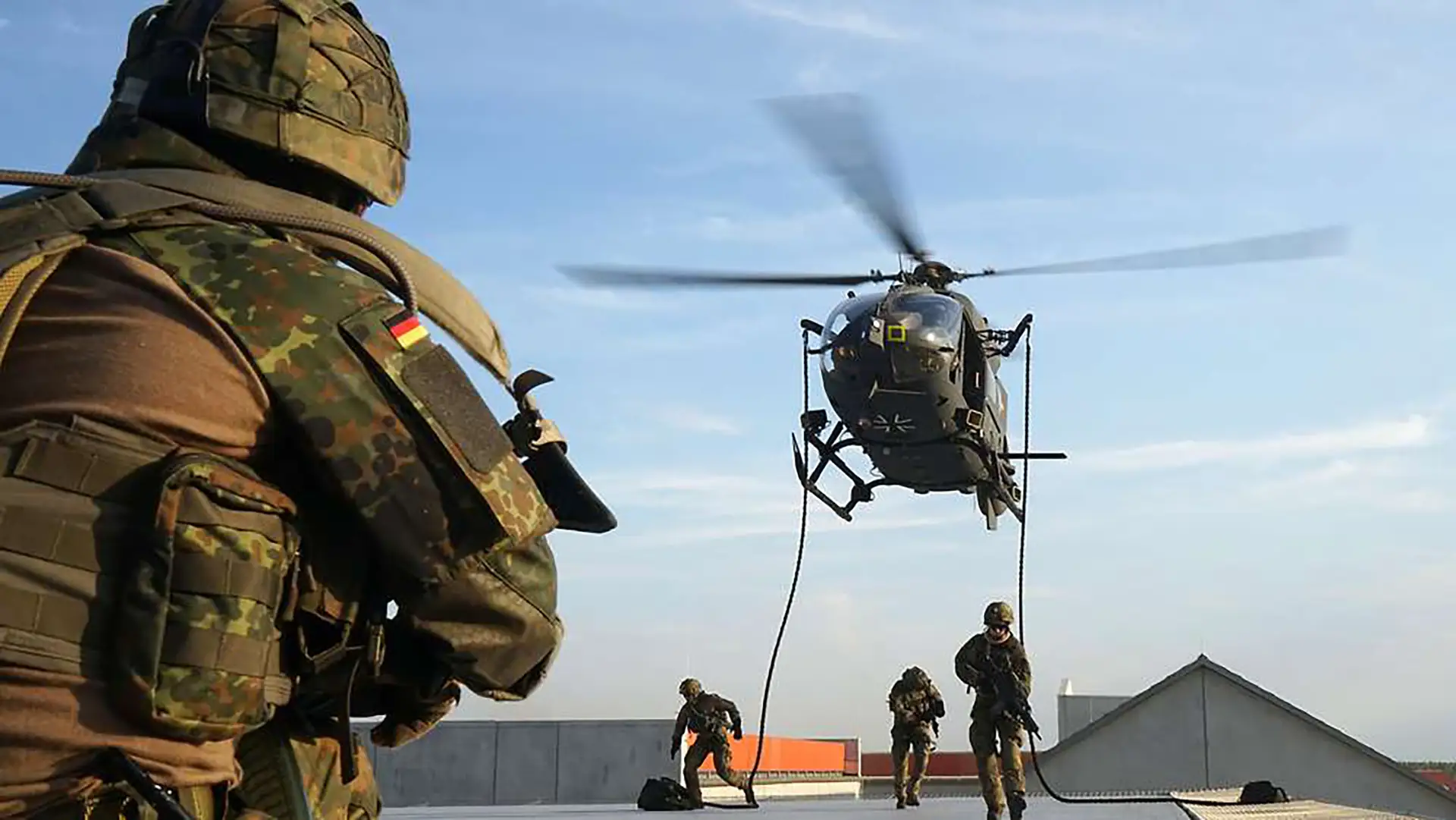
We can better understand the challenges facing SF in the grey zone by considering what it would take to conduct a raid into a third country to recover or kill a high value target, below the attribution threshold. Three quick considerations serve to highlight some basic challenges:
First the force would require a communications array which cannot be attributed to the user state but
is both protected enough to provide operational security while being benign enough to blend in.
Second there must be an ability to project and recover the force without employing declared aircraft,
potentially by utilizing airframes which are non-type specific and predominate in the operating environment.
Third, only employing weapon systems which predominate in the operational environment would be
permissible. These weapons cannot be directly in service with the user state and the task force must be proficient in their use.
What we can take from this quick exercise is that trying to achieve a special operations raid without attribution would be extremely difficult if not impossible. But SF are not a one trick pony, Special Warfare capabilities present an opportunity for SF to operate effectively in the grey zone.
Special Warfare and Grey Zone operations
Unhelpfully across the SF community, Special Warfare (SW) means different things to different people. To simplify, when we discuss SW we are employing a catchall term for the US doctrinal tasks of irregular warfare through to unconventional warfare. In the most simplistic form, we are talking about the use of proxies, inclusive of the access working with others affords SF to achieve objectives. This operating paradigm would be familiar to our forefathers who supported the Free French in WW2 or the Mujahedeen in Afghanistan. Yet for this generation, who have instead fought declared operations against non-state adversaries, a reversion to SW is somewhat foreign. To outline the utility of employing SW in the grey zone we can consider two possible examples.[1]
Declared options with undeclared outcomes
At the lower end SF can be utilised to provide Foreign Internal Defence (FID) in support of a friendly government. This is an often-declared task that accrues influence for the sending state while also filling a gap an adversary would otherwise fill themselves. Although this sort of activity is business as usual and occurs daily across the globe, when we apply the context of the grey zone as part of great power competition, the presence FID provides achieves additionally utility by enabling Special Recce (SR). To explain, if you have SF in a third country, and that country is unaligned, meaning it may side with the adversary or it may side with you, it is likely your adversary is present in that country also. It stands to reason that while accruing influence with the host nation by training their force, your presence in that location also provides a vector for reconnaissance against the adversary. By conducting reconnaissance below the detection threshold of both the host nation and the adversary you can better understand your adversaries’ intentions or accrue evidence of their malfeasance. This idea, while reasonably simple, clearly carries the risk that if detected by any party the negative outcomes could be severe.
Undeclared forces imposing cost within conflict
At the higher end, SF can be used to arm and support proxies to impose cost on an adversary already engaged in conflict with a separate party. While there are obvious examples of where this could occur currently, to stay on the right side of things operationally we will instead review an Islamic Revolutionary Guard Corps (IRGC) operation. One clear and well-documented example of an adversary’s use of proxies to harm U.S. personnel is the January 28, 2024 drone attack on Tower 22, a U.S. military logistics base in northeastern Jordan near the Syrian border. The IRGC Quds Force, trained, advised and equipped Katib Hezbolla, who carried out a one-way drone attack which killed three service members and injured more than 40. What we can take from this example is twofold. First, Iran’s Quds force achieved a tactical outcome via a proxy, but their methods and execution failed to ensure the operation remained unattributed. The US was able to link the proxy back to their sponsor and attribute the action to Iran. Second, the risk of vertical escalation tied to proxy operations is very real. The IRGC use of proxies and their exploitation of the grey zone have been cited as contributing factors to Operation Epic Fury, the destruction of all Iranian military power, which is executing as this article is being drafted.
What we can take from these two vignettes is that western SF have similar opportunities to operate in the grey zone to either support proxies who are actively imposing cost on our adversaries or by using access and placement to execute SR. Where direct conflict and attribution must be avoided, an indirect grey zone operation can instead be executed. To decrease the risk, forces must have the skills, equipment and training to ensure they are able to limit their attribution, or the consequences, as Iran is finding out, can be devasting. Having established that opportunities exist for SF to operate in the grey zone the final factor for consideration is to understand the opportunity costs of doing so. As pointed out previously, these operations can require bespoke capabilities and specific training so the question now becomes: Should SF optimise for grey zone operations at the detriment of war fighting capabilities or should they hedge by taking a limited approach.
Going Grey or Prioritising Combat?
Optimising solely for the grey zone may seem like a good idea on the surface however once analysed it becomes clear that it is generally beyond most militaries’ resources, the answer is instead to seek a balance. There are several reasons for this. First, the requirement for low/no attribution technologies and capabilities to optimise for the grey zone is resource intensive. Capabilities that are good for the grey zone are not necessarily good for joint land combat and vice versa. While one option is to have multiple fleets of equipment, allowing forces to remain flexible, this is not only costly, it also doesn’t account for the second factor which is the training burden imposed on the force. The skills required to operate in the grey zone although not a black art, are skills which require proficiency. Surveillance, counter-surveillance, sanitisation and increased OPSEC all need to be contextualized and trained for. Units that already have full operator training pipelines and a busy operational model will be hard pressed to add additional courses and qualifications. The option to dispense with the fundamentals of land combat to make way for grey zone capabilities will hold at risk the final consideration, which is the requirement for SF to support the joint force. Most, if not all SF, hold contingency response outputs generally spanning the conflict spectrum. The danger is that if a unit over optimises for the grey zone, they will be incapable of conducting a contingency response task like the Kabul NEO, or a direct-action operation like what could be required in Iran. Considering these factors, it becomes clear that completely greying out SF capabilities is a step to far. Forces must continue to juggle their capabilities and hedge their outputs.
SF planners also need to consider that other Agencies operate in the grey. Sometimes, at a sub-warfighting level, they may be better placed to execute the nation's mission - especially if they have long established in-country assets and personnel in receipt of specialist training.
So, what to make of all this? While the grey zone isn’t a new concept, it is one that western democracies struggle to grapple with. As great powers continue to compete across the globe the ability to impose costs on our adversaries by employing SW capabilities is something which suitably trained and equipped forces will be tasked to execute. To achieve this, SF must operate below the attribution threshold and therefore must be trained and equipped appropriately. While the need is clear and established, the problem of holding war fighting capabilities at readiness on the one hand, and projecting SW operations on the other cannot be assumed away. The US, as a superpower, may be able to generate multiple capabilities to achieve these effects, but small state SF that lack resourcing must instead seek to strike a balance. If the idea of completely greying out SF units is unworkable as it is too costly and it limits a force’s ability to conduct joint land combat, then the appropriate response is to hold a small portion of SF at readiness for this task and accept that only a small grey zone capability can be generated from within the SF community. If countries want to compete in the grey zone at greater scale, which is a stated aim of most western democracies, the discussion needs to move from trying to juggle SF outputs to instead either prioritising them, to enable SF to focus on the most important capability or to increasing the capacity and scale of SF, so they can be more effective.
[1] By using fictionalised examples or those of our adversaries we can ensure there is no operational bleed over to current conflicts while still highlighting the utility SF provides.