 HOME
HOME





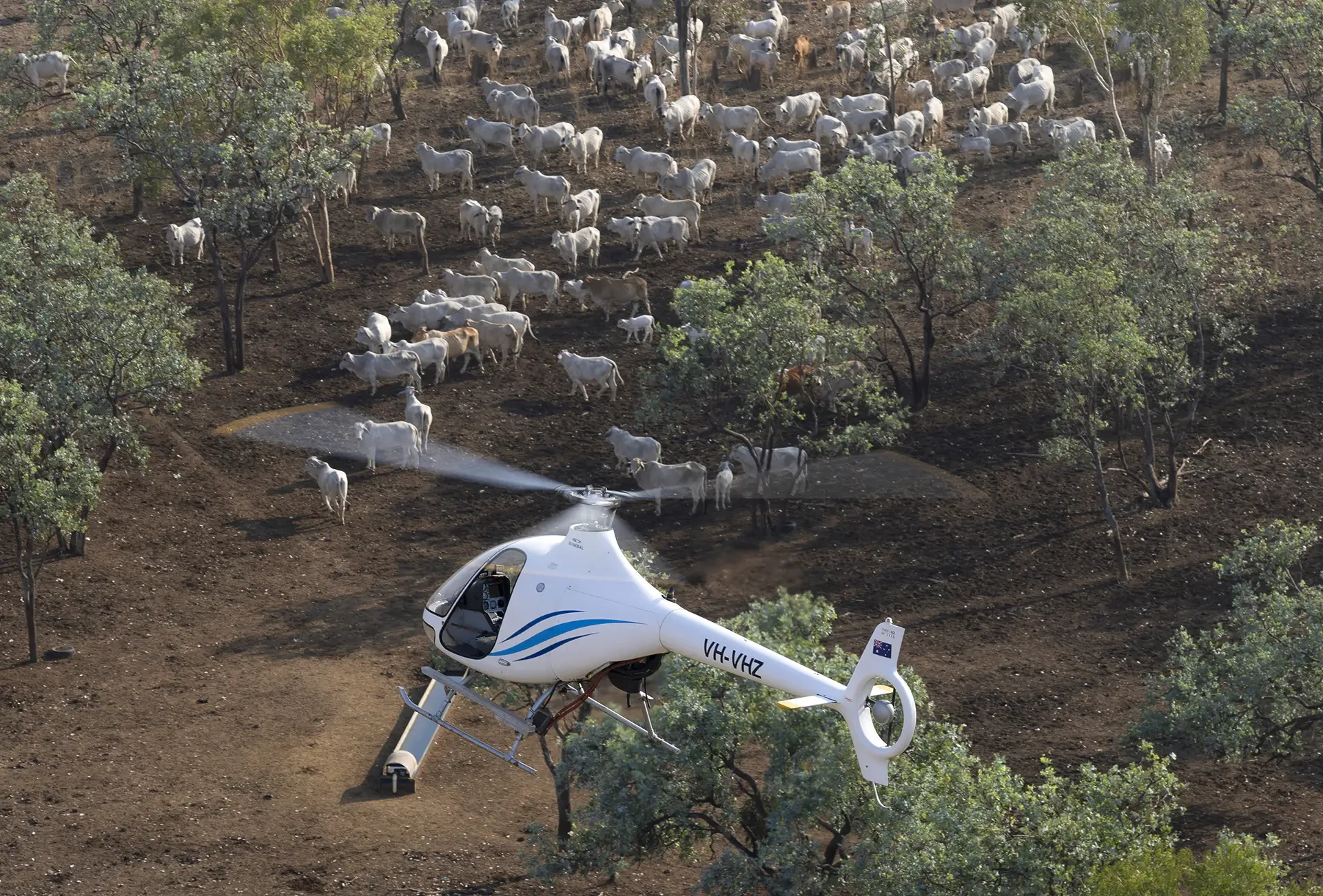
During its fifty-year history, Heli-Muster NT grew from a two-helicopter startup into the largest aerial mustering operation in northern Australia, always family-owned and operated despite changes in ownership. The current owners have now significantly reduced the mustering operation in favor of concentration on a broader range of air services.
Half Century
John Weymouth started Heli-Muster in 1976 with a pair of Bell 47s, operating from Victoria River Downs Station (VRD). The operation grew
consistently and later added another Northern Territory base at Katherine. By the mid 1980s, the company fielded more than 26 mustering
Bell 47s and Kawasaki KH4s across the top end of Australia. The late 1980s saw the introduction of the Robinson R22, which served as the
backbone of aerial mustering for decades, and in 2024, the Chisholms – the current owners - introduced the Guimbal Cabri G2. The base
at VRD and fourteen Robinsons have been sold, along with much of the mustering work, replaced by a much smaller number of Cabris to service
the reduced mustering workload.
New Management
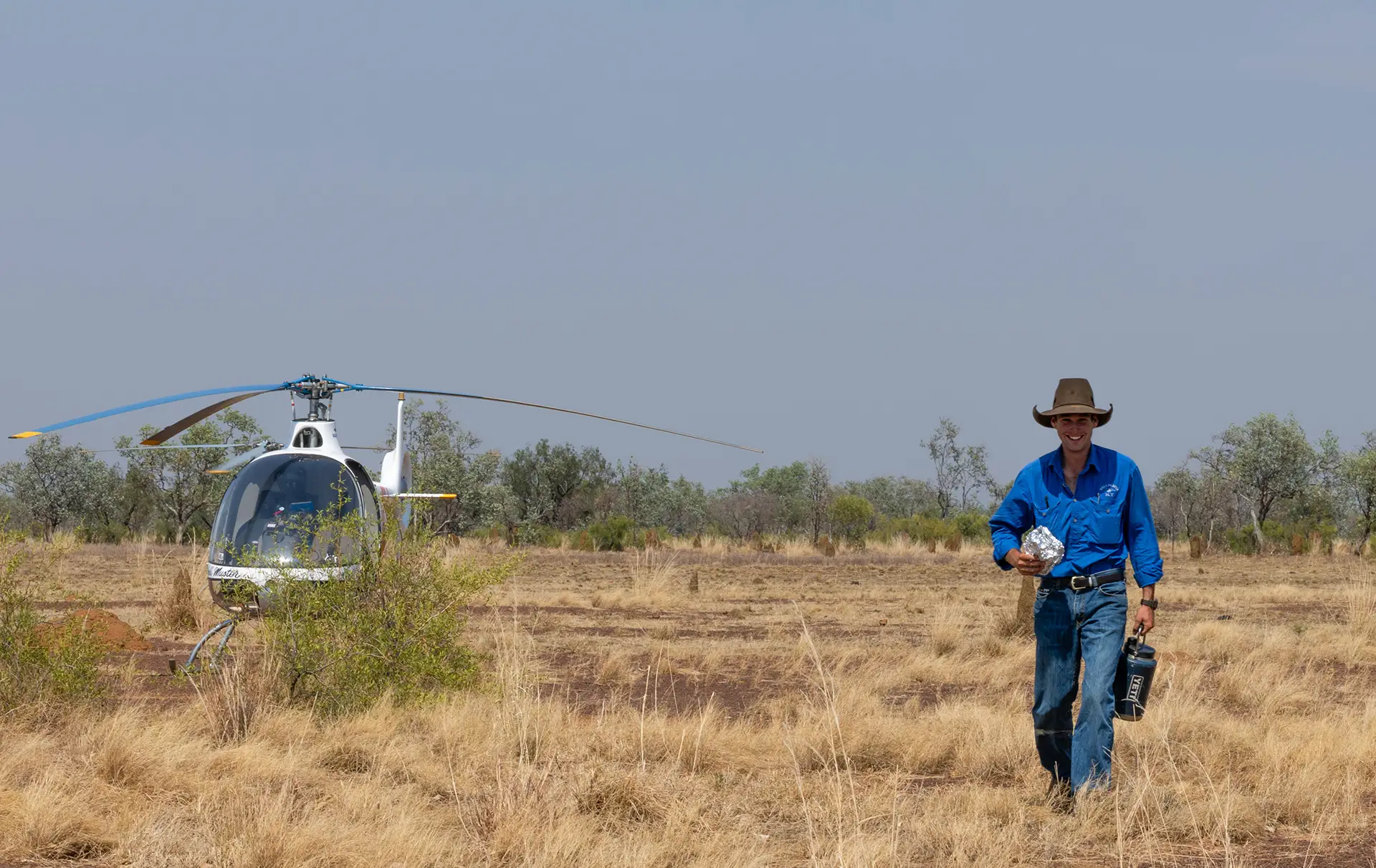
Siblings Sam and Georgie Chisholm took ownership of the company in 2021. Sam grew up on Napperby Station in the NT (Northern Territory) and started flying for Heli-Muster in 2014. While he said that former owners Nick and Kathy Dyer had done a great job building up the business and the workforce, he realized that expanding the mustering operation was generating more work but without increasing profitability. As a result, the Chisholms have concentrated on building up HM Air, offering an expanded range of utility aviation services alongside the downsized mustering operation. “The decision to sell the VRD base was purely commercial. Heli-Muster had been there since its very beginning. We had about twenty people based there, we were burning eighty thousand liters of diesel to keep the generator running, we had a cook and had to feed everyone; it was really costly to be based out there,” Sam commented. “Emotionally, it was a hard decision, but financially and risk-wise, it was an obvious decision.”
It was Sam’s idea to buy the business from the Dyers, “I’d flown for Heli-Muster so I’d known them a long time. I went back to give them a hand during Covid and that’s when Nick said that they’d had it for sixteen years and were looking to sell. It was about a twelve-month process to get the deal across the line, and Georgie initially didn’t want to do it, to be honest, but I talked her into it.” He explained that Georgie had worked in a bank and was highly experienced in safety and compliance work, so she is ideally suited for her role running the back end of the business, while Sam works the front end.
The Chisholms took over in 2021, at which time the business was around 95 percent mustering with the company fleet including fourteen R22s, a
pair of R44s, one Squirrel and two fixed-wings. Now, however, he estimates that mustering amounts to only around five percent of the
business, and the intention is to run a total of six Cabris by the end of the year to conduct mustering operations, with four based out of
Katherine and two in Alice Springs. “The market is pretty price-sensitive and we were doing more and more hours but not making any more
money. We realized then that bigger isn’t necessarily better and we were looking at alternatives that would allow us to save money and
increase our margins, so we trialed the Cabri.”
Economical
Sam went to existing operators of the Cabri, who showed him their operation and maintenance records. This revealed that the Cabri went through maintenance in significantly less time than the Robinson, with much less work required. Rebuilds are also much simpler and less expensive, with HM’s last Cabri rebuild costing $165,000 and taking three weeks, compared to $400,000 and three months for their R22. [SC1] Although Heli-Muster buys the kits and carries out the rebuilds themselves, the greater amount of component changes and resulting labor content accounted for the significantly increased timeframe and cost. “There’s a lot more to replace on the Robbie at a 2200 hourly, with new blades, new frames, and a new tail-cone every second overhaul, whereas the Cabri is mostly gearboxes and engine. That’s it; it’s a lot simpler and takes a lot less labor,” Chisholm elaborated.
Chisholm flew the Cabri and obtained his endorsement, then purchased the company’s first Cabri, new, about three years ago. He was not
initially enthusiastic about flying the Cabri and recalled, “I didn’t really like the machine for the first sixty to one hundred hours
because they take a bit of getting used to. With the fenestron and three-bladed rotor, they fly like a little squirrel, so someone can get
out of that with transferable skills when they start flying the squirrel but I hadn’t done a great deal in the Squirrel, and after about
5,000 hours in the Robinsons you just get into habits of flying a certain way. I just had to learn the machine, get comfortable with it, and
learn to trust it.”
Slow burn
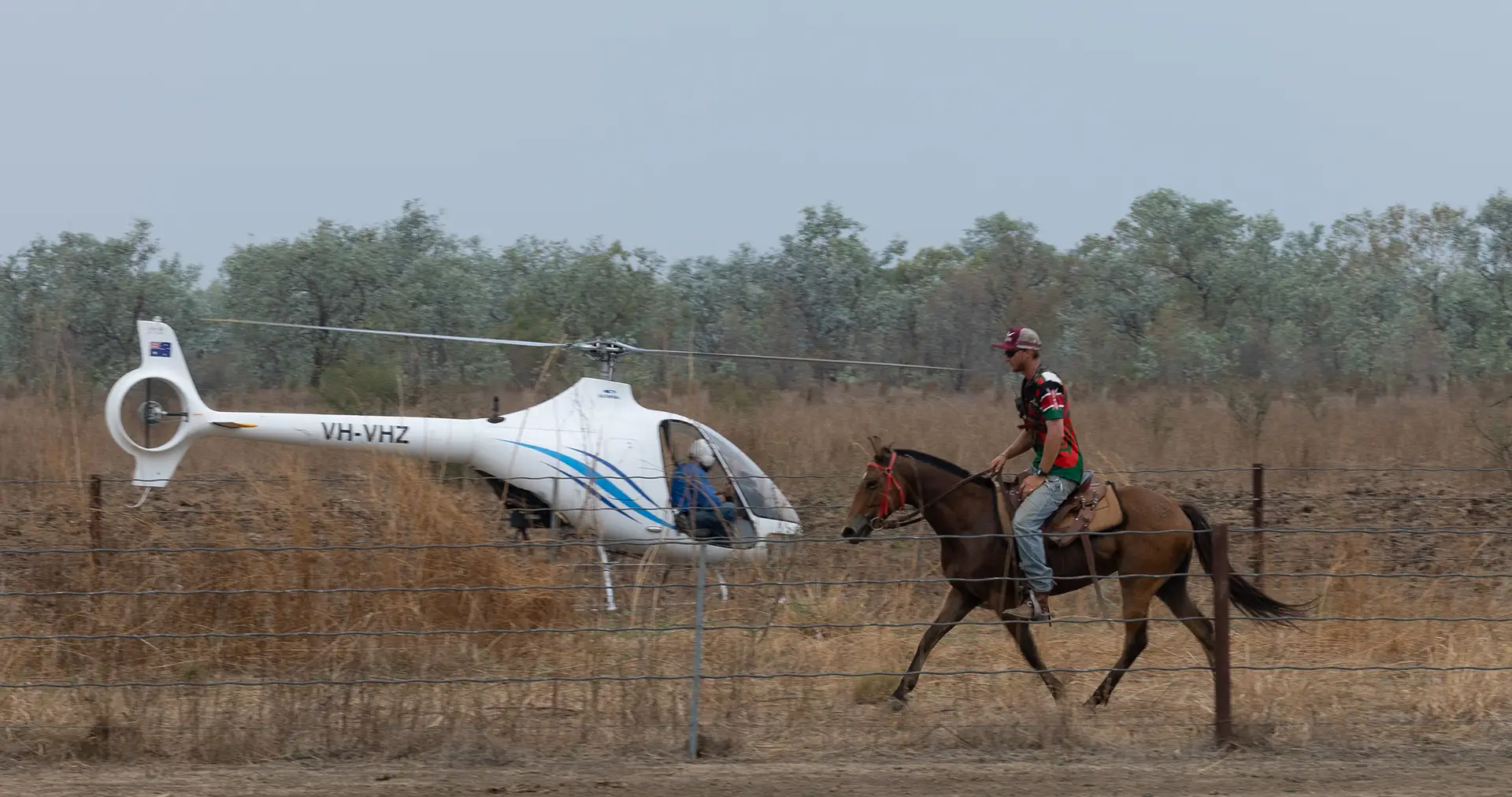
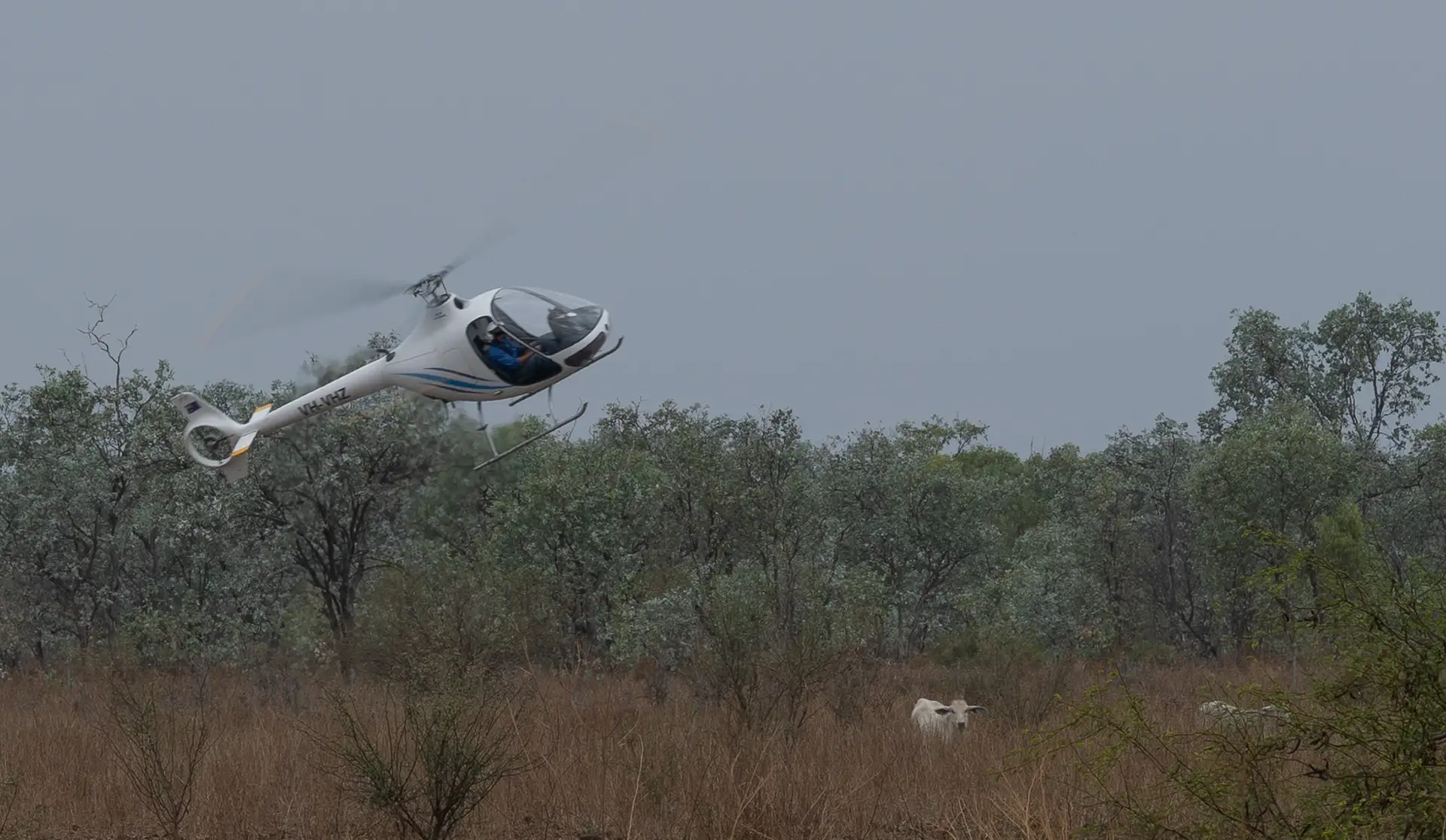
Charlie Borschmann, Heli-Muster’s Chief Pilot added, “A couple of us were a bit keener earlier and it's been a slow burn, but everyone who's jumped in it has taken to them. There are a few differences that require training. The fenestron is a little bit different to muster with and probably doesn't have quite as much authority when you start losing RPM if you start going into situations where you're pulling a lot of power. But the positives far outweigh any of the negatives. I personally have probably got a lot less time than my pilots who've been spending over 12 months in them mustering, but they're really fun to fly. They feel solid and really direct because of the three-bladed system. I've found that pilots transitioning into our Squirrels are actually jumping in and flying them like they've got 150 hours in a Squirrel under their belt because they're quite similar in nature.” Borschmann pointed out that while the enclosed Fenestron tail-rotor required some differences in flying techniques, it is a lot safer when mustering at low level, close to obstacles and people on horses and bikes. The three-bladed rotor system with an elastomeric head also eliminates mast-bumping.
Aero Power conducted the first couple of Cabri endorsements for the company, and Chisholm subsequently handled the rest. He advised that an
endorsement typically takes between three to five hours and noted that pilots with turbine experience seemed to adapt to the Cabri more
easily than those who had primarily flown the R22. “The Robbie has such a powerful tail rotor and you can just kick in a bootful. If you do
that in a turbine, you can easily over-torque the engine, so turbine pilots are used to being gentler on the pedals,” he remarked. Two more
Cabris are already on their way to Heli-Muster to supplement the current four examples; one used example from New Zealand and a new machine
from France, fitted with a second oil cooler, the first of its kind.
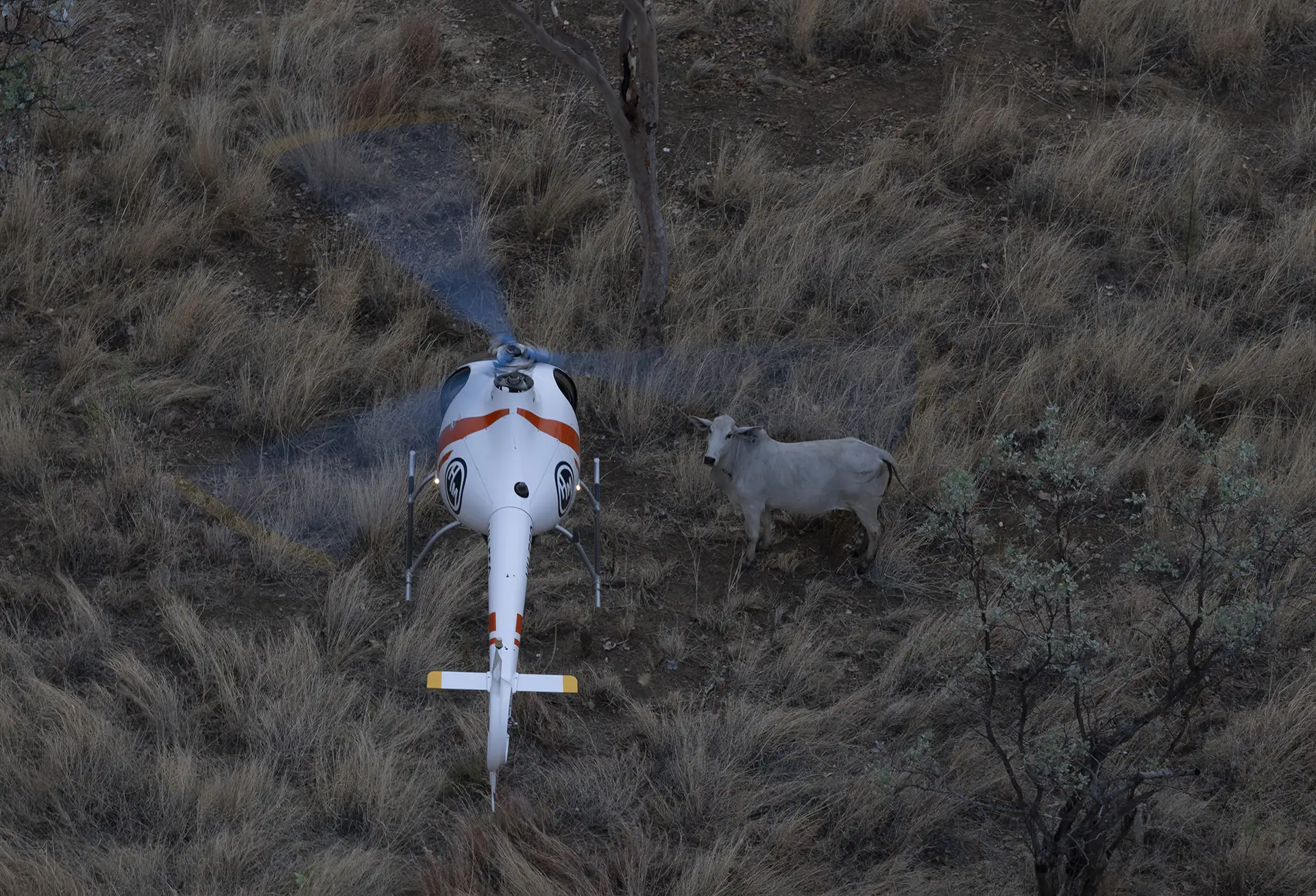
Flying The Fenestron
According to Chisholm, there is a bit of nuance to learning how to fly with the fenestron in the Cabri. “You have to preempt the pedal input, and it’s not a linear bell-crank, so it takes a bit to get your head around that. If you get behind, it’s easy to spin the machine, so we’ve done a lot of training about how to not get into that position,” he said. One of the Cabris was crashed through pilot error, and although that’s never a desirable outcome, Chisholm acknowledged two resulting positives. The incident showed that the machine has a far more crashworthy airframe than he initially expected, and the wreck has been a valuable source of spare parts.
The first Cabri was sent to the VRD base, assigned to a pilot who had trained on the type and was therefore already familiar with it. “Then we got another couple of guys through, just building up the capacity. We didn’t do it all at once,” Chisholm recalled. He commented that the industry is generally resistant to change, and it was quite hard work to get the pilots enthusiastic about the new machine, after a hundred hours or so, they adapted well and found it hard to go back to flying the Robinsons. As far as the customers are concerned, Chisholm pointed out that if the helicopter gets the cows in the yard, they don’t care what machine is used.
Evolution
Instead of rebuilding the R22S as they came due, they were replaced with Cabris. By the time the first three Cabris were online, the original intention to keep the large mustering fleet had shifted to a smaller fleet and reduced workload, as the company shifted its focus more towards turbine-powered services. “We put our energy towards the bigger end of town, but we still need to have the mustering as a way to bring our pilots through and get them to the minimum hours for our other contracts,” Chisholm explained. A recent acquisition is Heli-West and Chisholm said they may eventually send Cabris to Jandakot in Western Australia, where the company has a training school. “We don’t want to be a full-blown flight school, though. Our key focus for training is the specialist stuff, recurrency training, check-to-line, new endorsements, sling ratings, that sort of stuff,” he explained.
The main workload for the Katherine-based Cabris is mustering at Wave Hill and Killarney stations. Both are owned by MacLachlan Pastoral
Group and a machine is based at each, with the third operating from the Katherine base to fill in any gaps and service other clients. “We
fill gaps for other stations and we bought Alice Springs Helicopters last year, keeping their clients so we’ll continue doing their work but
up in Katherine our focus is the one client. That makes things simple and they care about the quality of the job, partnering with businesses
for the long-term.” While one client and two stations may not sound like much, scale is everything and the two stations have a combined area
of just over 1,750,000 hectares (over 3,850,000 acres[SC2] ).
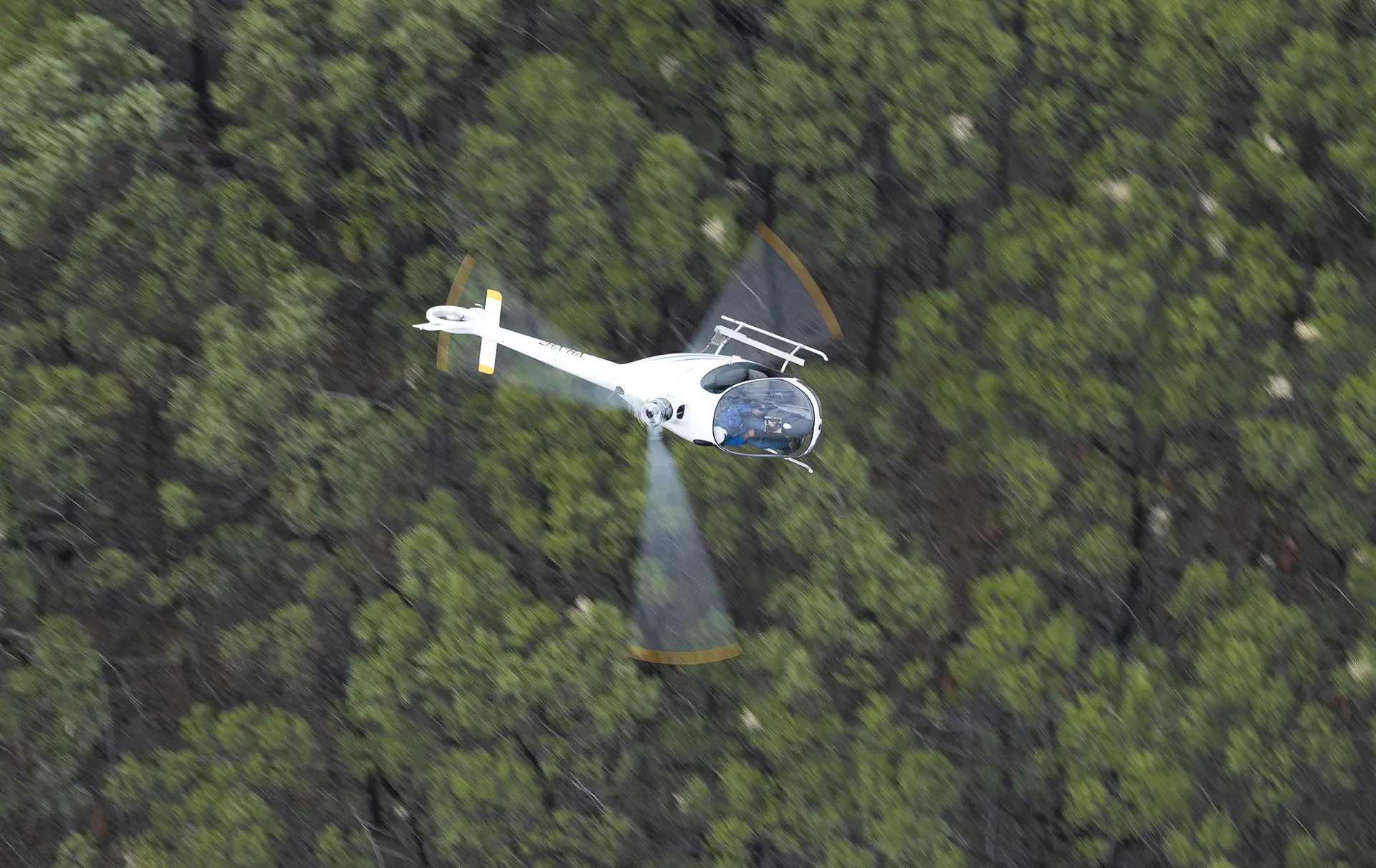
Pros and Cons
There are both pros and cons with the G2, compared to the R22. On the plus side, its 170-litre fuel tank provides greater endurance than the Robinson’s 105 liters while the fenestron and upwards-pointed exhaust make it much quieter so it can work in much closer to stockmen, horses and cattle. The noisier Robinson is better at moving cattle at a distance. The Cabri’s engine is more thoroughly shrouded than the R22’s, so its oil runs a lot hotter. “During the wet season, temperatures of around forty degrees are accompanied by 95 percent humidity and because of that we’ve had to deal with heat issues. At anything over about 300 Centigrade the oil would overheat really quickly, and you’d have to fly forwards to get ram air cooling the engine. The support from the factory has been really good though, and they’ve built us a second oil cooler but it took quite a while, so initially we built our own and got it approved.”
The rotor-blade height is lower on the Cabri so extra care has to be taken on the ground, when refueling or with ground staff on motorbikes approaching the machine. On shut-down the blades droop another 600mm at the tips so the blade height is a significant risk factor that has to be carefully managed. “That last bit of blade droop is definitely at head height so you have to use the rotor brake and stop the blades before you get out,” Chisholm advised and noted that although higher skids would mitigate the issue, the extra weight, cost and reduction in ferry speed made it an unfeasible option. “It’s a little bit underpowered compared to the Robbie when you’ve got full fuel and two people, but its tank is much bigger and you hardly ever fly with two, so it’s easily manageable and not really a problem.”
Experience
Maintenance can be a little problematic at times, simply due to the limited availability of in-country critical parts. Chisholm said that the situation is gradually improving, with a Melbourne-based Australian agent now holding some parts. “They can get stuff in quite quickly, but we can’t, so we really need to have everything on the shelf,” he advised.
Mustering is such a unique part of the helicopter industry and a very “Australian” part of it. Jeremy O'Brien flies for Heli-Muster in the
Northern Territory, “Everyone reckons it's full-on all the time, but a lot of the time it's cruising around trying to find cattle, working
out the best way to move them. It does get busy sometimes, but we often operate two helicopters together and sometimes even three, so
communication is massively important. It's a high-pressure situation when you're trying to put them in the yard. Sometimes you have to get
down and close. When you have got something that's bailed up, you can't physically move them, so you’re trying different tactics to get them
up and moving in the right direction. When you're flying around, you're focusing on one animal but you've also got to be cautious of your of
your surroundings, especially when you're moving into trees. It's exciting for sure and you're constantly learning and challenging
yourself.”
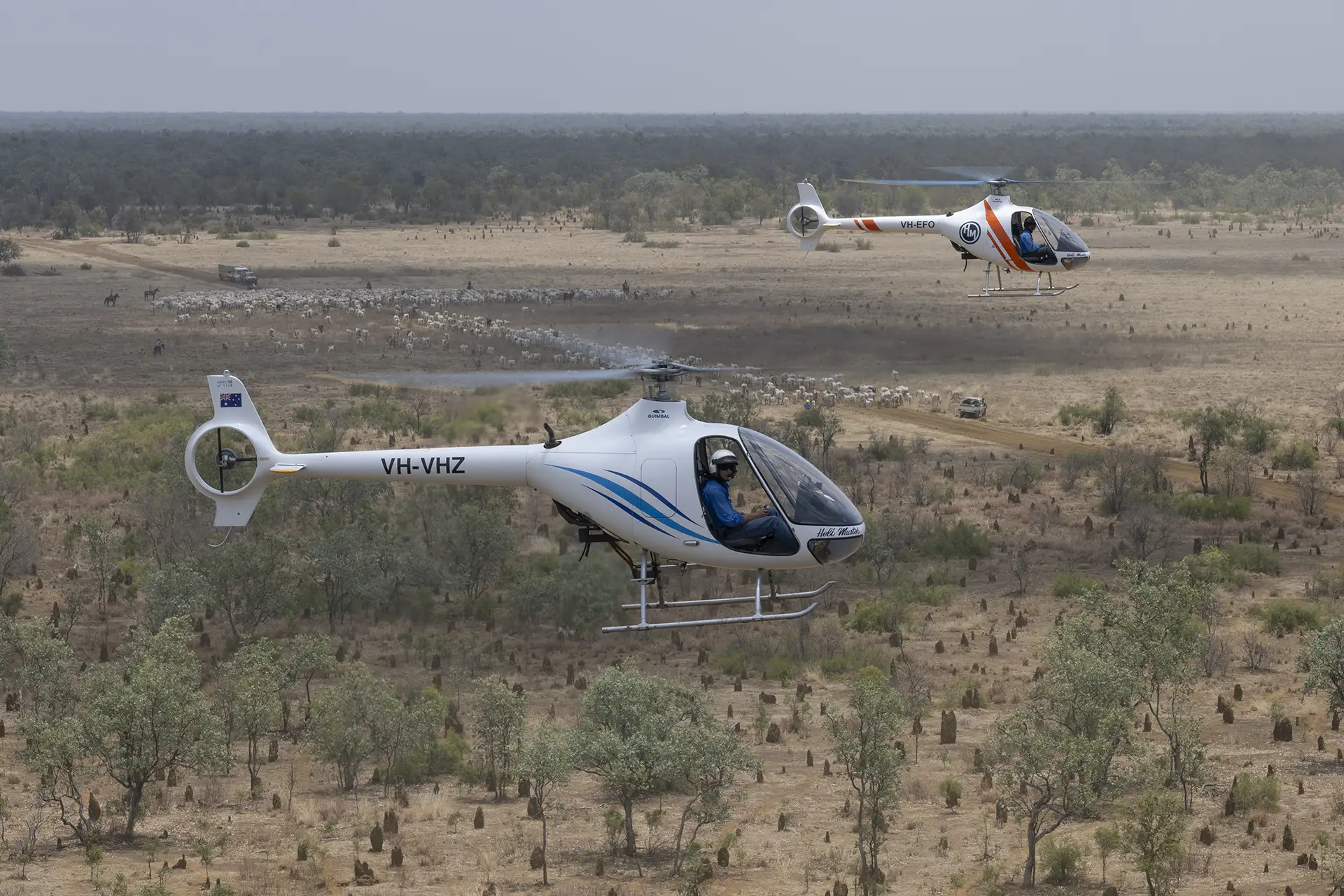
Nick Brisk is in his third year as a mustering pilot with the company. Rural Australia is beautiful and I love it. Yeah, it keeps me sane, I
guess. You get away from the chaos of the cities and the world. We'll be mustering between two machines for a day. They'll walk into the
yard, get them in and process them the next day. The day after that, we'll go again and get another lot of cattle; roughly a thousand in
each mob. I think the mustering industry has changed for sure. It's not what people make it out to be. Most of the day, it's slow, smooth,
and steady. Really, we're just here trying to get the cows to the yard as slow and steady as possible.” The mustering machines take off as
soon as it’s daylight and a typical paddock averages around six hours flying for two machines, although paddock size varies considerably and
a day might be anywhere from three to twelve hours.
Pilot John Armstrong agrees that communication and situational awareness are the keys to safety in aerial mustering, stating, “The most
machines I've had in a paddock was five. Usually you only have to worry about the person next to you so the situational awareness to get
around that is knowing where the next guy is. Generally, we set ourselves up so to make it easier for ourselves. There'll be a main marker
like a creek and I won't cross that creek at all unless I can see the guy next to me and then tell him I'm doing that. When people are
yarding up they'll sometimes swap sides, but they're always talking to each other. People don't see that when they watch the videos but the
communication is always happening between the pilots.” Armstrong describes the Cabri as being sturdy. “They're a tough little machine, no
doubt. But if something goes wrong, I feel a lot safer flying in this helicopter with a high-inertia blades and better auto rotational
characteristics. I think they're just a much better way to go for the future.”
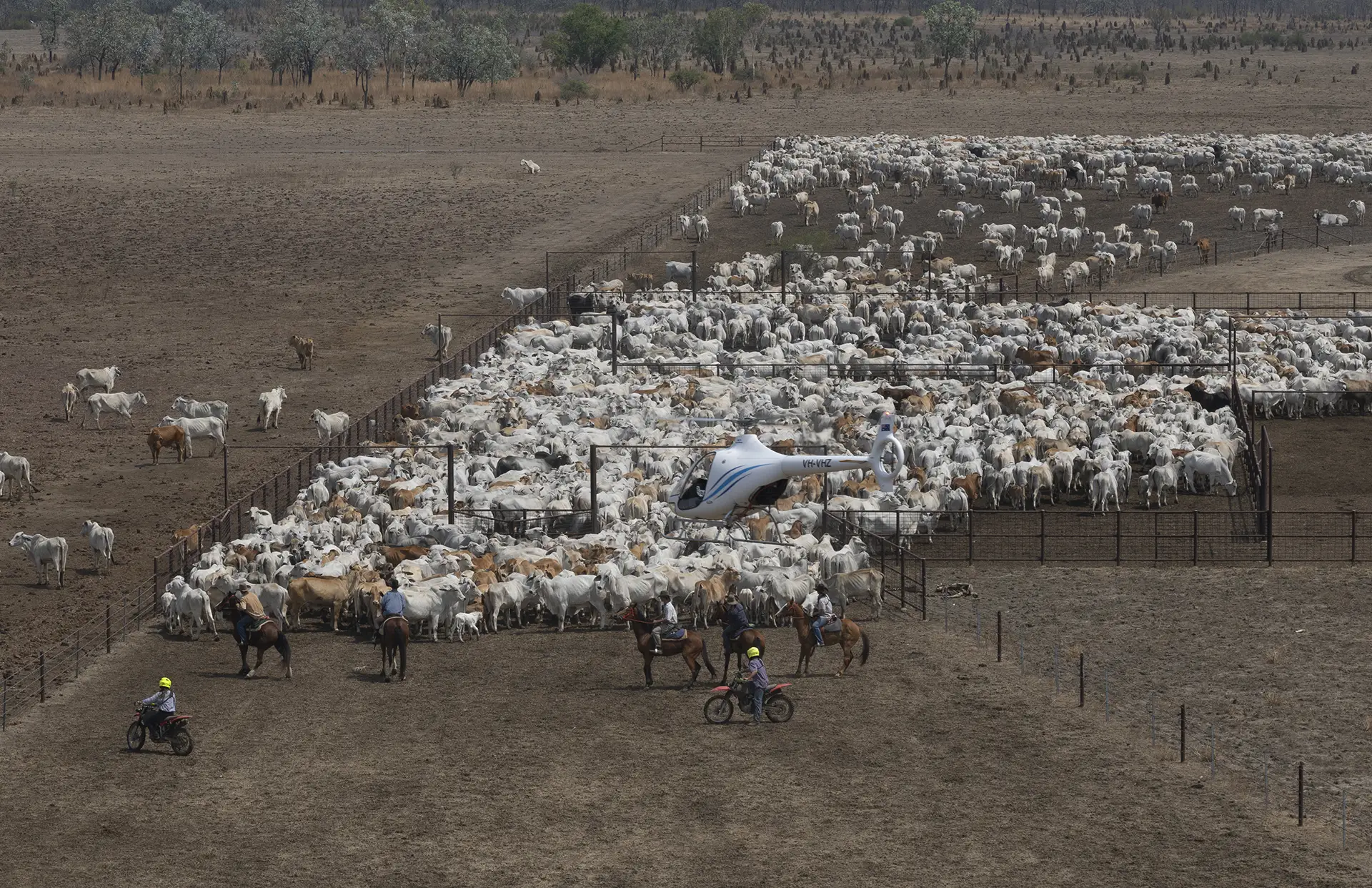
Chisholm said that the pilots fly the CASA annual limit of 1,200 hours in the mustering season that runs from April to November. “Life as a mustering pilot is a pretty good lifestyle for a young person and the ultimate freedom. It’s the last frontier I suppose here in Australia.”
Regarding the Cabri G2, Chisholm is entirely positive and estimates that the company will amass around 4,000 to 5,000 hours on the type this year. “It’s been a good move and I’ll back the helicopter. It’s a lot safer than I thought it would be and we’ve found it lot more profitable which at the end of the day is why we are all here.”