 HOME
HOME





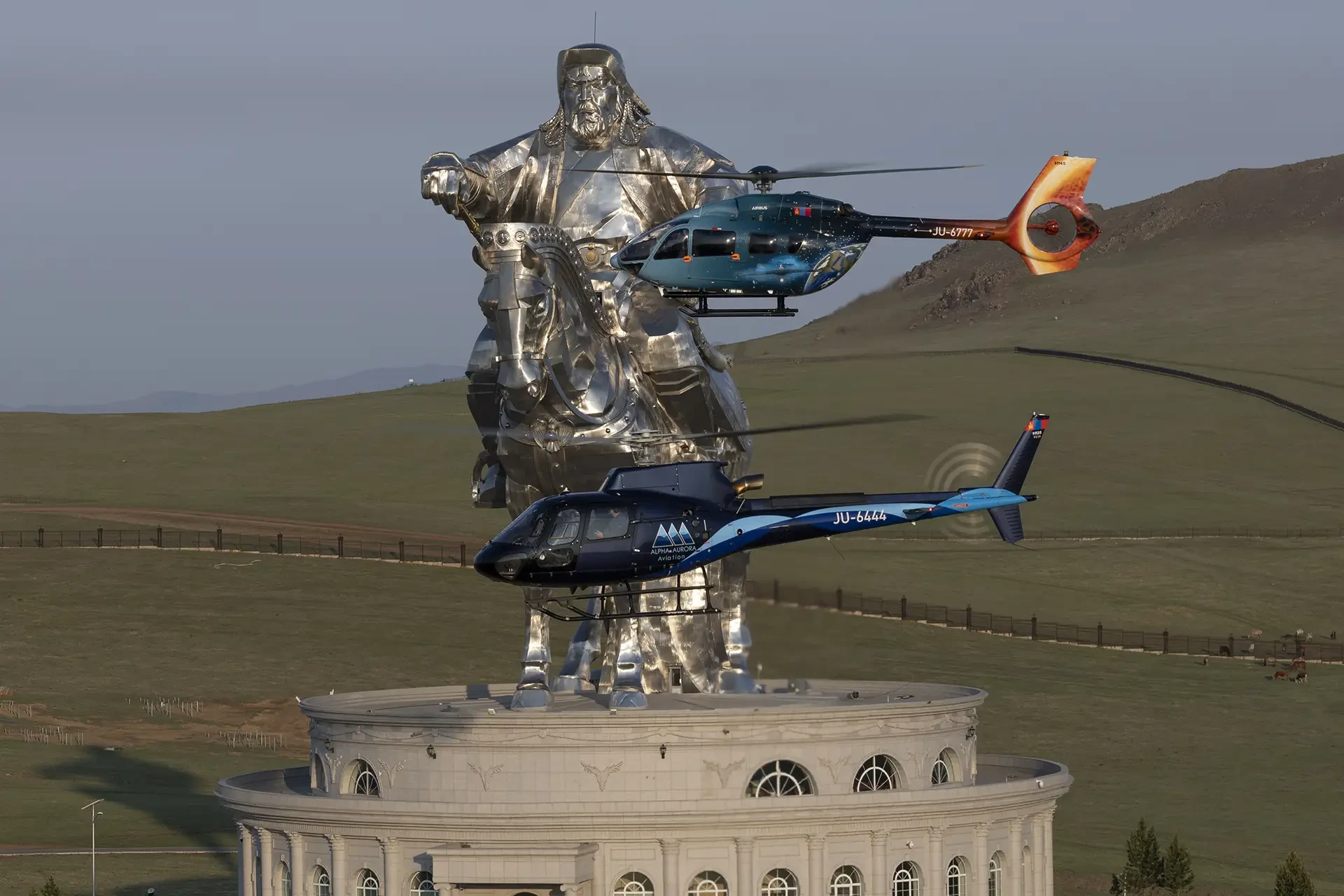
Alpha Aurora Aviation is Mongolia’s first commercial helicopter operator and was originally envisioned to manage and operate a private owner’s machine. The concept quickly evolved into managing several private aircraft, incorporating commercial use to generate revenue when the owners did not require their aircraft.
With almost thirty years of varied flying and aviation-management experience in diverse locations around the globe, David Edwards, Alpha
Aurora Aviation’s CEO, spoke to HeliOps about the new venture. “It’s been a bit of a challenge because, being so new, we’ve had to overcome
some obstacles that haven’t been encountered before,” he related. Adding to logistical challenges is the country’s location, adjacent to
the eastern tip of Kazakhstan and bordered by China and Russia. “Getting things in here across the ground is a logistical challenge, being
between two superpowers and to get our helicopters in, we flew them all in from Europe because that was the fastest and most cost-effective
way to do it.”
Territorial Limits
According to Edwards, flying near the borders can be challenging, especially near the Chinese border, as China is particularly sensitive about aircraft in or near its airspace. Russia, however, is much more tolerant, and it is not usually difficult to obtain the necessary permissions within two to three days. “Surprisingly, during our ferry flights, we’ve found that the most difficult country to fly through is Turkey, in terms of getting the necessary permits and approvals. Even Russia and Kazakhstan are much easier.” Flights into Russia are infrequent, but when they do occur, it is simply a matter of filing a flight plan, working with a ground coordinator in Russia, and supplying the required paperwork. Flights in Mongolia but within 30kms of the border require approval from the Mongolian Border Force. Edwards noted that, now that Alpha Aurora has been operating for two years, the company is well known, so the process is much simpler than it was at first.
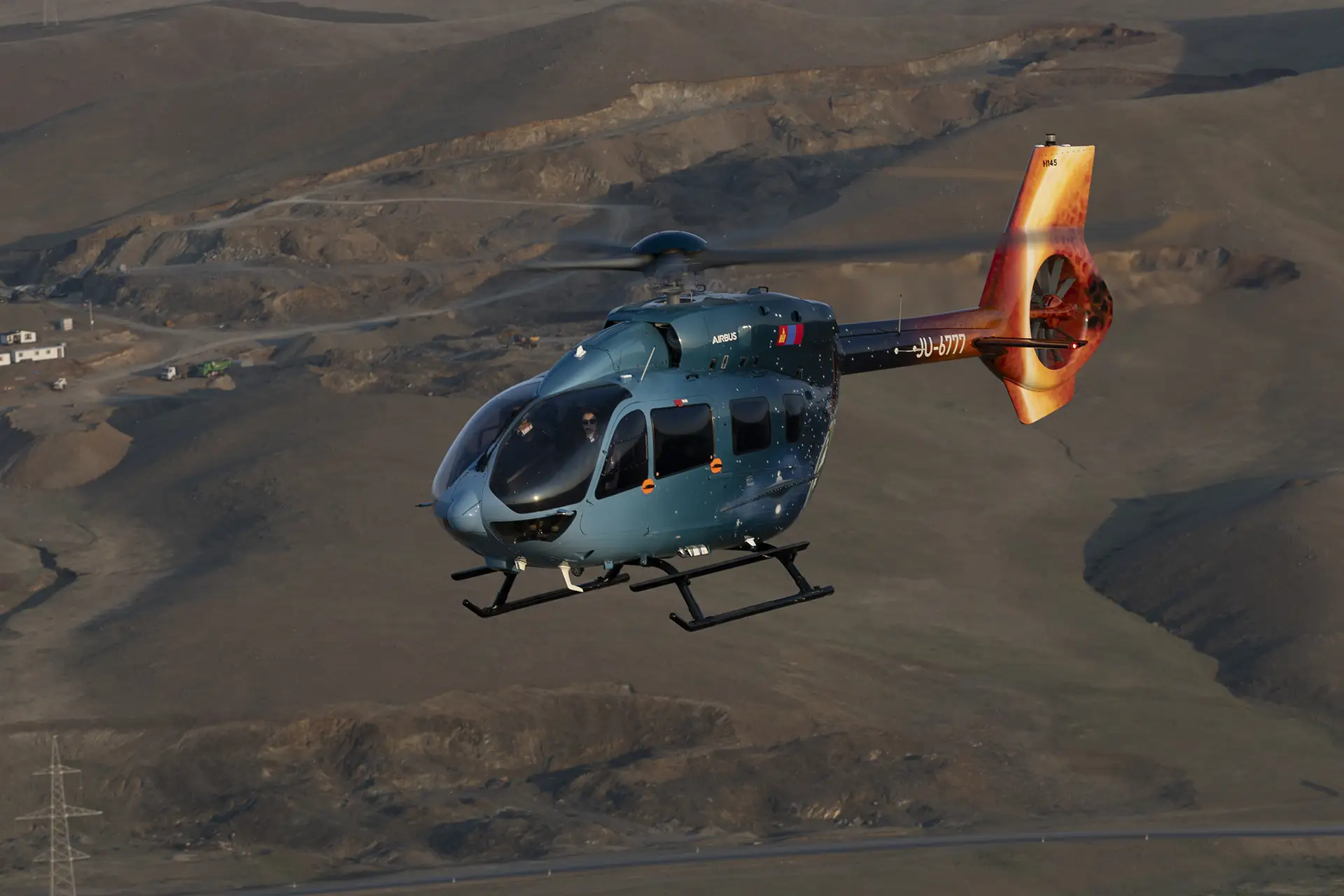
In 2021, Edwards ferried a BK117-C2 to Mongolia from Europe for a private owner; this was the first such delivery, and it occurred amid
heightened tensions between Russia and NATO. He then spent two or three months training up some locals on the new machine before leaving at
the end of that year. He remained in contact with the owner, however, who was very keen on aviation and wanted to obtain more aircraft.
“We’re part of a group of about 30 companies, and the original idea was to use the aircraft for private and business flights for senior
management, investors, and families. In one of our phone calls, I jokingly said that he should set up his own aviation company because of
the significant investment and asset base necessary, and we discussed it over several months, before I finally came here in May 2023 to set
this up,” he recalled.
Since then, Alpha Aurora has obtained its Part-135 AOC (air operator certificate), Part-133 approval for external load work, and Part-145
approval for maintenance. Other owners then approached the company to manage and maintain their helicopters. “Now we have a public-private
partnership because we provide pilots and maintenance support for the Air Force’s H145-D3 VIP helicopter,” Edwards advised, elaborating that
after flying Mongolian politicians around the country for six weeks in the lead-up to the latest election, the government decided to
purchase an H145-D3 that was originally destined for Alpha Aurora, who would operate up to four new aircraft on the government’s behalf.
“It’s developed far beyond what the original concept was,” he added.
Fleet Development
The fleet now consists of seven aircraft, a mix of H125s and H145s, and by the time that several aircraft transfers, sales, and purchases
currently in the pipeline are completed, Alpha Aurora’s own fleet will likely comprise four or five H125s and one H145-D3. Edwards came up
with the company name and logo, selecting the name for its search-engine strength. The logo incorporates three stylized ‘A’s enclosing
mountains in blue hues, with the light blue being significant in Mongolian culture as light blue ribbons are a traditional gift to wish
good luck and blessings to the recipient.
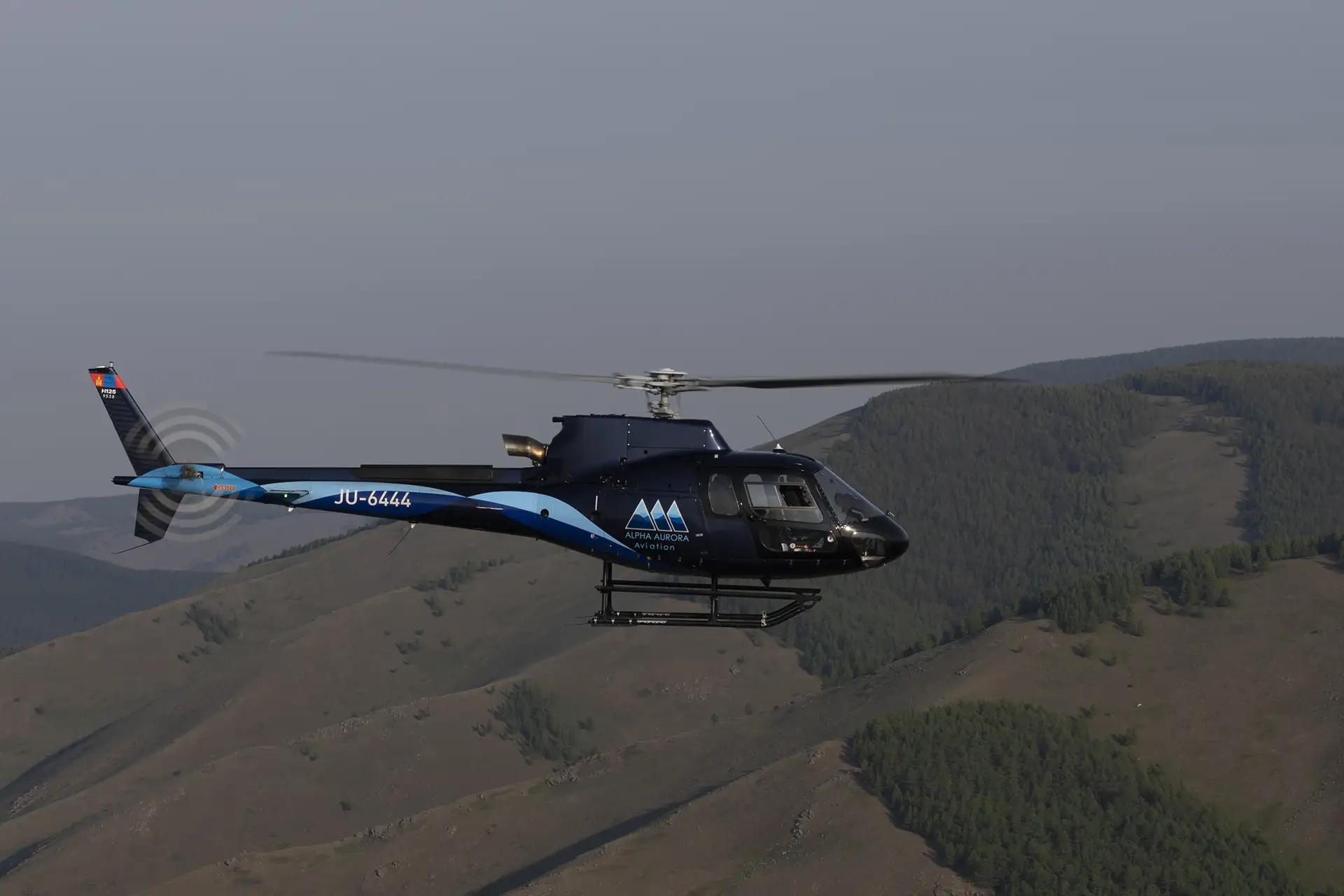
Edwards stated that choosing an H125 as the company’s first aircraft was simple. “I’ve flown around the Mongolian terrain, so I knew we
definitely wanted the H125 (AS350-B3). It’s good for tourism with the gallery seating, it’s good for corporate VIP, good for external load
work, and it’s great for high-altitude, low-density operations, so that was a no-brainer. We also wanted a heavy-lift capability – but
nothing with wheels because we’re landing out in rural and unformed locations – so I wanted the biggest and most durable light twin we could
find, and I thought the H145-D3 was ideal for that. We can strip it out in the back as a cargo aircraft, or we can have it as a VIP
aircraft,” he explained. He elaborated that the choice of those two platforms allowed the company to deal with Airbus as the sole OEM,
greatly simplifying maintenance and spares requirements.
Edwards recalled that in the very beginning, Airbus was reluctant to even talk with Alpha Aurora as they were completely unknown. However,
after a few eventual meetings, Edwards contacted the Airbus sales representative in China to order three H125s and one H145-D3. Once they
confirmed that not only was Edwards deadly serious but that Alpha would also be paying almost 20 million Euros up front for the new
aircraft, the manufacturer became very helpful and cooperative. “The relationship between Airbus and us is good, it’s really solid now,” he
commented and explained that Airbus approached Alpha Aurora in October 2024 with a proposal that they become the OEM’s Mongolian service
center. “We hope that we’ll be finished with that process and part of their network by April 2026.”
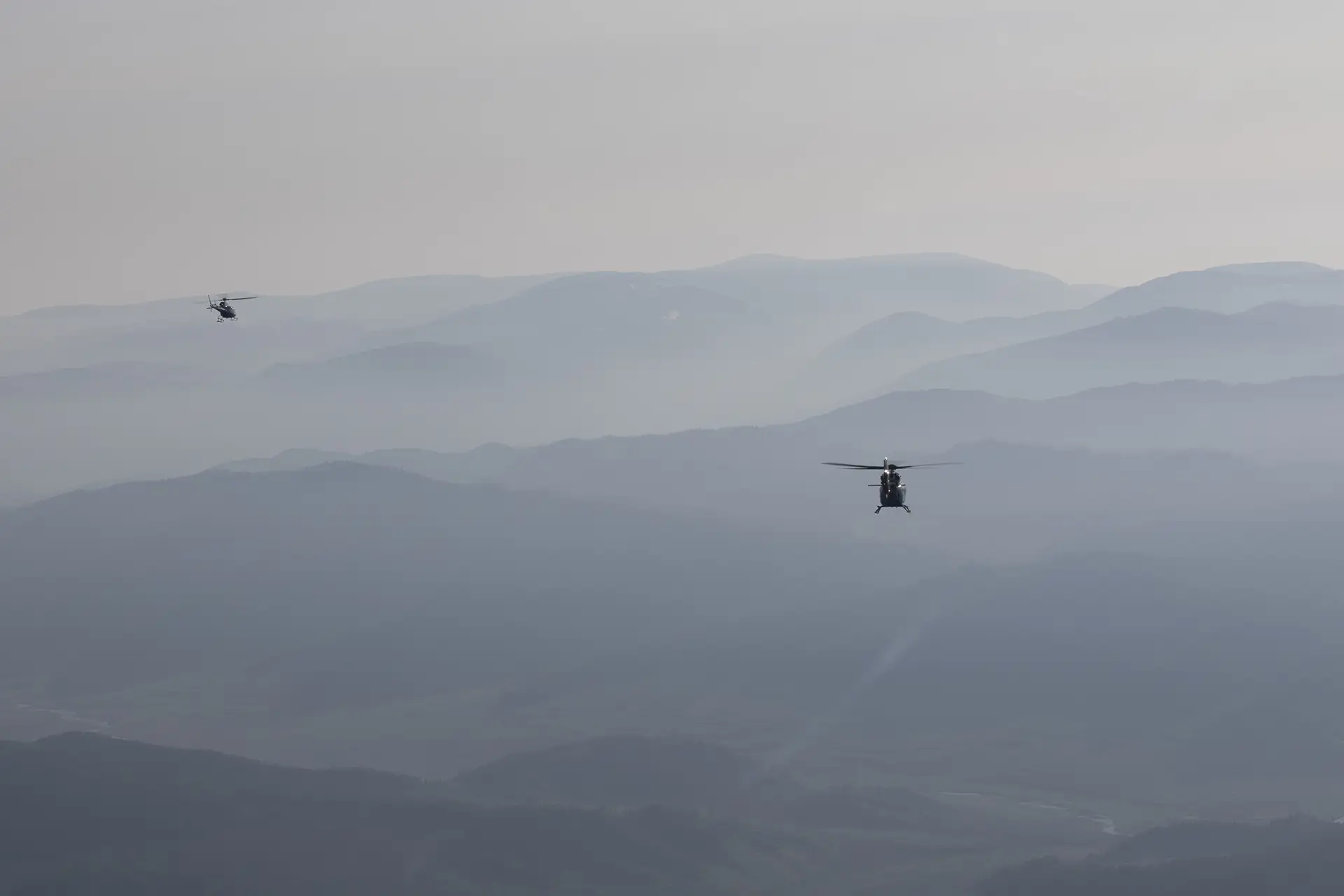
The geographical challenges mean that parts support is more difficult than almost anywhere else in the world. Even urgent AOG items take at
least seven days to arrive, and it is common to wait two weeks for deliveries. This makes effective forward planning a vital component in
keeping the operation running smoothly. Hazardous goods are even more challenging to obtain, as they can usually not be air-freighted, so
must be brought in by land, a lengthy and complicated process. “We can’t carry all parts and all equipment; not just because of cost, but
also the space required. It’s not ideal, and it means that sometimes an aircraft is grounded for longer than we would like, but we’re
learning from that and are continually improving our internal coordination and planning processes,” Edwards pointed out.
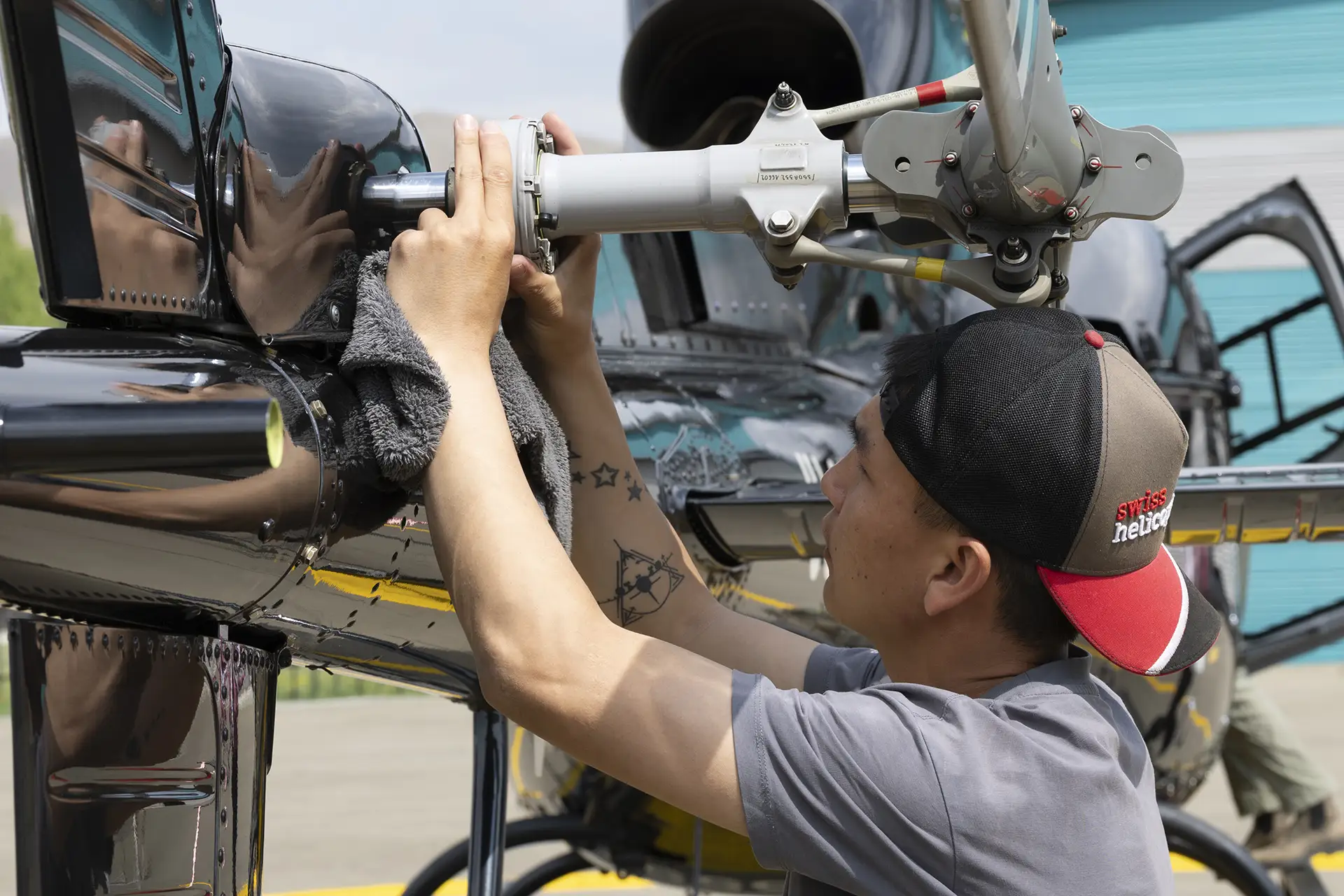
The four-aircraft order was placed in August 2023, and the first H125 was delivered that October, the second in December, and the last example was delivered in May 2024. The H145 was delivered in January 2025. All H125s were delivered ‘green’ and were completed at Swiss Helicopter Maintenance. One was fitted with air conditioning, one with a VIP spec’ and all were completed with two-axis autopilots and dual hydraulics. “We do a lot of distance flying here and having the pilot hand-flying for two and a half hours between fuel stops was just not going to work, hence the autopilots,” Edwards advised. “When I came in, the owner already had a couple of R66s, one B3, a 145-D3, and a 117-C2. The 66s weren’t being used except for a bit of training, so as soon as the new aircraft began to arrive, I sold them, the C2 and the old B3, because it only had a single hydraulic system, and my plan was always to standardize the fleet with just the two modern Airbus types,” Edwards recounted.
Personnel Factor
With the new aircraft on the way, the next challenge was building a team to operate and maintain them. Several maintainers were recruited
from other locales, with existing maintenance qualifications and lacking only the type-experience on the Airbus machines. The pilot roster
included just one Mongolian national – now the chief pilot – alongside Edwards, but two other ex-Air Force nationals quickly joined the
team and immediately received further training in emergency procedures and handling skills to bring them up to a high international
standard in the smaller, more sensitive machines than they were used to flying.
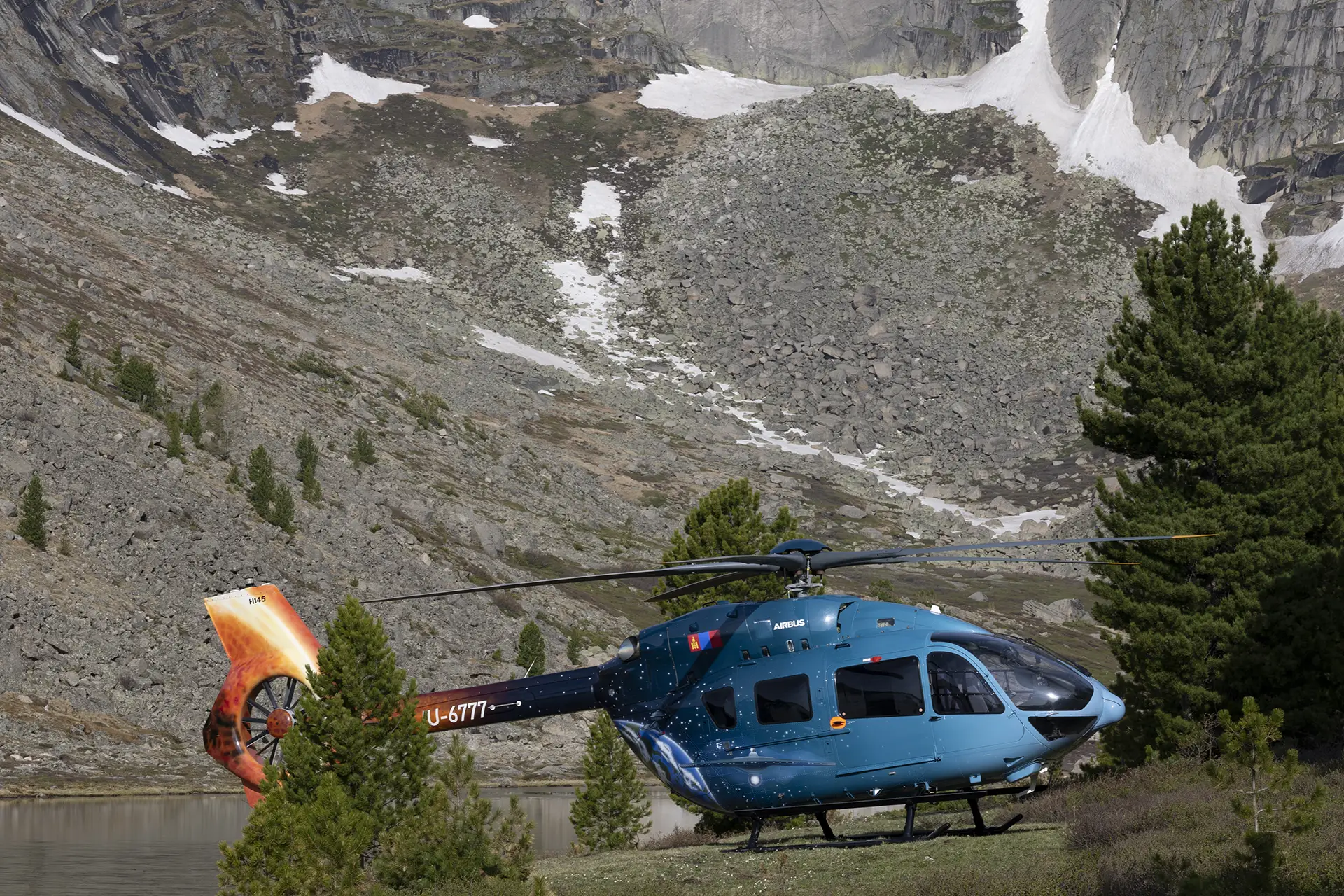
Three ex-pat pilots also joined the team, and more pilots will be recruited next year to swell the ranks as two more B3 deliveries for Alpha
Aurora are expected, as well as two H130s for On-Time Aviation, but under Alpha’s management and operation. Edwards stressed that the mix of
nationals and ex-pats is an ideal structure as the ex-pats bring in a wealth of experience and expertise, while the Mongolians are extremely
motivated and thirsty for knowledge. “They want to learn, to be better, and we’ve found the right individuals who want to do a good job,” he
remarked. “Also, we’re constantly looking to see if there’s a better way to do things, so we’re always pushing them to question if there are
better ways of doing something, never just accepting everything at face value.”
Plans
On-Time plans to operate a niche shuttle service with the H130s, as traffic in and around Ulaanbaatar is very slow and a 25km trip
from the airport into the city can typically take two to three hours, so there are plenty of businesspeople willing to spend the money for a
helicopter transfer that takes a mere fifteen minutes. “Marketing that will be crucial to its success, and we’re still waiting to obtain
permission from the regulators to land in the city because that’s also something that’s never been done before, and they are therefore quite
hesitant,” Edwards reported. “We’re too busy setting up our own infrastructure for our charter business to take that business on right now,
so when On-Time approached us, we offered to work with them on it, as it’s much better to have a partnership than a competitor.”
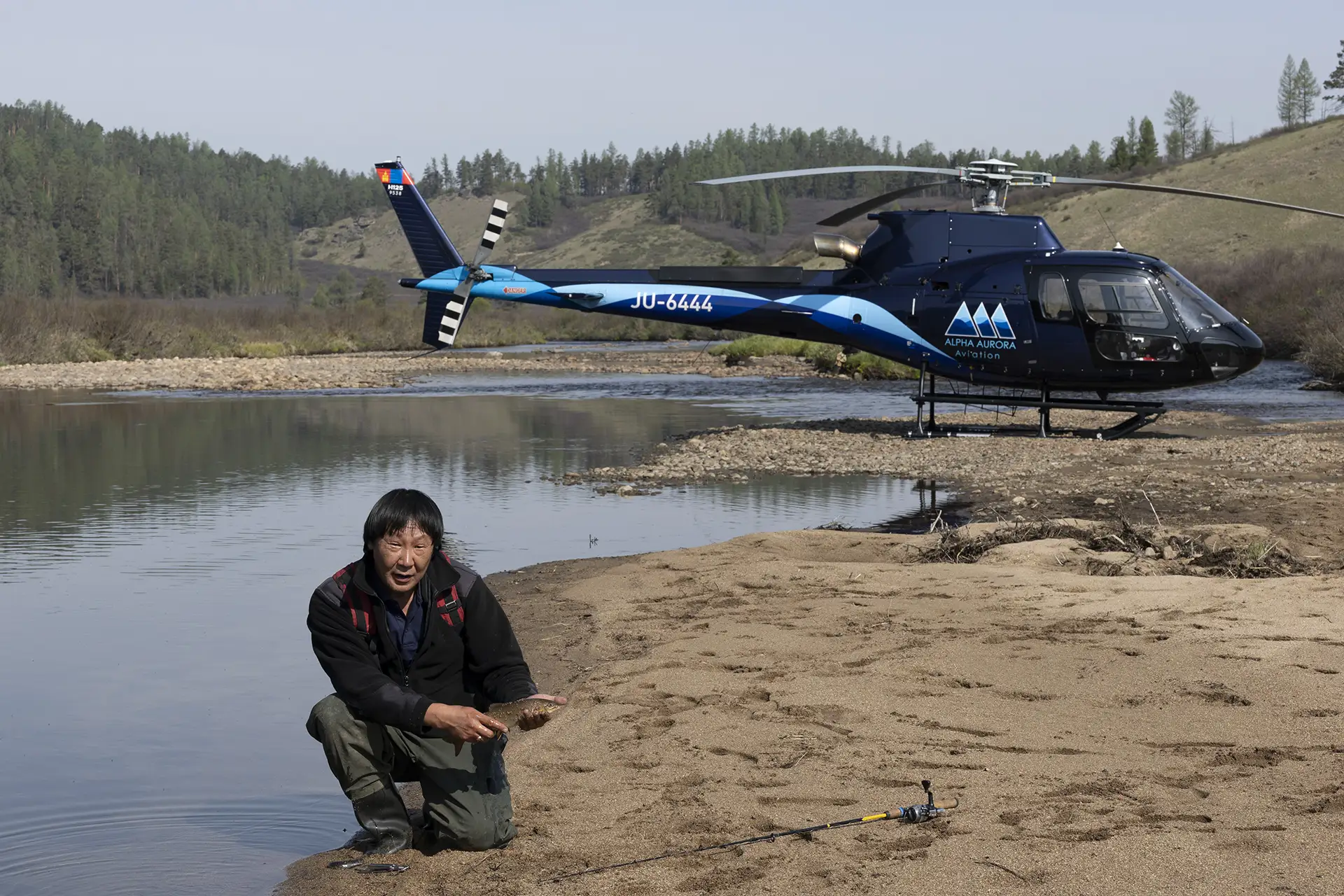
The first focus of Alpha Aurora’s business plan was the domestic market for high-net-worth Mongolians who want to travel outside the city on
weekends, escaping the congestion and pollution. Then there is the corporate VIP market for senior executives in industries such as mining.
“They’d rather spend two hours in a helicopter than twelve hours in a Landcruiser to get to their business location,” Edwards observed.
Alpha has targeted Japanese, Chinese, South Korean, and Russian companies that have business concerns in the region but in quite remote
locations. Many of them have been quick to recognize the benefits of helicopter transfers, and Edwards commented, “We’re two years in, but
we’re still a start-up business, and I want to make sure I don’t over-promise and under-deliver, so I’m a little cautious. However, we’re
flying almost every day, and from Friday to Sunday, it’s not uncommon to have all of our aircraft flying.” He also noted that overseas
clients are becoming more and more prevalent becoming charter clients, and word-of-mouth referrals from satisfied customers are a major
factor in the steady increase.
His cautious approach is why there has so far been little emphasis on the tourism sector, and that market will not be aggressively sought
until the core business infrastructure and operation are well established and supported. The company does engage in this work as and when
demand arises, however, and will continue to do so, as Mongolia offers spectacular and unique heli-tourism opportunities. “At the moment,
all we normally offer is the helicopter as an aerial taxi service to take them where they want to go. We have contacts at the resorts we
fly people to and can work with them to arrange one-off bespoke flights for customers who want them, but while we may look at all-inclusive
packages in the future, for now, all we offer them is the helicopter.”
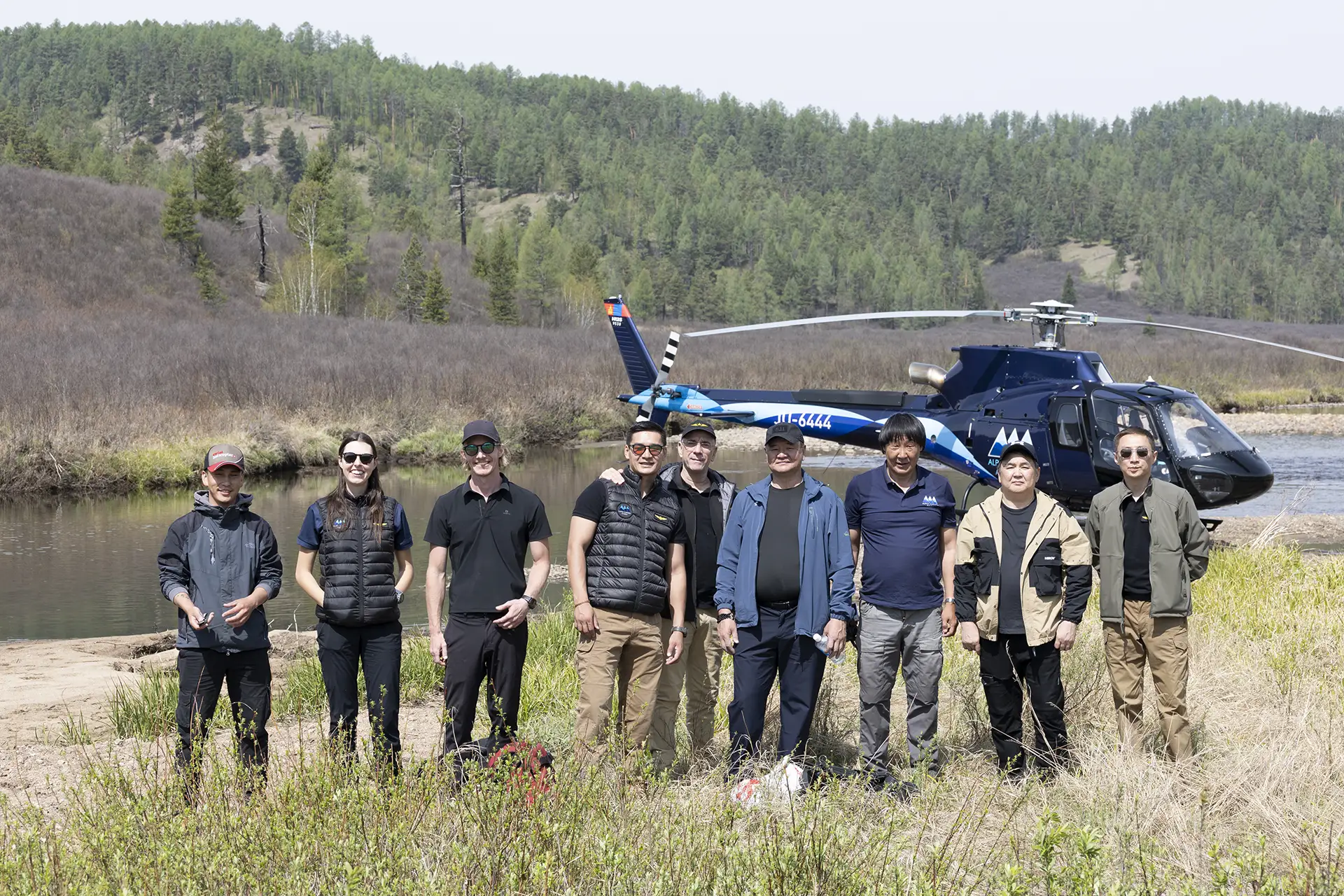
In addition to simple charters to transport people to their destinations, the company also offers heli-fishing charters. One of the
Mongolian pilots is also a fishing guide, so between him and other local guides, there is access to a wealth of local knowledge about good
fishing locations. “The beauty of where we go heli-fishing is that those spots are inaccessible by any means other than helicopter or
horseback, and the rivers are overstocked with fish because there is so little fishing pressure,” Edwards advised. Of course, for visitors
to the country with limited time available, it makes sense to spend money on a few minutes in a helicopter. The alternative is spending days
on horseback to reach fewer spots, leaving much less time for fishing or other leisure activities.
Taking In The Scenery
It is intended that in the future, tourism will be catered to only by tailored, one-off charters. “We plan on offering bespoke charters
instead of the usual type of tourist flights. The land mass of Mongolia is virtually the size of Western Europe, although about half of its
roughly 3.5 million population lives in the capital city of Ulaanbaatar. It’s vast, and we tell our potential clients that they have to
plan on spending two or three days just travelling if they want to see a lot of the country,” stated Edwards.
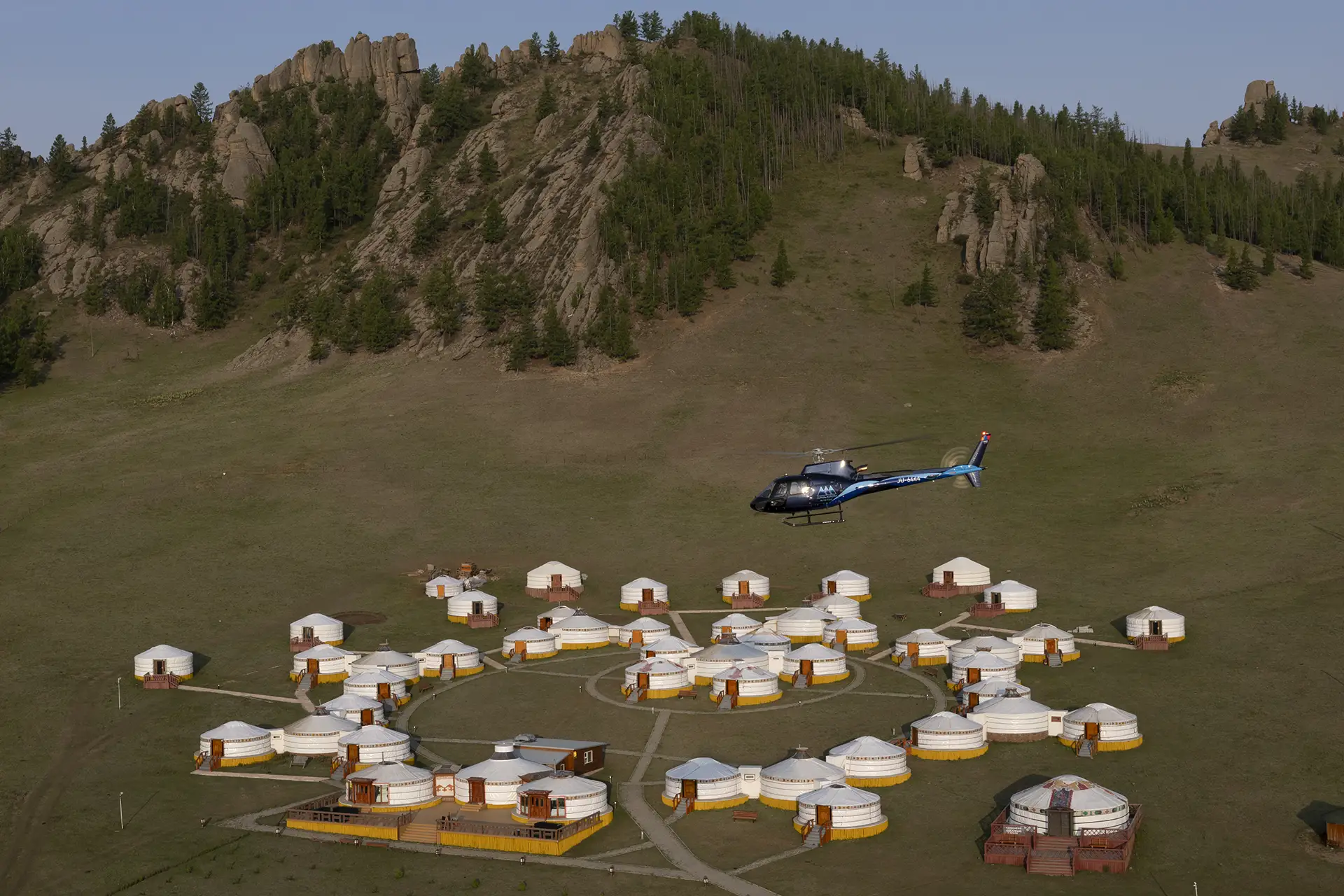
He acknowledged that although there are many beautiful locations within an hour or two of Ulaanbaatar, most of the truly spectacular
destinations are much further west and around six to eight hours flying time. “For that reason, we usually recommend taking two aircraft on
those longer journeys for our bespoke charters. It means there is a backup aircraft immediately available, and it permits carriage of much
more luggage and camping equipment.” The remuneration for bespoke charters is vastly higher than for generic tourist flights, which is
another good reason to focus on the high-end market. Edwards commented that virtually all the charter clients pay tens of thousands of
dollars for their helicopter service.
“Our target market is high-net-worth individuals and the corporate VIP sector; we’re really not in this for people who want to pay $99 for a
ten-minute scenic flight,” he advised. The H125 has a fuel endurance of around three hours, and in that time a flight can take clients
around the mountains, lakes, rivers, and Chinggis Khan statue complex to the north. “We could also go south to the northern part of the
Gobi Desert, or, if they have double that time, we could take them out into the steppe and into the Khovsgol lake and Khovsgol mountains.
That’s really beautiful as well, and about a six-hour round trip. It’s a long flight, but it’s really beautiful getting there, so you’re
not bored just sitting in a seat waiting to arrive.” Even longer trips are available and several have been conducted to the Altai Mountains
and Bayan-Ölgii
Province, around 1,400kms or eight hours flight time to the west.
Support
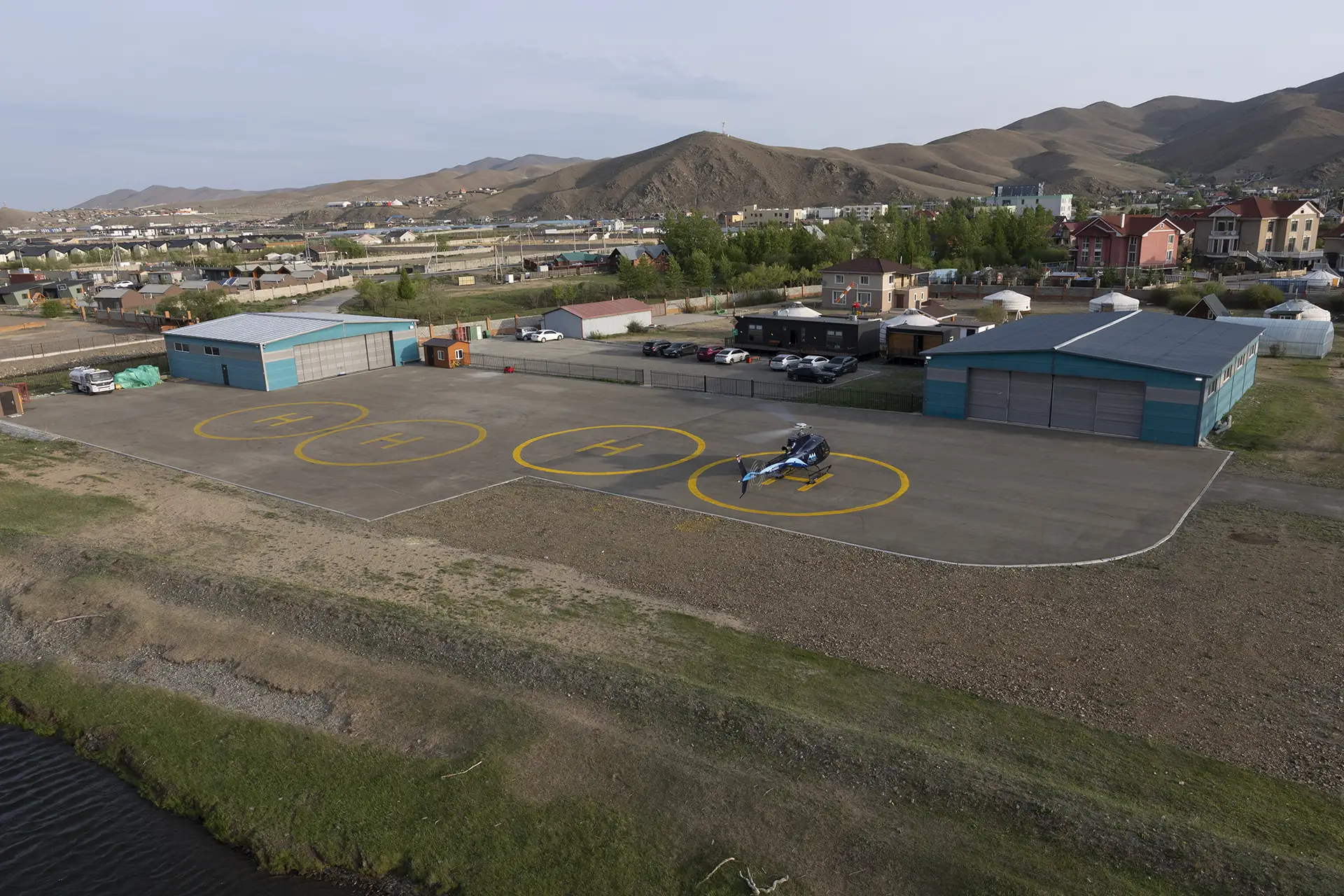
Because of the distances involved, the company operates a fleet of fuel trucks and has several 20-ft containers deployed in strategic locations, each outfitted with a generator and 5,000 liters of fuel storage. The fuel trucks refuel the container tanks and fuel can also be obtained from various airports when necessary. “The issue here is that the fueling infrastructure didn’t exist, so we had to build that as well as part of our investment,” Edwards related. “Our fixed-position fuel containers and fuel trucks are exclusively for our own use, so that’s something that gives us an edge over anybody else. You could bring a helicopter here but how far are you going to be able to take it, unless you have a fuel truck following you around? Buying the helicopter has been the easiest part of the whole operation, it’s everything else that’s been the challenge.”
The Mongolian Civil Aviation Authority has been very supportive, and Edwards noted that, by their own admission, they lacked experience in dealing with rotary-wing general aviation. When he brought in the first helicopter in 2021, the authority even questioned why anyone would want a private helicopter in Mongolia. However, when the company submitted its application for an AOC and Part-145 approval, the authority pulled out all the stops and issued them within about six months. “We’ve worked hard with them to develop their understanding and knowledge of rotary-wing aviation, and that has built up a very cordial relationship. They now trust us and know that we’re doing the right thing to a high international standard, and what we’re doing is to the ultimate benefit of the Mongolian aviation industry,” Edwards commented.
There is a desire to develop into utility work in the future and to that end, the company is working with an Australian company that is working with the Department of Mining and Heavy Industry on HeliTEM EM (electromagnetic) survey work in the Gobi. Edwards explained, “We did some work with them in 2023, and they’re hoping to sign some more government contracts for which we will be the services supplier. It’s really big and would entail about three years’ work for four B3s (H125s), flying every day, seven days a week, mapping hundreds of thousands of kilometers.” He added that he does not foresee many opportunities for other utility work, such as heavy-lift and construction, in the near future, as he does not believe there is currently strong demand for such services.
If the EM survey work does go ahead, it will entail establishing a new utility division of Alpha Aurora with dedicated maintenance and hangarage facilities in the Gobi. The work demands precision flying with a massive loop antenna at 55kts, 70ft above the ground, following the terrain. “We’d have to wet-lease aircraft for the first twelve months until we can get our own aircraft in and hire more pilots. As part of that, we’d want them to fly with our guys to train them on the longline work. They hadn’t thought about using helicopters before we got here because there wasn’t the capability, and everything had been done from a higher altitude in a Cessna Caravan, so now we’ll be creating a new segment of the market in Mongolia, and it will be a further expansion of what our organization comprises,” said Edwards.
The Mongolian climate poses a significant challenge during the colder season. Edwards stated that operations were shut down from December last year until March-April. “Ground temperatures can get down to about minus-45, and as you climb, it gets even colder, so you’re below the operating envelope of the aircraft. This year it was quite mild and only got down to about minus-25, which is fine to get airborne and fly away, but you can’t shut the aircraft down for any period of time because it kills the battery. You certainly can’t leave it shut down overnight, so you’re basically limited to day trips where you can fly out an hour or so and then back again. That substantially reduces our volume of work to maybe two or three times a month, instead of two or three times a week.”
The reduced flying means the operation is maintained during the lull by a skeleton crew of pilots, with the ex-pats returning to their home countries. The engineers remain, however, as they have the chance to carry out all necessary maintenance and repairs in the heated hangars. Even with the heating, however, temperatures in the hangars are typically around zero degrees on the colder mornings. The aircraft are not left outside overnight, so when there is any flying, pre- and post-flight checks are done inside the hangar. When it’s away, the aircraft is kept running and carries a ground power unit to keep the battery going, as any shutdown of around two hours or more in the freezing conditions will result in the battery being incapable of restarting the aircraft. To cope with the extreme cold, personnel are supplied with several layers of thermal clothing, made in Russia and designed for the significantly sub-zero temperatures. At other, warmer times of year, mosquitoes, horseflies, and other biting insects can make life rather unpleasant.
Maintenance Investmant
Mongolia’s remoteness necessitates a substantial investment in maintenance capability. Shane Beeton, the Director of Maintenance, runs Alpha Aurora’s facility. Beeton has been in Mongolia for five years, with around thirty-five years of aviation experience. His secondary role is training, to bring the quality of Mongolian maintenance up to the desired international standard. “For a long time here, the maintenance was based on the Russian maintenance ethos and an authoritarian mindset, but that doesn’t work with western aircraft, and nobody learns well under a punitive system,” he observed.
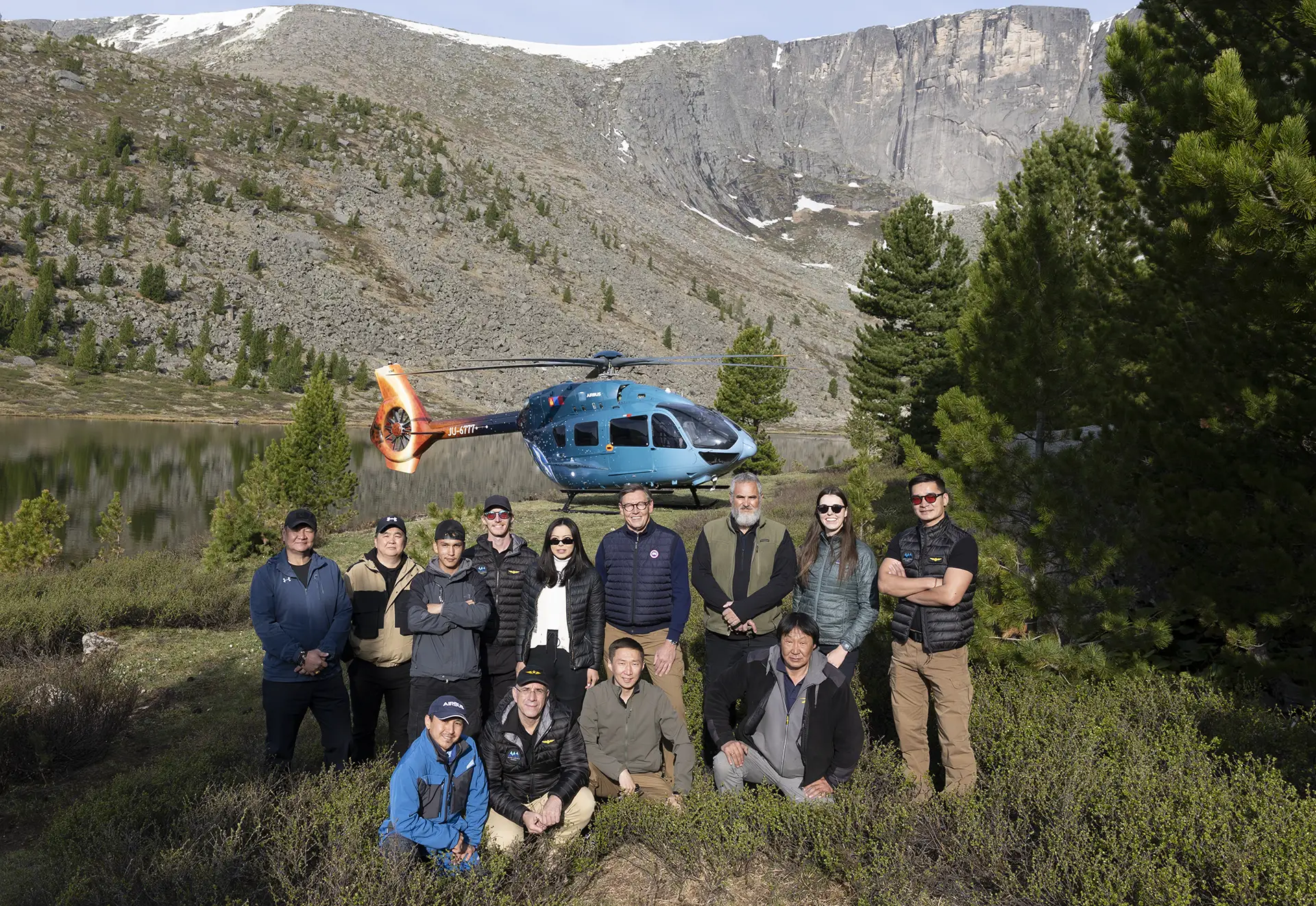
“One thing I’m working hard on with the maintenance team is their fault-finding, so they have a thorough understanding of what they’re doing, why they’re doing it, and what they hope to achieve,” Beeton commented. “I want to create an environment that is friendly for them to learn, to make mistakes and not be read the riot act; to make them understand that we are the same and the only difference between us is our level of experience. I need them to understand that we are a team and we have each other’s backs. If they see me make a mistake, they need to feel free to speak up. I’m very lucky that the team I’ve got is very tight. They work well together and have a really strong camaraderie.”
Beeton explained that while he has ten mechanics and avionics technicians working under him, just three of the mechanics are currently licensed on both types operated by Alpha Aurora. He stressed that he was strongly pushing his new staff to challenge and question decisions, to understand the rationale behind each decision, while taking responsibility as professionals for appropriate action. “We’re trying very hard to bring a European maintenance mindset here into Mongolia, so that’s thinking ahead, planning ahead, and being proactive instead of responsive. The new young guys have no experience so we’re taking them by the hand and leading them through the whole process.” The hunt is also on for four new apprentices who will be trained by Beeton when they join the company.
Beeton has a South African Air Force background, qualified under the South African CAA as a licensed aircraft maintenance engineer (rotary-wing) and external load/hoist operator instructor. He advised that there are currently about a dozen privately owned helicopters in Mongolia. All but three are Airbus products, so establishing Alpha Aurora as an Airbus service center will be a real boon to the local aviation fraternity. Likely, it will also make Airbus the leading contender for future helicopter purchases by Mongolian residents who will undoubtedly want strong local support for their aircraft. The D3 version of the H145 is a recent model, therefore little experience on the specific type worldwide, but Beeton’s long experience and qualification on all historic versions of the series from the original BK117-A1 to the H145-D2 give him an unsurpassed depth of knowledge and experience to draw on when training new engineers or working on client aircraft.
The company is already seeking local authority permissions to develop a two-story hangar and larger facility - complete with maintenance facilities, hangarage and a corporate/VIP lounge - on land it has found closer to the city. Edwards reported, “Even if we got permission now, we wouldn’t be able to break ground before next year so maybe we’d have the facility sufficiently completed to move in by the end of 2026. In the meantime, we’ve developed this place, which works for us and does what we need, but we’ve reached our maximum capacity and can’t really do anything more with it.”
Progress
Edwards is satisfied with where the company currently is, in relation to the overall plan. “There’s still a long way to go and a lot I want to do over the next two or three years, but I think the trajectory is right and the pace at which we’ve done it has been correct,” he stated. Looking ahead, he hopes to see the satellite utility operation established in the Gobi, the move to the new facility completed, the Airbus service center finalized, and the development of more Mongolian staff. “We want to take on Mongolian engineering apprentices and pilot cadets, who we’ll send overseas for training.”
As he intends to step back in two or three years, as part of his succession planning, Edwards will start an interview program this year to find a suitable Director of Flight Operations – hopefully a Mongolian national. Edwards will then be able to step into a ‘big-picture’ role, no longer taking responsibility for day-to-day operations but concentrating instead on long-term strategy, aircraft acquisition, and working with Airbus. In a few sentences, he summed up what Alpha Aurora Aviation is all about, stating, “Everything that’s worth having involves a certain amount of challenge and hard work, otherwise everyone would be doing it. Most new operators are trying to take a slice of an existing cake, but we’re making a whole new cake so while we’re hoping that the rewards are going to be there, we know it won’t be in the first three to five years as we have to build up from nothing. When we’ve succeeded, though, we’ll have created something that benefits Mongolia and its general aviation industry. Long after I and the other ex-pats have gone, this will still be something that the whole country can be proud of.”