 HOME
HOME





Simulators and simulation have their genesis in efforts by the military to provide realistic and lower-cost training to its personnel. Technology has encouraged their development in the airline and general aviation worlds. In this final piece of his two-part feature, Jonnie Rockingham-Smith continues his exploration of the history of simulation especially for helicopters.
The pursuit of ever-increasing accuracy, fidelity and detail has been unrelenting. While early devices had no visual cueing, the need for
an ‘out-the-window’ view to improve immersion and realism was self-evident. Raster graphics and the development of 3D imaging and
projection overtook the simple, vector-based systems. Those first systems were novel, to say the least. The Lightning simulator at RAF
Coltishall in South-East England had a vertically mounted roller of scrolling scenery with a camera tracking across it (much like the
device NASA had developed to simulate landings in the Lunar Module), but detail was limited to the area around the airfield for approach
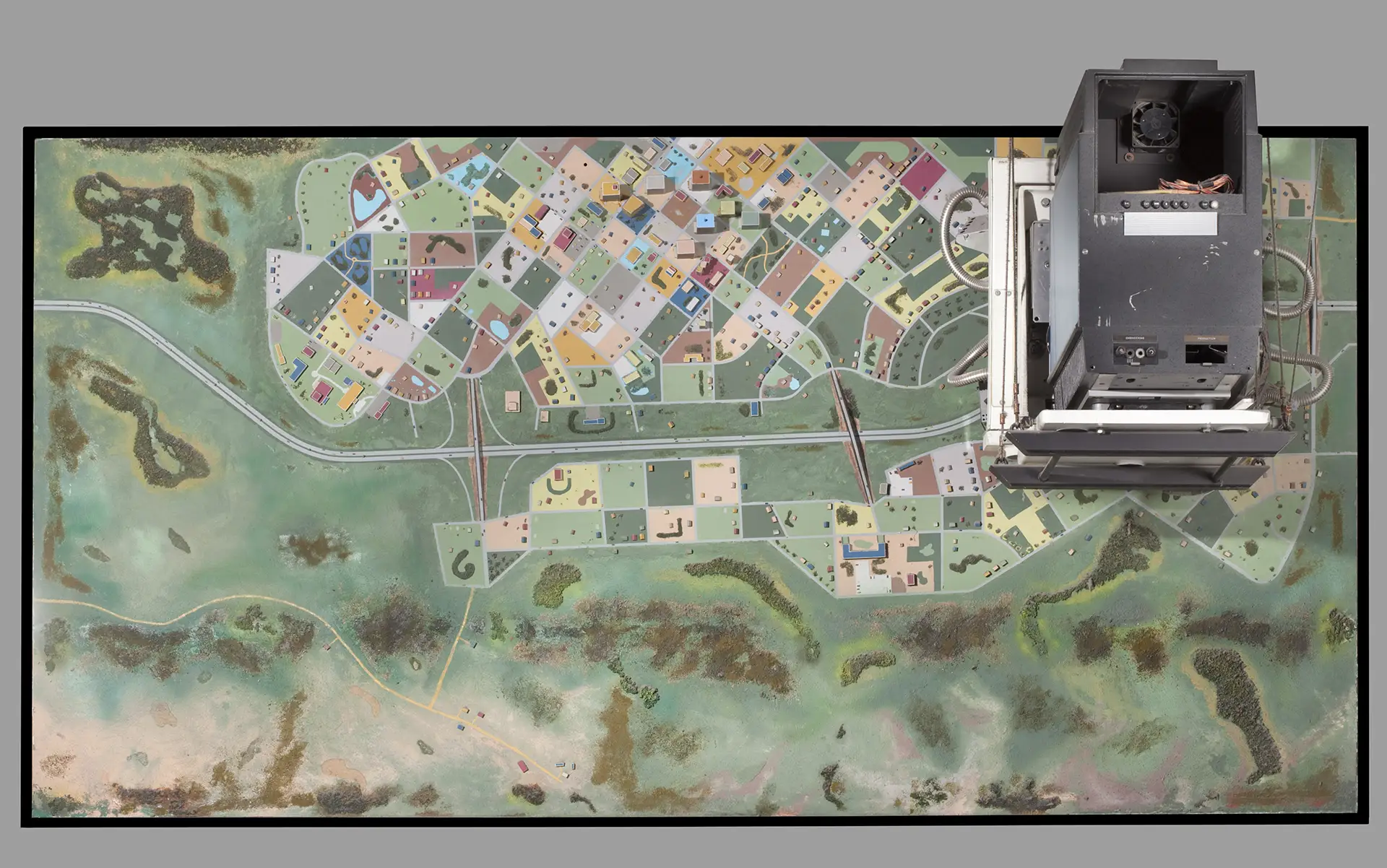
and overshoot. Other setups utilised enormous map tables, with beautifully and accurately modelled terrain, trees and buildings which a
small camera mounted on to suspended rails would ‘fly’ across. These terrains could be physically swapped around, with SECRET terrains
built for target sets beyond the iron curtain. These were not without their problems, though. As time wore on, pilots would occasionally
see chunks of plaster missing where the camera had clipped a ridge or ‘crashed’; bridges were frequently broken as pilots tried to fly
under them, church spires were knocked over and on more than one occasion pilots have turned into a valley to be presented with an enormous
spider sat in their path!
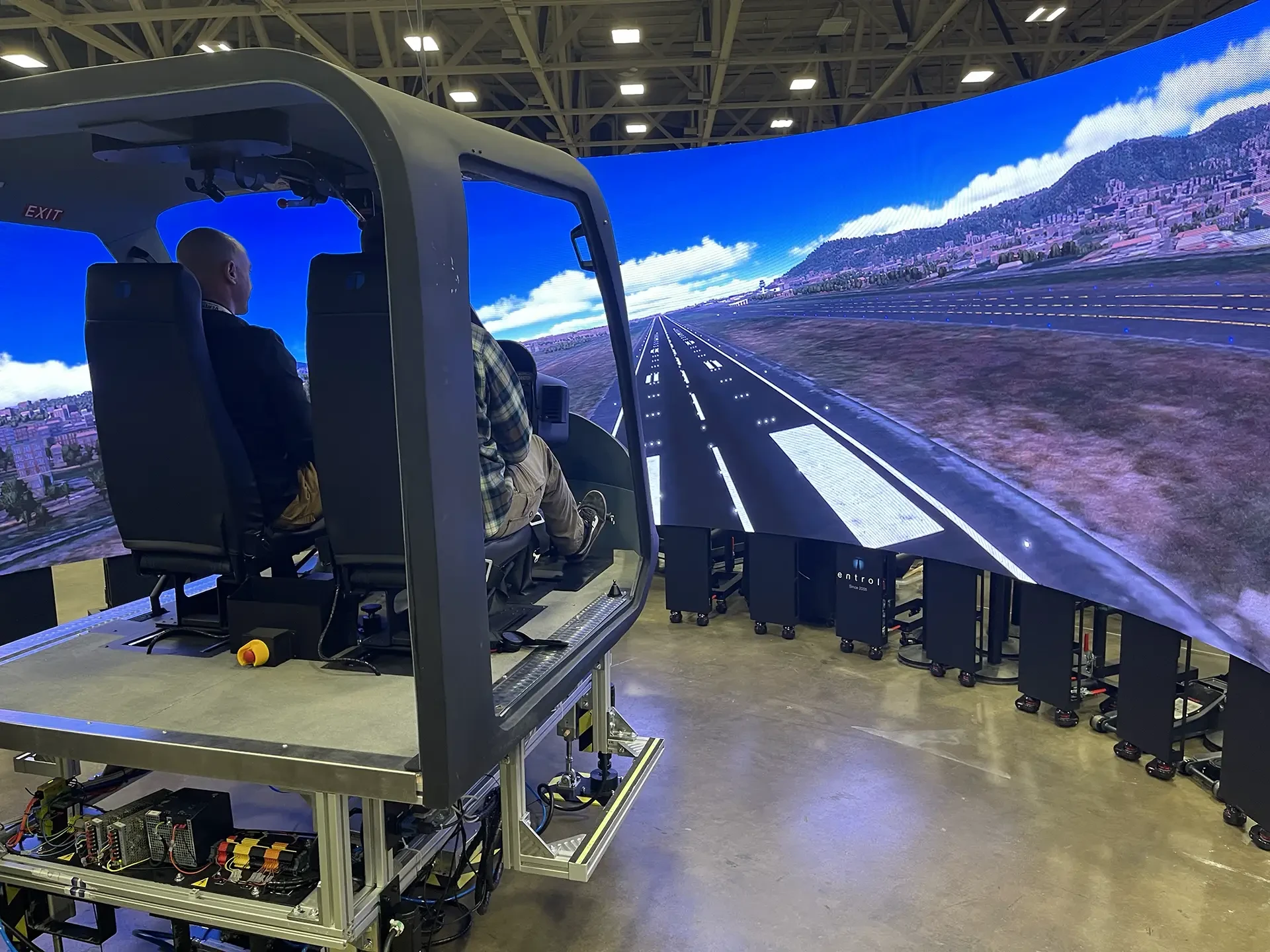
As the world moved into the era of the microchip, so graphics and motion technology moved with it. By the 1990s, simulators were utilising
projection systems with accurate and realistic visualisations of the outside world. Real-world locations were being simulated, and digital
terrain databases were being used to provide startling immersion and realism. Heavy and complex hydraulic systems had been used extensively
to provide a full 6-axis movement (the linear movements forward/backward, up/down, left/right and the rotational movements pitch, roll,
yaw.) These were now being replaced with electric actuators, allowing quicker reaction, greater precision and smoother motion, resulting in a
more realistic flight experience for pilots. The introduction of real-time physics engines to flight simulator software made it possible to
simulate more complex flight dynamics. These systems accounted for factors such as wind speed, turbulence and aircraft performance, allowing
for highly realistic simulations of various flight conditions.
Rotary Problems
One of the continuing challenges facing developers of simulators for the rotary world is the reliance on visual cueing and reference for
the maintenance of hover and close-in manoeuvring. The hovering pilot depends heavily on a blend of visual reference points to hold
position. Typically, two or three points are needed by the pilot who then uses backdrop to determine relative movement and apply a
correction to the controls. Without the benefits of full flight augmentation, the pilot constantly applies tiny movements and corrections
to maintain position and account for gusts of wind and drift. As the pilot’s experience increases, so the speed with which they scan those
reference points increases and the distance those reference points are can be reduced. Ultimately, most helicopter pilots rely on ‘the 2
o’clock daisy’, an imaginary point on the ground a few metres away near the pilot’s feet. Even today, that reference point is incredibly
difficult to replicate using computer graphics; it isn’t possible at the moment to visually represent a real-world level of detail and
texture, be those individual grains of sand, pebbles, bushes or blades of grass. The requisite movement that downwash plays on that medium
and the shadows it may cast, sufficient to give a representative and realistic experience, remains prohibitively processor-heavy, although
some come close. Similarly, the modelling of specific effects such as downwash-generated seaspray, snow or dust clouds and the disorienting
effects this can have remains a challenge for developers. Even considering the latest developments in Virtual Reality hardware - a medium
entirely suited to aviation - it is still only as good as the view.
For military pilots, the adage of ‘train as you fight’ is an important one and one which needs to be considered carefully in the synthetic
world. Modern military simulator systems provide realistic hardware - the cockpit frame, switches, instrumentation, stick top etc. The crew
usually wears their regular flying kit and helmet. The simulator, then, has to provide in terms of immersion and believability, particularly
when moving in to mission-specific areas, such as the use and wearing of night vision devices or flight display monocles.
One problem for the simulator’s out-the-window view is the side-by-side cockpit seating arrangement of larger aircraft and helicopters. This can cause parallax problems in terms of displaying a distant image to the left and right seats, when in reality the image is on a screen a few feet in front of the pilots. The problem only gets worse the further apart the seats are and the closer the projection screen. This is not such an issue in single seat aircraft where the displayed image can be fine-tuned to the pilot’s seat (the Design Eye Point.) The answer to this conundrum was solved by the British company Rediffusion in the 1980s, who developed a collimated display using curved mirrors. Whilst resolving this problem, it of course increases cost when compared to a flat screen, straight projection system or worn VR headset. A wide panoramic display requires a number of projectors - at least three, but often five or six. One of many issues with using a series of projectors as opposed to a headset or single screen is the blend line, where two projectors overlap. This causes problems not just in terms of the overlap being much brighter, but also in alignment, where the image becomes rippled or torn. This typically manifests itself on horizons, or long, straight lines like the edge of a ship or runway. Whilst not insurmountable, there is a degree of tuning, balancing and calibration which must be undertaken and regularly checked, adding to the simulator’s maintenance schedule.
At the Synthetic Training Facility at RAF Odiham, the CH-47 Chinook is replicated with two Flight Deck Devices and a separate Rear Cabin
Device, which can be synthetically linked to either FDD. The crewmen in the RCD wear their regular helmets, to which an Augmented Reality
headset is attached. The basic premise being that the workstation, cabin, centre hatch, ramp, hoist and weapons are all real, interactive
and actionable, but when looking out of the windows or off the ramp, the computer-generated image is superimposed in to the view. This
solution comes with its own problems, including weight, fragility and field of view, coupled with the fact the amount of data and refresh
rates needed to display the images to the crewmen’s headset requires a long umbilical. Whilst the cockpit has active seats which provide an
element of vibration and turn cueing, there is nothing in the RCD but the noise; that lack of motion sensation can cause disorientation and
occasionally nausea and sickness.
To move or not to move?
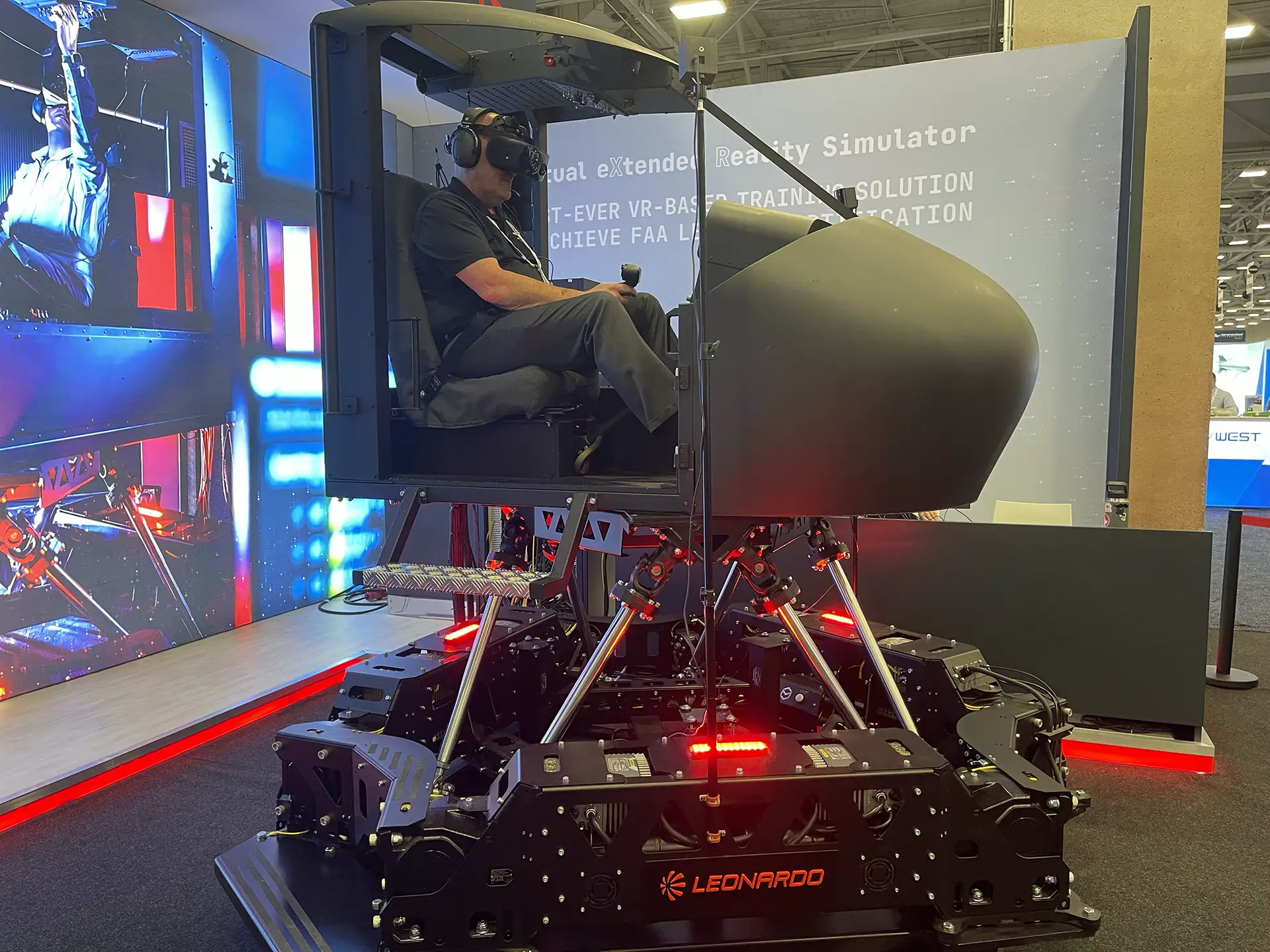
Motion cueing will be an increasingly contentious issue going forward. There is no doubt the quality of current Ultra High Definition 8K (with 16K just around the corner…) computer graphics being driven by software such as Unreal Engine can provide a level of immersion and psychosomatic illusion (the belief the body is doing something it is not) that genuinely calls into question the necessity for an expensive full 6-axis dynamic system. However, the facts remain that vestibular cues from the inner ear, along with kinaesthetic cues from the body (the ‘seat-of-the-pants’) are detected by the brain before any visual prompt. This is because the body senses the change in acceleration before any noticeable displacement out the window or on the instruments. This means corrective action can be quicker than if only visual cues are used. Captain Bryan Burks (Training Council of the International Airline Pilots Association) wrote in his paper "The Need for Motion: a Pilot’s Perspective" that simulator motion was required because the pilot’s vestibular system provided "the most powerful and quickly sensed cue for motion.” Other sources of motion cueing from what the pilot sees or hears were important but complementary. He concluded that "to leave motion out will mean that pilots will use differing, and incomplete, cues during training, and to develop the required skills we simply must recreate the flight environment as closely as possible".
What is it for?
There have been recent changes to how Full Flight Simulators and Flight Training Devices are classified. As far as ICAO is concerned, there
are now seven categories, with the highest specification being the new ‘International Type 7’, which is broadly equivalent to the old
‘level D’, with a few enhancements in areas such as visuals and communications. This, ultimately, leads to the final question: What is the
device actually going to be used for? A great deal of misunderstanding can be resolved by answering this. Unfortunately, there is a
broad-brush belief that anything with a control stick and an out-the-window view is a ‘sim’. As such, entirely reasonable shortcomings in
motion, control-loading or display can be written-off as faults with the system, as opposed to being simply a function of the design
requirement. There is a big difference between a joystick and a computer screen and a 6-axis Full Flight Simulator, both in terms of cost
and expectation. So, the requirement needs to be considered - is the device going to be used for formal training or familiarisation /
exposure? Is it for entertainment? In the helicopter world, for example, is the purpose of the device to familiarise the user with local
airfield procedures, or to learn cockpit checks? To train hovering in degraded visual environments? Or do all these objectives represent a
tiny fraction of the overall requirement? Much is made of the so-called ’80% solution’, where pursuit of the final 20% becomes
exponentially harder and more costly to achieve - is the device good enough to achieve the training objectives?
Conclusions
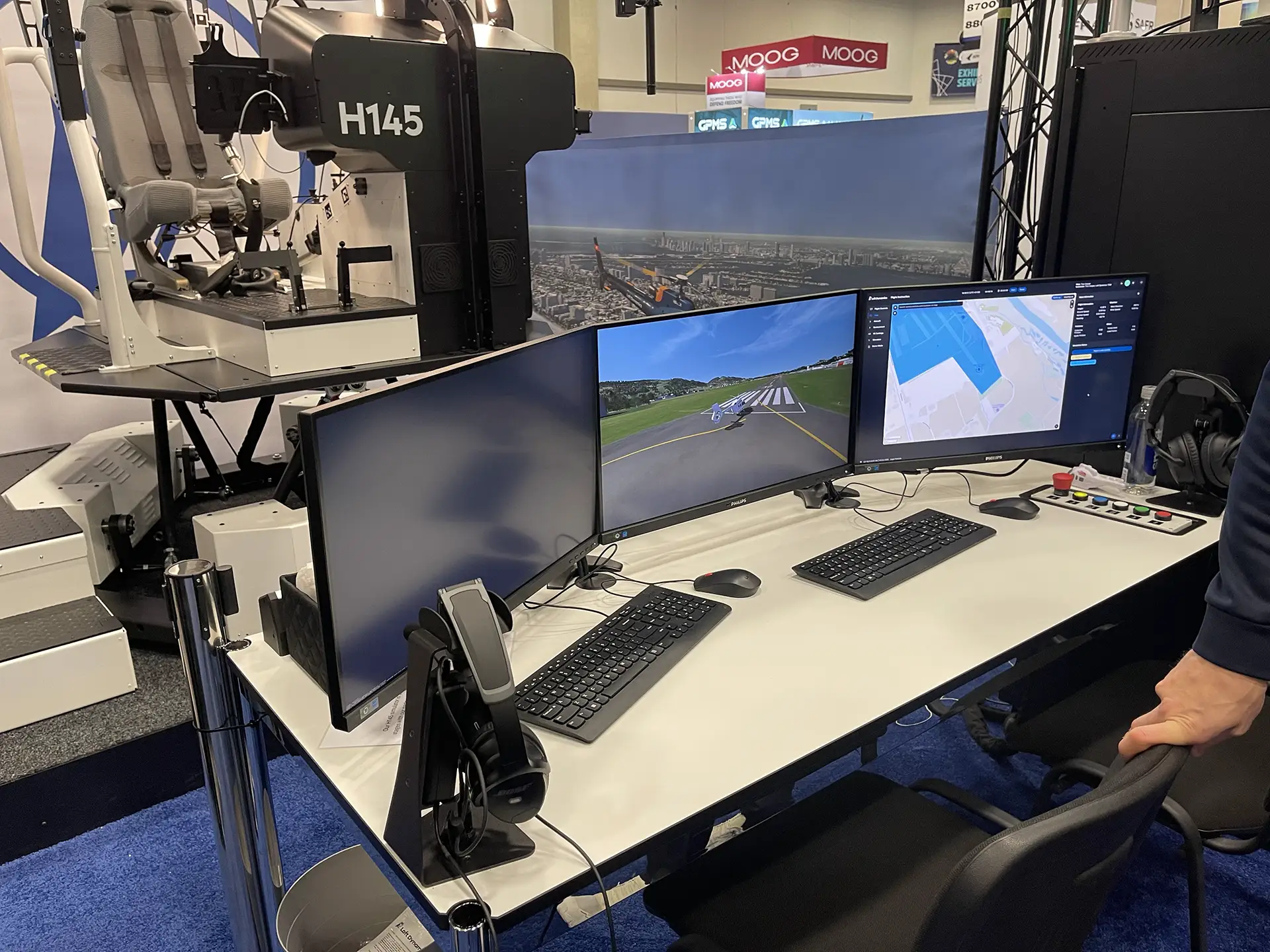
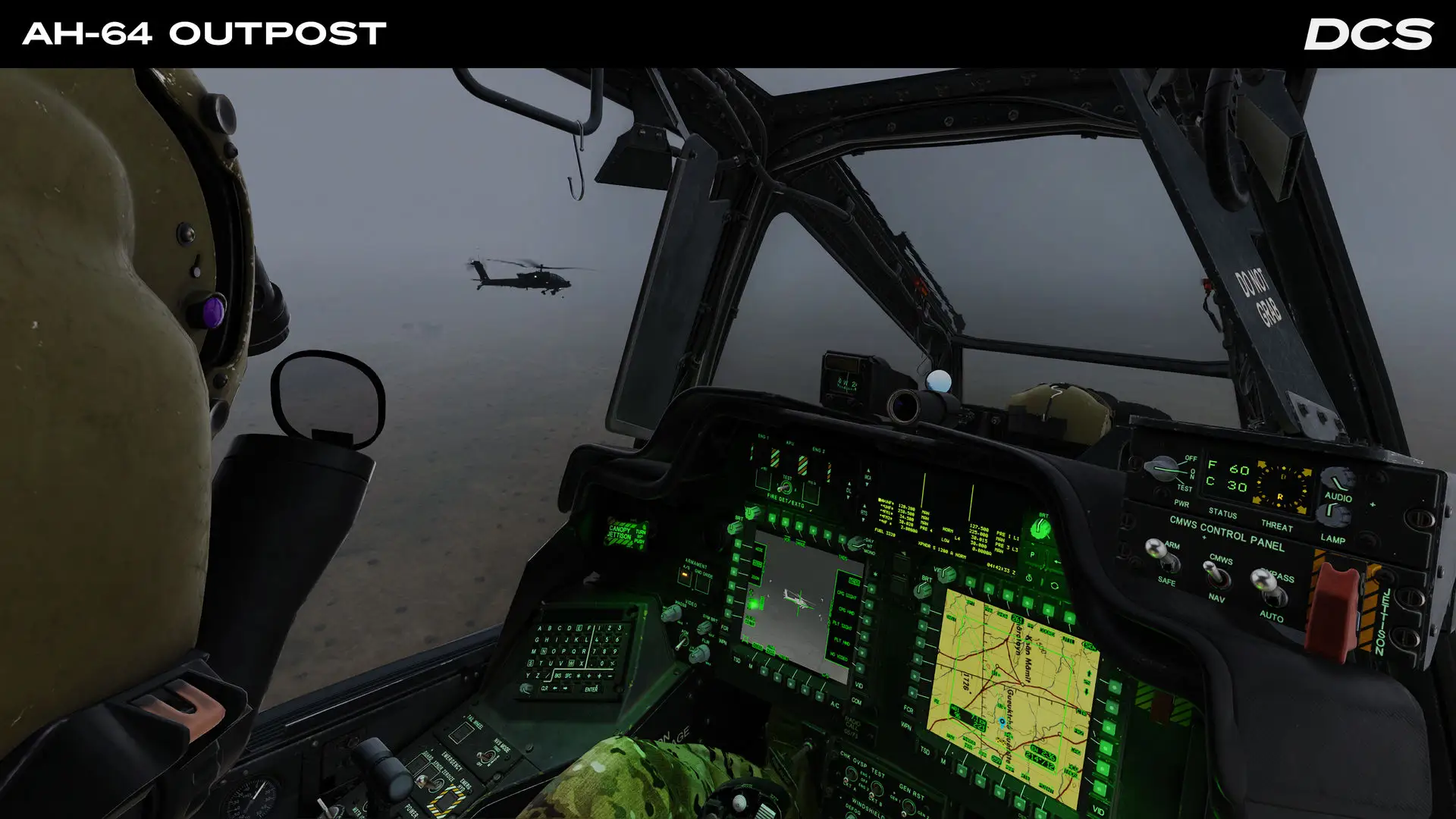
So, it may well be that consumer level, commercially available software and equipment can answer a large portion of the training
requirements specified. Sure, it is never going to be able to offer direct and accurate handling, or deal with classified training and
manoeuvres, nor be ‘qualified’ in the eyes of the regulators, but in the big scheme of things and at consumer prices (hundreds, rather than
millions…) does that matter? It is practically disposable, much like a modern-day printer. The speed with which modern software is improving
means that such solutions can be readily updated, meaning the device is always ‘fresh’ and up-to-date, which keeps enthusiasm and interest
high. That said, in 2024 CAE announced a partnership with Unreal Engine and unveiled their ‘Prodigy’ image generator, the first time that
gaming software has been used in formal simulation and has achieved ICAO level 7 fidelity. A blend of the latest in gaming technology mixed
with the best of 6-axis motion cueing is an exciting way forward but, inevitably, 'Rolls Royce solutions' come hand in glove with
'Rolls Royce costs' and this may be a barrier to entry for smaller businesses and an ever-increasingly financially limited Defence
department.
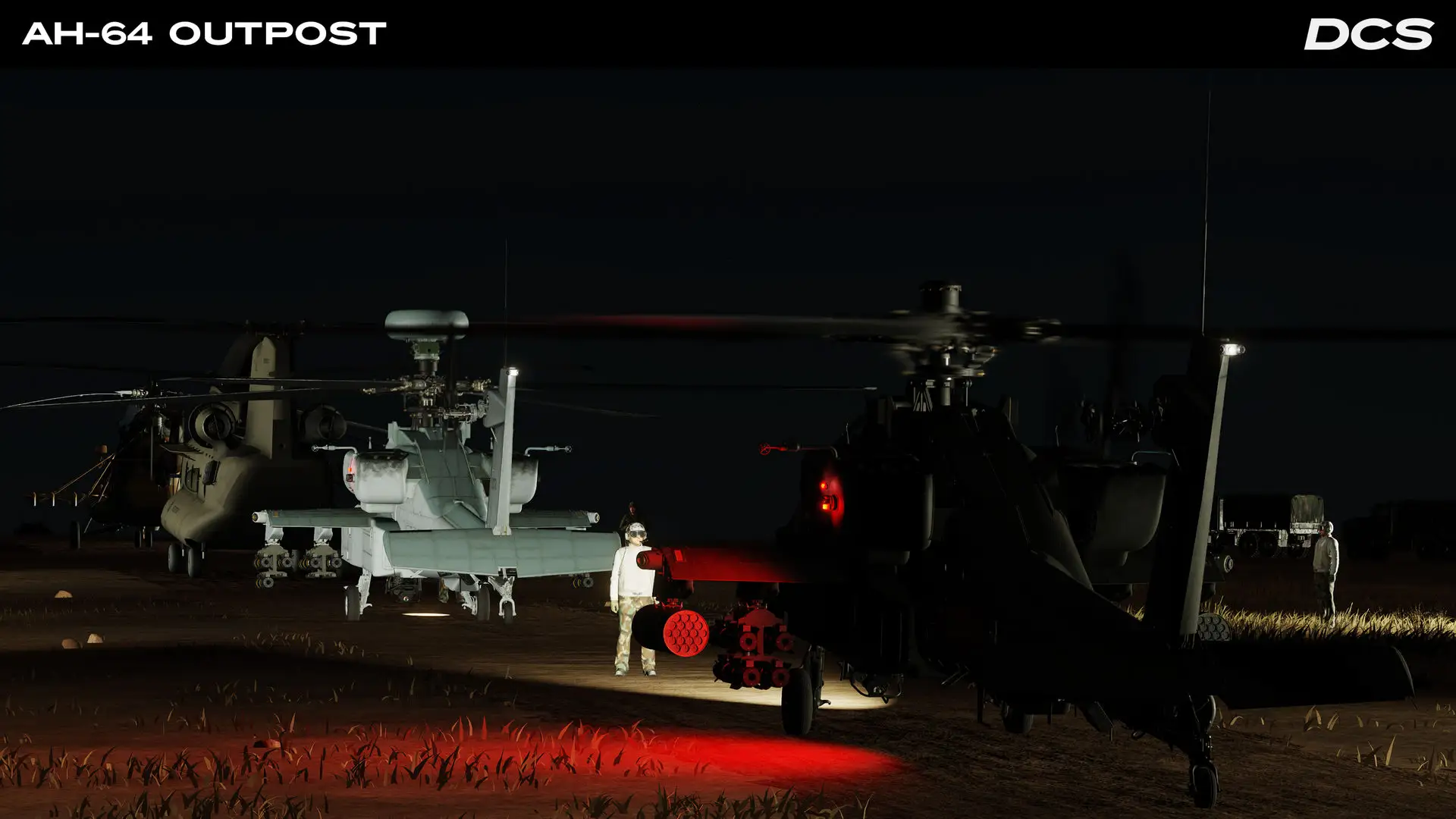
As the wider costs of real world, live, flying spirals and formal synthetic training on established simulators becomes ever more in
demand, is there now a third way? In the same way Full Flight Simulators took some of the cost and risk out of training on live aircraft,
could cheap, off-the-shelf ‘stick and throttle’ solutions ease the burden on the Full Flight Simulator and the Flight Training Device? As
Captain Burks pointed out, motion cueing is an essential part of the Full Flight Simulator experience and should not be left out, but could
there be a place for cheaper and simpler systems, especially where the gap in the quality of immersion has been so significantly narrowed?
Relatively cheap hardware, open architecture, cloud-based servers and fibre optic, high speed internet means that day-to-day peace-time
flying for both military squadrons and private enterprises alike could operate in real time but virtually, just like they do in the real
world. Just as Edwin Link’s first devices were initially seen as a form of fairground entertainment, perhaps things have gone full circle.