 HOME
HOME





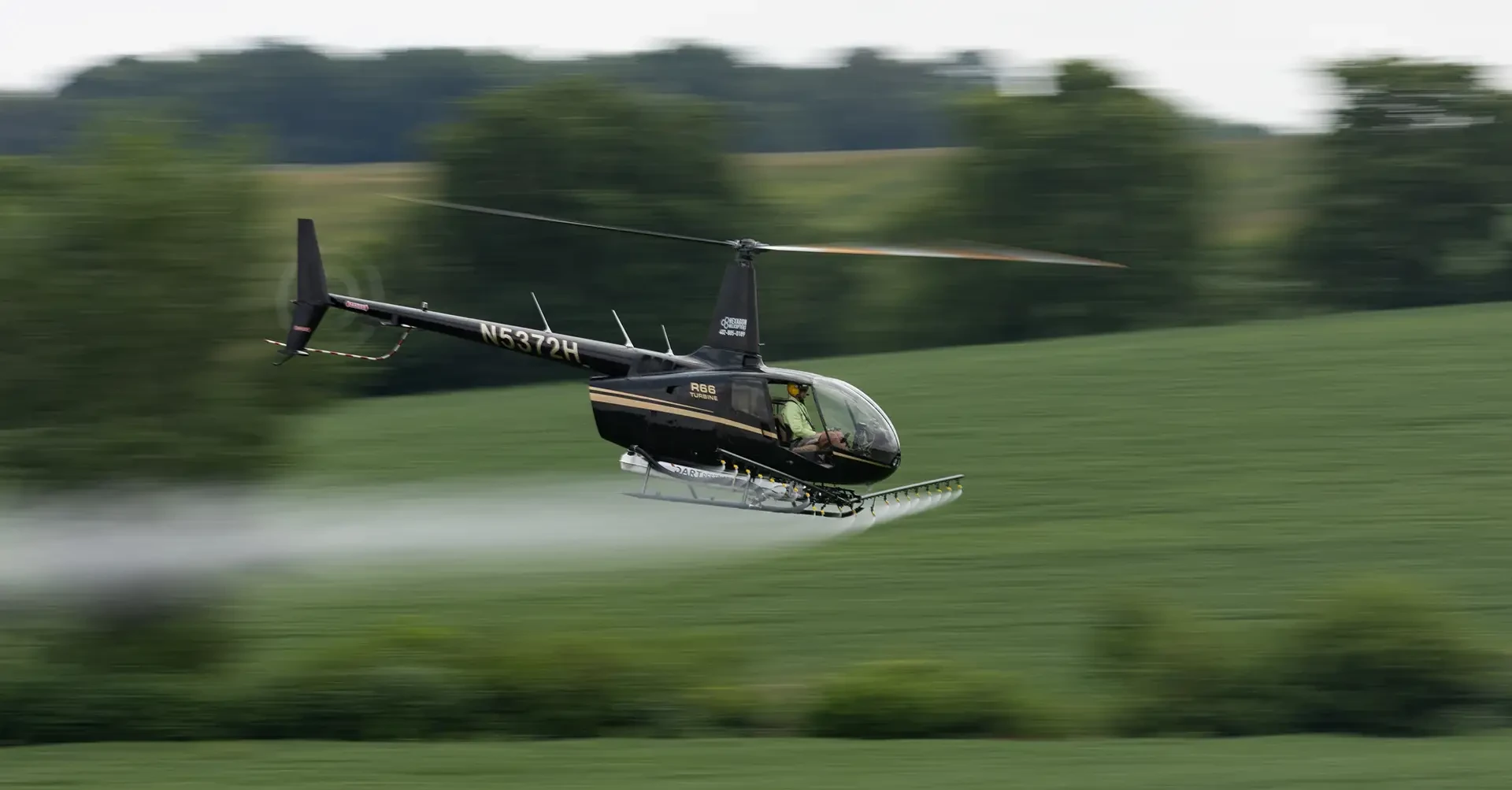
By mid-July in eastern Nebraska, there’s no easing into the day. The sun comes up early, the humidity is already there, and by 5:30 a.m., the trucks are rolling. Fuel, water, chemical totes, maps, coolers; everything that will make or break the next twelve hours has already been staged. By the time the first helicopter lifts, there’s no room left for improvisation.
For Brent Wulf, this part of the season, from July through early August, known as the corn run, is the primary reason Hexagon exists. “This is it,” Wulf says. “That month is the season.”
Hexagon is based in Valley, Nebraska, just west of Omaha, but during the corn run, its footprint stretches across a dense patchwork of
Midwest agriculture. Most of the work sits within an hour of home. That proximity matters. It allows crews to sleep in their own beds most
nights, and it keeps ferry time to a minimum when the pressure is highest.
Wulf didn’t inherit the operation. He built it deliberately, one aircraft and one decision at a time, shaping Hexagon around the realities
of helicopter agricultural flying rather than chasing scale for its own sake.
Today, the company operates a small but focused fleet: one Robinson R44 and two R66s, supported by a growing load truck operation and a tightly controlled set of procedures that reflect years spent learning what holds up when the days get long, and the margins get thin. That operational mindset didn’t come from theory or business planning; it came from years spent on both sides of agricultural aviation, learning where things break first.
From Airplanes to Helicopters, and Then on His Own
Wulf’s path into helicopter ag work wasn’t linear. He started in agricultural aviation in the early 2000s, flying airplanes before
transitioning into helicopters with an operator who was also a helicopter instructor. “I started as a load driver,” he says. “I
just kept bugging the guy. Eventually, I talked him into helping me get my license.”
“Around 2016, I wanted to do my own thing,” he says. “But I wanted to do it right.”
Hexagon officially launched in 2018, after two years of lining up equipment, certification, and financing. The first aircraft was a Robinson R44 sourced from Alaska and brought south over the winter. That spring, Wulf completed the Part 137 process and went to work. The choice of the R44 was pragmatic. A smaller piston helicopter fit the scale of the operation he was building and allowed flexibility for other mission profiles beyond spraying. “We were too small for anything bigger,” he says. “And there were some other things we wanted to do with it.”
From the start, Hexagon wasn’t competing head-to-head with entrenched helicopter operators. In much of eastern Nebraska, helicopter
spraying was still relatively new. The real shift came when new corn fungicide products hit the market, and demand surged. “Most of the
work we do now used to be done by airplanes,” Wulf explains. “Some of it never got sprayed at all.”
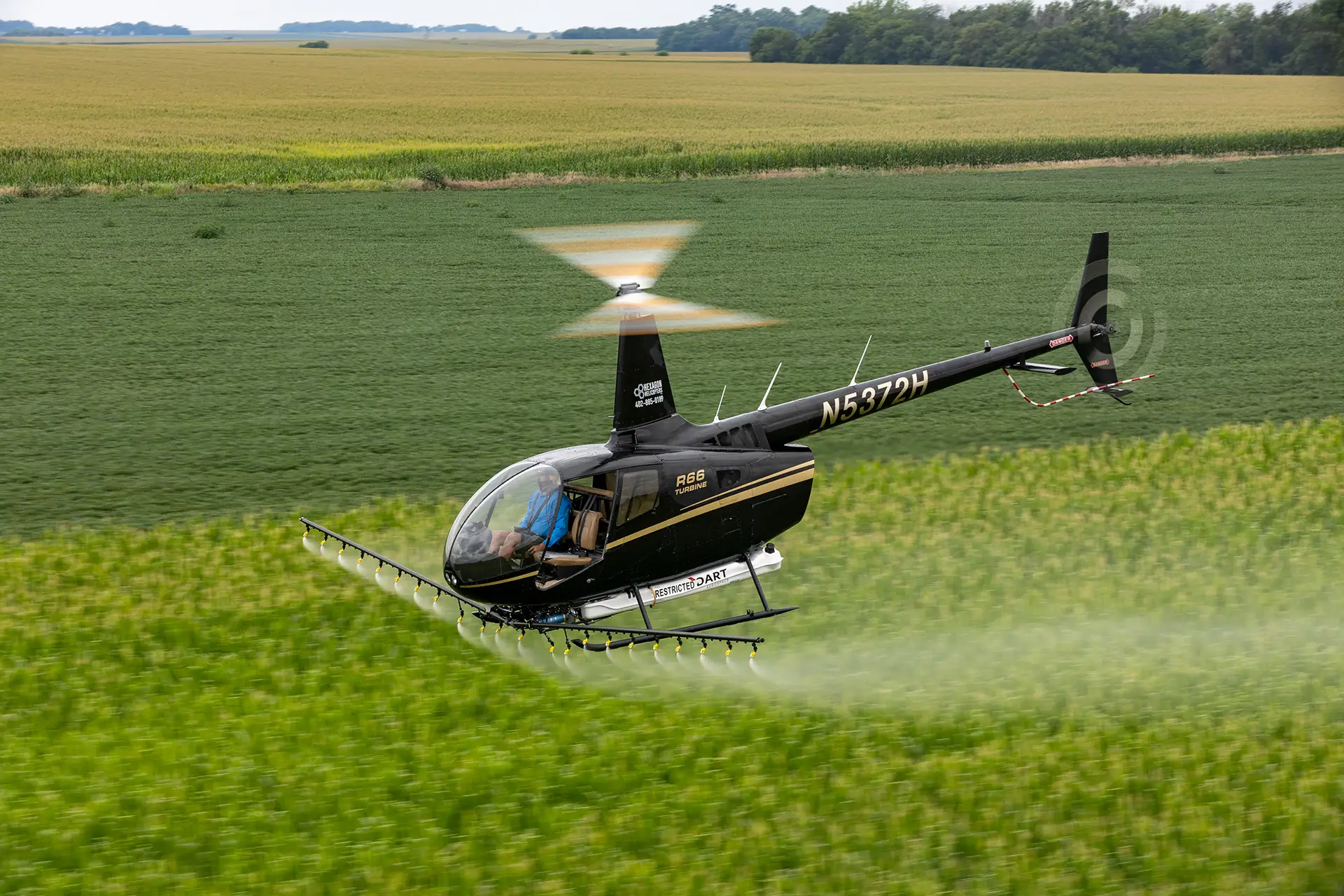
That distinction matters; helicopters didn’t just take market share, they unlocked acreage that fixed-wing aircraft struggled to reach efficiently, particularly tight pivots and irregular fields where higher precision matters. As demand shifted and helicopter work became more common, aircraft choice became operationally decisive.
Why Robinson, and Why It Stayed That Way
Wulf had experience in legacy aircraft early in his career: OH-58s, Hillers, and older platforms that once dominated agricultural helicopter work. By the time Hexagon launched, he’d experienced enough to want to steer away from them.
“Parts were getting harder to find,” he says. “Maintenance was always an issue. From the pilot’s perspective, operators were
constantly fighting that.”
The Robinson path was about availability, support, and predictability.
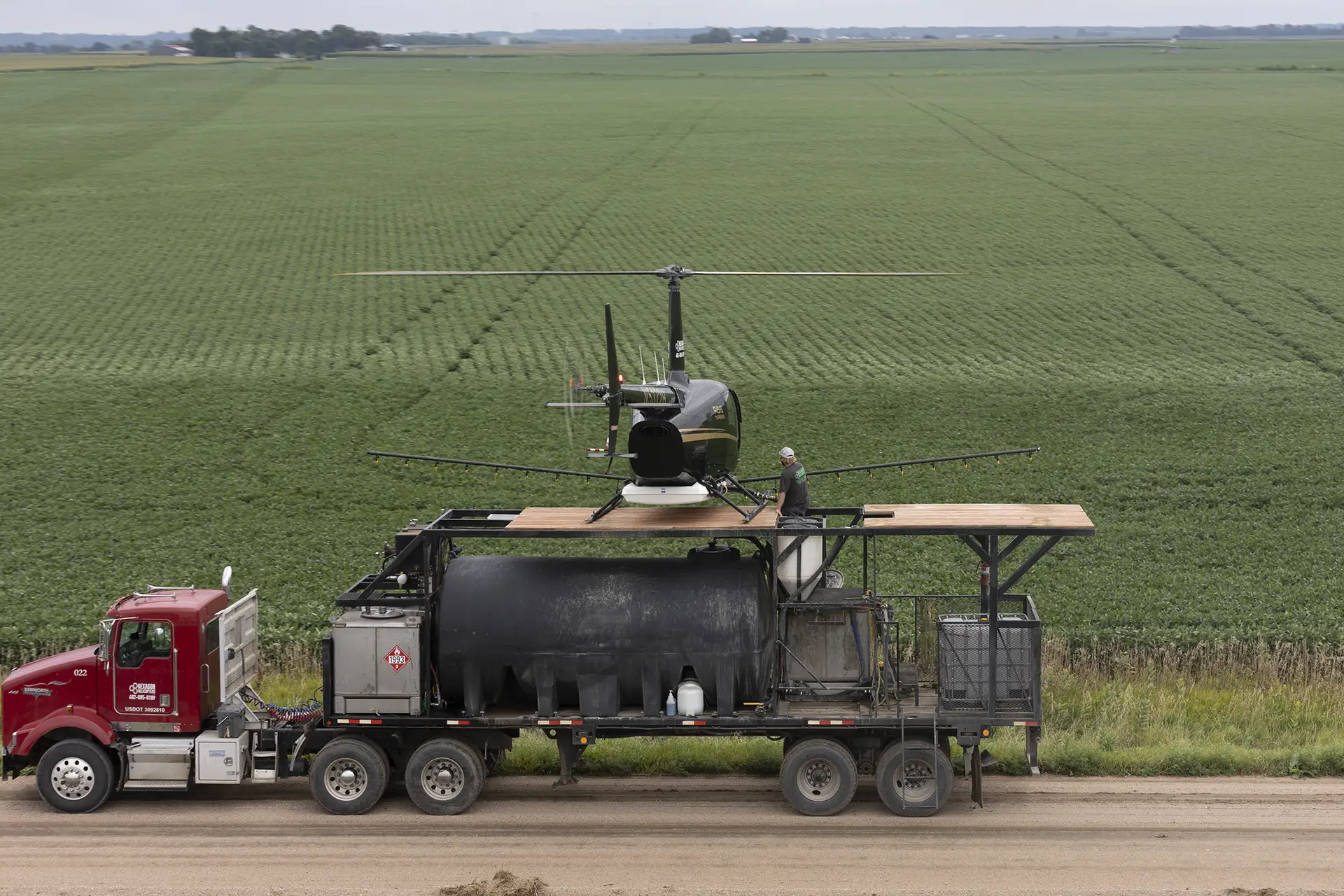
The R44 carried Hexagon through its early years, but as the operation matured, its limitations became clearer. Most of the mechanical issues
Wulf encountered were piston-engine related: sticky valves, magneto problems, many of them learning-curve mistakes that were addressed
through refinement in maintenance techniques and planning of parts logistics. Eventually, growth forced the next decision. “We knew we
needed bigger aircraft,”
he says. “And we wanted to get away from some of those piston issues.”
The move to the turbine-powered R66s happened about four years ago, and today the two aircraft form the backbone of the spraying operation.
The R44 remains in service for lighter-duty work and cost-sensitive missions, but the long-term vision is clear. “In some ways, it
makes sense if we went with all R66s,” Wulf says. “Things like spare parts, aircraft familiarization, and everything get simpler. But in reality, we still need the R44.”
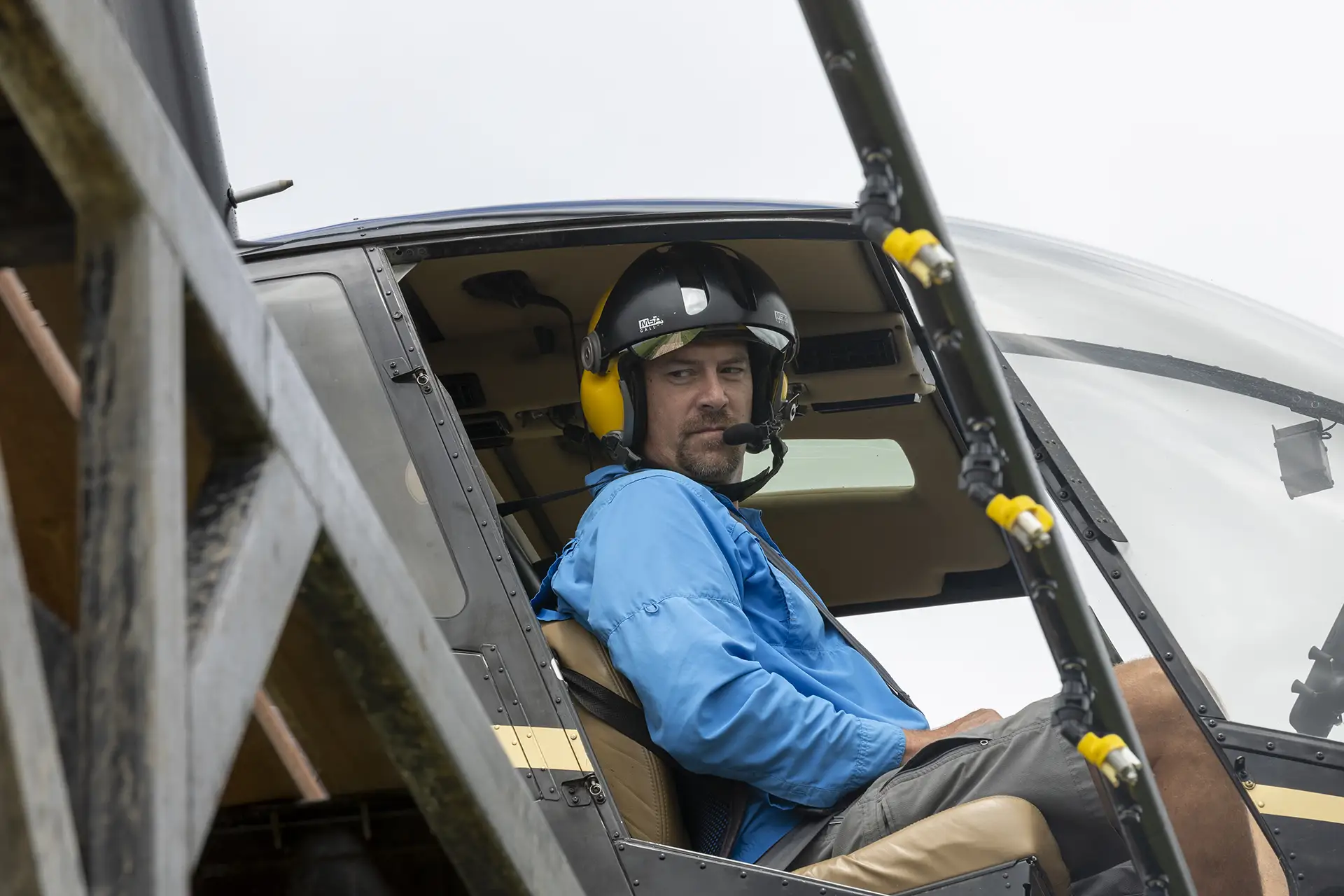
Still, there’s restraint baked into the plan. Larger aircraft, AStars, and similar don’t pencil out for a five-week peak season in this market. Insurance costs rise, mistakes get more expensive, and utilization outside the corn run doesn’t justify the step up. “You have to be honest about what the operation actually needs,” Wulf says. That same honesty carries into how the year is structured, because for Hexagon, aircraft decisions only make sense in the context of when and how the machines are used.
The Rhythm of the Year
Hexagon’s calendar is defined by agriculture, not the other way around. The year typically starts in March with wildlife survey work, which can run into early May. Around the same time, crews head south into Kansas and Oklahoma for pasture spraying, a spring operation that carries through June. By mid-June, everything slows briefly. “That’s when we catch up on maintenance, inspections, and let people breathe a little,” Wulf says.
Then the corn run arrives.
From roughly July 4 through mid-August, the helicopters fly hard, often around 250 hours per aircraft in a single month. During this time, the two R66s will spray 35,000 to 40,000 acres each, and the R44 will fly around 30,000 acres. In the most demanding stretches, crews may work more than 30 days in a row, weather permitting. “That’s dawn till dark,” Wulf says. “That’s just the reality.”
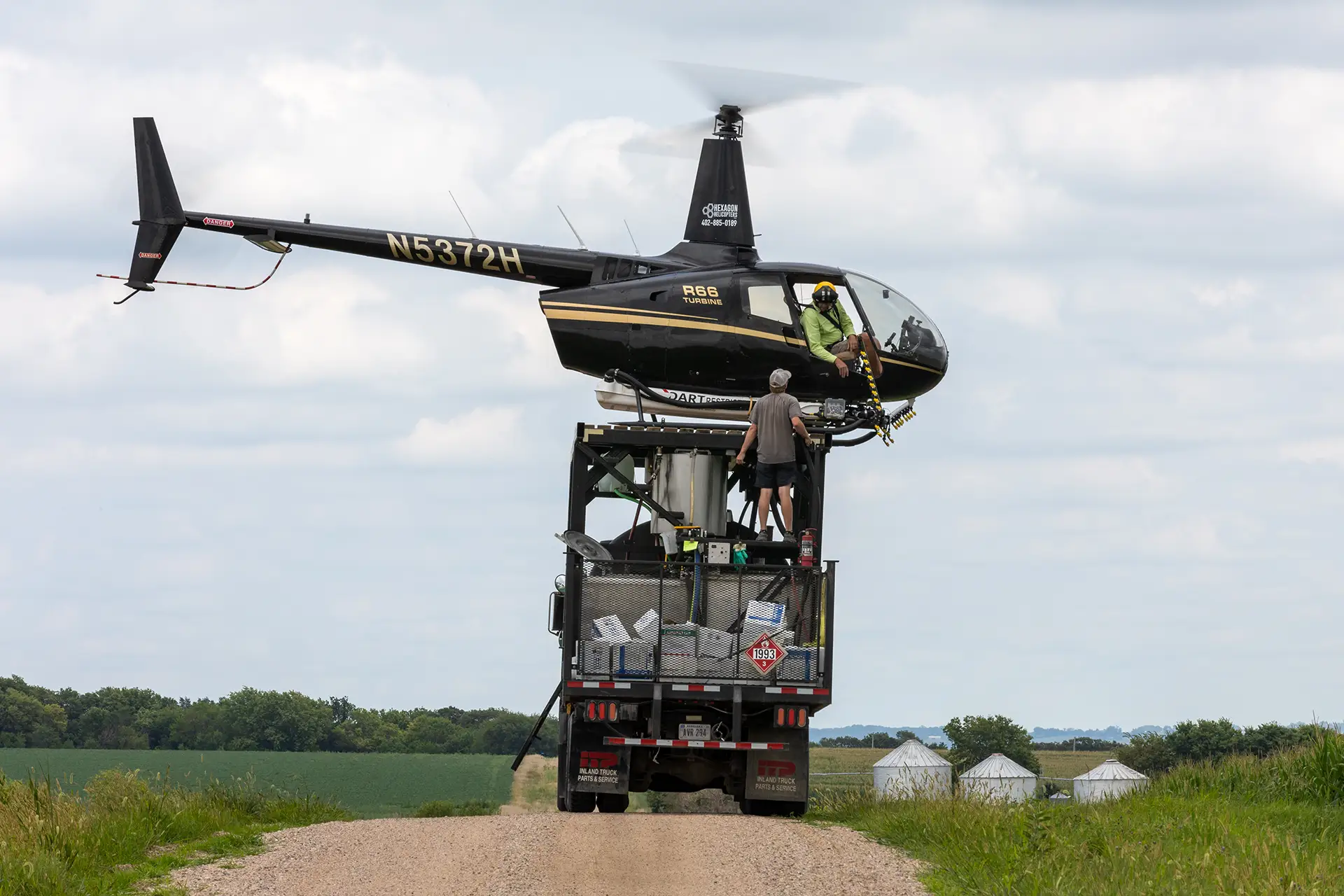
After fungicide spraying winds down, Hexagon transitions into cover-crop work using a spreader bucket, usually one machine at a time, depending on demand and market conditions. Some years, that work runs into late September. Other years, tighter farm budgets shorten the season.
The operation flexes, but it never forgets which season pays most of the bills. During that peak window, nearly every decision revolves around one mission: applying fungicides accurately, efficiently, and inside a narrow biological and weather-driven window.
Inside the Corn Run: What’s Actually Being Sprayed—and Why
During the corn run, Hexagon’s helicopters are primarily applying fungicides to maximize field corn crop yields (corn grown for livestock feed and ethanol production), not the sweet corn found in grocery stores.
What those fungicides are not doing is just as important as what they are. “We’re not spraying the kernels,” Wulf explains. “We’re protecting the leaves.”
The common diseases Hexagon treats, southern rust, tar spot, and other fungal pathogens, attack the leaf surface of the corn plant. When those leaves break down, the plant loses its ability to convert sunlight into energy, starving the kernels during a critical growth phase. “The leaf is what feeds the ear,” Wulf says. “If you lose the leaves, you lose yield.”
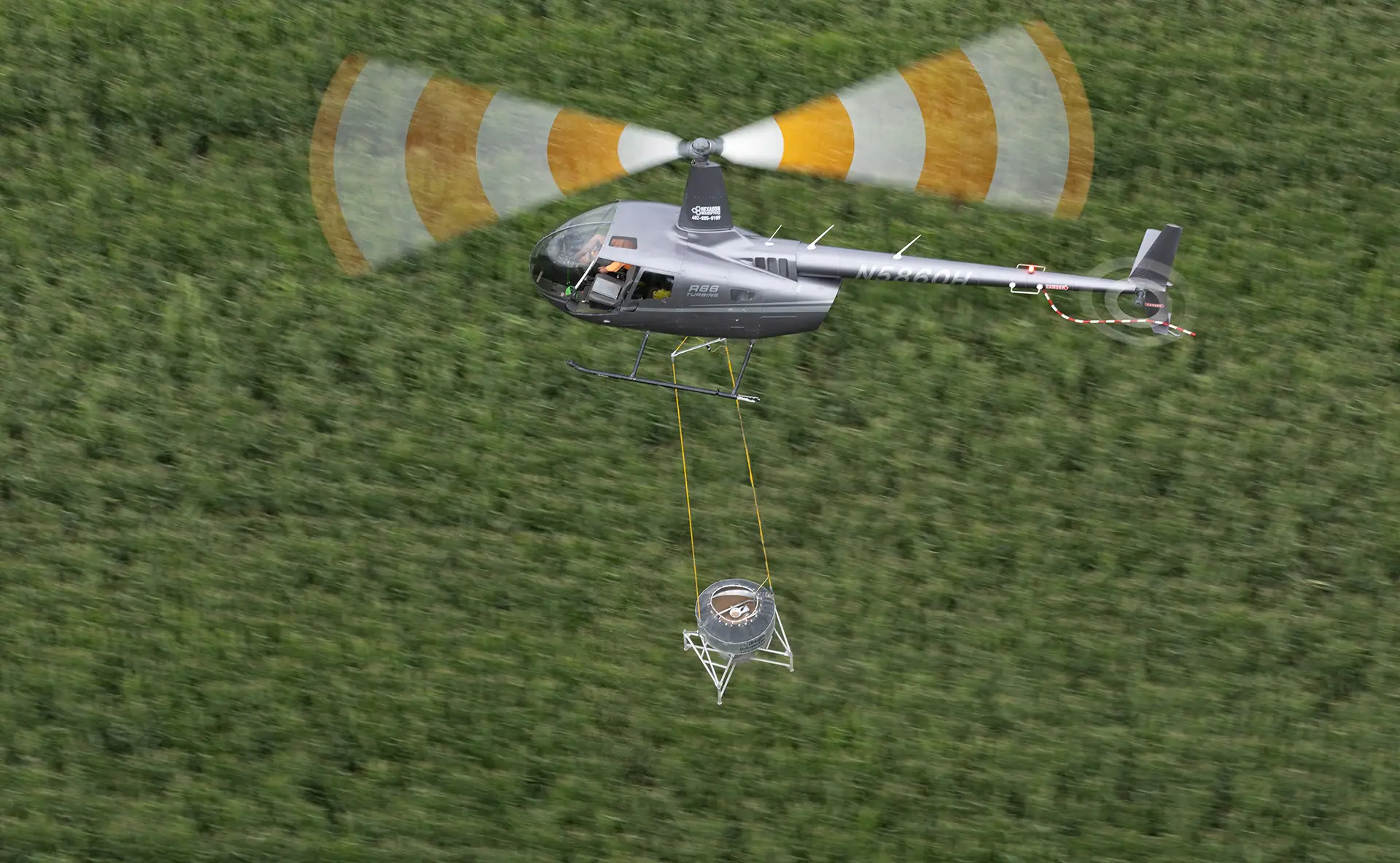
By preserving leaf health, fungicides allow the plant to continue photosynthesis longer, translating directly into additional bushels per acre. In wet, moderate-temperature summers (ideal conditions for fungal growth), the difference between sprayed and unsprayed fields can be dramatic. “In a year like this one, guys were seeing up to 70 bushels per acre difference,” Wulf says.
That math matters. A fungicide application might cost $30 to $40 per acre once chemical and application are combined. If the treatment only adds five extra bushels, it doesn’t pencil out. But when disease pressure is high, the return can be several times the investment. “That’s when it becomes a no-brainer,” Wulf says.
Most acres receive a single fungicide application, typically timed around mid-to-late July when the crop reaches a critical growth stage. In recent years, however, some farmers have begun experimenting with multiple applications, especially in seasons with prolonged moisture. “Some guys will have us spray once around July 20, then come back the first week of August,” Wulf says. “In a year like this, that really worked well.”
The products themselves vary. Name-brand fungicides such as Trivapro and Delaro Complete are common, alongside generic equivalents. Depending on field conditions and agronomic goals, applications may also include insecticides, micronutrients like boron or manganese, or supplemental nitrogen products, but those decisions aren’t made in the cockpit.
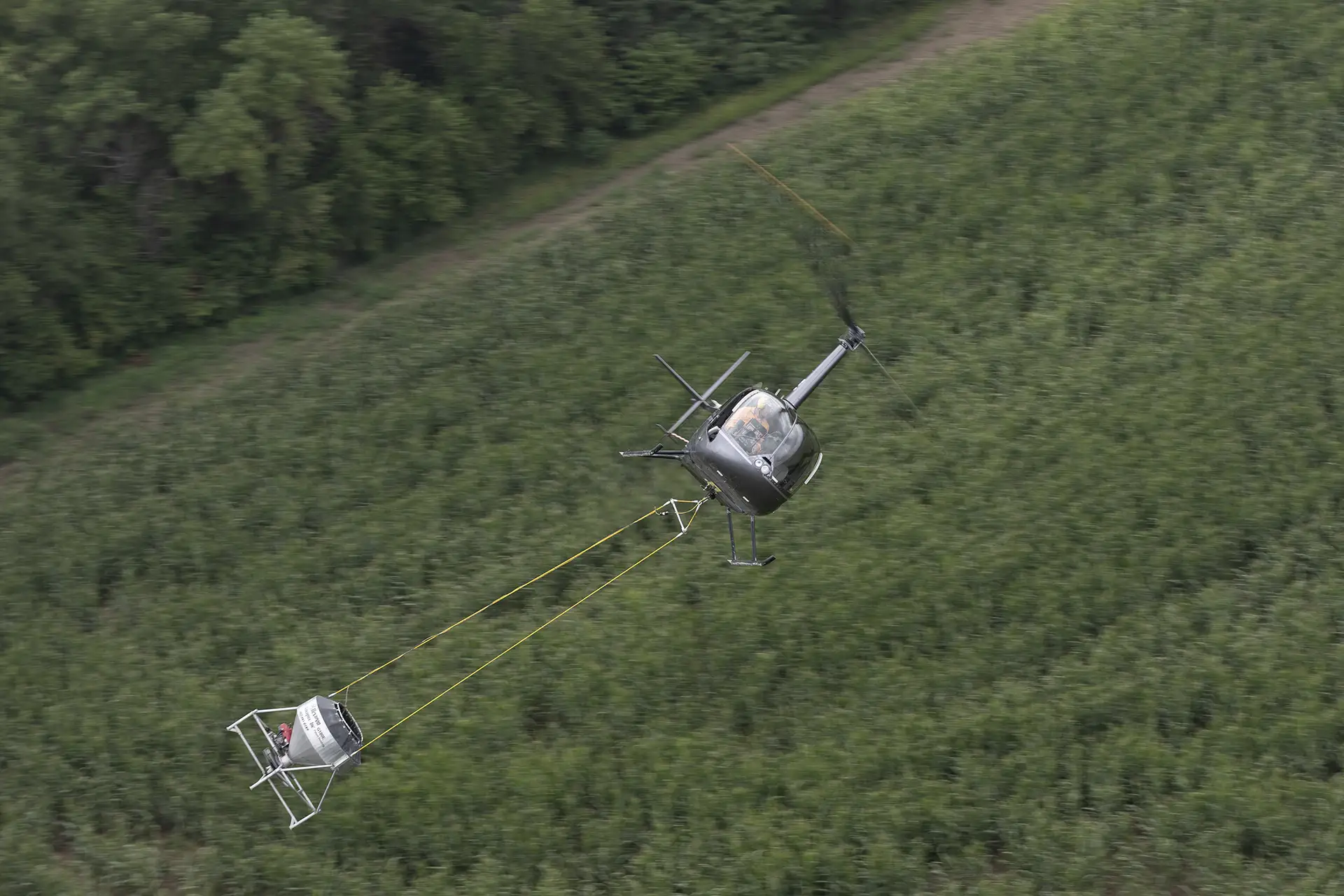
Hexagon works closely with agricultural retailers and agronomists who determine product selection, rates, and timing. Orders arrive digitally, fully specified, including chemical mix, flow rates, acreage, and priority, allowing Hexagon to focus on execution rather than sales. “If we tried to do all that ourselves, we’d need a whole sales department,” Wulf says.
For the helicopter crews, the mission is precision and consistency. Height, droplet size, nozzle angle, and wind limits all influence whether the fungicide does what it’s supposed to do. “You can’t just throw it out there,” Wulf says. “Everything has to line up.” Making that alignment happen in the air starts with discipline on the ground, long before the first rotor turns.
Staging the Day Before It Starts
The real work of a spray day often happens the afternoon before. By then, Wulf is already looking ahead, checking progress, weather forecasts, and incoming orders. Fields are grouped geographically to minimize travel. Maps are printed. Chemicals are staged outside the hangar, sorted by truck and load sequence.
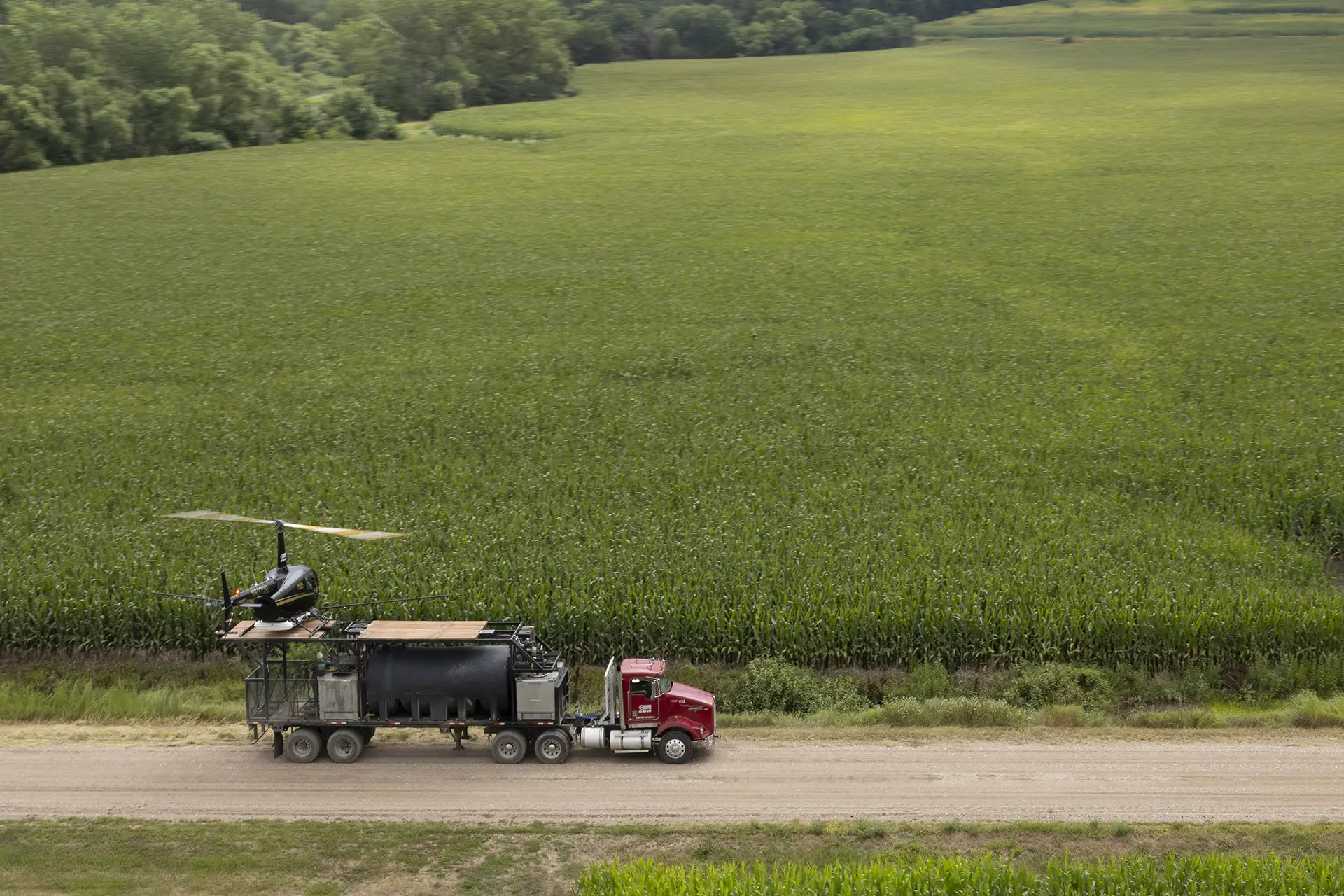
Load trucks cycle in at the end of the day to offload leftovers and prepare for morning. Fuel tanks are topped off. Water tanks are filled. Coolers are stocked with ice and drinks. Everything is ready for the next morning. By the time crews arrive at 0530, there should be nothing left to decide. “They start the trucks and helicopters, and go,” Wulf says.
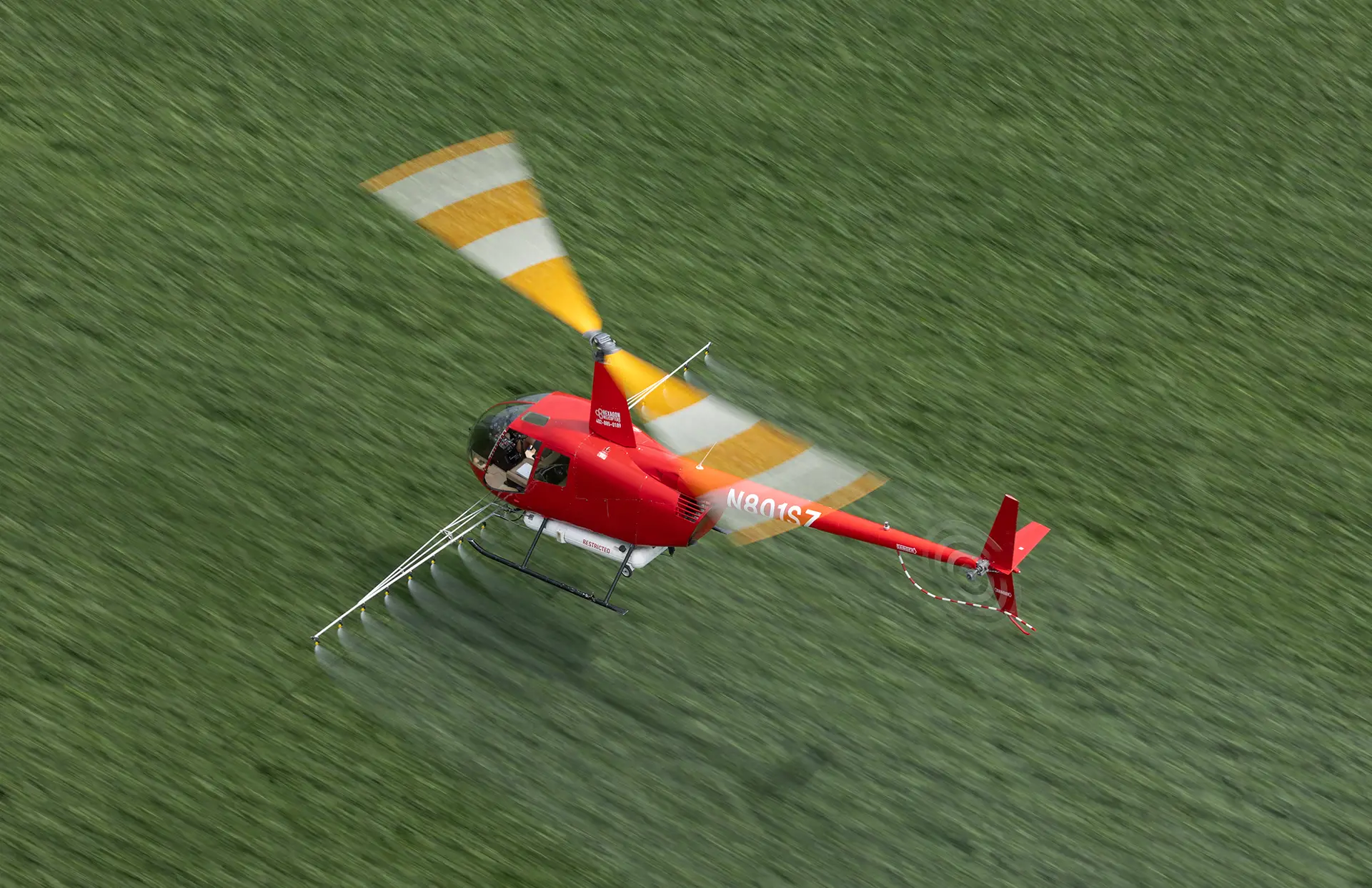
Each helicopter is paired with a dedicated load truck, though additional trucks can leapfrog ahead when work is tightly clustered. The goal is always the same: keep the aircraft spraying and eliminate idle time without creating confusion. “You can make it more efficient,” Wulf says. “But it gets harder to manage. You have to know when simple is better.” That philosophy extends beyond logistics and into how Hexagon approaches safety, routine, and human factors on the loading line.
Discipline on the Ground: Where Most Mistakes Start
In agricultural helicopter work, mistakes rarely begin in the air. At Hexagon, Wulf is blunt about that reality. Loading routines, ground discipline, and human factors receive as much attention as aircraft performance or spray technique because that’s where complacency creeps in first. “Most of the problems you hear about don’t start with flying,” he says. “They start on the ground.”
Each aircraft is paired with a load truck and a loader who follows a standardized routine. The system is intentionally repetitive. If the fill hose is connected, the loader’s hand stays on it. When it’s disconnected, it goes immediately onto a visible rack that is mounted where the pilot can see it without leaning or twisting in the cockpit. That visibility matters, “We mounted the coupler point even with the pilot,” Wulf explains. “You can glance out and know, instantly, whether you’re clear.”
As an added safeguard, Hexagon runs breakaway couplers designed to fail at a controlled weak point if a pilot ever does attempt a takeoff with the hose still attached. The concept isn’t theoretical either; Wulf first built a crude version years earlier at another operation and carried the idea forward when he started Hexagon. “If it snaps where it’s supposed to snap, you’re back up and running in an hour,” he says. “That’s a lot better than tearing up a skid or worse.”
This system isn’t there to excuse mistakes; it’s there to buy a margin when humans inevitably have an off moment during a 30-day sprint of long, hot days. “If it gets to that point, yeah, it’s the pilot’s fault,” Wulf says. “But we try not to let it get there.” The same preference for simple, repeatable systems carries into the equipment bolted to the aircraft.
Spray Gear, Droplets, and Why Details Matter
The spray systems on Hexagon’s helicopters reflect the same philosophy: simple, adjustable, and well understood.
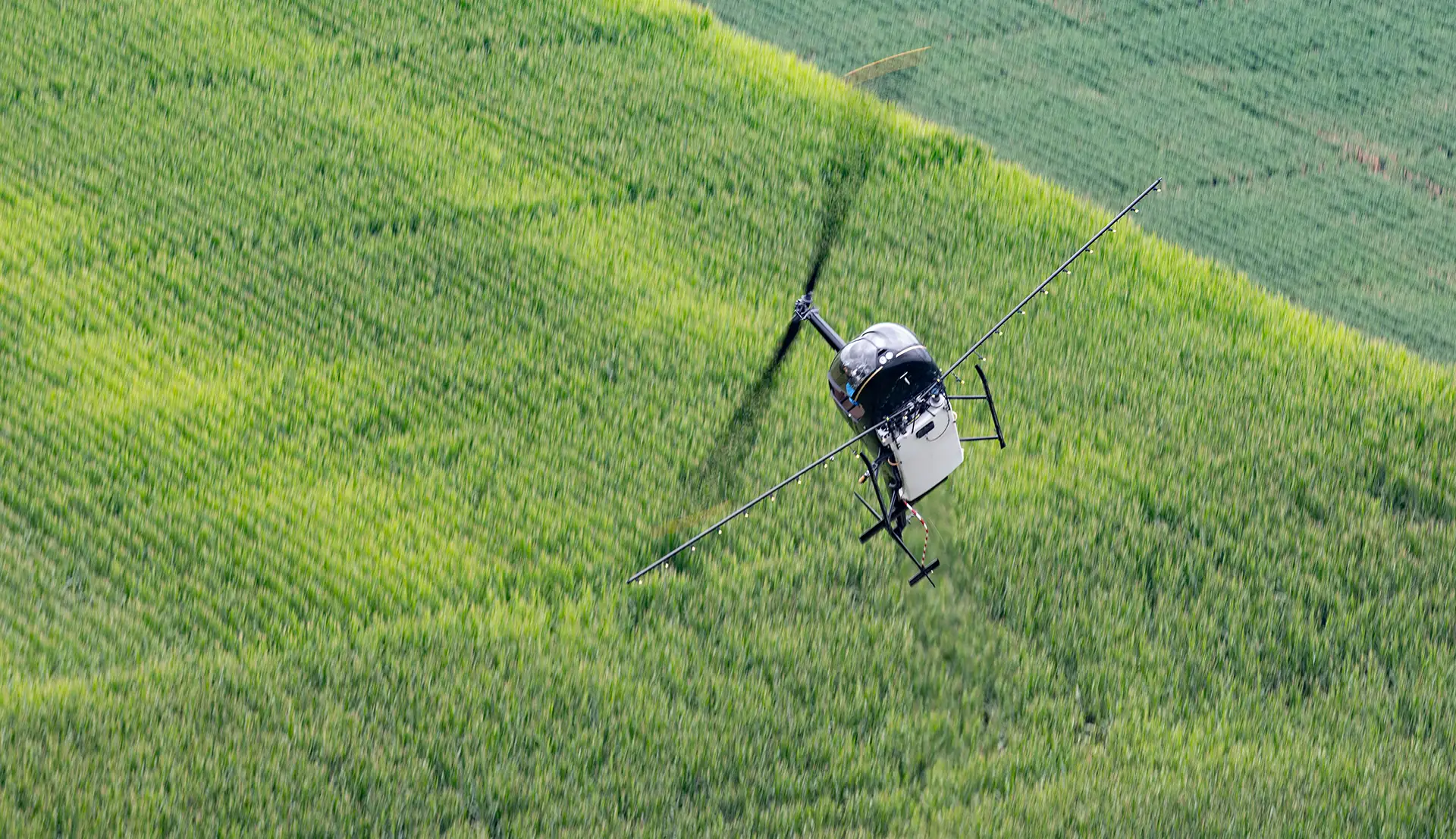
The R66s are fitted with Dart tanks and spray booms; the R44 uses a Simplex tank and booms. All setups utilize Transland CP-11 nozzles: flat fan, carousel-style units that allow pilots to select different orifice sizes without swapping hardware. That flexibility matters when application rates vary from two gallons per acre up to four or five, depending on product and agronomic goals. “You don’t want to be changing nozzles in the middle of the season,” Wulf says. “You want to adjust and go.”
Beyond flow rate, nozzle angle becomes a primary tool for droplet control. Pointed straight back, the nozzles produce larger droplets with minimal shear, reducing drift but narrowing swath width. Tilted downward, airflow breaks the spray into finer droplets, improving coverage where fungicides benefit from smaller particle sizes. “There’s a lot more to it than just dumping product,” Wulf says. “All those little adjustments add up.”
The target height for spraying typically sits between eight and ten feet above the crops, not because lower is always better, but because it allows the spray pattern to develop and even out before reaching the crop canopy. “It’s counterintuitive to some people,” he says. “Lower isn’t always better.” Precision at that height depends not just on hardware, but on how pilots use technology without letting it take over the cockpit.
Technology Without Tunnel Vision
To provide the application maps for the pilots, Hexagon runs AG Pilot X guidance systems, built around an iPad-based application paired with
a dedicated hub, GPS antenna, and light bar mounted near the pilot’s natural line of sight. This placement is intentional. “You should
be looking outside 95 percent of the time,” Wulf states. “The light bar is there to verify what you already feel.”
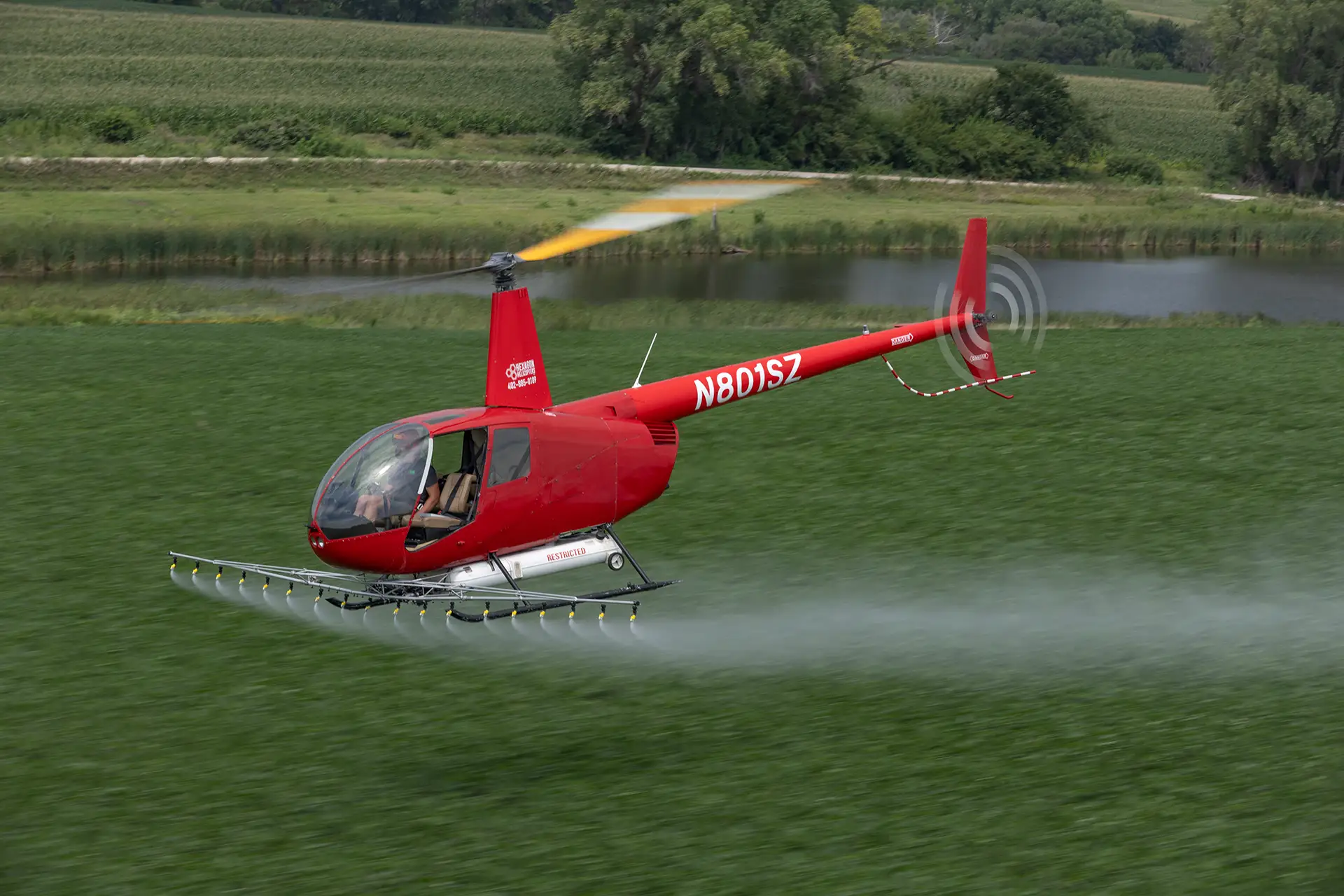
Hexagon’s internal training program emphasizes exactly that: glance, don’t stare. New pilots often fixate on cross-track guidance early on, trying to fly a perfect digital line. Wulf pushes them to develop physical awareness first. “You feel the drift before you see it,” he adds. “Then you glance down to confirm.”
That philosophy runs counter to how many pilots are trained early in their careers, but it’s essential when operating eight feet above crops with wires, roads, and terrain constantly in play. Teaching pilots when to trust their eyes and when to verify with tools is a cornerstone of how Hexagon develops new ag pilots.
Building an Ag Pilot the Slow Way
Hexagon’s training pipeline reflects years of watching what works and what doesn’t. New ag pilots don’t arrive straight from flight school into the cockpit. They start on the trucks. Loading teaches geography, field layouts, chemical handling, and the cadence of a spray day long before someone ever flies a line.
Jackson, one of Hexagon’s newer pilots, spent three seasons as a loader before transitioning into the R44. By the time he moved into the cockpit, he already understood how the operation should look from the ground. “That helps a lot,” Wulf says. “He knew what right looked like.”
Training itself follows a structured syllabus broken into small, manageable blocks. Early ag flights (about the first 30 - 40 hours) focus on fundamentals such as line tracking, height control, and basic spray turns, which are conducted over large, flat fields with no terrain or obstacles. Only once those basics are solid does complexity increase. Pilots progress from empty, flat fields to empty fields with rolling terrain, then to fields with power lines, roads, and irregular boundaries with each element introduced deliberately rather than all at once. “You don’t throw everything at them at the same time,” Wulf says. “You add pieces.”
Initial training is conducted with an instructor in the aircraft, but autonomy grows quickly once fundamentals are consistent. Practice flights transition to supervised solo work, followed by debriefs focused on awareness and decision-making rather than perfection.
By the end of his first season, Jackson was flying wherever the operation needed him. “That’s when you know it’s working,” Wulf says. But even the best training doesn’t remove the physical limits imposed by heat, weather, and long days during the corn run.
Fatigue, Heat, and Knowing When to Stop
The corn run pushes crews hard, but it doesn’t ignore limits. Temperature, for one, often sets the ceiling. Above roughly 92°F, agronomists generally prefer not to spray fungicides, believing plant uptake suffers when crops shut down in extreme heat. Operationally, that creates a natural stopping point for the crews.
Wind is another hard line. Ideal conditions sit below 10 knots, with 15 knots effectively the upper limit depending on product and surroundings.
Fatigue management is less formalized—but no less intentional. “There aren’t FAA duty limits for this,” Wulf says. “So we self-police.”
Hydration is treated as operational equipment. Trucks carry coolers loaded with ice, water, drinks of choice, and snacks. Eating matters; long days burn energy quickly.
“I always remind the guys, you have to eat and drink more than you think,” Wulf says.
Breaks aren’t rigidly scheduled, but pilots are encouraged to step out of the aircraft periodically, especially during fuel stops, to stretch, hydrate, and reset. “If the weather shuts us down in a hard week, sometimes we just call it a day,” Wulf says. “Even if it might calm down later.” The goal is sustainability through the season, not heroics that burn people out before August arrives. Those operational pressures don’t exist in isolation, especially as agricultural flying increasingly happens in view of people unfamiliar with the work.
Operating in Public View
Eastern Nebraska isn’t empty farmland anymore. As Omaha expands outward, more fields sit adjacent to homes, hobby farms, and rural properties owned by people who didn’t grow up around agricultural aviation. Every season brings a few phone calls, questions, concerns, or complaints. “Horses are a big one,” Wulf says. “To some people, they’re like kids.” Most issues are easily resolved with explanations. Many residents simply don’t realize helicopter spraying has been part of local agriculture for decades. A calm conversation usually goes a long way. “There’s always one or two who make noise,” Wulf says. “But it’s not a huge deal.”
Because of the changing countryside pilots also conduct reconnaissance passes over every field, even ones sprayed weeks earlier, watching for new wires, structures, or changes. Familiarity never replaces verification.
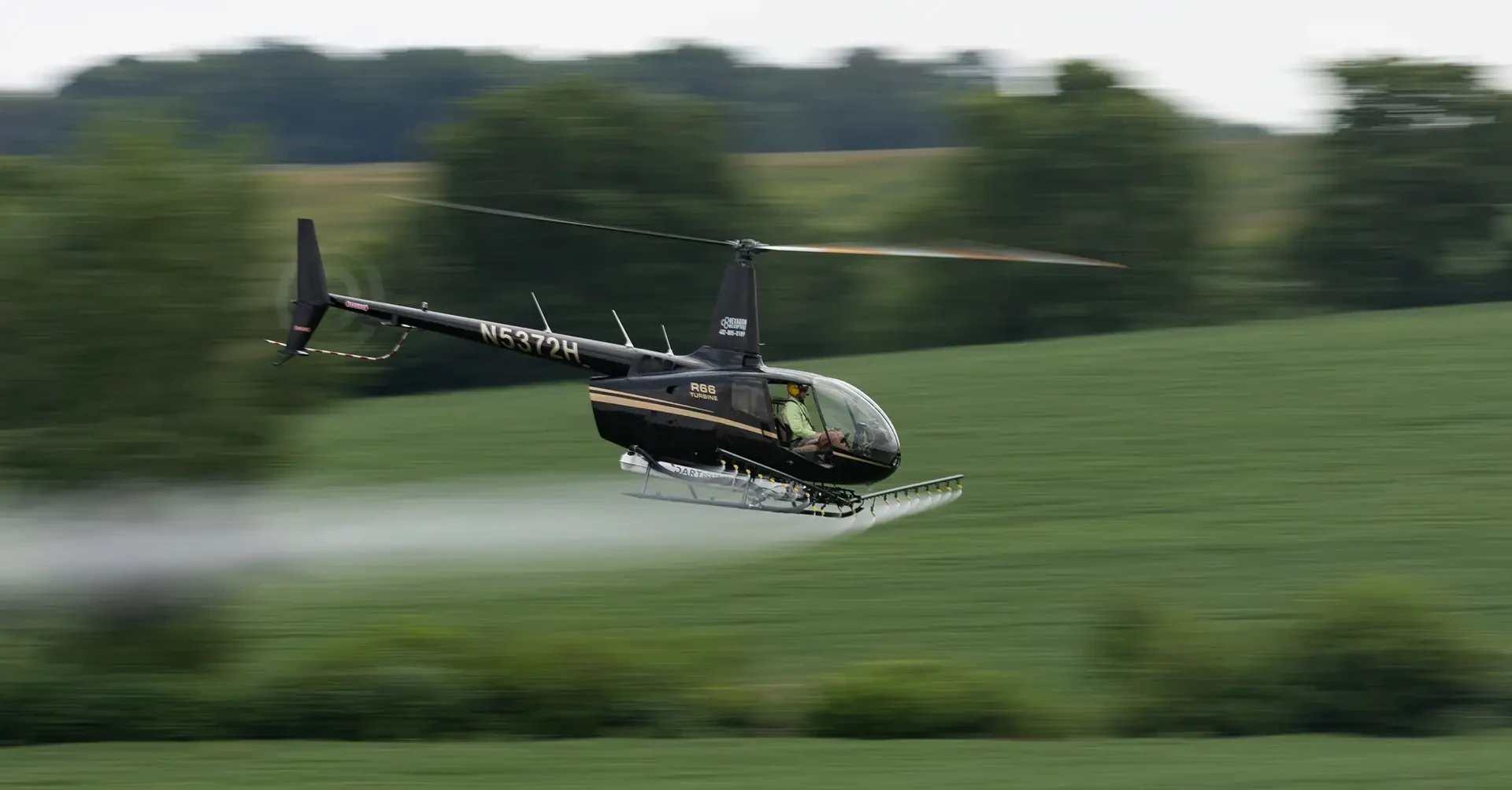
“You refresh your memory every time,” Wulf says. “Things change.” Managing those changes, on the ground, in the air, as well as in the broader business, has shaped how Hexagon chooses to grow.
Hexagon’s growth has been deliberate, not aggressive.
The operation runs four load trucks, with a fifth under construction, each upgraded as resources, time, and necessity allow. Air conditioning, reliable pumps, and organized layouts aren’t treated as luxuries; they’re fatigue-management tools for loaders working long days in the heat, keeping the operation moving when the pace is highest.
After the corn run, cover-crop work provides additional revenue, but it remains tied directly to market conditions. When margins tighten, cover crops are often the first expense farmers cut. “It’s optional for a lot of farmers, not a guarantee,” Wulf says.
That same restraint applies to fleet decisions. A third R66 only makes sense if utilization supports it. A second spreader bucket and seed tender would improve logistics, but only if demand justifies the investment. Expansion is never assumed. “You have to know when something makes sense and when it doesn’t,” Wulf says. That mindset carries through the off-season. Helicopter maintenance, truck overhauls, and preparation quietly determine how well the operation performs in peak season when the corn run arrives again.
In an industry that often celebrates expansion for its own sake, Hexagon stands out for its restraint. It isn’t built to be everything, everywhere. It’s built to maximize a narrow, intense aerial application window where timing, discipline, safety, and execution matter most.