 HOME
HOME





When Health and Usage Monitoring Systems (HUMS) were first introduced as an ‘add-on’ system to helicopters, they were viewed with suspicion by both aircrew and maintainers alike. Aircrew, and pilots in particular, were sceptical of the proposed benefits of the system. Paul Kennard reports.
Spy?
There was a perception of HUMS, that the system acted as another ‘spy in the cab’ alongside a Cockpit Voice Recorder (CVR) or Air Data
Recorder (ADR) – the ironically brightly painted ‘Black Boxes’ used in post-accident investigations. This sense of being
'watched' probably stemmed from the fact that, unlike the CVR/FDR which would only normally be accessed in the event of an accident or
significant incident, the HUMS data would be routinely downloaded as part of the normal post-flight servicing and turnaround
activities. Therefore, any 'over-indulgence' on the part of the crew in terms of exceeding manoeuvre, transmission or engine limits
would be immediately flagged as the HUMS data was downloaded. There is, of course, the counter point that crews should declare
any known inflight exceedance post flight, if only to ensure the next crew that fly the machine are aware that the aircraft may not be 100%
serviceable. Engineers were also concerned by the imposition of HUMS; many were veterans of their charges, and understood them in a
way, they claimed, that a sensor and algorithm-based system simply couldn't. If HUMS erroneously reported a failing component (which
did happen a lot in the early days before the prognostic software and sensor fidelity improved) the groundcrew would offer a wry smile and a
'well, I told you so. sir...'.
Despite the somewhat shaky start that HUMS had as a retro-fit modification to legacy rotorcraft, especially in my own experience of it being introduced to the Royal Air Force's Chinook Mk2s in the late 1990s, it gradually came to be viewed with more utility and, increasingly, grudging respect by crews and engineers alike.
Gaining Respect
Firstly, the HUMS modification to the Chinook included Optical Blade Trackers (OBTs) which conducted constant monitoring of how the blades were flying. Until the OBTs were fitted, the aircraft had to fly a Rotor, Track and Balance (RTB) air test with a dedicated engineer and specialist rotor tuning equipment on board to gather the required data to assess how accurately the rotors were flying. Out of balance rotors could cause vibrations which might be uncomfortable to crews/passengers and, more seriously, fatigue mechanical or electrical components. If a rotor blade (or blades) had been changed, or the aircraft had just finished a maintenance / transport cycle that required the removal and refit of the rotor blades, then it could become a long drawn out process to 'tune' the blades within mandated limits. Each RTB sortie typically took about 30 minutes as the aircraft needed to spend enough time straight and level at various speeds from the hover through to Vmax (160kts) to gather sufficient data to assess the Track and Balance through the flight regime. Upon landing, the engineers would make some adjustments and the profile re-flown to see if the rotors were now within acceptable tolerances. Invariably they weren't and several sorties were needed to 'tweak' the blades into limits. As a relatively junior Aircraft Commander in Kosovo in 1999, my navigator and I conducted nearly 6 hours of RTB sorties over a three-day period after my Flight Commander suffered a front head wire strike (ironically whilst conducting a wires recce sortie....). We got the profile down to about 20 minutes by the end, so it's clear how difficult it was getting three blades into tune. Naturally, as the junior pilot, I didn't suggest that the Boss fixed his own aircraft...This small anecdote is, however, representative of the burden (and subsequent expense) that RTB sorties placed upon the Chinook fleet prior to the installation of HUMS. Pre-HUMS, according to an engineer colleague, between 10-15% of the annual flying task for the Chinook comprised of RTB sorties and other maintenance air tests. One of the issues that Supervisors and Authorisers had after HUMS was rolled out across the fleet was keeping flight crews current - before HUMS was fitted the sheer number of test flights offered ample opportunity to keep crews in flying practice. Suddenly the training staff had to generate more training sorties to 'fill the gap'.
Secondly, HUMS soon started to win people over with its flexibility. The system fitted to the Chinook had an 'event marker' which
made life for crews significantly easier if some form of inflight anomaly was noticed; the event marker would leave a trace on the digital
files enabling the engineers to swiftly find the timestamp of the data stream surrounding the incident - saving significant time post
sortie. Furthermore, as the HUMS on the Chinook tapped into the existing sensors around the aircraft, in the event of a deviation
from normal temperatures/pressures/volts we could swiftly rule out an indication error by scrolling to the appropriate page. If the
HUMS matched the gauge, then instrument failure could be ruled out (though sensor failure could still be a factor). This could be useful.
On one occasion I had an indication in the cockpit that an engine was about to spectacularly 'let go' in flight. The nearest suitable
location for the 'Land ASAP' was a large shopping centre car park. However, the aircraft was flying OK and the engine 'felt'
fine. A quick check on the HUMS suggested all was well, but as we were not permitted to use the HUMS as a sole source of flight
critical information (if I recall correctly, for certification expense reasons...) we couldn't continue the sortie as planned, but it gave
me the confidence to fly the aircraft for another two minutes to land at a nearby grass airfield - an infinitely better choice for a number
of reasons.
Small Market Penetration
So far so good. HUMS, and its close cousin, Helicopter Flight Data Management (HFDM) which measures and records flight parameters, have proven their value to crews and maintainers, if albeit grudgingly at times in both a military and off-Shore Oil & Gas (O&G) context. Interestingly, in the civil world, market penetration outside O&G has proven surprisingly small. Estimates vary, but most seem to suggest that only 5-10% of non-O&G commercially operated aircraft are fitted with such a system. There might be a variety of reasons for this, including the decreased risk to life by not spending a significant part of the flight profile over water, or, perhaps, a simple matter of economics. However, what could a product that leveraged the advantages of both HUMS and HFDM bring to more mainstream civil helicopter operators, and to future military and para-republic users?
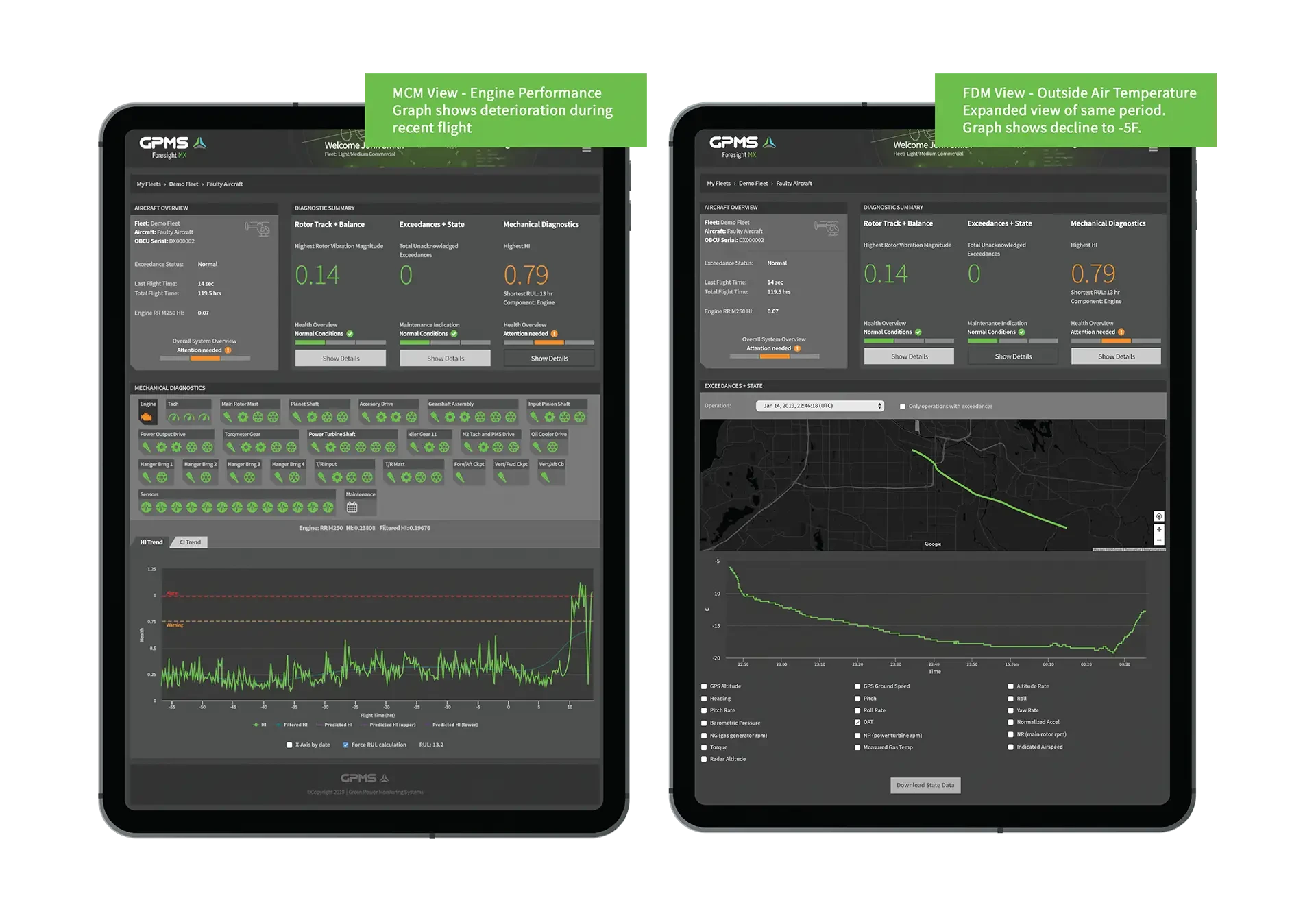
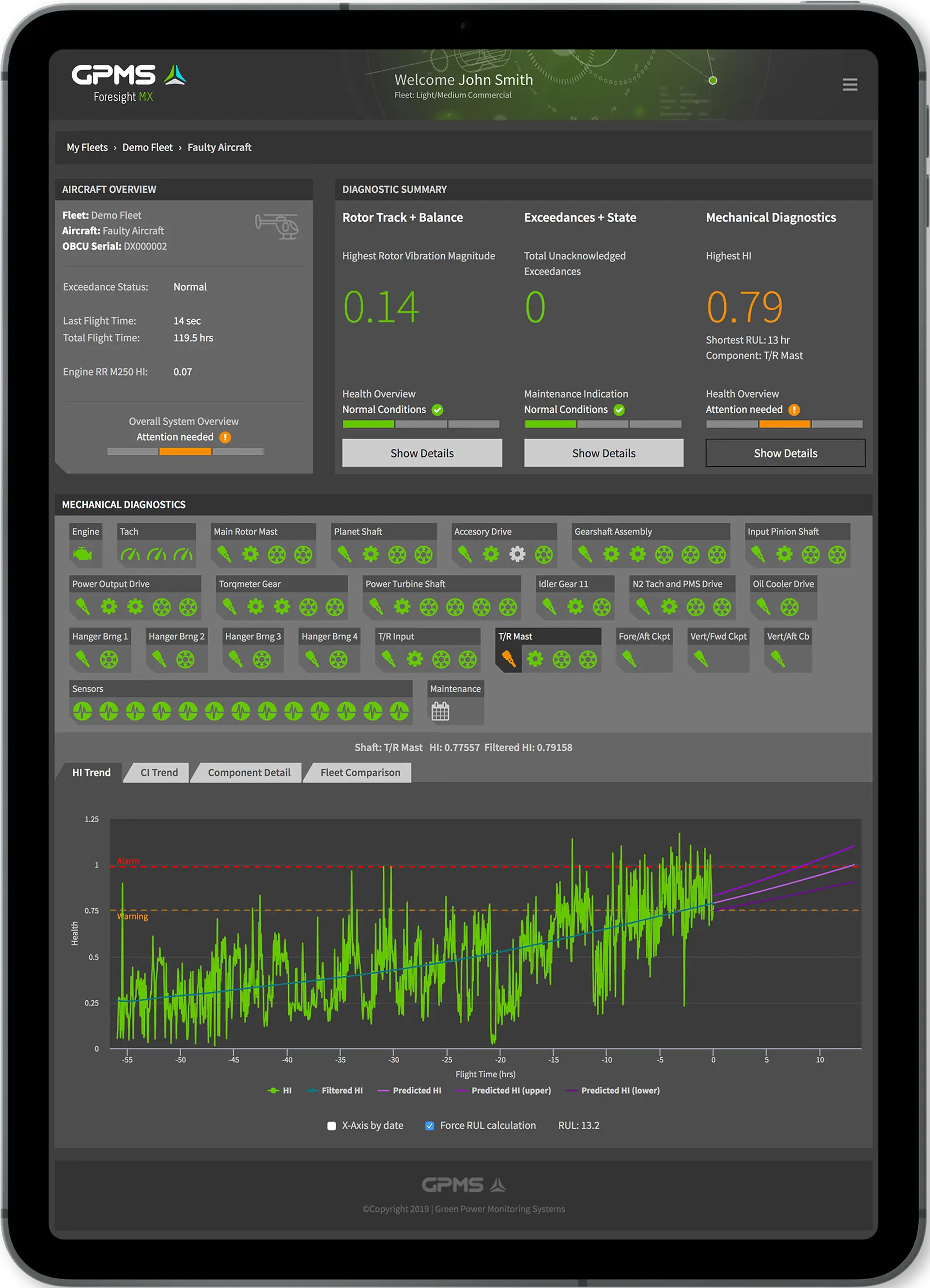
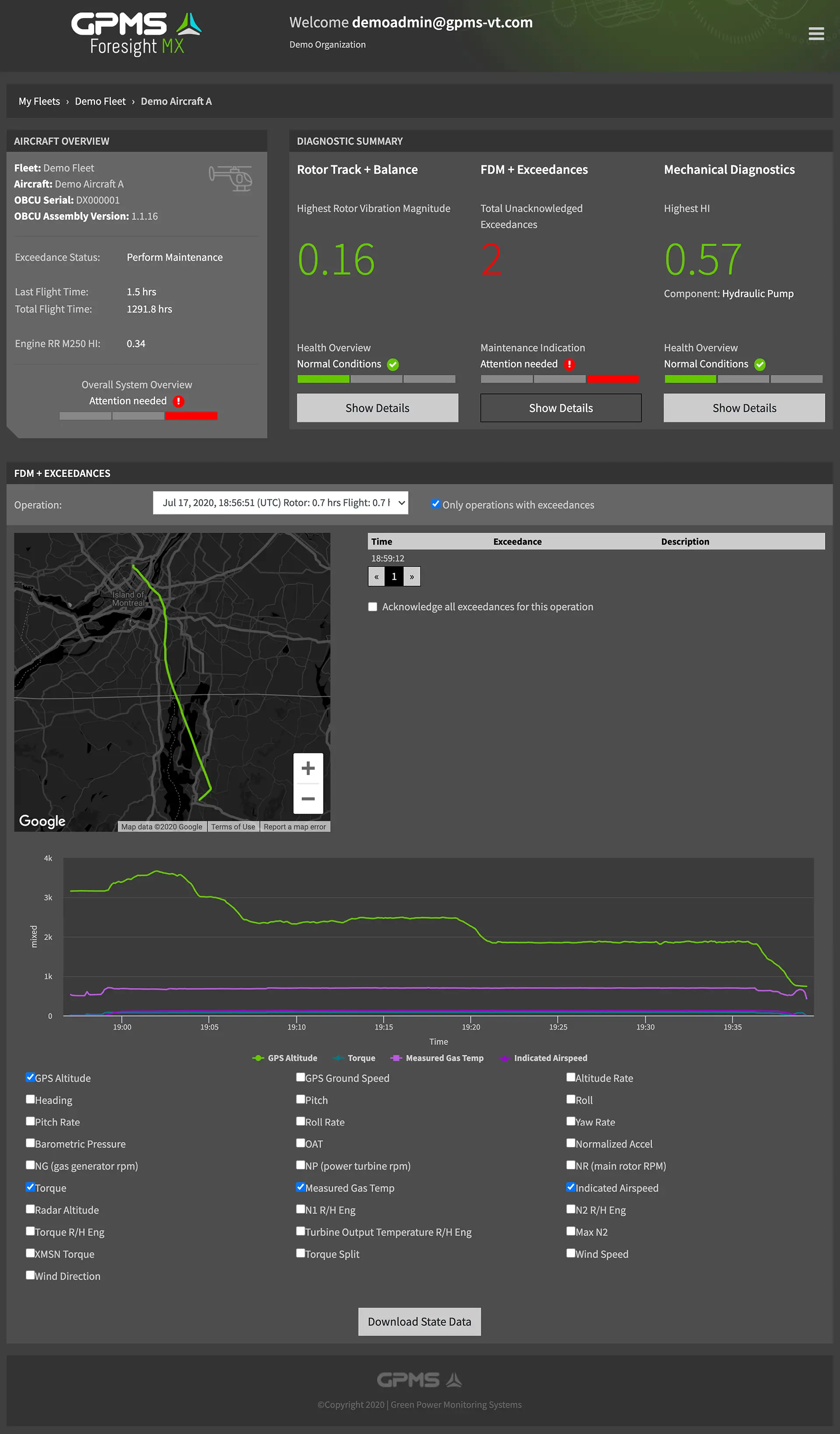
Heli-Ops was recently able to conduct a Video Teleconference with US based market leader for just such a product, GPMS, to discuss their 'Foresight' system. On the call we had Eric Bechhoefer, Co-founder, CEO and Chief Engineer, Andrew Swayze, Head of Marketing and Ronnie Fahy, helicopter advisor. Foresight points a finger in the direction of where HUMS is going; a full 'wrap-around' system capable of offering significant improvements to safety/reliability and, importantly in the Commercial sector, the opportunity to improve profit margins by driving down the need for unnecessary maintenance, or the ability for the Operator to exploit the most cost-effective 'window' to complete scheduled or unscheduled work.
Foresight
Eric explained that unlike most HUMS systems, Foresight has been designed to offer tangible cost benefits for operators of smaller
rotorcraft operated under CS27 rather than the more traditional use in larger, CS29, machines. The Foresight components have been
designed to be both lightweight and relatively inexpensive, helping to generate a quicker Return on Investment without significant mass
penalty. The design aim is an initial fit-up cost of roughly 1% of the platform value and a modest weight increase of approximately
10lbs that even the smallest of rotorcraft can bear. Even when considering ‘HUMS-as-a-Service' fees, GPMS maintain that this
investment can swiftly be recouped through a number of benefits.
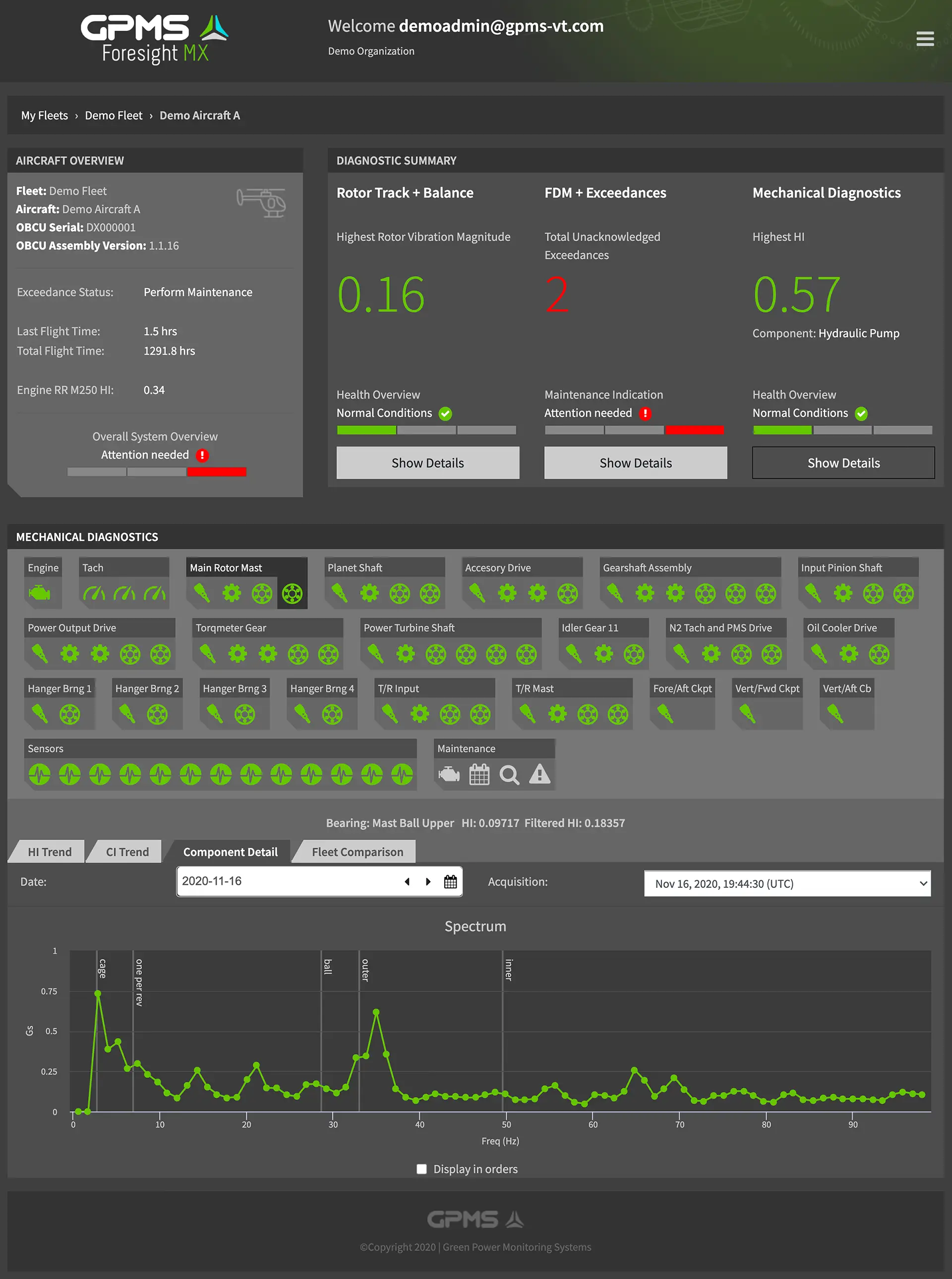
The first benefit is that, with GPMS's own low Space, Weight and Power (SWaP) sensors fitted, newly fitted components which arrive with hitherto undetected manufacturing faults can be quickly identified after installation - allowing operators to replace defective or sub-standard parts quickly, invoking any warranty that may apply. The monitoring that Foresight also provides an ever-improving database of component knowledge and lifetime health, permitting, for example, a modest over-torque or over-stress to be acknowledged and monitored, without the need to ground the aircraft to carry out a strip and inspection. Not only does the maintenance burden of the strip-down check cost time and money, but it also risks causing further problems due to the need to remove serviceable components (which may not work optimally after being disturbed) and, all the time the aircraft is on the ground, it's not generating revenue. Smaller operators need to 'sweat the metal' to turn a profit in order to be able to reinvest in growing their operations. Foresight offers a clear way of minimising 'down time'. These measurements can also be exploited in near real-time, as Foresight can offload data swiftly via 4G cell networks or WiFi as part of routine post flight activity. Therefore, if a minor fault is detected whilst deployed away from Home Base, the necessary parts can be sourced swiftly to minimise the time the aircraft needs to spend on the ground upon return.
Secondly, Foresight can offer a perspective on how a company's pilots are performing and how the role the machines are performing can directly impact their operating costs. On the VTC, Eric was able to share some anonymised data from some of their clients as a means of vividly demonstrating this. On the one hand, one company had a relatively benign Part 135 flight regime, whilst another had a more dynamic role in an identical CS27 Aircraft. The Foresight tool clearly showed the small increases on wear and the occasional exceedance on the part of the latter. Over time, these small differences can aggregate into having to pull an aircraft off-line early to conduct maintenance - which increases the Operating Costs of the aircraft - and, essentially, hits the crucial bottom line for small operators. Being able to accurately control your maintenance costs is vital in setting the 'price' for your work. In what can sometimes be a cut-throat market, being able to confidently undercut your competitors on price can be a key edge.
Other Beneficiaries
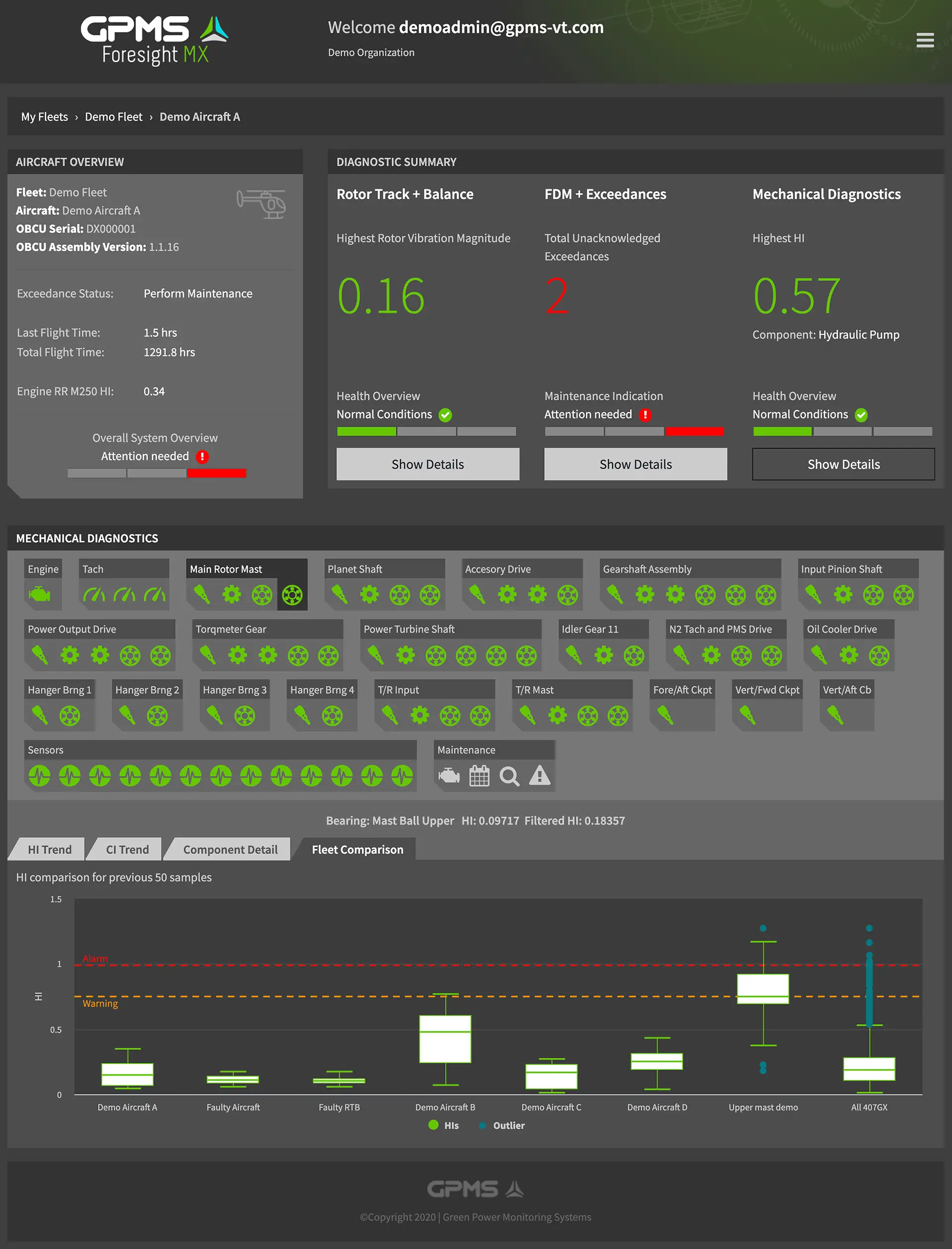
However, it's not just small-medium size CS27 / Part 135 style operators that can benefit from Foresight-like support. NATO nations have
been looking at Next Generation Rotorcraft (NGR) capability for a number of years. Importantly, they've not become fixated on just
platform configuration and capabilities, but also on leveraging support efficiencies. Most militaries have sizeable helicopter fleets,
and, in the case of the US military, subjectively huge. An incremental maintenance and support saving over, for example, 2000 JVL-M /
FLRAA adds up to a significant amount of cash over a 30-40 year platform lifecycle. Moreover, with militaries the world over
struggling for budget allocation and competing for high quality personnel, any reduction in maintenance cost and manpower burden would be
welcome, especially the latter when deployed 'forward' on operations. It is also a patent advantage if militaries can keep a higher
percentage of their platforms airworthy and 'mission ready'; not only does it confer a tactical advantage on the field, but it also,
potentially, permits fewer aircraft to be purchased or deployed to deliver the same effect. Traditionally, the 'rule of a third' has
applied. This suggests that to maintain a fleet of, for example, 66 aircraft at first line (i.e., available for daily tasking) then an
additional 33-34 aircraft are required to provide a 'sustainment fleet'. The sustainment fleet is where the Maintenance, Repair and Overhaul
(MRO) function is discharged, and also where militaries try to embody upgrades/modifications or even conduct Mid Life Updates (MLUs) - all
without adversely impacting the number of platforms available to conduct front line operations. Ultimately, the sustainment fleet is
also where attrition reserves are counted. Therefore, if the front line currently needs a 'whole fleet' of 100 aircraft to provide
sufficient 'forward' airframes to fulfil their allocated tasks, a system such as Foresight could be employed to significantly reduce the
overall fleet number whilst maintaining output.
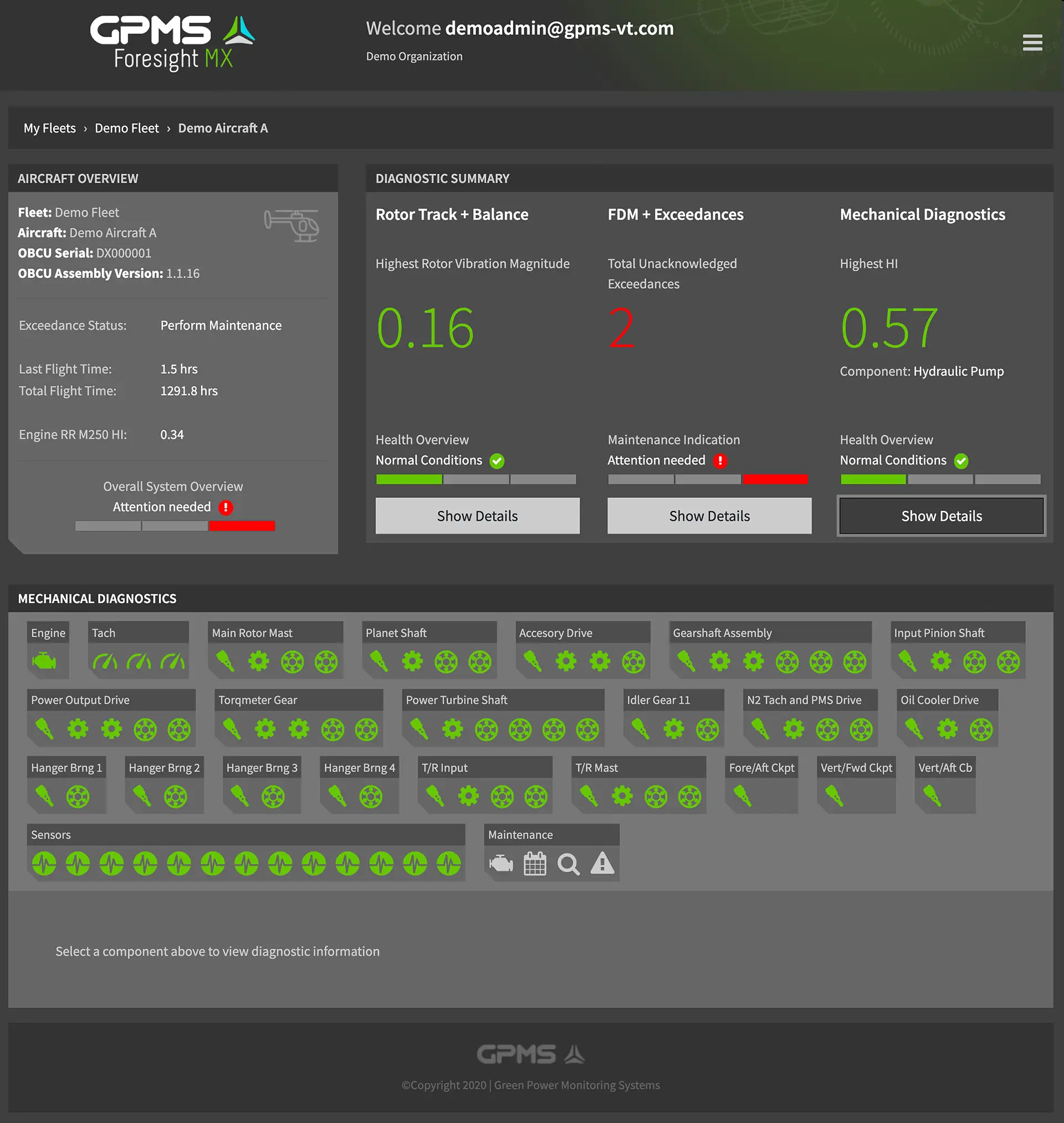
This could be achieved by eliminating the traditional approach of scheduled maintenance based upon cycles, flight hours, subjectively assessed fatigue measurement and calendar backstops and moving towards a Condition Based Maintenance (CBM) regime. Such a regime would make objective decisions on platform health, based upon actual readings of wear rather than assumptions that, by necessity, include a substantial margin of additional tolerance. Clever use of such a tool by both the operational commander and his/her engineering deputy could make it far easier to balance the fatigue lives across a fleet and optimise when aircraft are pulled from the front line for MRO work or upgrade. During sustained deployed operations, it also allows the commander to balance the risks of maintaining a high combat tempo against conducting maintenance. He or she may well make a judgement to 'fly now and fix later' to exploit a tactical advantage, informed by accurate near real time Health monitoring of the platforms available. Ultimately, they may be able to decide to continue of operate a platform in an unmanned mode as 'man rated' tolerances are passed. Our notional 100 aircraft fleet could perhaps be reduced by as much as 10 aircraft without a reduction in the 66 aircraft forward fleet - a significant saving both in acquisition and through life support costs.
As GPMS explained, Foresight is a 'learning technology'. The 'learning journey' is just starting, but the potential is there to achieve substantial gains in safety and availability, allied with significant reductions in lifetime ownership costs, for both legacy rotorcraft as a retro-fit system, and new designs. The helicopter maintenance 'information war' is just starting; the ability to accurately and safely prolong servicing intervals and to anticipate failure will help those companies that adopt technology such as Foresight to claim an early lead and then accelerate away. In commercial operations 'cost is king' and demonstrably better data collection, management and exploitation will inevitably play a clear part in discriminating between competitors.