 HOME
HOME





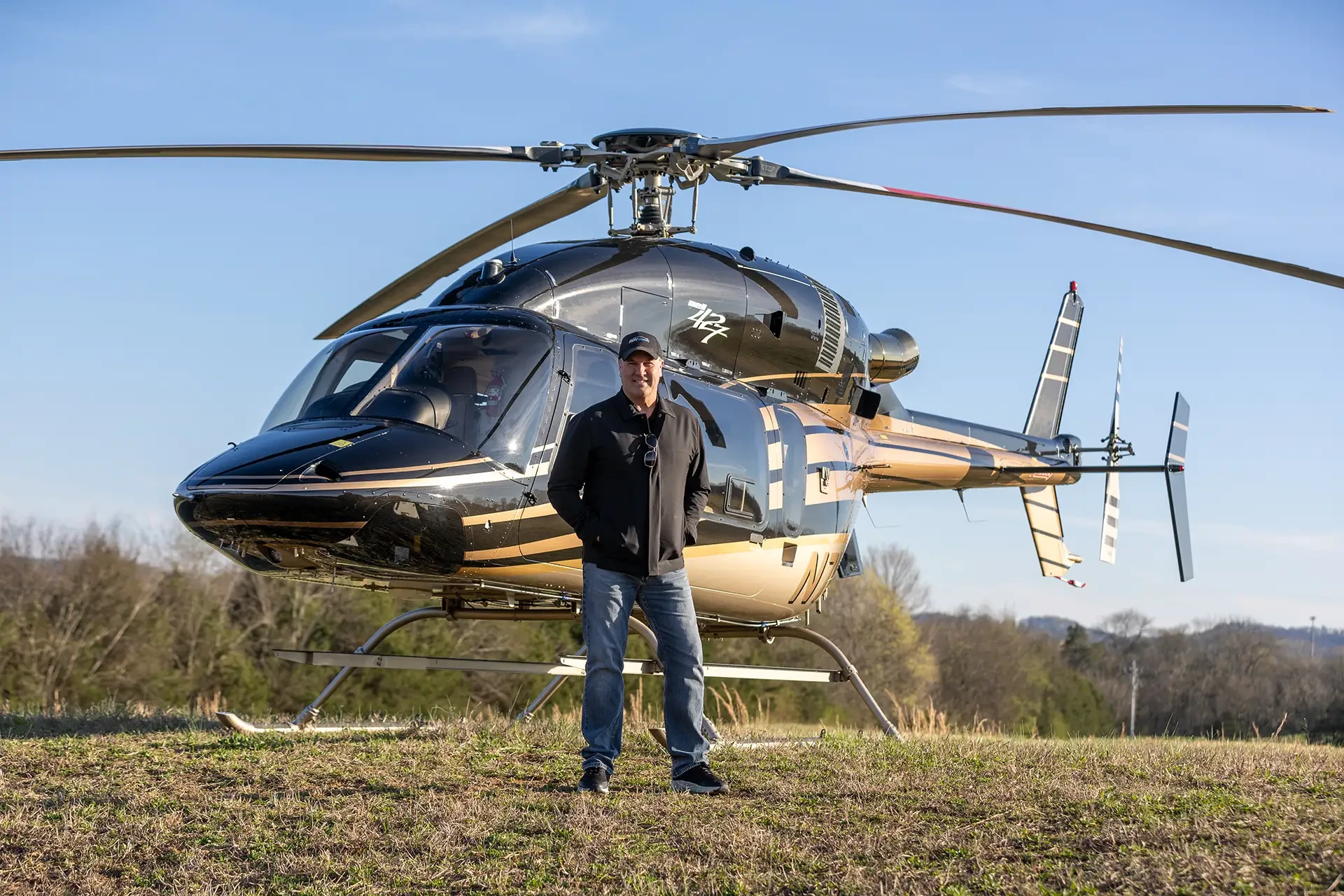
A total of just 84 examples of the Bell 427 were produced between its first flight in 1997 and the cessation of production in 2010. Superseded by the larger, more powerful, and capable Bell 429, the 427 is nevertheless a safe and comfortable light twin. It is also a much more affordable option for the private owner. Kevin McCutcheon spoke to HeliOps about his low-time, immaculate example.
Around 32 years ago, Kevin McCutcheon started the business that would become Flight Solutions. Leaving a position running a corporate fixed-wing flight operation in Minneapolis St Paul, he shifted to Nashville, Tennessee to start a company from scratch with country music star Reba McEntire. The pair were partners for five years in ‘Starstruck Aviation’ and at her peak, Reba herself would fly up to 700 hours a year in the company’s private jets. “We started off with Hawkers and Lears and then grew into Gulfstreams, flying both private and charters, expanding into buying and selling aircraft, leasing equipment, and providing maintenance. We built a pretty substantial aviation business in the Southeast, doing much the same as I do now as a full-service business aircraft company and FBO. Mostly fixed wing but we expanded into buying and selling helicopters too.” McCutcheon acquired the business from Reba in 1997, and he changed the name to Flight Solutions Inc.
In 2001 McCutcheon shifted the base of operations to Music City Executive Airport (KXNX) in Gallatin, Tennessee, which had previously only served as a satellite field close to Reba’s home about 20 miles outside of Nashville. In recent years he built a completely new facility on the airport. Flight Solutions has grown to include operations in Cincinnati and is involved in partnerships with other operations in Kentucky, Indiana, and Ohio. McCutcheon also owns an aviation insurance agency operating under the name of “Ingram Aviation Insurance”. The total fleet that Flight Solutions either owns, operates, or manages is now exceeds forty aircraft, with the largest being the Falcon 2000EXand Gulfstream GIVSP, but ranges through an eclectic assortment of smaller types as well including a Bell 429 and 427 helicopter. “We’ve had many types of aircraft such as the Falcons, but you go where the business leads you and when you get in a lane that works, you tend to stick with it,” he remarked and pointed out that sticking with a limited number of familiar types makes crewing, spares, training, and maintenance much simpler and more efficient.
McCutcheon’s history with the Reba and the Country Music Business means that the company still provides aviation services to a lot of the music industry in Nashville - about 80 percent of its business comes from the Nashville area. “Working with the music industry and many successful people from all walks of life makes for great connections and is a heck of a lot of fun. I’ve been doing this for so long that some of our longest-term clients have been with us for 25 years. I grew up with a love of music and so this combines two of my greatest passions” he commented.
McCutcheon related his first memory of helicopters being at around six years old, when his father, who worked with the Saint Paul Minnesota Police Department, was trying out Bell 47s for the department. “I remember running out into our back yard as a small boy while my dad flew in with the pilot and hovered over our place in a Bell 47,” he recalled. “Ever since that moment, I’ve been passionate about helicopters and it was always my dream to fly them, but I wasn’t able to afford it for a long time. Fixed wing was much less expensive and there were far more jobs, so that’s the path I took when I started flying at 17. Later as a Gulfstream pilot I spent a lot of time in Los Angeles. When I had down time, I completed my commercial helicopter add-on rating. I started with six or seven hours in an R22 but then, then moved up to a Schweizer 300C.”
McCutcheon then found a local instructor in Nashville with a Schweizer 300 and finished his helicopter commercial license, which he
described as a relatively straight forward process as he was already a fixed-wing ATP. “That was about 25 years ago, and I then went out and
bought a 300C from a Northwest Airlines captain, a real cream-puff machine from Seattle.” However, he quickly realized that the 300C was not
really suitable for private use as it was too limited in capability and capacity, so he sold it and bought an Enstrom 280FX, followed by his
first turbine a Bell 206B3 Jet Ranger. Today, McCutcheon is type-rated in eight different jets, pushing 16,000hrs total time and about
3,000hrs of helicopter time.
As McCutcheon had been introduced into the Enstrom world, he was invited by the then-CEO to visit the factory and was offered the chance to
become an Enstrom dealer. He took up the offer, sold his JetRanger and was an Enstrom dealer for about five years, flying a new 480B
demonstrator every year. “Positive aspects of the 480 were its simplicity and that it’s a really stable platform, but it didn’t carry much
and didn’t match the classic old B3 Jet Ranger in capability,” he noted. Tackling the dealership with gusto and a desire to operate at the
very highest standards, McCutcheon was dealer of the year for three of those five years but when the Enstrom Helicopter Company was sold,
the new ownership increased prices, cut dealer margins and started taking direct orders from customers, so McCutcheon gave up the dealership
on moved on.
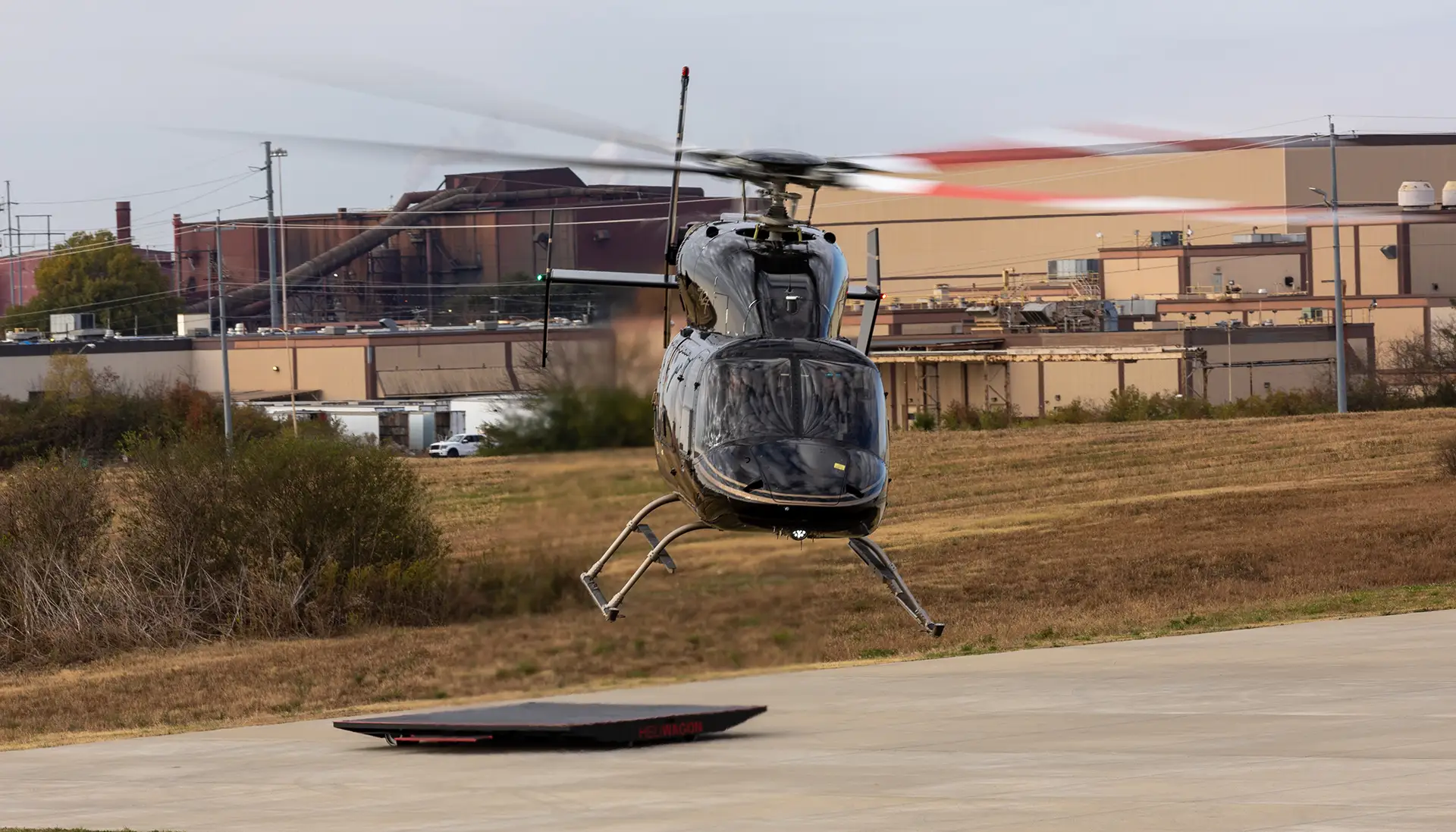
McCutcheon’s next helicopter was an auto-pilot equipped 206L-3 Long Ranger that he bought from one of his aircraft customers in Atlanta. After sticking with Bell product for a while, he then owned a couple of EC120B Colibris, that he described as beautiful, sexy helicopters but underpowered. Moving up from the Colibris, he owned an AS350-BA, a -B2 and a couple of -B3s. “I played in the Eurocopter world for about ten years, and I absolutely loved the B3s. You could pull tree stumps with those machines!” Just before Covid first hit, McCutcheon sold his last AS350-B3 and bought a Bell 407. “I bought a beautiful 407 out of Mexico City and when I sold that around three years ago, I came across this immaculate 427, which was bought brand new by the previous owner,” he recalled and explained that he had been wanting something twin-engined as he flew a lot of cross country and didn’t like flying single-engine at night. “I got it in my head that everything else I fly is twin-engine, so I wanted the same advantages in a helicopter, purely because I’m older, wiser and I’ve gained more resources to afford such a machine.”
Most of McCutcheon’s helicopter flights are business related, predominantly company business, goodwill flights for customers that include
traveling with them to the Indy races for example and some charity flights. McCutcheon has been involved in racing himself, one of the
founders of the ‘Music City Grand Prix’ and a part of Dan Wheldon’s team when he won the Indianapolis 500 in 2011. “I’ve never chartered
out the company helicopter, we only keep one for company use. Most of my flying is around Nashville and I’ll go and see clients, go to car
events, visit the tracks, and drive the cars, otherwise just enjoying the privilege. I’ve had this 427 for three years and this machine has
been absolutely perfect. I’m flying about 100 hours a year and enjoying the heck out of it. It flies as smooth as glass; I’ve had no
problems and I just got another annual done at the Bell Service Center which was very inexpensive.”
Relating the 427’s history, McCutcheon advised that it was apparently sold new to a German dealer in 2002, for delivery to a Saudi prince.
However, the machine was never completed and sat for two years as a ‘green’ aircraft, only getting engine runs every three months. “If I
understand correctly, Edwards and Associates bought it, brought it back to Tennessee, did the completion that you see here in 2005, and sold
it to the first owner in D.C,” he explained. The aircraft has only clocked up about 1,600 hours and still sports that original 20-year-old
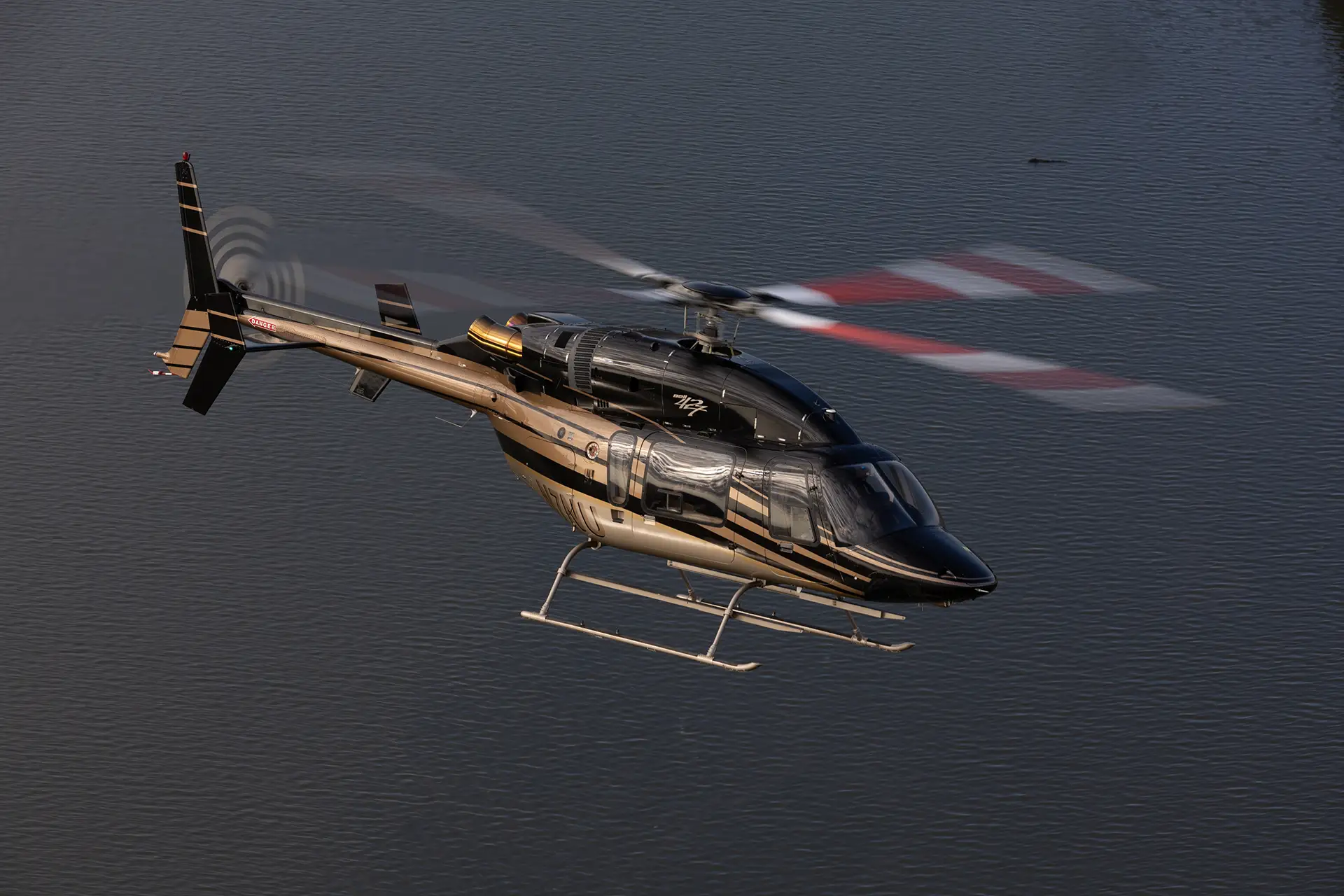
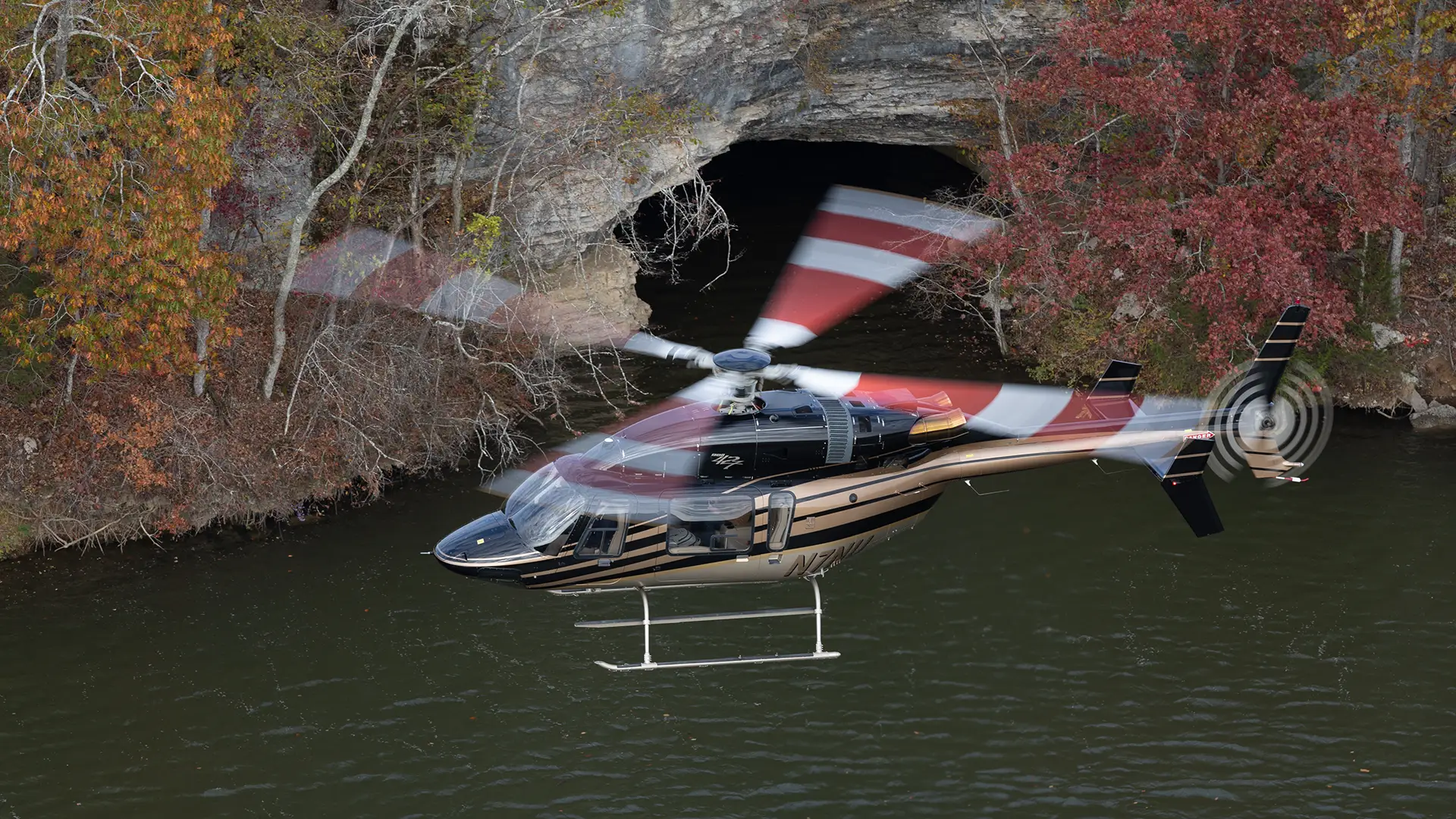
completion in absolutely immaculate condition, with a striking black and gold paint scheme and luxurious tan interior. As an aside,
McCutcheon remarked that although his mother was his very first passenger when he got his private license in a Cessna 172, his father didn’t
want to fly with him until it had two jet engines. Although both parents have since passed they later enjoyed flying together on many
occasions both in airplanes and helicopters.
The previous owner just used the 427 for fun, private flying, he upgraded the avionics with a high-end Garmin suite that includes the 500H with synthetic vision, traffic and HTAWS, the GTN-750 Nav/Com/GPS, GRA-5500 radar altimeter, GDL-88H, GNC-255A #2 VHF Nav/Com and a Pointer 4000 ELT. “It’s never been a charter ship or used for anything other than private use. I might go weeks without flying it at all but this week I’ve already had it out three times. I never use the word ‘toy’ though, when it comes to aircraft. To me they’re never toys. Aside from direct benefits, I get intangible benefits from flying helicopters too, including flying with employees and customers. I’ve closed many significant deals and accomplished a lot of business in and around helicopters, just having clients in that unique environment even though the business has had nothing to do with helicopters.”
McCutcheon is equally adamant that the helicopter is not merely a business tool and stated, “There is a part of the helicopter
experience that is my salvation. I will literally go out on a beautiful day just for a cruise because it’s a release. I’d compare it to
having a Harley in the garage.” Elaborating, he pointed out that when flying the jets, one is under positive control the entire time,
whereas the helicopter is below the radar and able to operate with relative freedom, without having to talk to someone all the time. “I
love doing the ‘Young Eagles’ stuff and we have breakfasts here, so I’ll land the helicopter and give rides, especially to people who have
never flown before, and I just love sharing that experience. These are tools that you can literally change people’s lives with.” He stated
that one of the most memorable experiences he recalled was taking the 95-year-old great grandmother for a flight. “She was in a nursing
home and had literally never left the ground in her entire life. I took her for a ride and she was sharp as a tack, and she wrote me a
letter about her experience and what it meant to her and I still have it. Rose has since passed away, but that letter will always be
priceless to me.”
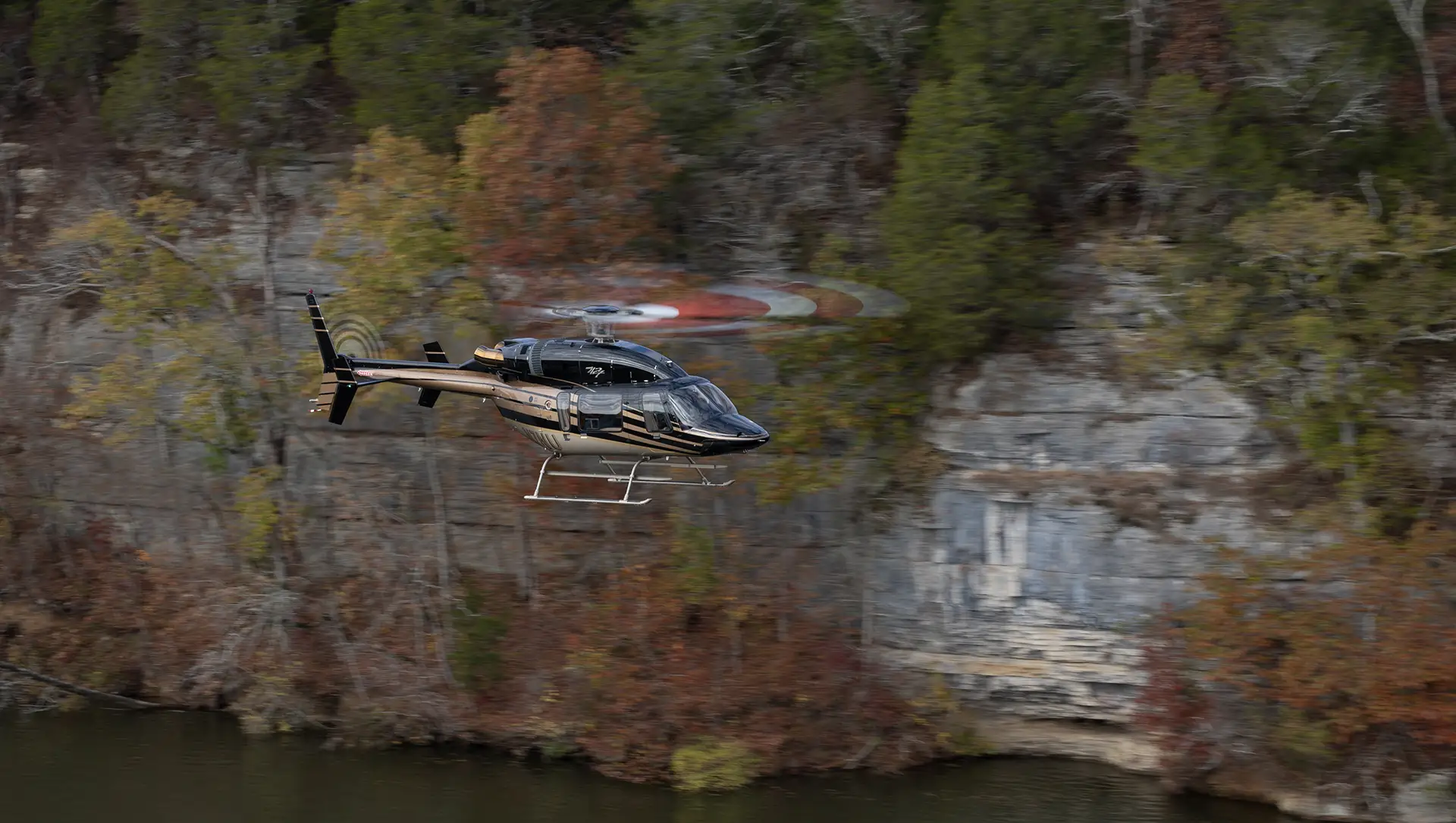
The 427’s production ended around thirteen years ago and only about 77 examples are still in operation, there will inevitably come a time
when parts support will become an issue for owners of the type. McCutcheon has no strong desire to quit the aircraft. To date, he has had no
support issues at all, and he reported that Bell Helicopter has been fully supportive and helpful. He also pointed out that the engines are a
de-rated version of the same Pratt & Whitney Canada PW207Ds that power the Bell 429 so parts and support for the powerplants will not be
an issue for the foreseeable future.
“The market is fairly limited for 427s as they are not IFR options and not great at hot-and-high density operations,” McCutcheon advised. “But when you boil it down, for a guy like me that wants the reliability and safety of an efficient twin at a fraction of the cost of a 429, the 427 hits a bullseye and I love this machine. The de-rated engines are never sweating, and it has a Vne of 140kts, which I can run at effortlessly. In fact, you can go past redline and it has no bad habits. In a perfect world I’d like an autopilot for longer cross-country legs, but 99 percent of my legs are twenty minutes or less and I’d wouldn’t use the autopilot for that anyway. I have contemplated selling the 427 and looking at a 429 or other twin option, but I don’t get anything faster and lose a little range, and yet it would double or triple my cost. If I went back to a B3, I’d miss the smooth ride and the speed of the 427 not to mention the twin engines. Of all the multiple types I’ve owned over the years, the 427 is my all-time favorite helicopter.”