 HOME
HOME





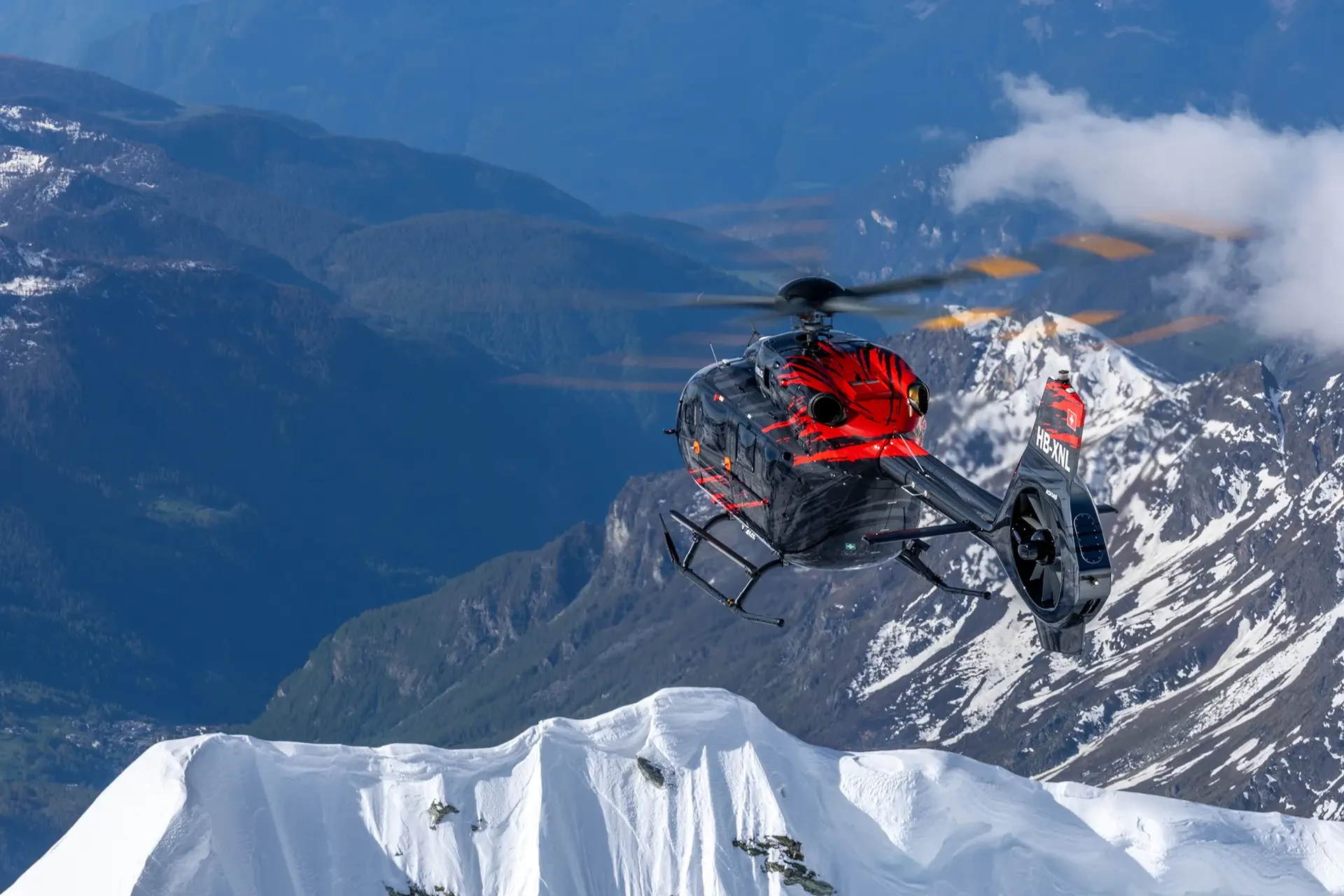
New Swiss company 7K AIR has introduced the ACH145-D3 into service, the first such example to enter commercial air-transport service outside HEMS in that country and CEO Arnaud Rossier spoke to Ned Dawson about the company’s aircraft and operation.
Thanks to Switzerland’s spectacular Alps and scenic terrain, it has no shortage of heliskiing, sightseeing and charter operators. The ubiquitous AS350 series is the mainstay of the tourism sector, but until very recently, no one has fielded the larger, luxurious corporate-grade twin-engine H145 to service the high end of this market.
New Helicopter
The ACH (Airbus Corporate Helicopters) 145-D3 is a model in high demand, due to its luxury, class-leading performance and capabilities,
resulting in a normal lead time of around three years to obtain a new example. The aircraft operated by 7K AIR, despite obtaining an early
production slot, has taken approximately 18 months to be delivered. It fortunately gave the partners plenty of time to plan how they would
utilize the machine for private and/or commercial use, with 7K AIR being the result of that planning. The company’s name showcases the
aircraft’s performance and is derived from the groundbreaking landing of an H145-D3 on top of the Aconcagua in high winds, the southern
hemisphere’s highest peak at 6,962 meters and the first time a landing at such an altitude was achieved by a twin-engine helicopter.
Arnaud Rossier took on the role of 7K’s CEO several months ago. Rossier has been flying for almost 20 years, accumulating several thousand hours of experience almost exclusively in the challenging and demanding environment of the Swiss mountainous terrain. His partner for the H145 was one of his existing clients and approached him two or three years ago to ask his opinion on the best twin-engine machine currently available, and when Rossier outlined his reasons for selecting the H145-D3, the partner decided to purchase one. He then commenced extensive discussions with Rossier to determine the best way to operate and market the new machine. “Airbus were great people to work with and the follow-up on the project was very good, but it involved a lot of people, so the communication was sometimes a little difficult,” Rossier explained. As an aside, Rossier pointed out that purchasing an H145-D3 currently involves almost no risk because the type is in such high demand that if you elect to sell it, you can likely obtain a significant margin over what was paid for it.
Partnership
Rossier elaborated, “It was always the goal to serve the needs of my partner and, also, to sell the aircraft hours to other people and
clients. I think that there is more than ever a market for such a helicopter, and although it might seem strange, there is less competition
than in the squirrel market because we’re currently alone in our own league.” This approach has dictated the focus on the high-end market,
which is constantly growing in Switzerland, centrally located in Europe and boasting numerous ski resorts and tourism-friendly cities. “We
have a lot of ultra-wealthy individuals who have come to live in Switzerland or choose to holiday here,” he added. “We have a VIP corporate
helicopter, so our main market is those wealthy people and big companies that demand time-efficiency.” For example, driving from Zurich to
Sion takes around three hours, whereas the D3 can usually fly it in 45 minutes, or 75 minutes if bad weather dictates a more roundabout
low-level route.
Putting the new helicopter into commercial service means that servicing the needs of his partner and third-party customers will no doubt lead to scheduling conflicts at times. Rossier stated that his partner has made it clear, however, that he is aware of the commercial priority and that third-party customers must come first. The D3 is extremely comfortable and capable by helicopter standards, but Rossier sees its efficient limit at flights of two hours or less, as beyond that, a jet is probably a more efficient alternative. 7K’s 145 is not equipped with de-icing but will be operated IFR in non-icing conditions, and its range is obviously affected by prevailing wind and weather conditions. However, a flight of up to two hours will easily cover 450 to 500kms, making much of Europe readily accessible from Sion. When the helicopter’s ability to often land very close to a client’s destination is considered, some longer flights are still an efficient option over a jet that is constrained to landing at an airport.
Rossier has an entrepreneurial bent, and when he was approached to participate in the project, he jumped at the chance. “Opportunities like
this project come along maybe once in your lifetime and 90 percent of people would take time to reflect and focus on the risks, but ten
percent see the opportunity and choose to run with it. It’s a mindset in which you can accept a level of uncertainty.” He explained that
his partner’s entrepreneurial drive made a commercial operation the natural choice for deploying his new machine, and it was therefore part
of the planning from the moment the purchase was decided upon.
Top End of the Market
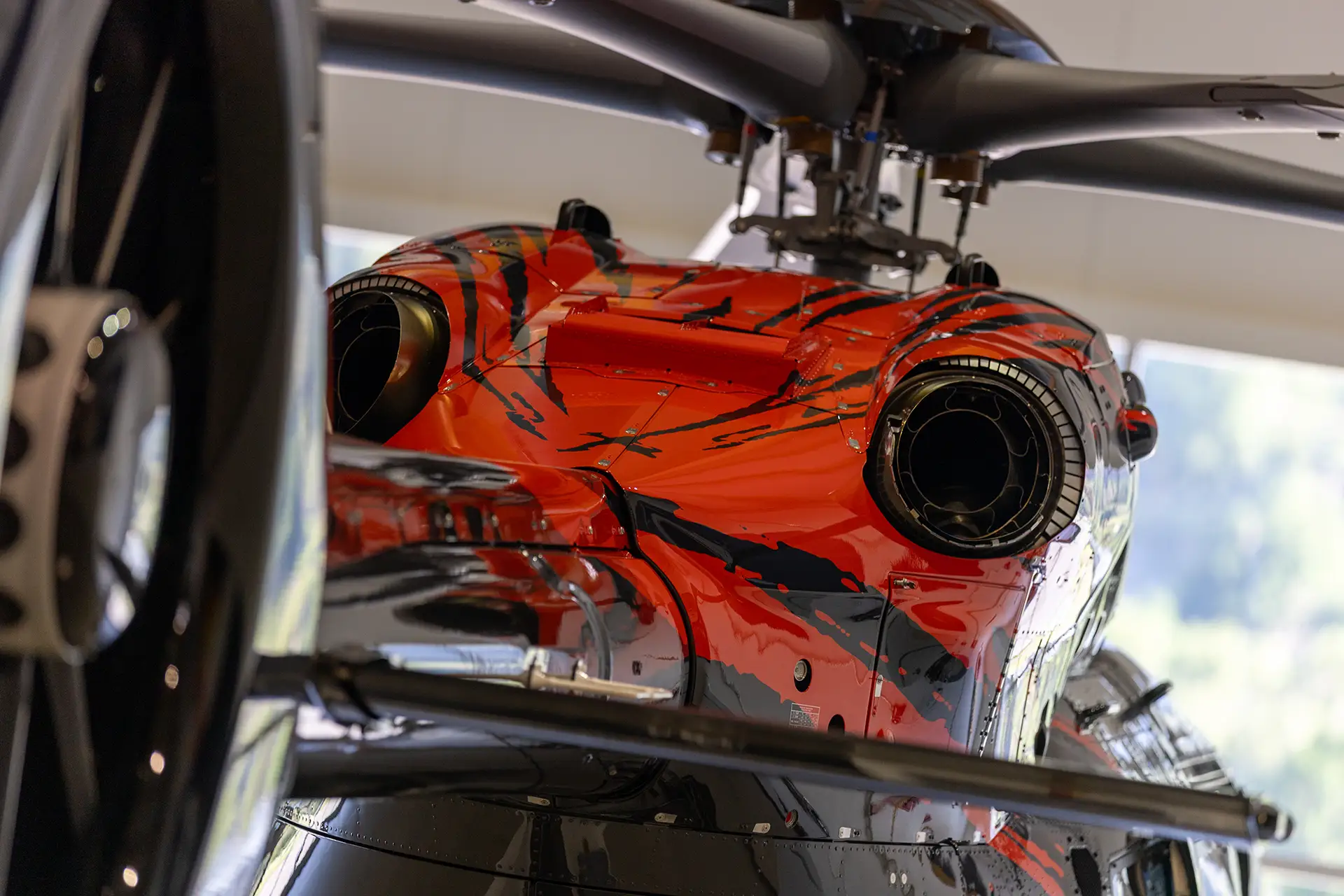
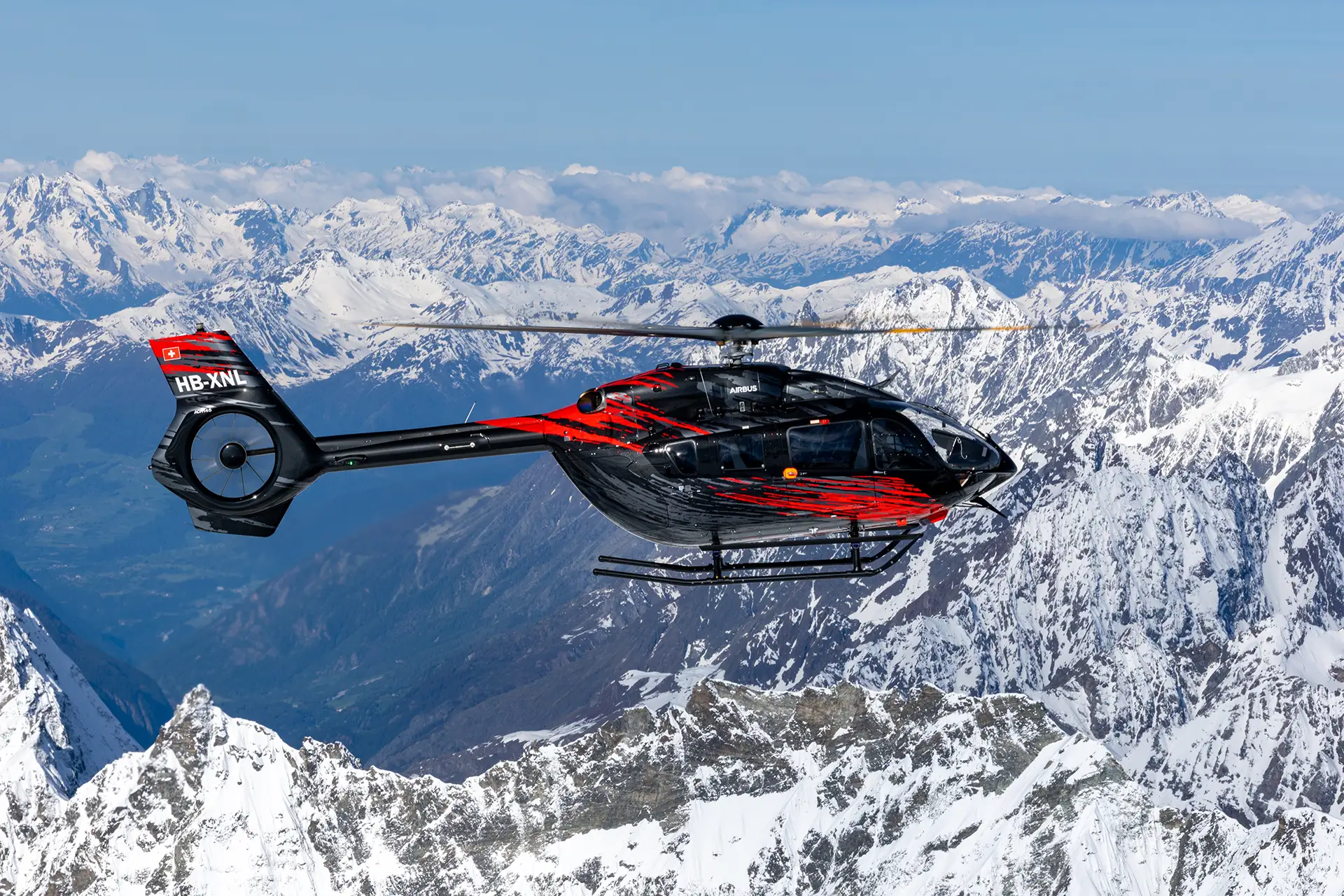
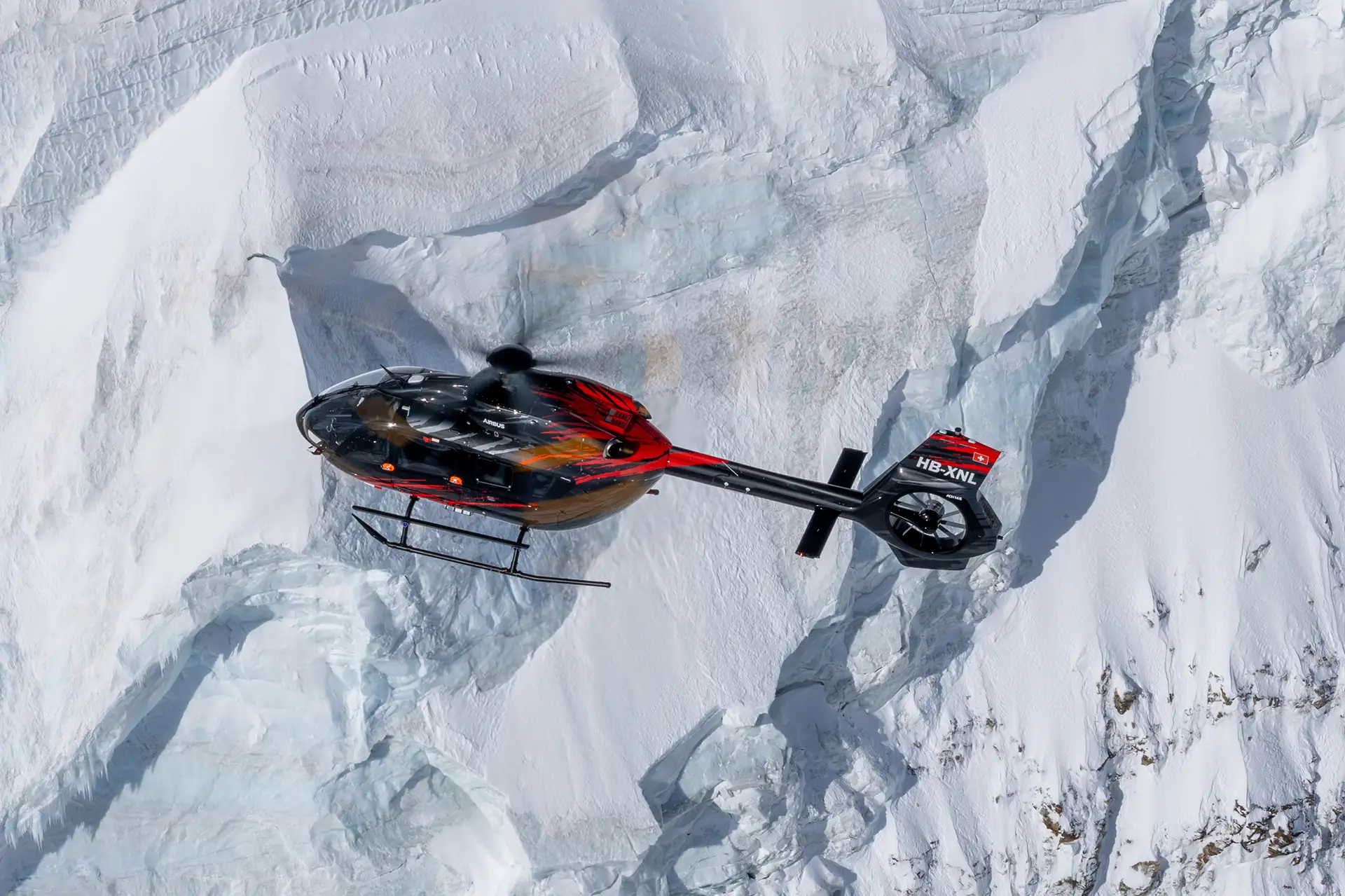
The H145-D3 is considerably more expensive to purchase and to operate than a B3 AS350, so the new company’s focus is on the very top end of the heli-tourism, skiing and charter markets. The helicopter presents magnificently, resplendent in a gloss-black paint finish, emblazoned with a diagonal contrast pattern in bright red and silver-grey. Rossier commented that the idea for the paint scheme came from ideas originally sketched out by the partner’s children and then fine-tuned by a designer. The Mecaer-designed interior is fitted out with plush cream leather upholstery and high-grade carpeting, and Bluetooth headsets are provided for all eight passenger seats.
As a new operation, 7K is entering the market in a calculated and cautious manner. “Any business has to earn money but we’re not crazy. We
know that it’s not easy to make money with the H145 because the costs are so high. So, we start the business and have objectives, then
step-by-step we hope that every year we will increase the flight hours and keep a good price. Then we will cover the costs and even more,
see some benefits. In the non-winter months, especially spring and fall, we’ll have a lot less activity for sure, but we’ll plan
maintenance during those times,” admitted Rossier. “In January, which is the lower-demand winter period we have the WEF (World Economic
Forum) in Davos, so there is a demand for helicopter transfer from Zurich or even Sion. We’ll also try to find activity in foreign
countries like Italy and France, for example there are always a lot of transfer requests for the Formula-1 world, and we have a good
partnership with companies like Air Corporate in Italy, so maybe we’ll try to work with them. With such a helicopter, the market is
everywhere, not just in Switzerland.”
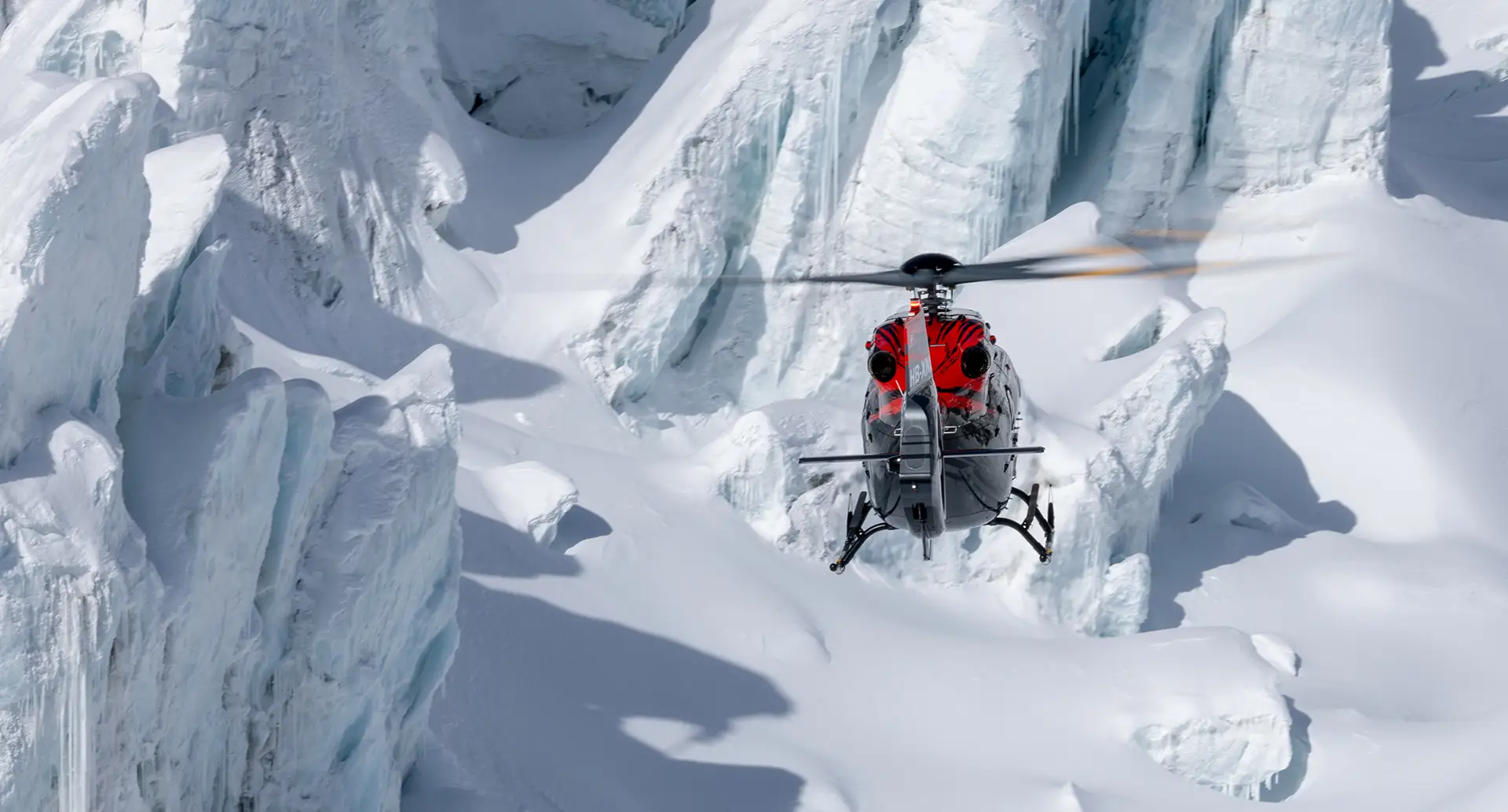
7K’s operation is based in Sion, in Switzerland’s Rhone Valley, and is housed at Alpark, an immaculate facility that provides heated hangarage, catering, reception, and all associated aviation services for corporate aircraft and helicopters. Centaurium Aviation MRO performs maintenance at its Sion facility, conveniently situated near Alpark. “We have a motorized heli-lift for the helicopter, so it’s easy-in and easy-out, we have good service from the great people here and it’s all in line with our level of service,” Rossier remarked. A signature FBO is immediately adjacent to Alpark, making it simple and efficient for transfer clients arriving at Sion to exit their aircraft and step straight on board the waiting helicopter. Sion is large enough to take a Boeing BBJ or Airbus A320, so most corporate aircraft can land there comfortably.
Sion
Sion is the closest airport to many ski resorts, including Verbier, Gstaad, Villars and Zermatt, where many wealthy people live year-round
or spend their skiing holidays. “That means we have clients that we can serve all year long, while in the winter high-season there are many
people who we can bring from the main airports to the ski resorts,” Rossier commented and he explained that, although Sion is close to the
resorts, its location in the mountains means that its approach and decision minima are higher than for other more distant airports.
“Because of that, we pick up people in Berne, Zurich or Geneva most of the time because their minima are much lower for landing with a
jet,” he advised.
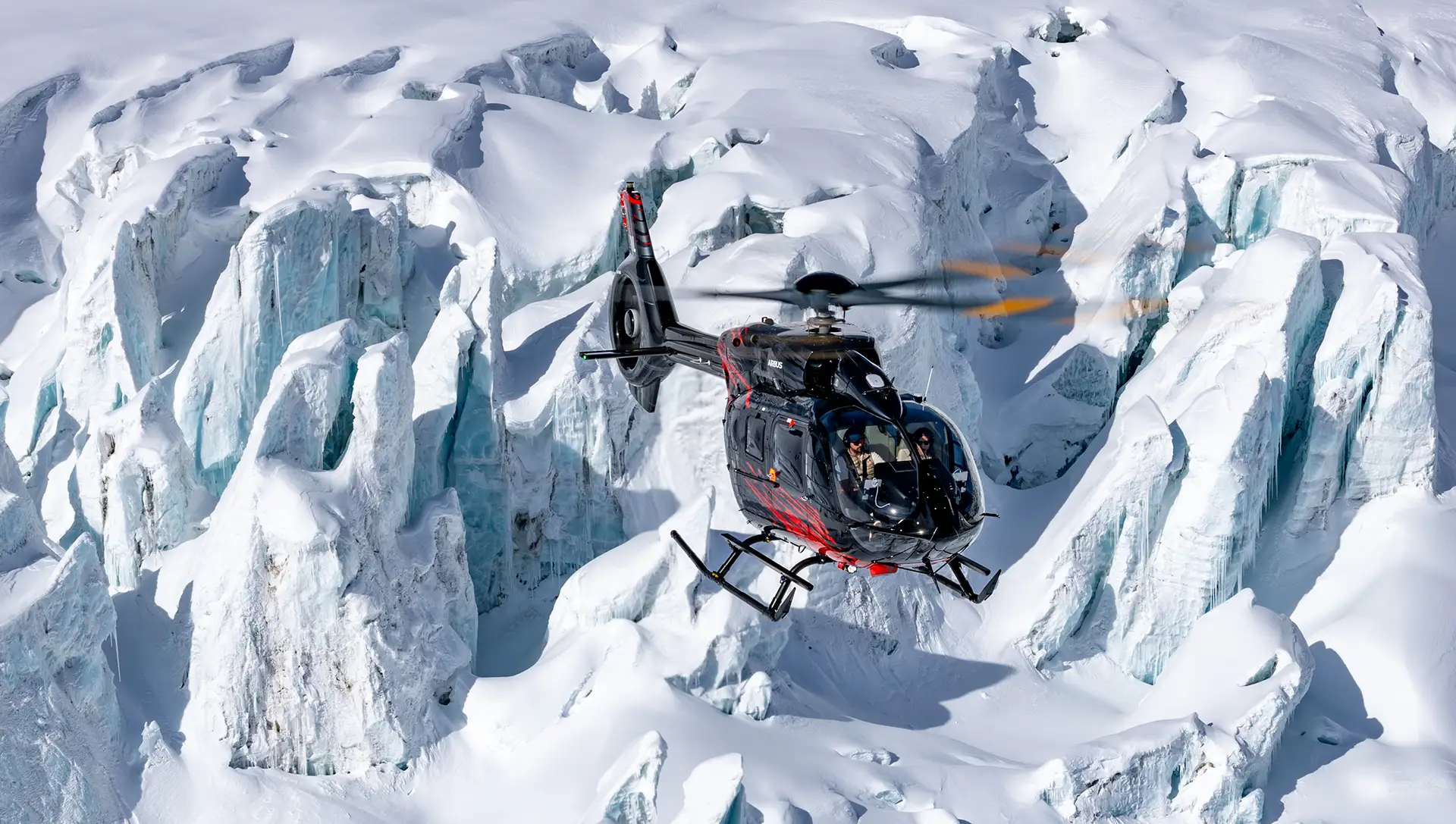
Such airport transfers were the first major component of 7K AIR’s operation and a second, rapidly growing component is heli-skiing, with
Rossier commenting that the H145-D3’s power and performance match the needs of those people who want and are prepared to pay for the safety
and security of twin engines and although the operation is usually conducted single-pilot, two pilot operations are possible for those
clients who require them. Mountain landings are strictly controlled in Switzerland and there are only 43 locations where they are permitted,
not all of which are ideal for heli-skiing. According to Rossier, there are ten permitted mountain landing sites in 7K’s area of operation
that are well suited though, so clients have a good choice of destinations from which to go heli-skiing.
Unlike many countries, heli-skiing in Switzerland is all booked and conducted by mountain guides, who approach helicopter companies on a
day-by-day basis to arrange heli-skiing trips for their clients if the weather is suitable. There is currently no external ski-basket
certified for the H145-D3 but Rossier explained that Dart is in the throes of building and certifying one and he stated that 7K has already
ordered one. It is hoped that it will be ready in about six months and when it is delivered, 7K AIR will be the first operator in the world
to have an H145-D3 with a ski basket. Heli-skiing flights will utilize Bearpaws on the 145’s skids and because they can be dirty, wet
operations, the seats, carpets and doorways will have protective coverings to preserve them in their pristine original condition.
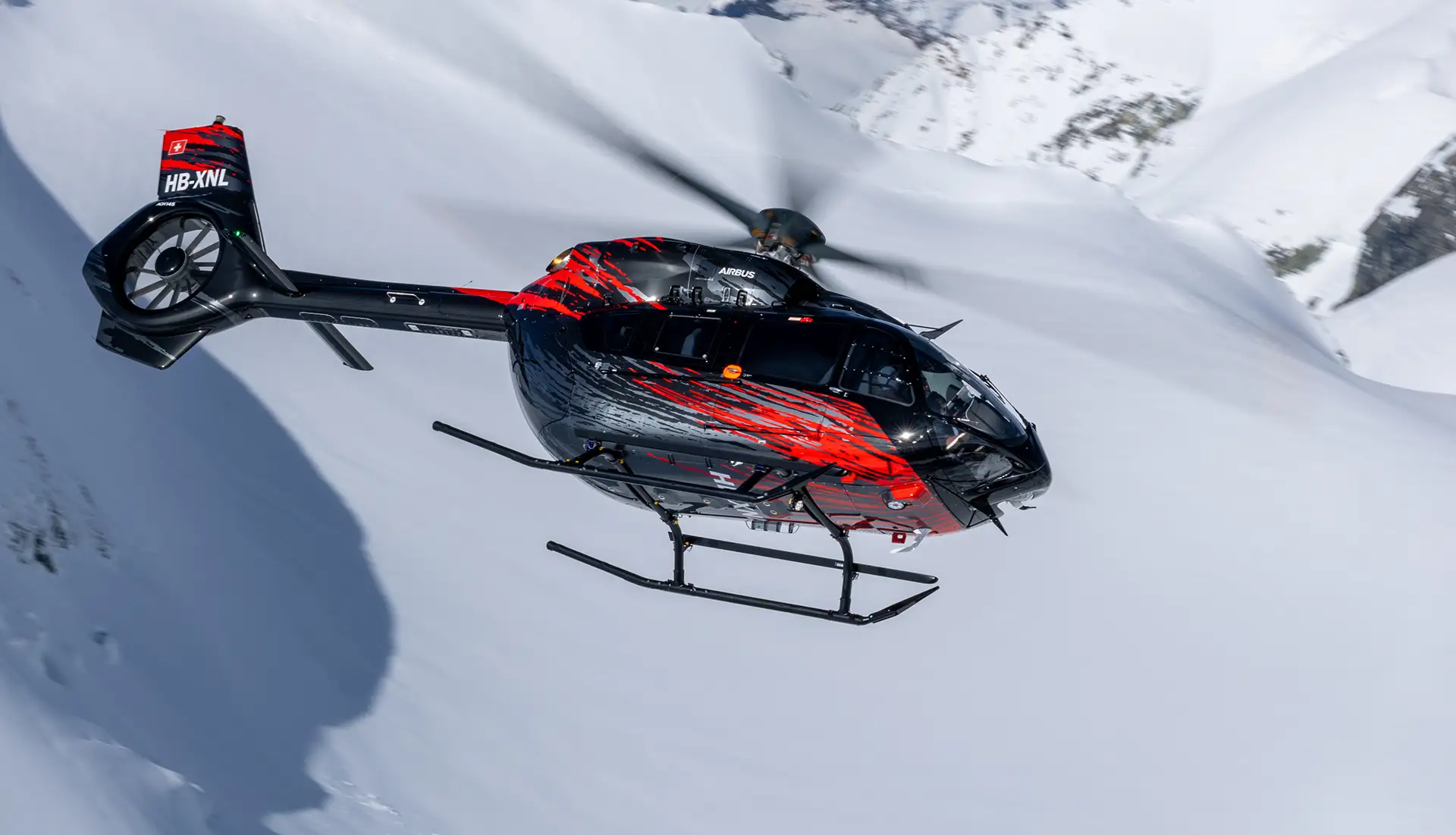
Rossier pointed out that the price of flying in the H145 largely dictates the market and customer base. Although he is happy to accept spur-of-the-moment or walk-in business for sightseeing flights, he does not expect much of that sort of business as Sion already boasts a number of operators servicing that segment effectively and more affordably with AS350 series aircraft. Nevertheless, the 145 does offer a hitherto unavailable level of capacity and luxurious comfort that is now accessible for those prepared to pay a premium price. 7K is entering the market at 6,000 Swiss francs/hour, a price held as low as feasible to compete with the Bell 429, the nearest competitor to the more powerful, larger-capacity H145.
Crew
Aside from Rossier, 7K has two other pilots on strength. Werner is one of Rega’s most experienced pilots and has flown the C2 variant of the H145 since 2003, with further time on the D2 and D3 versions, so he brings a wealth of experience and type knowledge to the team. Lukas is a freelance pilot who flies for Lodrino-based Heli-TV and for 7K as needed. The three pilots flying for the new company have amassed a total of around twenty thousand hours between them, so the skill level is unquestionable, and 7K operates under Heli-TV’s AOC, as obtaining their own is almost impossible due to bureaucratic hoops and immense expense, according to Rossier.
Getting the new company set up and running was not easy, but Rossier stated that they had great help from FOCA (Switzerland’s Federal Office of Civil Aviation). “It was the first time for them that the H145-D3 had been established in commercial air transport outside HEMS in Switzerland, so they were also in discovery mode,” he pointed out. “We did it in less than one month, which was pretty cool, and the next step for us is probably to do some IFR flying. We are developing our capabilities step-by-step.” Rossier also stressed that he and his partner have a relationship he describes as a strong entrepreneurial partnership. Each at their level, they developed and sold companies. “We discuss everything before we make a decision and sometimes he wins, sometimes I win.”
Future
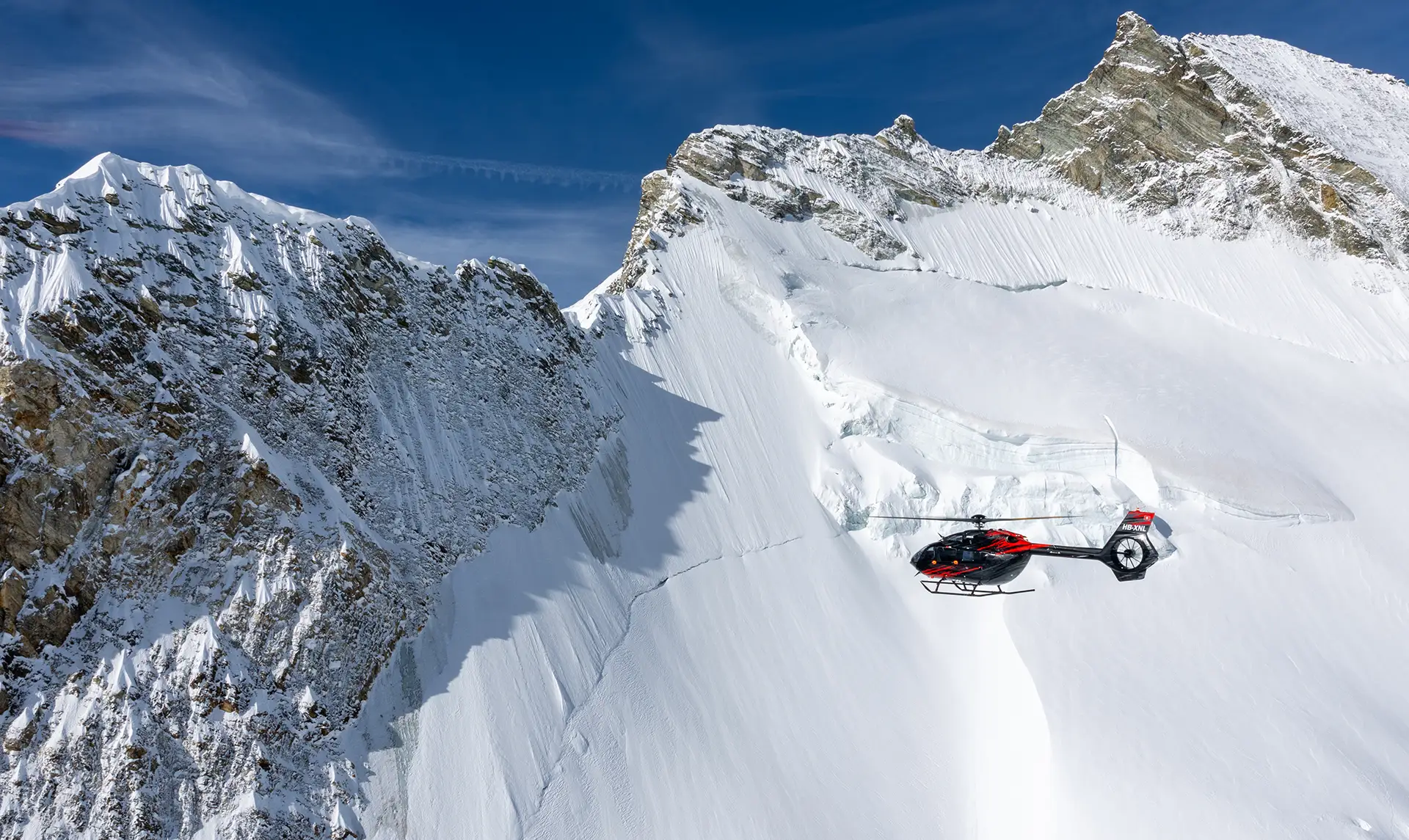
Rossier believes that in the near future, 7K AIR will be seen as the leader in VIP/corporate twin-engine helicopter services in Switzerland. “There will be a lot of curiosity about this helicopter, and it is a better aircraft than the 429. The service will be better, and we have a great team that will grow as our business increases. We’ll focus on what we know how to do and what we can do. Everything is possible, and we will tailor a package to suit whatever our client desires, provided it is safe and of the highest quality,” he commented. So, the future looks more than promising for this young, tightly focused company.