 HOME
HOME





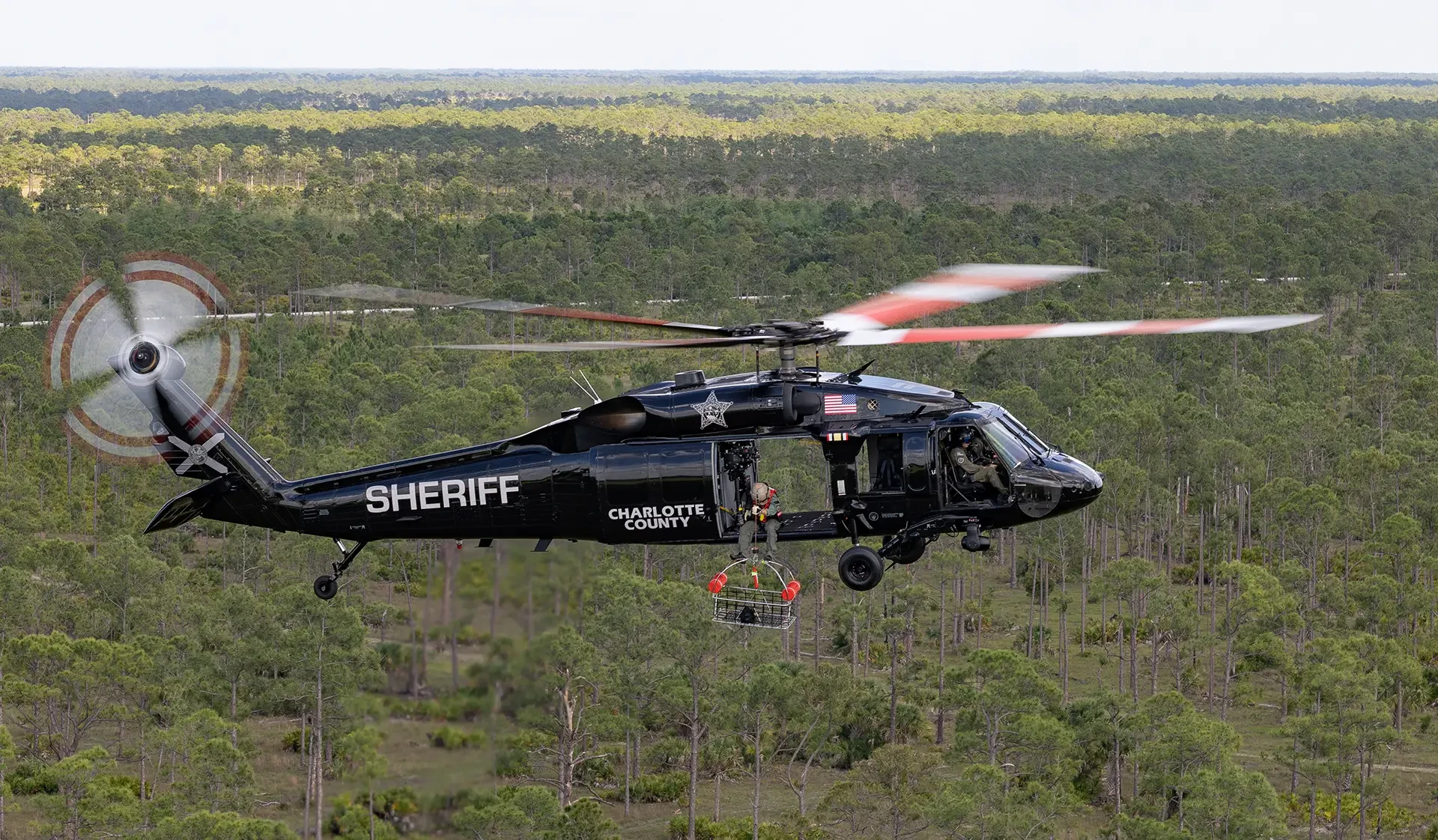
Missions, Math, and Public Safety: Inside Charlotte County Sheriff’s Office Black Hawk Program
Any lingering questions over the usefulness or necessity of the Charlotte County Sheriff’s Office (CCSO) Black Hawk nearly vanished the first time the aircraft responded to a fire with homes in its path. In Part 1, HeliOps explored the acquisition and equipping of the Black Hawk for the county’s needs. In Part 2, the story continues exploring the introduction of a Black Hawk to local law enforcement.
Fighting Fires in Florida
One of the easiest criticisms to make from a distance is also one of the easiest to misunderstand. Charlotte County’s terrain is flat and nearly at sea level. Why would it need a Black Hawk? The answer is performance.
At sea level, the aircraft can use its lift. In mountainous or high-density-altitude environments, a helicopter may have an impressive tank or bucket but not always be able to use its full capacity. The conditions in and around Charlotte County allow the ‘Hawk to operate to its full capabilities.
“We can actually fill up our bucket to 900 gallons,” Engelauf said. “Out west, when you’re working in the mountains… You may have a 900-gallon bucket or 1,000-gallon fire tank, but you may not be able to fill it up completely until later in the mission when you have burned off a good amount of fuel weight.”
That makes the aircraft a significant firefighting tool. Florida may not have the mountainous terrain often associated with aerial
firefighting, but it has brush fires, heat, wind, and large areas of wildland-urban interface where a fast aerial response can change the
outcome.
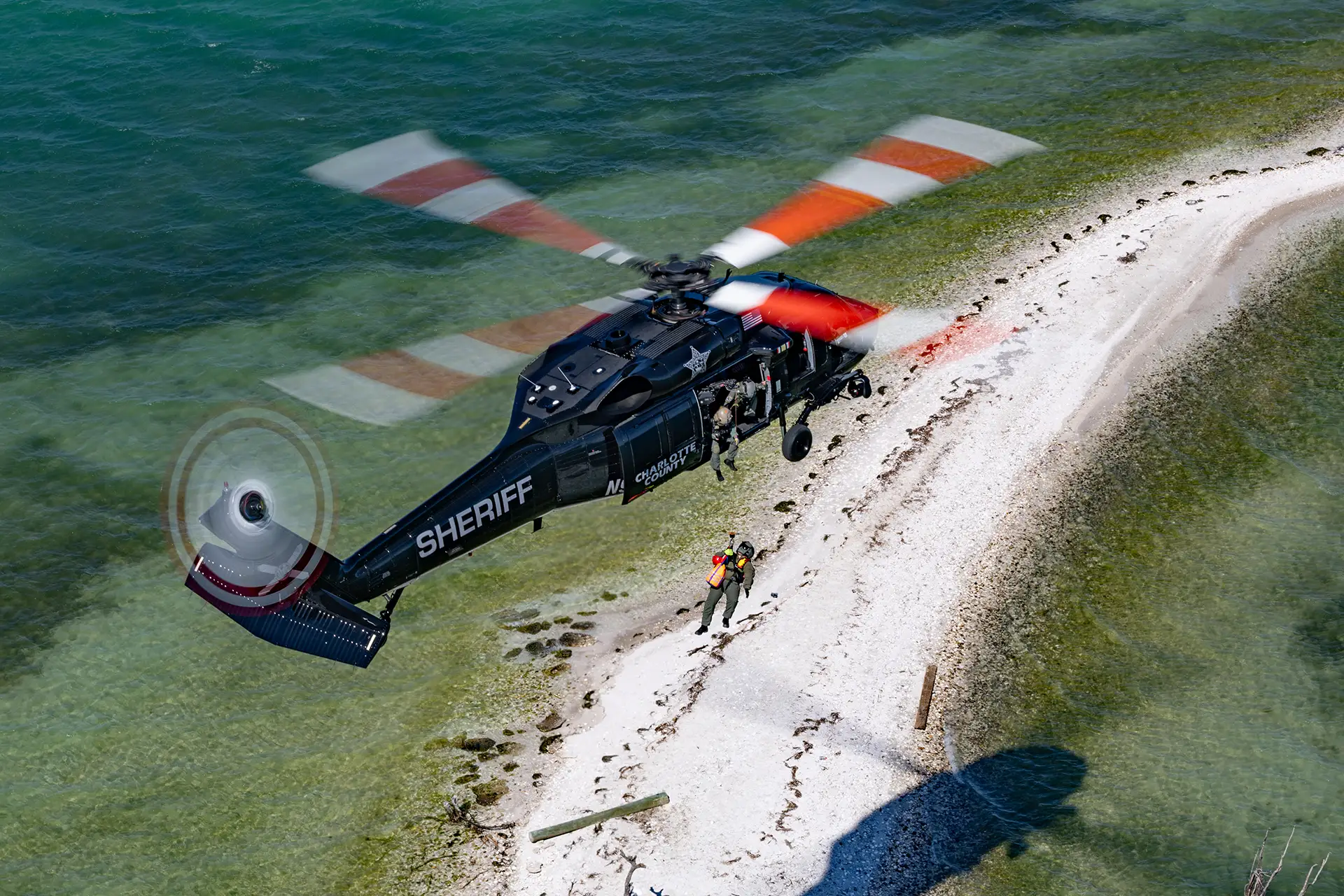
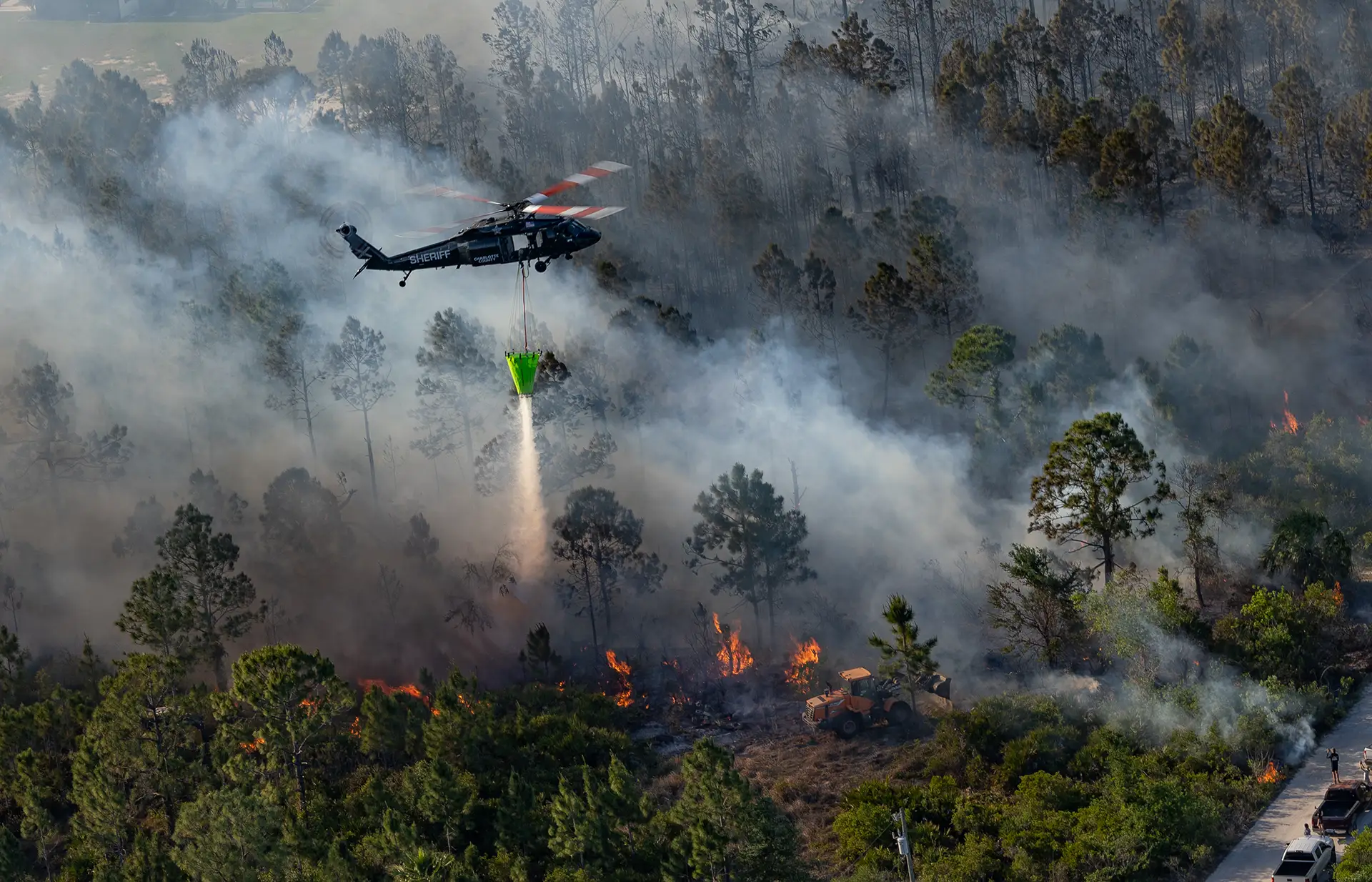
The unit’s first major fire response after receiving the Black Hawk proved this point. The call to respond to a brushfire came in while the aircraft was already in the air, conducting firefighting training. From Kloer’s seat, the mission was busy from the start. He was still new in the Black Hawk’s SIC role, and the crew was working inside a complex communications and aircraft-monitoring environment.
“It was pretty hectic,” Kloer said. “You’re talking to the fire command on the attack channel, you’re talking to law enforcement dispatch on another channel, and you’re talking to tower because we were in Class-D airspace… and you’re talking to the rest of the aircrew.”
At the same time, Kloer was helping monitor torque, fuel, wind, bucket loads, aircraft position, fire activity, and the rhythm of the drops. This mission was where the Black Hawk’s numbers moved from theory to operational reality.
At 900 gallons, the Black Hawk’s fire bucket dwarfs the unit’s previous aerial firefighting capacities. That difference changes how quickly a crew can attack the head of a fire, how many turns are required to have an effect, and how much support the aircraft can provide to ground crews when the fire gets loose.
“I love the AStar,” Engelauf said, “but 144 gallons of water wasn’t going to cut it that day.” For Kloer, the mission also carried a larger meaning. It was an early opportunity to show the community that the aircraft had been purchased for a reason.
“It was a really good feeling to go out there and put the aircraft to use,” he said, “and show the people of the county that we bought it for a reason.”
The same lift, power, endurance, and margin that make the Black Hawk so effective over a fire also matter in another mission type that pushed CCSO toward a larger twin: offshore rescue.
Closing the Offshore Gap and Storm Response
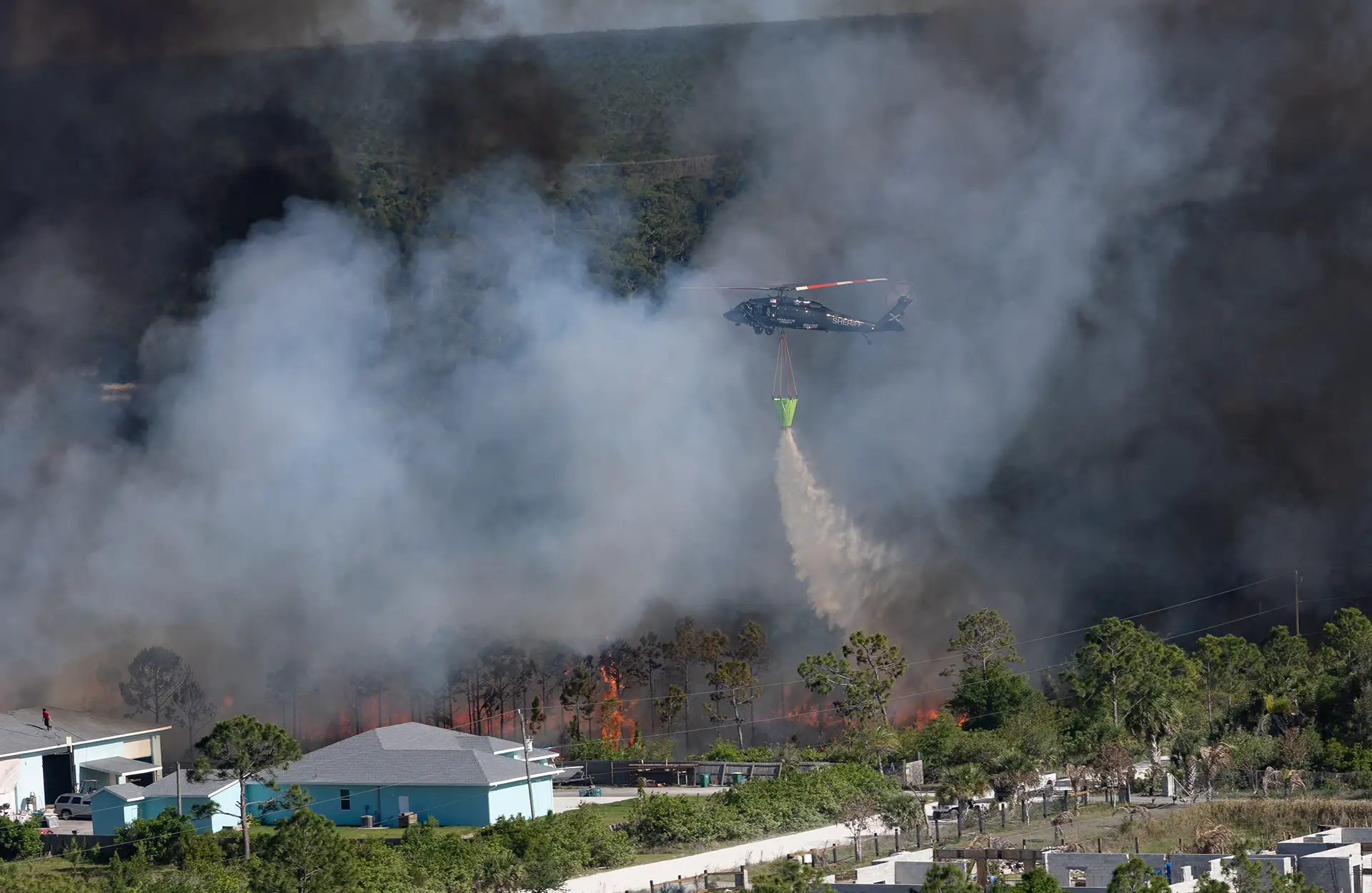
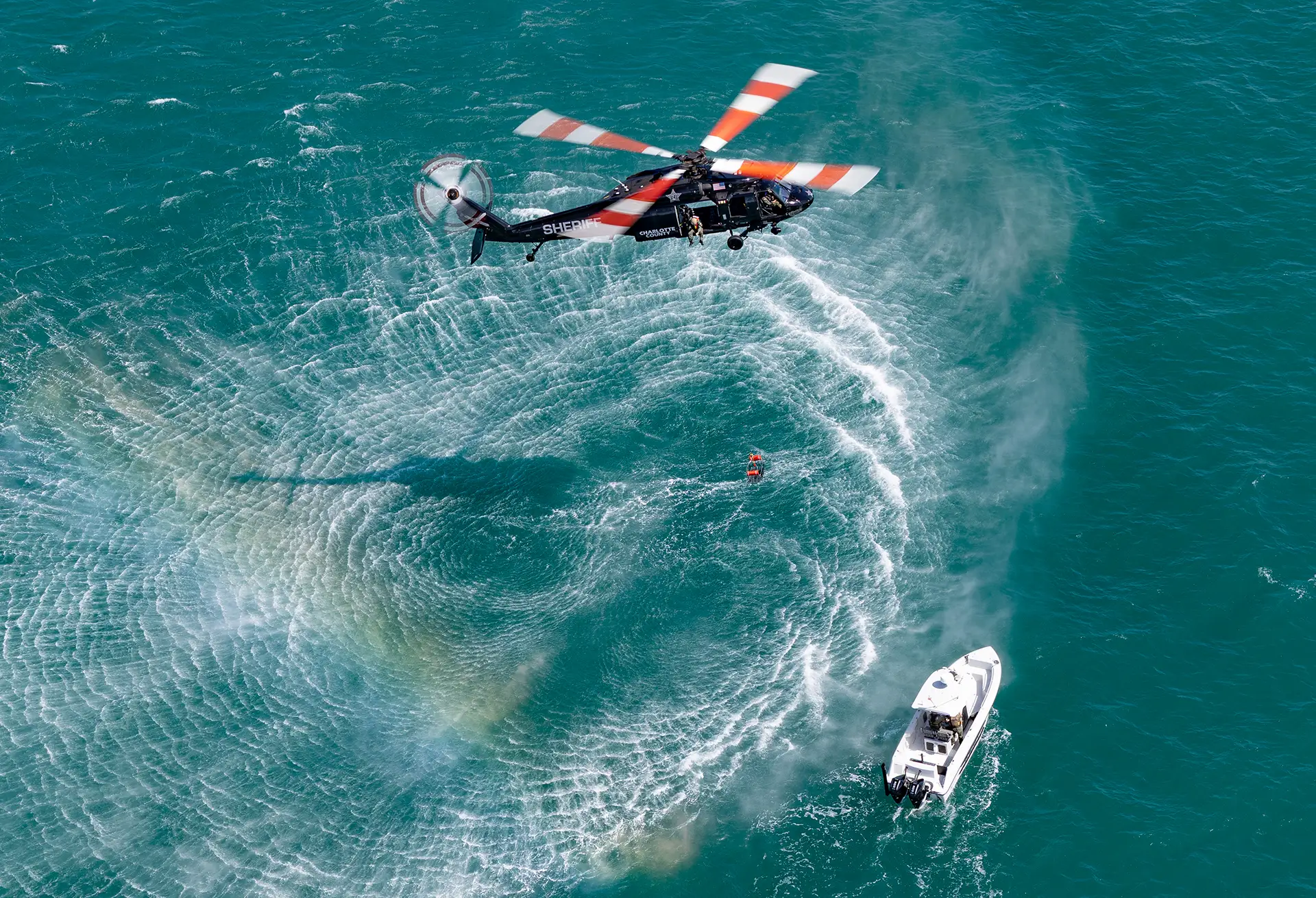
Charlotte County sits in a coastal environment where offshore response is not a niche mission. Around Punta Gorda, Port Charlotte, Englewood, and the surrounding region, boating and fishing traffic routinely pushes 40 to 60 miles offshore. For a county aviation unit, that creates a practical public-safety question: how far can the aircraft go, how long can it remain useful once it gets there, and how many people can it bring back? “It’s made for going offshore and doing rescues,” Engelauf said. “We’re going to be able to reach out 50 miles offshore.”
The United States Coast Guard remains the primary federal maritime rescue agency, and Engelauf is careful not to diminish that role. He sees the Coast Guard’s offshore hoist experience as a valuable resource, especially as the Aviation Unit continues developing its own capability. But geography has a real effect on response time. With Coast Guard sectors based around St. Petersburg and Miami, Charlotte County sits in what Engelauf describes as a gap in the middle.
“We’re that missing gap in the middle; our location adds nearly an hour to their response time,” Engelauf said. “That’s why you’ve seen Collier and Sarasota get into the hoist game also.” CCSO’s rescue experience does not begin with the Black Hawk. The unit has already performed rescues from its AStars and Huey. That experience gave the unit a solid foundation even before the H-60 arrived. “We’ve done rescues in our AStar before via the long line, we’ve done them in our Hueys with our hoist,” Engelauf said. “The Black Hawk gives us longer legs and improved safety going offshore.”
The transition from Huey to Hawk for hoist rescues has been evolutionary. The unit has extensive experience with the same hoist that carried over to the H-60, allowing crews to build on existing procedures instead of starting from scratch. “We already did the crawl, walk, run, with our Huey.” Engelauf said. “Now you get into the 60, and you have twice as much room in the cabin, but you’re operating the same exact piece of equipment.”
Offshore, the Black Hawk brings twin-engine redundancy, greater range, more cabin space, more power, and better margins for night and overwater rescue. After a storm, those same qualities are just as valuable over land.
Barrier islands and coastal communities such as Boca Grande, Don Pedro, and the Englewood Beach area can become difficult or impossible to access by road after a hurricane. Agencies need to solve the logistical problems of how crews, supplies, rescue equipment, and firefighting capability can be moved when sand, debris, and damaged roads cut off normal access.
With the Black Hawk, CCSO can now sling-load equipment, supplies, and pre-position rescue or fire response packages into areas vehicles cannot reach, using the aircraft much as it was originally intended: as a multi-mission utility platform.
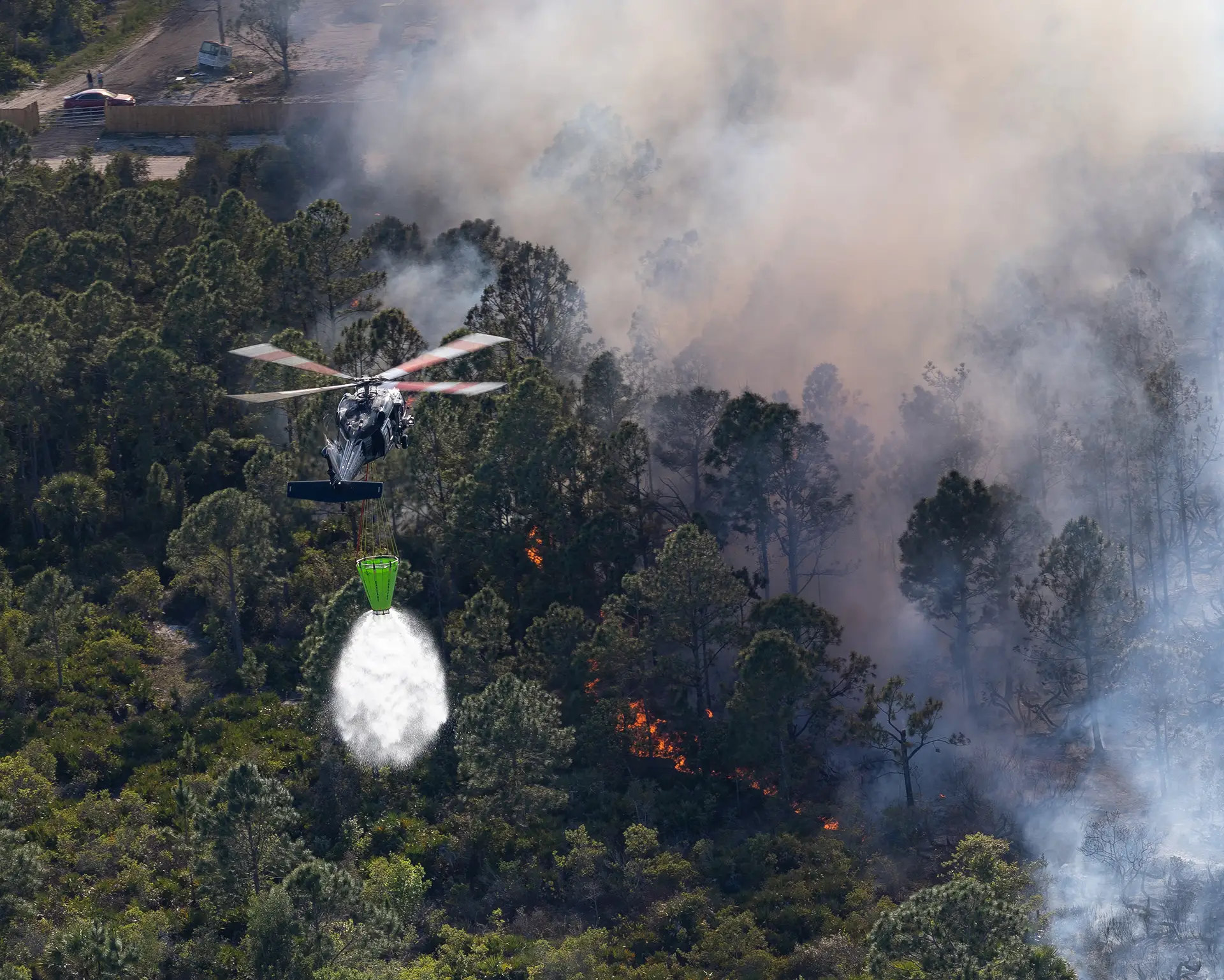
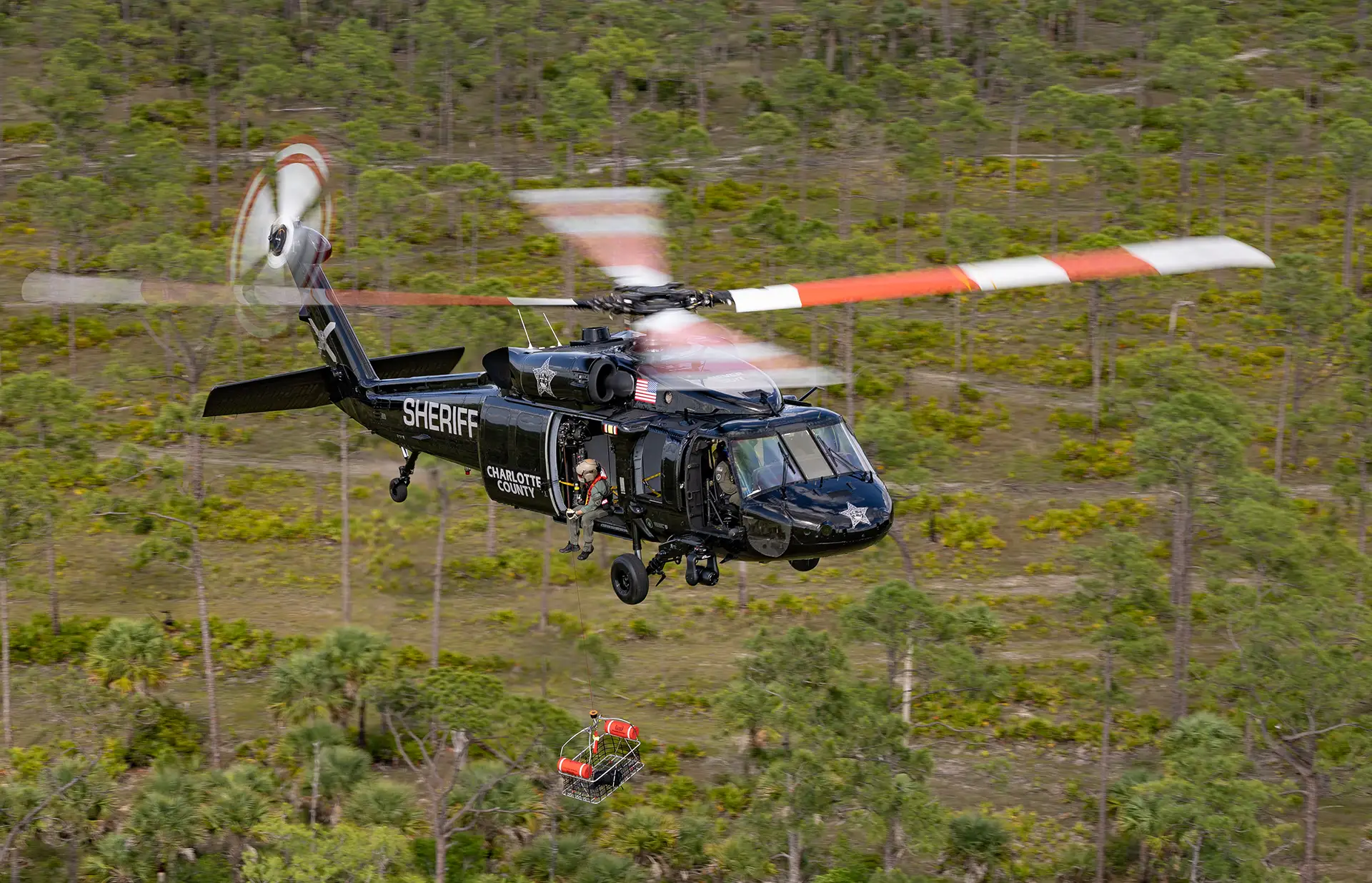
Those same mission demands have also shaped the aircraft’s interior. To make the Black Hawk useful for offshore rescue, hoist work, fire support, tactical operations, and disaster response, CCSO built that multi-mission thinking into the cabin, crew stations, and mission equipment.
Mission Equipped, Inside and Out
Charlotte County’s Black Hawk is not simply a surplus aircraft with new paint. It has been configured around the public-safety work the unit expects it to perform.
The cockpit was updated with Garmin glass, including the G500 TXi, dual GTN 750 navigation and communication units, and a GRA 55 radar altimeter. The mission equipment includes Technisonic 9100 radios, Churchill/SHOTOVER mapping and downlink, a Trakka searchlight, front and rear TFO stations with 15-inch Macro-Blue monitors, Starlink, Axnes wireless communications, public address capability, and video monitoring for the hook, hoist, and tail.
A Goodrich internal hoist and the 200-gallon Robertson auxiliary fuel cell give the aircraft rescue capability and extended range. The aircraft also carries the practical tools needed for multi-mission work, including cargo hook capability, rescue equipment, water-rescue gear, and the communications redundancy needed when crews are working over water, around fire, or in complex public-safety environments. Not every modification was about avionics or rescue systems. Some of the most telling details are smaller. “The common 42305 Onboard Systems hoist used on both the Huey and Black Hawk allows us to close the training gap much quicker when it comes to hoist operations, because we already have established SOPs and the crews are comfortable on the equipment.” Explained Engelauf
One of Engelauf’s favorite examples is the SeaDek-style flooring installed in the cabin. Borrowed from the marine environment and adapted after CCSO saw another agency use it successfully, the material gives crews a more forgiving surface when working on their knees in the back of the aircraft. That may sound minor compared to a hoist or FLIR turret, but in rescue work, ergonomics matter. Crews crawl, kneel, secure equipment, rig patients, manage lines, and move around the cabin under pressure. Knee pads get forgotten and hard floors are punishing.
“None of us here are spring chickens,” Engelauf said. “A career of military law enforcement, your knees hurt, and that material makes a huge difference.”
Further, the aircraft’s 110-volt power capability, supplied through a True Blue converter, also opened the door for practical public-use additions such as Starlink and auxiliary cabin cooling, details that rarely lead a spec sheet but make a difference when an aircraft is operating daily in Florida’s environment.
That combination of mission systems and crew-driven refinements reflects how Charlotte County is approaching the aircraft. The unit is not treating the Black Hawk as a static platform. Storage, equipment placement, crew stations, monitors, rescue gear, communications, and mission flow are continually being refined as the unit learns what works best in the aircraft.
That matters because the cabin is not just a workspace for rescue crews. It is also what allows the Black Hawk to move people, equipment, sensors, and command capability into places where ground access is limited, time is compressed, or a smaller aircraft cannot carry enough people or equipment to change the outcome.
Tactical Reach
The Black Hawk also changes the scale and speed of tactical support options available to the sheriff’s office. Charlotte County has rural areas where moving a team by road may take time or limit options. With the Black Hawk, CCSO can move a larger Special Weapons and Tactics (SWAT) element, insert personnel, support deputies on the ground with airborne FLIR and searchlight capability, and retain the ability to evacuate casualties or move people at scale if an incident demands it.
“We have a lot of rural areas, and this helicopter is a huge opportunity for us.” Engelauf said. “Now we can take an entire SWAT team to an objective, or to a target, put them on the ground, or fast rope them in with the specialty-built Fast rope/FRIES bar from Fulcrum Concepts”. ”
Capacity matters here. A smaller helicopter may be able to place a few people or provide overwatch, but the Black Hawk can move a team and equipment while still carrying the sensors, lighting, communications, and crew needed to support the operation.
Some advanced tactical capabilities remain in development, and Engelauf is careful about what he discusses publicly. But the direction is clear. The UH-60 gives CCSO options it did not previously have; rural team movement, fast-rope potential, large-scale casualty evacuation, and the ability to bring a capable airborne platform to complex incidents.
In remote tactical operations, active shooter incidents, hurricane response, or major rescue, capacity determines how many people can be moved, how quickly, and with what support. That kind of capability is shifting public perception away from asking why the county would need a Black Hawk.
A Community Aircraft
Military-looking helicopters can create complicated reactions in civilian communities. Engelauf expected some of that. However, the response to Charlotte County’s Black Hawk has been overwhelmingly positive.
Part of that reaction is cultural. The county’s large veteran community understands the emotional weight of aircraft like the Huey and Black Hawk. For Vietnam-era veterans, the Huey remains deeply familiar. The Black Hawk carries a similar resonance for the post-9/11 Global War on Terror (GWOT) veterans.
But the broader public response has gone beyond nostalgia. The first major fire response gave county residents a direct connection to the aircraft’s purpose. Some people who had earlier questioned the purchase changed their view after seeing the Black Hawk at work. Others have approached the crew at static displays and connected the mission to homes and people they knew.
“You know, that was my neighbor’s house,” Kloer recalled people saying. “I was there that day… thank you so much.” For a county program, that kind of in-person or social media validation matters. Public acceptance is not built through specifications alone. It is built when people see an aircraft make a difference.
Some of that impact is highly visible, like stopping a fire or rescuing boaters offshore, some is less obvious but just as important. Mosquito control is one of those practical county missions that helped make the aircraft’s size and lift capacity meaningful from the beginning. Charlotte County’s aviation unit had long supported mosquito-control work, and the ability to carry more product per cycle changed the efficiency equation in much the same way the 900-gallon fire bucket changed the firefighting equation.
A larger aircraft can reduce a mosquito-control mission from numerous smaller turns to a handful of larger ones. The county gains time, fuel efficiency, and operational flexibility. It is not a glamorous mission, but one that the Black Hawk is well-suited for, and exactly the kind of routine county mission that contributes greatly to public health and safety.
That combination of visible impact and practical county utility has now shifted public conversations from questioning why the county needed a Black Hawk to expressing pride in what the aircraft provides for the community.
“The community has kind of really taken hold of the 60 now,” Engelauf said. “They think it’s as cool and useful as we do.”
Built to Answer the Call
Being the first local law enforcement agency in the United States to operate a Black Hawk will always be part of Charlotte County’s story. But the more meaningful achievement is that CCSO built a disciplined, effective, public-safety aviation program around an aircraft that many agencies might have dismissed before ever running the numbers.
Agencies operate in different environments, with different budgets, fleet needs, and mission demands. For many, a Bell 412, 429, or another civil twin is the right fit. Engelauf is clear that the Black Hawk is not the answer for every sheriff’s office. “If you have the need for a ’60, and can find a way to get into one, it makes sense,” Engelauf said. “But if you don’t have the need for it, it doesn’t make any sense to get one.”
Charlotte County had the need. The Black Hawk may have made Charlotte County first, but the program was never built around being first. It was built to ensure CCSO’s Aviation Unit is ready when the call comes.