 HOME
HOME




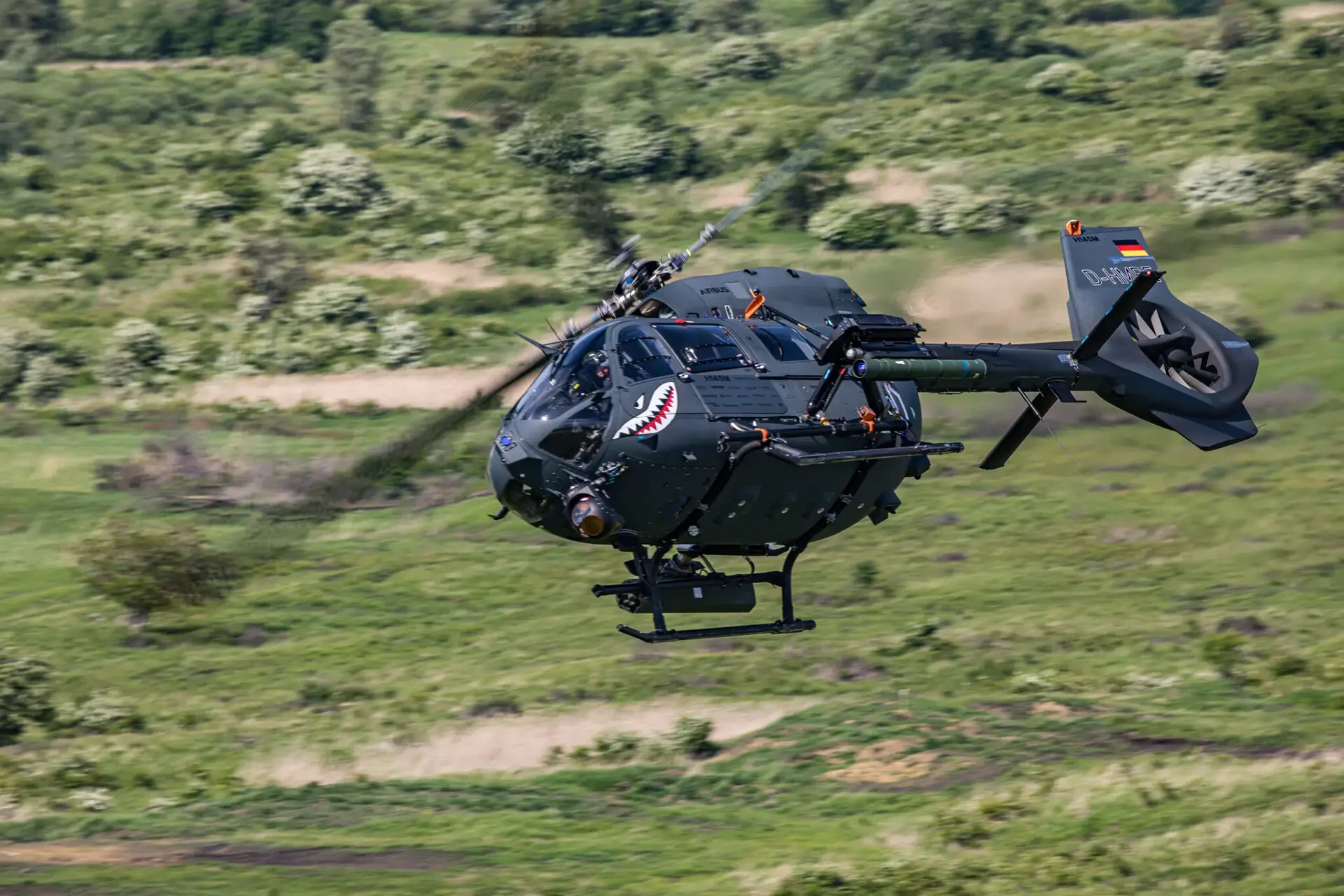
We've written quite a lot recently about and including Airbus Helicopters’ popular H145 twin engined helicopter. Paul Kennard now assesses the 145 as an attack helicopter. Could it be an economical alternative to the specialized machines? In this two-part series, Paul flies with Airbus and the H145M.
Firstly, the recent buzz around the Product launch of Airbus' H140 at the first 'Verticon' ('Heli Expo' in old parlance) has inevitable
caused many in the industry to examine where this new niche-filling product, bigger than a H135 but smaller than a H145 (logically), might
steal sales off its siblings. 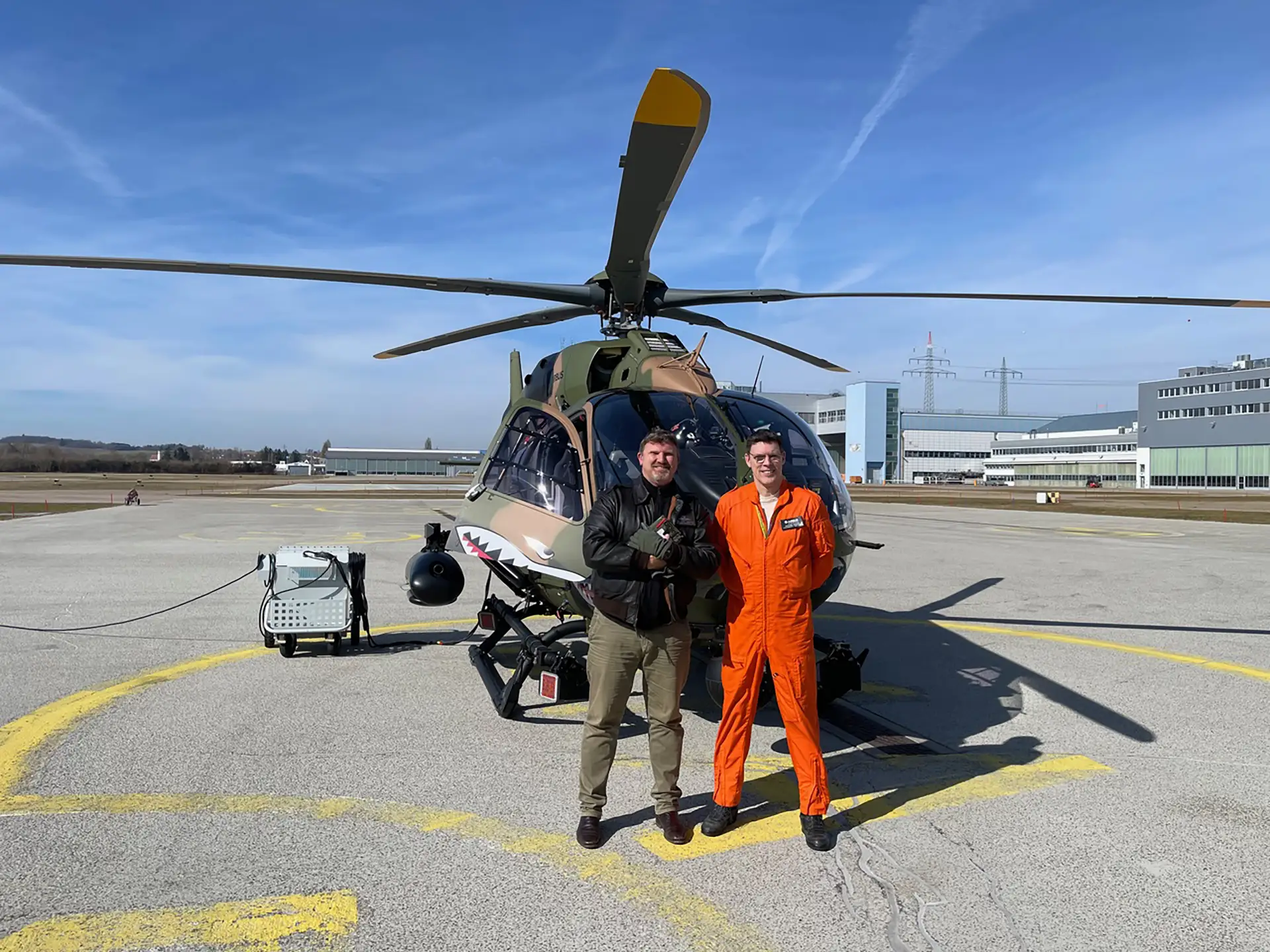
Secondly, we've looked at the aircraft in the training role for the US Army, as the UH-72A Lakota, as part of an examination of why the Army
feel that now is the time to change back to a cheaper, simpler, single-engined machine to teach elementary helicopter handling skills to
future generations of pilots. In sum, the Army seems to think that the Lakota is 'too much helicopter' for the training role; too
expensive to maintain and operate and offering too much 'pilot help' in terms of flying and navigations tasks. The Army has suffered a
noticeable 'spike' in its Class A Mishap Rate in recent years, which some attribute to an erosion of basic, 'pure', handling skills.
The Auto Pilot on the Lakota is accused of 'numbing' raw helicopter aerodynamic effects, and the inability of the aircraft to conduct
routine touchdown autorotations (due to mast moment strain and blade hub stresses during high coning angles) has become something of a
crusade amongst many instructors.
Almost a case of 'Make Autorotations Great Again'.
It's manifestly no fault of the aircraft if it's been pressed into service in a role for financial convenience, and where the requirements are now shifting under its feet. Nor, perhaps, is the root cause of the climbing accident rate a criticism solely of the product being outputted by the 'training pipeline'. The broader cause of the increase in losses, and tragic fatalities, could be a combination of the dilution rate on front line units (where the erosion of experience is seemingly placing greater demands upon front line crews, perhaps earlier in their careers than would normally be the case), reduced monthly flight hours, and a shift in emphasis back to peer on peer warfighting after two decades of Counter Insurgency (COIN) heavy operations. Having to go back to practicing 'Cold War skills' at low level in a sensor-heavy and sophisticated threat environment will prove a challenge to many aviators. As John Boyd noted, if you're not training realistically and suffering occasional accidents, you're probably not training hard enough for high intensity combat against a near-peer foe. 'Train hard, fight easy'.
Another recent piece has posed the question of whether the Lakota could be repurposed as a solution to Army Aviation's seemingly
intractable problem, finally delivering a replacement Scout helicopter after a number of false starts and failed initiatives - the Future
Armed Reconnaissance Aircraft (FARA) being simply the most recent of them. Germany has recently showed the US Army what it could
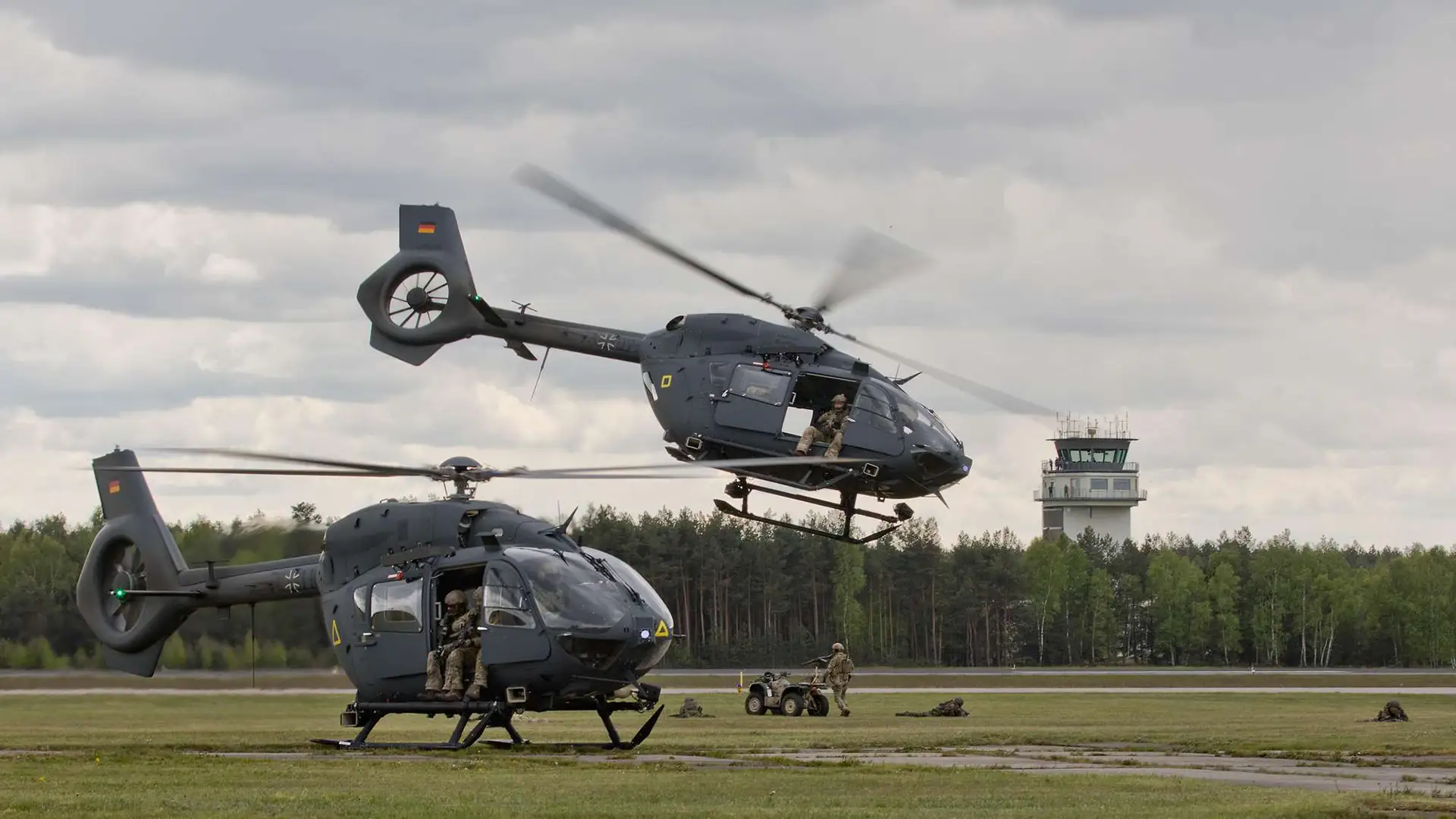
consider doing with its estimated 150-200 surplus LUH-72s if, as expected, they are removed from the training role. Germany has placed
an order for 62 H145Ms (with options for 20 more) as a kind of “bridge-solution” for its Tiger Attack Helicopters (AH). Concerns over
the technical risk and operating costs of the latest Tiger upgrade, 'Tiger MKIII', have led the Germans to abandon plans to upgrade
their Tiger fleet, and to seek a cheaper and more resilient “bridge-solution” replacement. At times, German Tiger availability has
averaged around 25%, meaning that less than 15 of the 51-aircraft fleet are ready for operational use. Given the H145M's civil roots,
where 'availability is king' and 'AOG an anathema', it seems that Germany is willing to forego some of the high end capabilities a dedicated
AH can offer, in exchange for more combat mass at any given time and a more flexible asset, both in peace and wartime use.
Given then, the swirl of recent activity around the H145M, I was delighted to receive an invitation from Airbus Helicopters to experience a demo flight in their H145M the day after the pre-Verticon (and heavily embargoed!) media introduction to the H140. Even better, the aircraft I was to fly was equipped to a very similar standard to the 'weaponised' portion of the 62 (+20) that the Bundeswehr have ordered. This meant the latest incarnation of the Helionix cockpit, 4-axis Auto Pilot, twin channel FADEC and the 'HForce' weapons system. I was also permitted to fly the aircraft with the Thales Scorpion Helmet Mounted Sight Display (HMSD) to gain a fuller appreciation of the H145M's full 'talents'.
My pilot for the day, Raymond, took me through a swift familiarisation and fit of the helmet and HMSD combination, before outlining the sortie profile. The key objectives were to assess the Handling Qualities improvements afforded by the latest version of the Helionix cockpit and auto pilot, as well as the workload reduction and situational awareness enhancements provided by the twin-channel FADEC and HMSD, before completing some Simulated Attack Profiles (SAPs) to investigate the systems integration of HForce. We completed the safety brief and strolled to the aircraft on a cool and crisp Spring morning at Donauwörth.
And didn't she look both pretty and pugnacious?
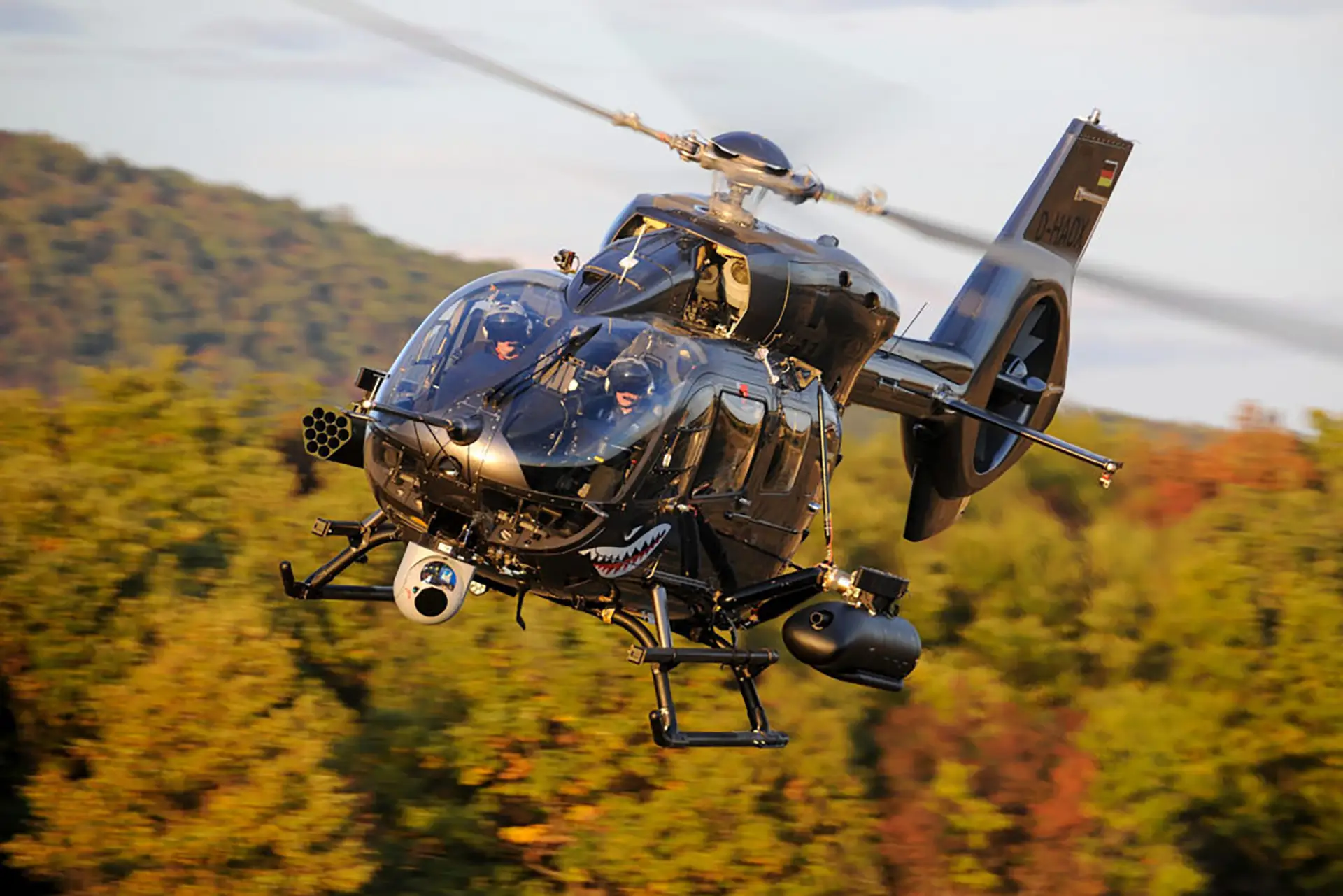
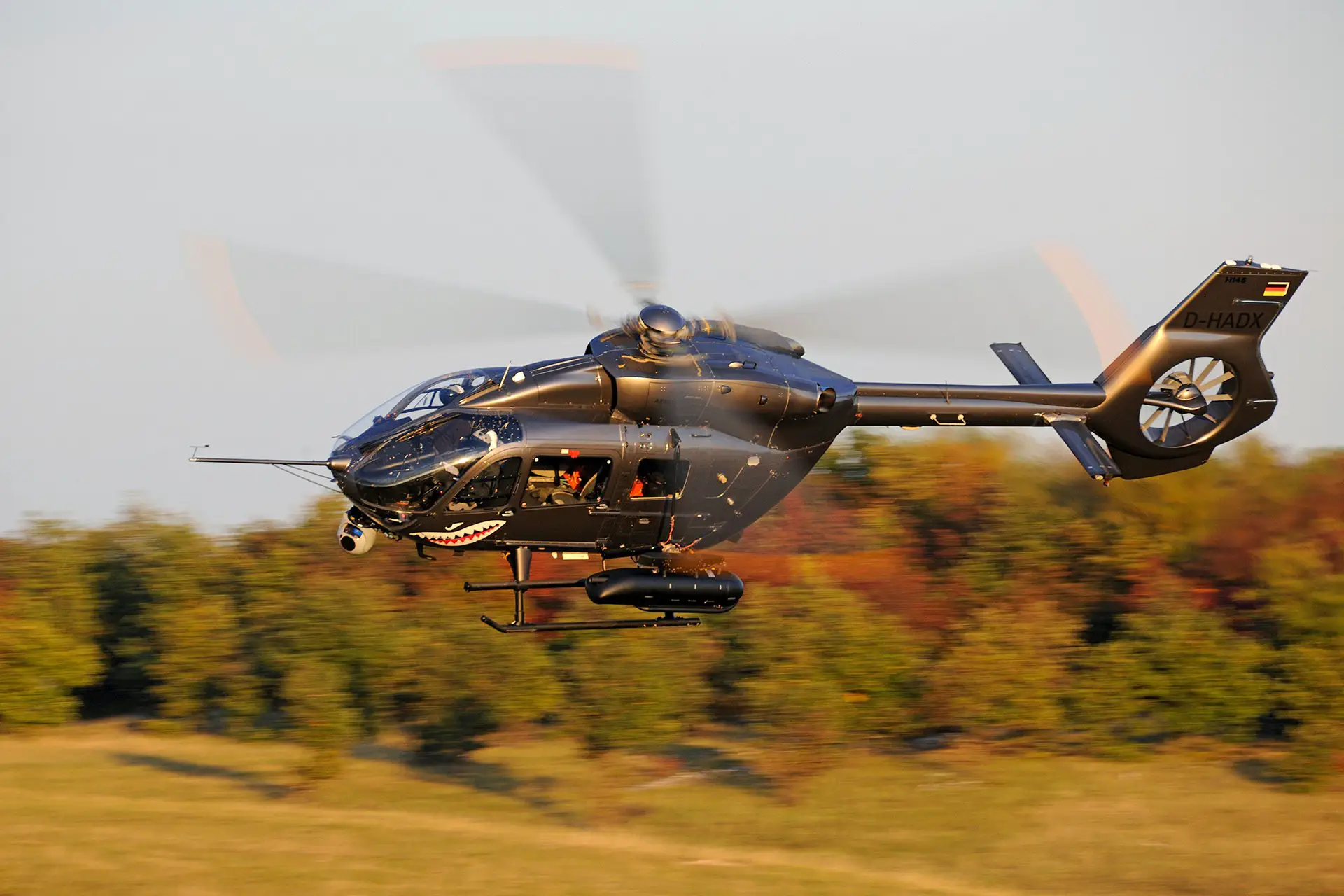
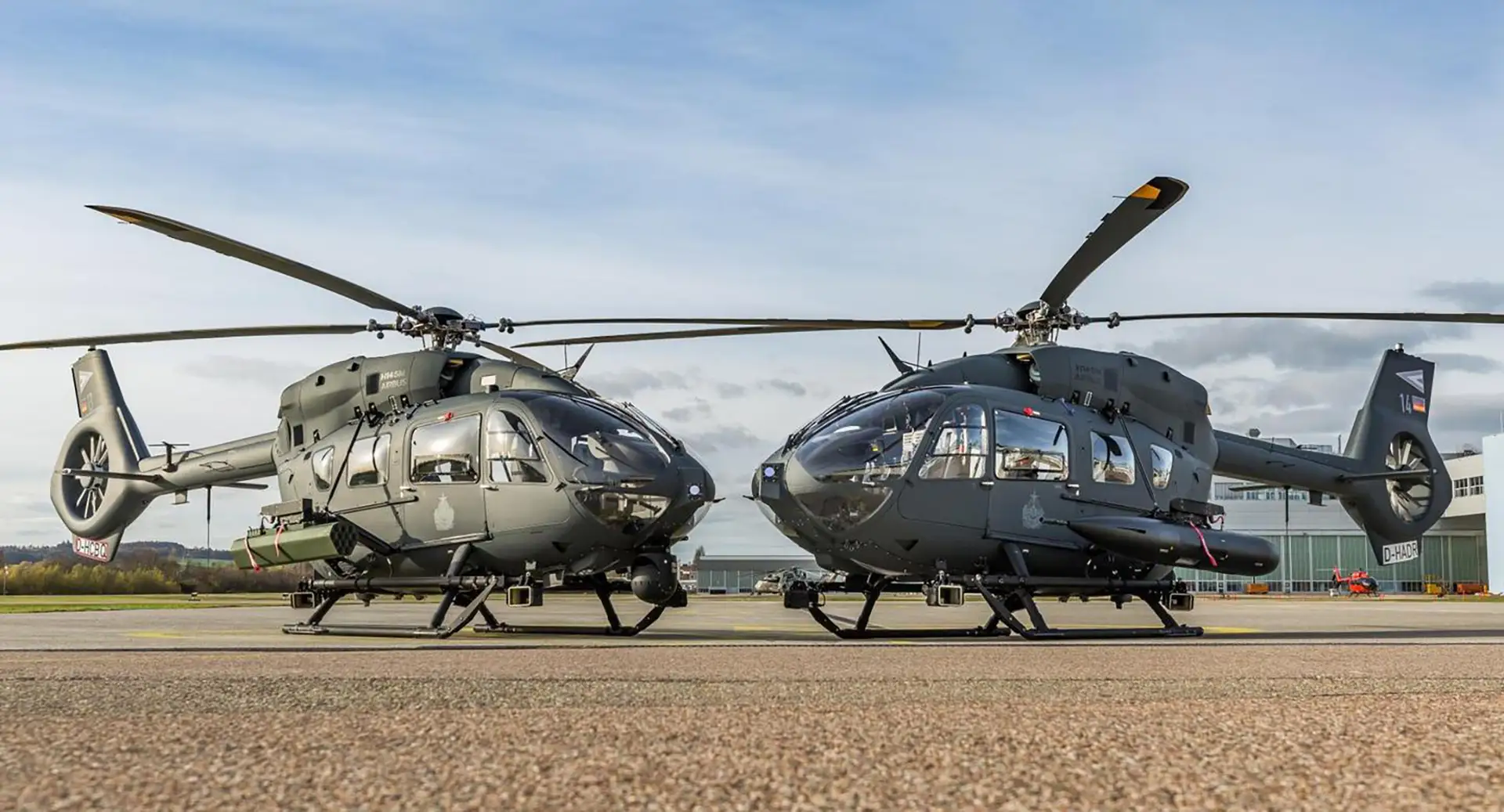
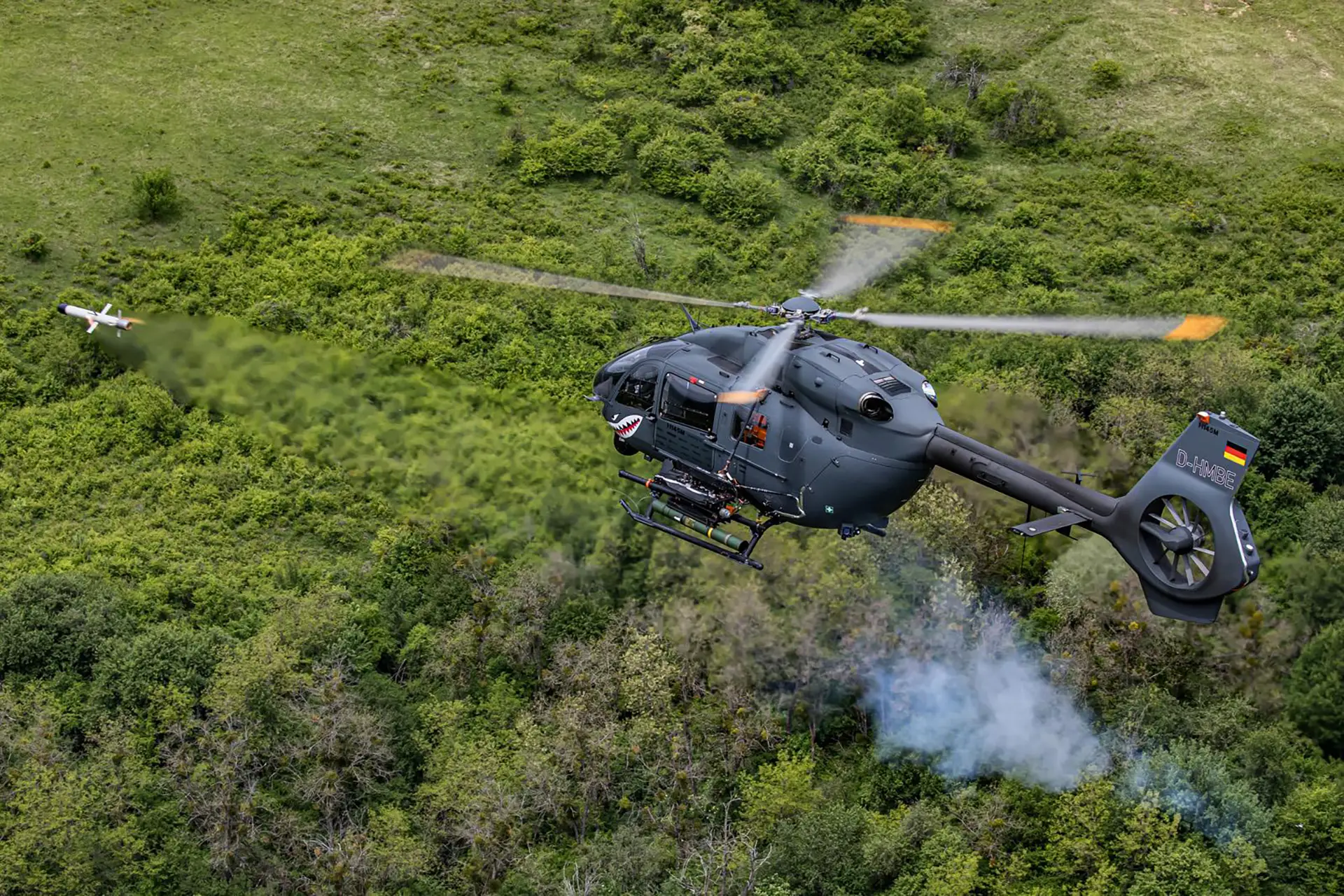
Pretty in terms of an attractive camouflage paint scheme and, most importantly, shark’s teeth either side of the nose. To paraphrase Jane Austen, it is a fact universally acknowledged that essentially all flying machines look better with shark’s teeth painted on them - and the H145M is no exception. Pugnacious as the normally somewhat sleek, bordering on effete, lines of the civil H145 were considerably changed by the fitment of Meeker mounts equipped with flare dispensers, CMX-15D EO/IR turret and Missile Warning Sensors on the nose, and, finally, HForce weapons pylons either side of the fuselage. The CMX-15 being an ITAR-Free version of the ever-popular MX-15 family of EO/IR systems. The pylons were equipped with a 2.75" rocket pod on the port station and a podded FN 12.7mm gun on the starboard.
We stowed our gear, and I followed Raymond as he completed the walk-around. Given the compact dimensions of the aircraft, it didn't take long. We lingered over the security of the weapons, dispensers and sensors, then went to our respective cockpit seats. I was privileged to be permitted to fly in the right-hand seat (RHS), and strapped in. The cockpit felt roomy, and the visibility was excellent. The key difference between the front seats was that the left-hand seat (LHS) had additional handgrips, and ergonomic arm rests, for primary control of the CMX-15D and targeting systems; the concept being the RHS flies the aircraft, the LHS 'fights' it. To help the LHS in this task, a large, foldable, additional display screen is fitted alongside the Helionix three screen cockpit. As it is federated, this additional display is not subject to lengthy and expensive regression testing as extra functionality is integrated. The screen is folded and stowed for take-off and landing and therefore does not interfere with the LHS's visibility out of the front, nor occult the Primary Flight Displays. Larger screens are available (also swivable).. Key to the 'Find' task now and in the future, this extra screen enables the operator to better exploit the optical and thermal sensors of the CMX-15D turret to identify, track, mensurate and designate targets for ownship or third party delivered weapons. In the future, it will be invaluable to controlling ownship or third party Launched Effectors and other UAVs.
Raymond helped me situate the Scorpion HMSD, a task made easier by the generous exit pupil the system has. We were using external
power so there was no rush to get airborne, allowing for a comprehensive brief of the aircraft's systems. The Helionix displays were crisp
and highly legible, and the CMX-15D powered up to start its cooling process. Raymond took me around the systems in turn, noting that
H Force required the fitting of a large Power Distribution and switch panel, called the 'Vertical Rack, behind the
pilot seats, in the front of the cabin. The Stores Management System (SMS) was configured to represent a blend of simulated 'normal'
and Laser Guided Rockets in the pod, and API ammunition in the gun system. I enquired if the simulated guided rockets were the near
ubiquitous BAES Advanced Precision Kill Weapon System (APKWS), and they were not - the baseline LGR is the Thales FZ 275 (but, obviously,
other rockets are available....).
Finally, we powered up the Scorpion HMSD. After a couple of minutes of fettling the exact location in my Field of Regard, necessary as the helmet was not custom fitted to my head, I had a crisp and clear picture, with excellent illumination - often a tough ask of the industry standard waveguide technology, and especially so on a bright and sunny day. I dropped my dark visor, and the display picture got even sharper. I then used the Boresight Reticule Unit (BRU) mounted on the right hand side of the cockpit displays to align the HMSD with my head position, ensuring that the system was correctly registered - if I 'looked' at something in the scene, Raymond could select his system to show an 'X' where I was looking, and vice versa. I could also slave the CMX-15D to my HMSD for target acquisition and ID - which we would look at more when conducting some simulated attacks when airborne.
Starting the aircraft was simplicity itself; the twin-channel FADEC delivered carefree spool up of the engines (in a rapid start situation
both engines can be started at the same time - the switches being moved directly from 'OFF' to 'FLIGHT' bypassing 'IDLE') and after a quick
control check and systems run-down we were ready to commit aviation. For convenience, Raymond lifted the aircraft into the hover, completed
the after-take-off checks, and repositioned the aircraft to a heli pad and handed over control to me. As I've learned over the past
few years, when flying an aircraft with a powerful and competent Auto Pilot /AFCS, the trick is to try to actually 'fly' the aircraft as
little as possible. It risks over-riding the stable condition that the aircraft has established and is capable of maintaining. I
conducted a couple of relatively gentle spot turns; the Fenestron tail proved powerful in moving and stopping the tail crisply and, it must
be said, the aircraft's AP flattered my hover. Raymond then took the aircraft back and demonstrated how aggressive you could be with
the pedals, rapidly starting and stopping as he made his way around a spot turn, before some 'enthusiastic' sideways and backwards
manoeuvring. He was demonstrating, succinctly, that as a 'Scout' or 'Find' asset, the H145M possessed the control power and inherent
agility to operate effectively Nap of Earth (NoE) - staying in enfilade cover as much as possible and being able to dart quickly between
observation locations or to evade detection and engagement. He then demonstrated 'Training Mode' where the engine/cockpit systems
combine to back one engine off as if in a One Engine Inoperative (OEI) situation. The aircraft gently sank slightly as the FADEC responded,
but it was drama free as we established a comfortable simulated OEI Hover Inside Ground Effect (HIGE). He cancelled training mode, handed
the controls back to me and asked me to transition into the local flying area.
Departure was simplicity itself, with plenty of spare power available, and I transitioned down the facility's short helo runway and then turned smartly to the right to avoid getting too close to the power lines close to the overshoot - which were flagging on the collision avoidance system. We climbed rapidly to 2000ft and as I levelled off I got my first mild disappointment of the sortie. The H145M really didn't want to go much faster than 110kts. The cause? Form and (probably) induced drag as a result of the pylons, podded weapons, flare dispensers and EO/IR fitted underneath the nose. That said, she was perfectly steady, and the crisp handling was still evident as I got a feel for the control forces. I was able to stay Heads Out most of the time thanks to the flight information being presented by the Scorpion; heading, air speed, groundspeed and rad alt /bar alt were all readily available and easily exploited thanks, again, to the excellent relative illumination.
In Part 2, Paul continues his impressions of the H145M.