 HOME
HOME




For readers of a certain age, the US Colonial Marines' Drop Ship from James Cameron's brilliant 'Aliens' motion picture is burned into the mid-80s zeitgeist. An entirely improbable flying machine that was capable of being 'dropped' from an exo-atmospheric platform in orbit, conducting a manually flown re-entry, and then executing a pinpoint vertical landing in near Degraded Visual Environment (DVE) conditions - ready to rapidly ‘clear ramp, clear troops' and deploy a squad of Marines in their highly specialized low-profile Armored Personnel Carrier (APC).
And, frankly, who could forget the sheer majesty of watching the Drop Ship unfurl those awesome highly weaponized 'wings', as well as the complimentary 'cheek' rocket pods, once the planetary interface was complete? Handy additional firepower for when the chin-mounted cannon was simply not enough to cope with unexpected 'close encounters'...
Even though in the mid-80s, I was still convinced I was going to fly Fighters (spoiler alert - it never happened), the Drop Ship's menacing configuration, combined with the pilot's rolled-up sleeves, wearing of aviator shades in the driving rain, and laconic, yet confident, demeanor, captured exactly what I thought combat aviation was all about.
Top Gun without the Sun
So, apart from indulging in some wistful reminiscence of my youth, why am I using the Aliens franchise as a segue between the US Army's newly monikered MV-75 Cheyenne II tiltrotor assault aircraft and today's US Marine Corps?
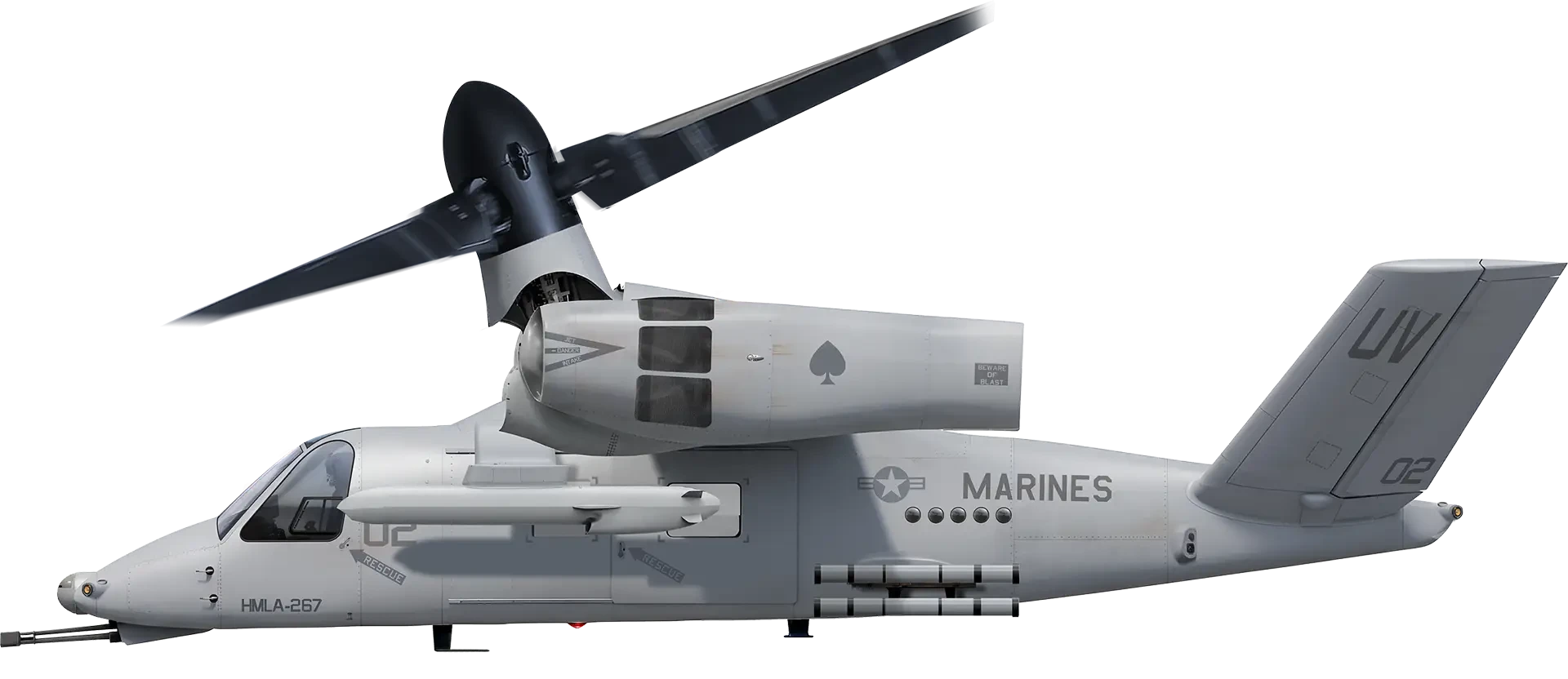
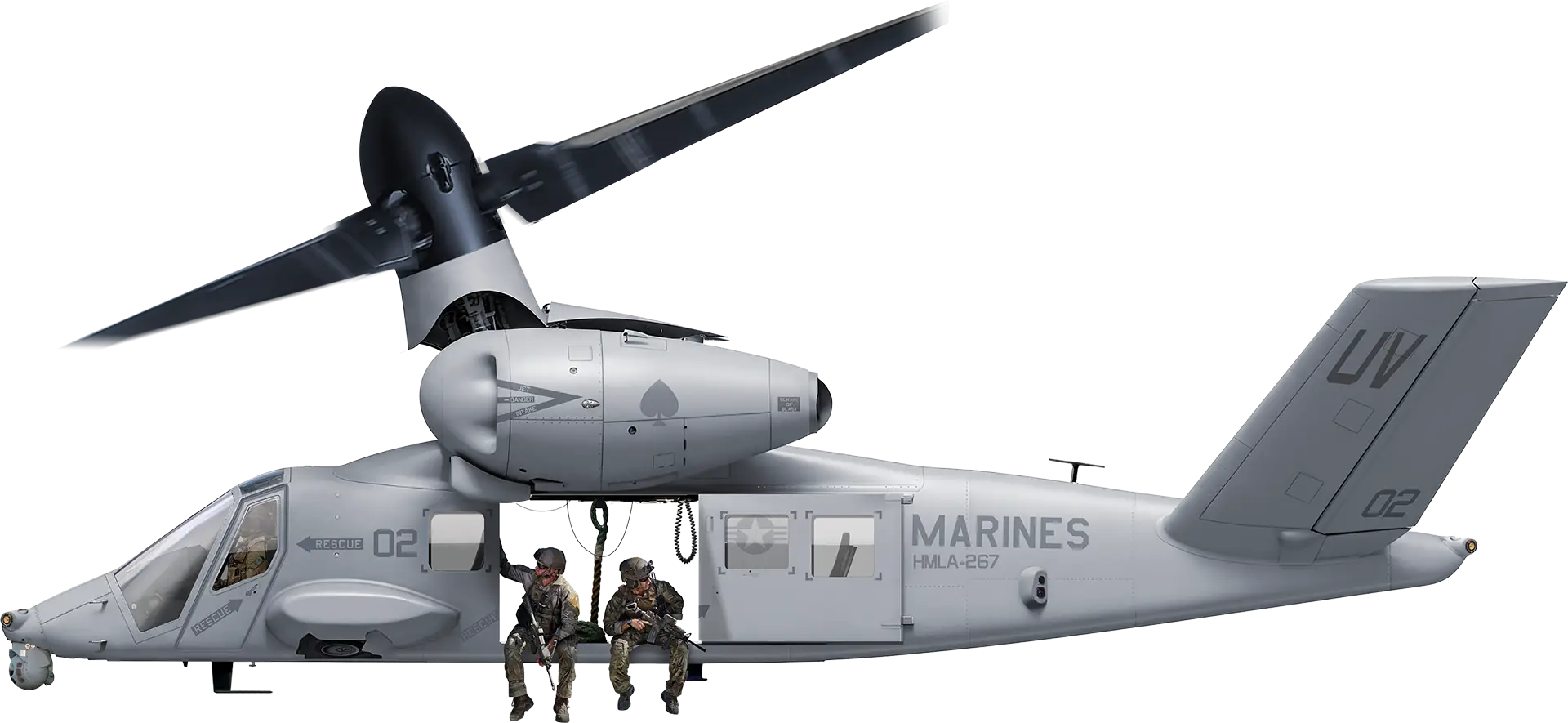
The recently held 'Modern Day Marine' (MDM) conference at the exhibition in Washington, DC, featured a proposed variant of the MV-75 Cheyenne II in USMC livery, prominently displayed on the Bell stand. Painted in USMC wraparound grey, and with HMLA-267 'Stingers' markings (a unit currently flying the Bell Viper/Venom combination out of MCAS Camp Pendleton, California) the model was equipped with a powerful simulated load out with the Kongsberg Naval Strike Missile (NSM) and Precision Attack Strike Munitions (PASMs) on the forward stub wings, and what appear to be generic Air Launched Effect (ALE) launch tubes on two rear fuselage mounts and, intriguingly, a neat row of five possible openings for internally mounted ALE (or sonar buoy...) deployment, employing, perhaps, the Common Launch Tube (CLT).
Under the nose, the model is packing a three-barrelled cannon, probably the M-197 that is currently found in the chin turret of the AH-1Z Viper. Squint a bit, and the MV-75's configuration and weapon load has more than a ring of 'Drop Ship' about it.
And here's the thing. I'm not sure how many in Bell realise this, and to be fair, you need to be a bit of a Sci-Fi nerd to know it, but the supposedly eponymous 'Drop Ship' actually has a designation and name in the broader, canonical, Aliens 'universe'.
UD-4L Cheyenne
The MV-75 may well prove capable of many things, but exo-atmospheric flight is not quite there yet (we may have to wait for the follow on to the Bell/DARPA X-76 High Speed VTOL for that capability...).
Until now, the broader public has not been aware of the type's potential to fulfil a series of key roles for the USMC, replacing two long-serving, well-loved, but undeniably aging platforms - the UH-1Y Venom and AH-1Z Viper. This is understandable; maritime operations were not a key consideration for the US Army's Joint Multi Role Technology Demonstrator (JMR-TD) program, which set off in 2011 looking at technologies that could provide a transformational improvement in terms of speed and range to the UH-60 Black Hawk in the Medium Lift role - strictly in support of Land operations. In time, under the Future Vertical Lift (FVL) initiative, JMR-TD carried forward its two demonstrators (Bell's tiltrotor V-280 Valor and Sikorsky/Boeing's SB>1 Defiant thrust-compounded coaxial design) into the Future Long Range Assault Aircraft (FLRAA) competition, as the potential solutions to the FVL-Medium / Capability Set 3 (CapSet3) requirements.
Bell's V-280 came out of the blocks fast, and, no pun intended, accelerated away in terms of flight testing. Bell's long history of tiltrotor design and the hundreds of thousands of flight hours accrued by the V-22 Osprey family were invaluable; Bell knew where the Osprey's performance and maintenance shortcomings lay, and produced a 'Second Generation Tiltrotor' to address them - leading with extensive use of digital modeling in not only design, but also in generating Reliability and Maintainability (R&M) predictions. The V-280 (named for its target airspeed) literally flew through the test points, achieving over 300kts and even securing additional funding for extra flight testing of potential autonomy and unmanned capabilities. The V-280 effectively completed the flight test program, including the ADS-33 Handling Qualities assessment, before the SB>1 had gotten much out of the hover. Ultimately, the Army was more convinced by the V-280's demonstrated ability 'out of the box', and impressed by the accuracy of the 'digital twin' that Bell was investing in. The Army was able to overcome decades of institutional suspicion over tiltrotors, dating from the decision to walk away from the V-22 program in its JVX days, and opt for Bell's tangibly lower-risk offering.
However, the USMC has always kept an eye on FLRAA - and they certainly have no preconceived bias against the tiltrotor. Ever since the Army exited JVX, the Corps have been the prime driver for the V-22 Osprey program and remain by some margin the largest user. The 'Ship to Objective Manoeuvre' (STOM) and 'Sea Basing' concepts were predicated on the V-22s long range and high speed - offering the Marines the ability to stay well offshore. Positioning over the horizon kept their valuable amphibious platforms far from prying eyes, out of the range of most land-based Anti-Ship Missiles (ASMs) and away from the threat of Fast Inshore Attack Craft (FIACs). Indeed, ever since the arrival of the MV-22 in the Corps to replace the CH-46, the USMC has had something of a 'three-speed' planning problem, with the CH-53, AH-1, and UH-1 all flying at helicopter speeds, the AV-8B and F-35B at jet speeds, and the MV-22 in between. While the 'Kilo' clearly isn't going anywhere for the time being, the heavy-lift task can be treated as an individual mission in many ways. The more complex interaction among rotary recce (UH-1), assault (MV-22), and organic fires (AH-1) entails several overheads. Having flown the previous UH-1N version with the USMC at MAWTS-1, although a well-equipped and flexible machine, there was no denying it was slow. Even in a dive attack to unleash some unguided (and boy, did they mean 'unguided'...) rockets, getting the IAS much above 120kts was a genuine struggle. Although the UH-1Y is appreciably quicker than the older 'November', it's still not quite as fast as an AH-1Z and remains significantly slower than an MV-22. In mission planning terms, you still have to plan for the slowest component’s speed and range. The 'Yankee' is the USMC's Limiting Factor (LimFac) in many respects.
It may be slow, but the utility and flexibility the venerable Huey offers remain valuable. In the MV-75, the USMC is likely viewing those mission sets being delivered from over the horizon and MV-22 speeds, as well as potentially new ones.
The UH-1's cabin is big enough to accommodate up to 10 lightly equipped troops for occasions when the MV-22 isn't available or needed - and it can access smaller flight decks and landing zones. Alternatively, the aircraft can be configured for a casualty evacuation role, with up to six litters (stretchers) mountable. The cabin is also large enough to carry an airborne Command and Control (C2) element. Commanders can utilize the aircraft's own sensors and communications fit or bring additional capability if required. With the emergence of ALEs, the Yankee may well find itself in the role of 'Drone Quarterback' - acting as the C2 and tasking authority for self-deployed or third-party launched drones.
The future role of ALEs remains undefined. Indeed, what constitutes an ALE is still subject to debate - in a recent NATO Study that I was a part of, drawing a boundary of what was 'in' and 'out' proved difficult. The hardest area is the separation between a conventional guided missile, a loitering munition, and a One-Way Effector (OWE) - effectively a 'drone that goes bang'. Whatever the future employment of ALEs entails, a platform that can provide C2 node functionality will likely remain an enduring requirement. In the heavily degraded and denied operating environment expected in a peer on peer conflict, there will inevitably remain ALEs exercising functions and tasks that require an element of Human In or On The Loop control - and that needs to be either line of sight (LoS) or via a series of tactical comms nodes, such as a Mobile Ad hoc Network (MANET) which is much like the Mesh Wi-Fi system you may have a t home, but on a larger scale.
Finally, the Venom operates as both a 'find' and 'attack' platform, backing up the Viper. To do so, the aircraft has its own EO/IR sensor (FLIR Systems BRITE Star II) and comprehensive EW suite. In terms of weapons, the aircraft is highly adaptable and can carry a variety of payloads depending on mission needs. These range from unguided 70mm rockets and their laser-guided cousins, the Advanced Precision Kill Weapon System (APKWS), to the AGM-114 Hellfire on occasion. Guns can include door and pylon mounted GAU-21/16 .50 Cal, GAU-17 minigun, and the dependable, but much less hard-hitting, M240D.
The Marine MV-75 model at MDM seemed to cover the Yankee's weapons fit nicely - indeed adding significantly more firepower and range with the NSM mounted on the cheek stub wings - the large Norwegian-produced weapon can hit targets on land as well as afloat. The rear fuselage ALE tubes and dispensing ports hint at the 'all-court game' the USMC will be looking for in its UH-1Y replacement aircraft. A flight of Marine MV-75s could lift from far over the horizon, transit at high speed and low level towards the Area of Operations (AoO), deploying ALEs ahead of them to scout for potential targets for their long-range weapons, or to feed back into the Common Operating Picture (COP) for prosecution by, perhaps, F-35Bs or long-range weapons launched from warships. The cabin should offer plenty of space for a section of marines, or indeed multiple additional CLTs. The ability to carry Marines will remain important for boarding operations on the high seas - although the tiltrotor will likely require a change to existing Tactics, Techniques, and Procedures (TTPs). It also goes without saying that using an MV-75 for Medical Evacuation will be dramatically quicker.
Much like the US Army, the Marines have a focus on the Pacific Region and the 'tyranny of range' that it presents. While Sea Basing can help offset the challenge, the major ships will ultimately still be reluctant to close to a shoreline due to the increased risk. Staying resolutely 'blue water' but still being able to hold targets inland at risk will be a key capability - and one that the UH-1Y cannot credibly deliver.
Then there is the matter of the AH-1Z replacement to consider.
The choice of HMLA-267 for the paint scheme on the MDM model is highly unlikely to be a coincidence. The unit operates both UH-1 and AH-1, sometimes in a 'hunter-killer' teaming arrangement - using secure voice or Link 16 to pass tactical and mission data between platforms, and indeed ALEs and other unmanned platforms such as the MQ-8C Fire Scout. The heavy armament and chin cannon on the Marine MV-75 suggest it could also replace the Viper. The current pair share over 80% commonality in spares - an important consideration for embarked operations in peacetime, and a crucial one in wartime where extended supply lines in, for example, the Pacific, will be at risk - ‘Contested logistics' is a very real and very present concern for US military planners. By replacing both types with the MV-75 that 80% becomes 100%, and planners will have increased flexibility to re-role airframes as the campaign unfolds and command priorities change.
The MV-75's high speed and manoeuvrability will also help it in the Viper role.
When I flew the demonstration sim in Bell's Advanced Vertical Lift Center (AVLC) in Washington, I was delighted by the aircraft's impressive handling envelope. I'd certainly not entered low level in a vertical lift platform before by rolling inverted and pulling through (though, doubtless, some will suggest it felt like it sometimes...), and once established at 100ft/250kts, the aircraft was pleasingly agile - that wing and power-to-weight ratio endowing the aircraft the ability to bring new dimensions to the RW 'fight'. Against airborne opponents, the MV-75 will be a nasty shock - especially if equipped with IR Air to Air Missiles like the AH-1Z can be. Being able to 'turn and burn' leaning on that wing against the likes of an armed turbo prop or non-radar subsonic jet will be interesting, as will the ability to fight much more in the vertical than a conventional helicopter. Might make a very handy drone killer too...
Against ground-based radars, if at altitude, the MV-75 will be able to employ a variety of tactics to exit a radar resolution cell and, of course, can still slow down to more rotor-borne flight if needed to exploit Nap of Earth techniques to terrain mask. It can also accelerate and stop quickly to help mitigate the risk of ballistically laid threats - it can certainly pass through the Threat Band quickly...
I bet the WTIs at MAWTS-1 will love it...
So far, so good in theory. But a couple of key questions remain. First, how practical is a real, not rendered, Marine variant of Cheyenne II?
Bell has explained since the early days of the program that they designed the aircraft to be 'wet built' - i.e., with appropriate design features and materiel choices that would support use in the maritime and littoral environments. This matters. Trying to reverse-engineer embarked capability into a mature design is expensive and always limited in what is achievable - having operated the CH-47 Chinook from aircraft carriers, I can attest to the significant additional engineering burden in terms of husbandry, corrosion prevention, and ship interface measures. Building the MV-75 with all that in mind is important.
The 'elephant in the room' is the issue of shipboard stowage. The MV-22 was the original 'transformer', contorting itself to fit the deck, elevator, and hangar requirements of the USMC. It was not immediately obvious that the V-280 could perform a similar party trick. But it's important to consider that the MV-75 is not a V-280. It shares certain configuration characteristics, but they are different platforms. One could almost suggest that the MV-75 is a 'Gen 2.5 Tiltrotor' taking the lessons from JMR-TD and applying them. The key is driving out cost, weight, and complexity. The MV-75's wing is much less complex than the V-22s, which makes adapting it to fold in a similar way easier. Yes, there will be a weight impact - but with the latest version of the Rolls Royce AE1107 engine offering additional horsepower (and commonality with the V-22), this impact can be broadly contained. If the Marine MV-75 ends up being 15-20 kts slower than an Army 'bird' due to weight growth and reprofiling of drag due to the wing folding pivot housing and external stores, it'll still be over 100kts faster than a UH-1/AH-1 and capable of much longer ranges, and of cruising above the weather if needed.
Finally, is Bell just flying a kite here, or is there a genuine demand signal from the USMC?
If you are lucky enough to visit the AVLC, you'll not only see the model of the Marine MV-75, but you'll also see models of USN and USCG derivatives. Bell sees a business case for replacing the UH-1, AH-1 as well as elements of the SH-60 Seahawk and MH-60 Jayhawk fleets - offering NavAir significant whole life cost benefits. While I think many in the USN would be reluctant to give up their beloved Romeo Seahawks, the 'Sierra' role may prove a good fit for the MV-75, especially given its speed, endurance and firepower - coping with drones, FIACS, small warships, and smugglers should all be very straightforward - and at a speed and range the Sierra simply can't match. It's that same combination of speed and range that might prove attractive to the USCG too - flying at near C130 speeds but then being able to hover when you get to the scene of search/recovery might permit further fleet streamlining. A fleet of Jayhawk-sized tiltrotors might permit reductions in the number of fixed-wing aircraft and short-range helicopters. MV-75 could also land, disembark casualties, and refuel from ships or offshore installations with an adequately sized deck.
As for the Corps, well some in Bell have suggested it might be a case of 'build it, and they will come'. The Marines have stayed close to the program throughout - indeed, when I visited the AVLC my visit got bumped by a couple of hours as a USMC 1* was in DC and requested a briefing for him and his staff.
On the face of it, the Marines should be interested in the MV-75. They have a need at some stage to replace the Viper and Venom fleets, and making mission planning easier by having more 240kt+ 'players' would be welcome - as would those key tenets of speed and range to maintain operational relevance in the Pacific. If marine aviators ever get the chance to slip on a pair of shades and call 'in the pipe', I'm pretty sure they'll be delighted with 'their' Cheyenne...