 HOME
HOME




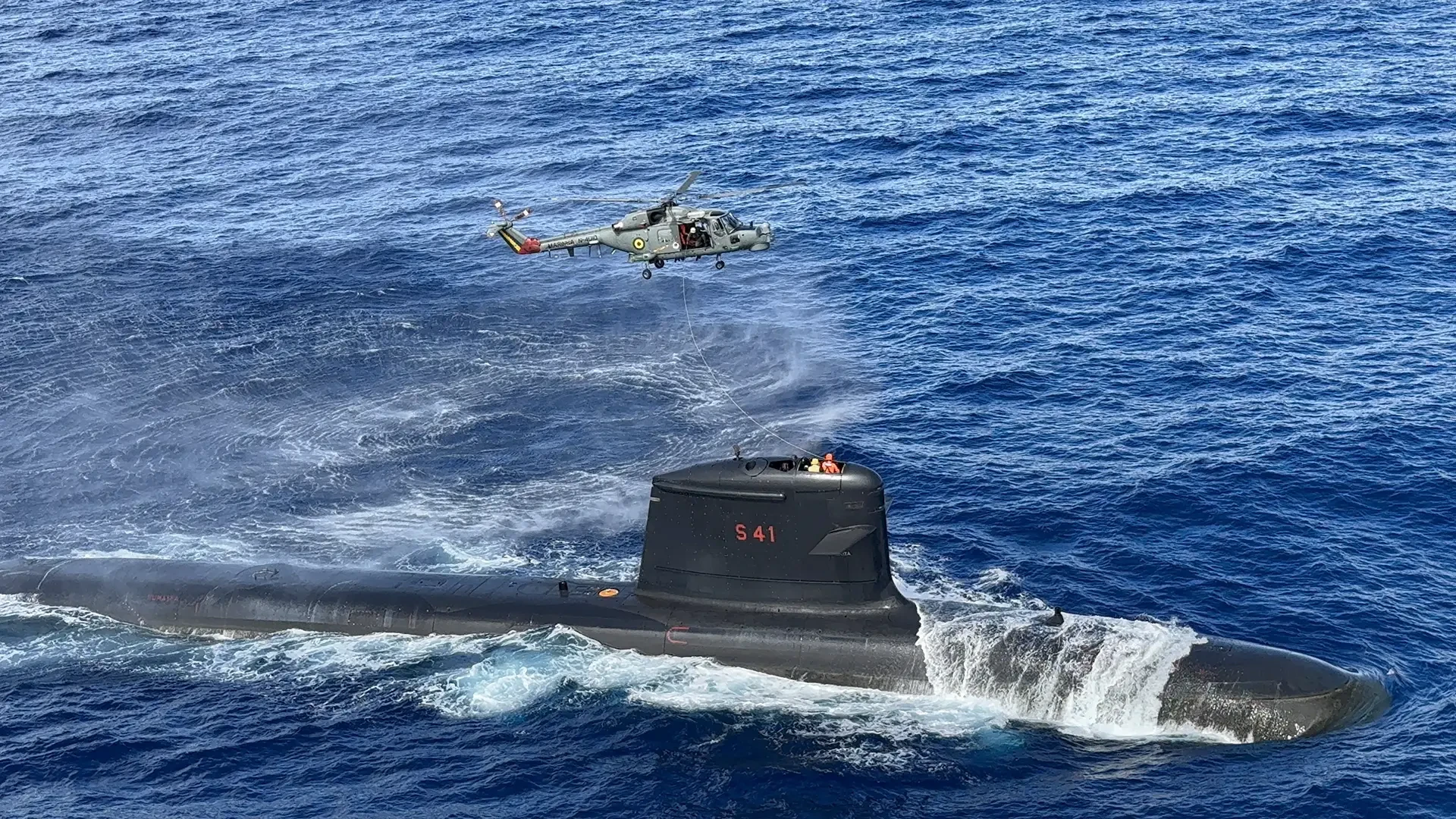
Santiago Rivas visited the HA-1 Squadron of the Brazilian Navy, the unit equipped with Westland (now Leonardo) Lynx helicopters in Latin America and one of the most powerful naval air attack squadrons in the region. Recently modernized to the Wildcat standard by Leonardo Helicopters, the aircraft are prepared to execute their mission efficiently in the current scenario.
The 1º Esquadrão de Helicópteros de Esclarecimento e Ataque (1st Squadron of Reconnaissance and Attack Helicopters – HA-1) of the Brazilian Navy has been, for many years, one of the most powerful rotary-wing naval air units in South America and the most powerful in Brazilian naval aviation until the arrival of the A-4 Skyhawk. Today, together with the S-70B Seahawk helicopters and the AH-15 Cougar, despite their more than 40 years in service, the Lynx continue to be among the force's main attack vectors, both for anti-submarine, anti-surface and fire support missions.
History
The Westland (Leonardo) Lynx was the last British helicopter model purchased by the Brazilian Navy, after having previously operated the
Westland Widgeon, Whirlwind and Wasp. Its purchase was made after the construction of the six Niterói class frigates, based on the Royal
Navy's Type 21 design, in the United Kingdom in 1970. They began to enter service in 1976. To equip the ships, several different models of
helicopters were analyzed, including the Agusta Bell AB-204, Bell 212, MBB Bo-105 and an additional batch of Sikorsky Sea Kings. The
latter were assessed as being too large for the frigate's hangar; however, when the Sea Lynx demonstrated its capabilities during the
evaluation, the Marinha Brasileira considered it the superior performer. Consequently, in February 1975, a contract was signed for nine Sea
Lynx HAS. Mk.21 (very similar to HAS. Mk.2 of the Royal Navy) for a value of £10,062,767.
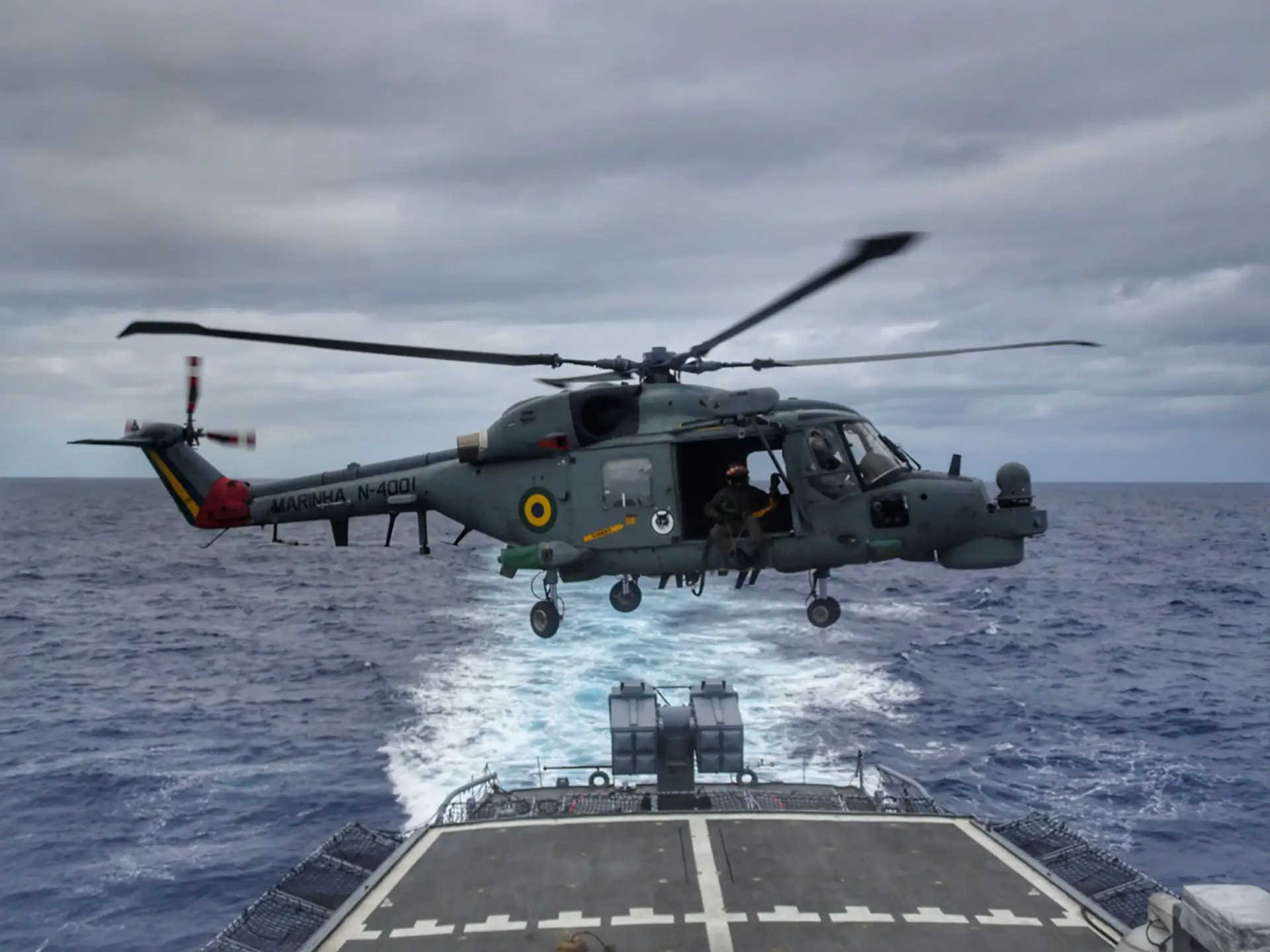
In Brazil, they were originally called SAH-11 and later AH-11. The first example was exhibited at Farnborough 77 with the British registration G-BFAU, and in March 1978, the first two arrived in Brazil. Shortly after, in May, the 1st Anti-Submarine Attack and Clarification Helicopter Squadron HA-1 was created and was declared operational in January the following year. On January 30 of that year, one of the Lynx carried out its first embarked operation, landing on the lead frigate, the Niterói.
Initially, the Lynx were only armed with Mk. 44 and 46 torpedoes and Second World War vintage Mk. 9 depth charges, although in 1987, they also received Sea Skua anti-ship missiles, expanding its mission to also Anti-Surface Warfare (ASuW). The first launch of a Sea Skua was carried out on August 31, 1989, using the decommissioned Fletcher-class destroyer Santa Catarina as a target.
The aircraft are also equipped with a 12.7mm Browning or FN Herstal M3M machine gun at the doors for interdiction operations or special forces support during boarding or landing operations.
The aircraft also began operating from the decks of the four Pará-class destroyers (ex US Navy Fletcher class), incorporated in 1989. Shortly afterwards, they also operated from the four new Inhaúma-class corvettes, also incorporated in 1989.
While the Navy was working on the development of the Inhaúma-class corvettes, they assessed the AS365N Dauphin, the Agusta A109, the Bell 222 and the Sikorsky S-76, but the new version of the Lynx, then called the Advanced Lynx, caught the attention of the force. Finally, on in December 1993 a new contract for £11,505,000 was signed for the purchase of nine Super Lynx HAS. Mk.21A and the modernization of the remaining five examples of the first batch. Among other improvements, the aircraft were equipped with an Orange Crop/Racal MIR II Electronic Support Measures (ESM) system and a Seaspray 3000 radar with 360° coverage.
In 1995, the first Brazilian Super Lynx flew for the first time.
In September the following year, the first new example arrived. Upon arrival of the new helicopter, the unit changed its name to 1st Helicopter Squadron of Clarification and Attack HA-1. In April, 1998, the last modernized units were delivered, finishing the program.
In August, 2008, to expand helicopters all-weather capabilities, a contract was signed with FLIR Systems to acquire twelve FLIR Sea Star Safire IIIs, which began installation in 2010. The FLIR included a day and infrared camera, and a laser pointer, which permits crews to see and identify targets, but not designate them for the use of weapons.
In 2011 the Super Lynx force began to participate in the United Nations Interim Force in Lebanon (UNIFIL) aboard the Niterói-class frigates
or the corvette Barroso, carrying out sea control and security missions, to prevent actions by terrorist groups in the waters around
Lebanon.
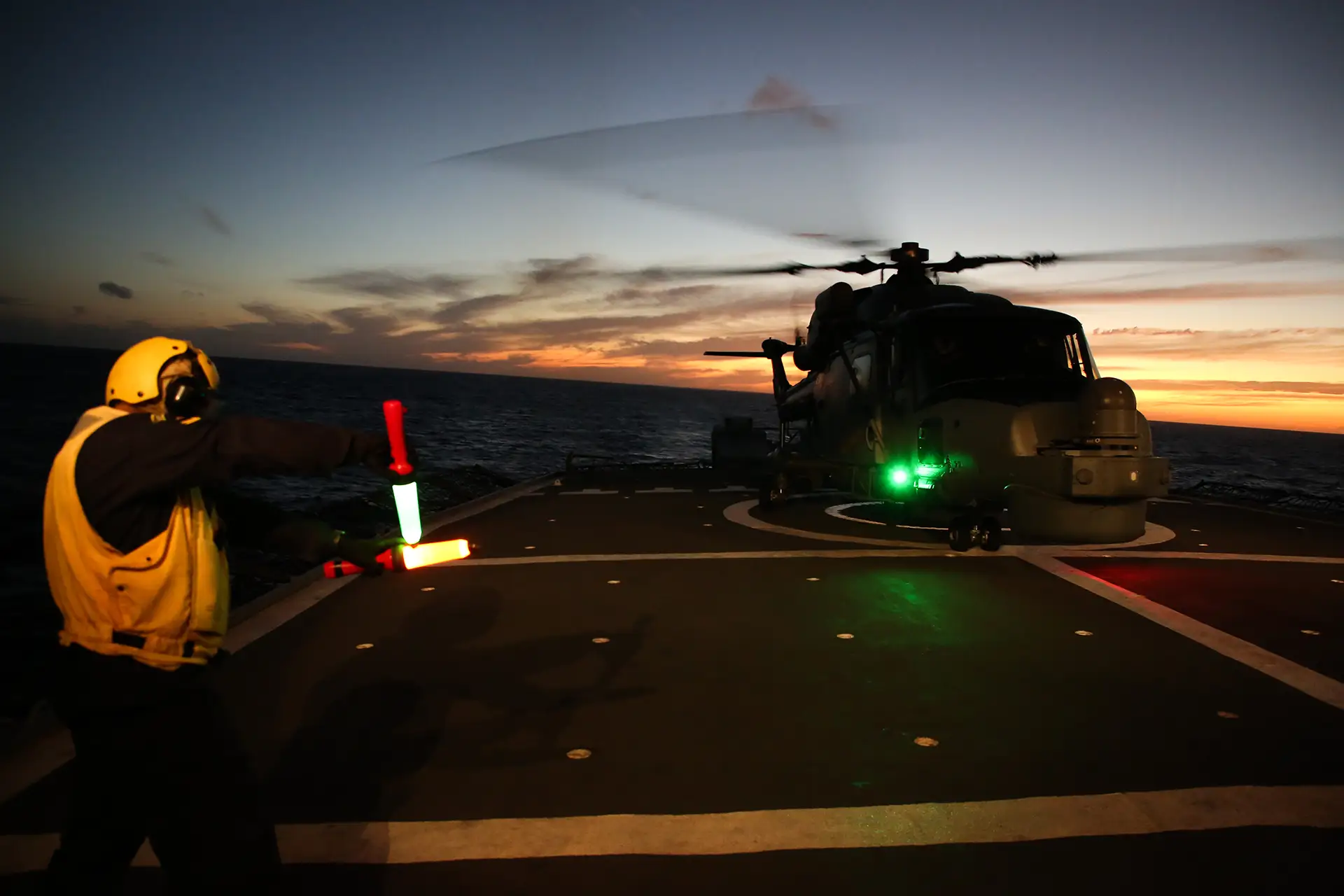
Although the aircraft had usable airframe life, their mission systems were becoming increasingly obsolete. A new modernization contract for $160 million was signed in 2014 for eight helicopters. This was mainly addressed logistical problems in maintaining the engines, which had already been changed in the Super Lynx. The Honeywell/Rolls-Royce LHTEC CTS800-4N engines not only provided more power but were also safer with a much lower failure rate.
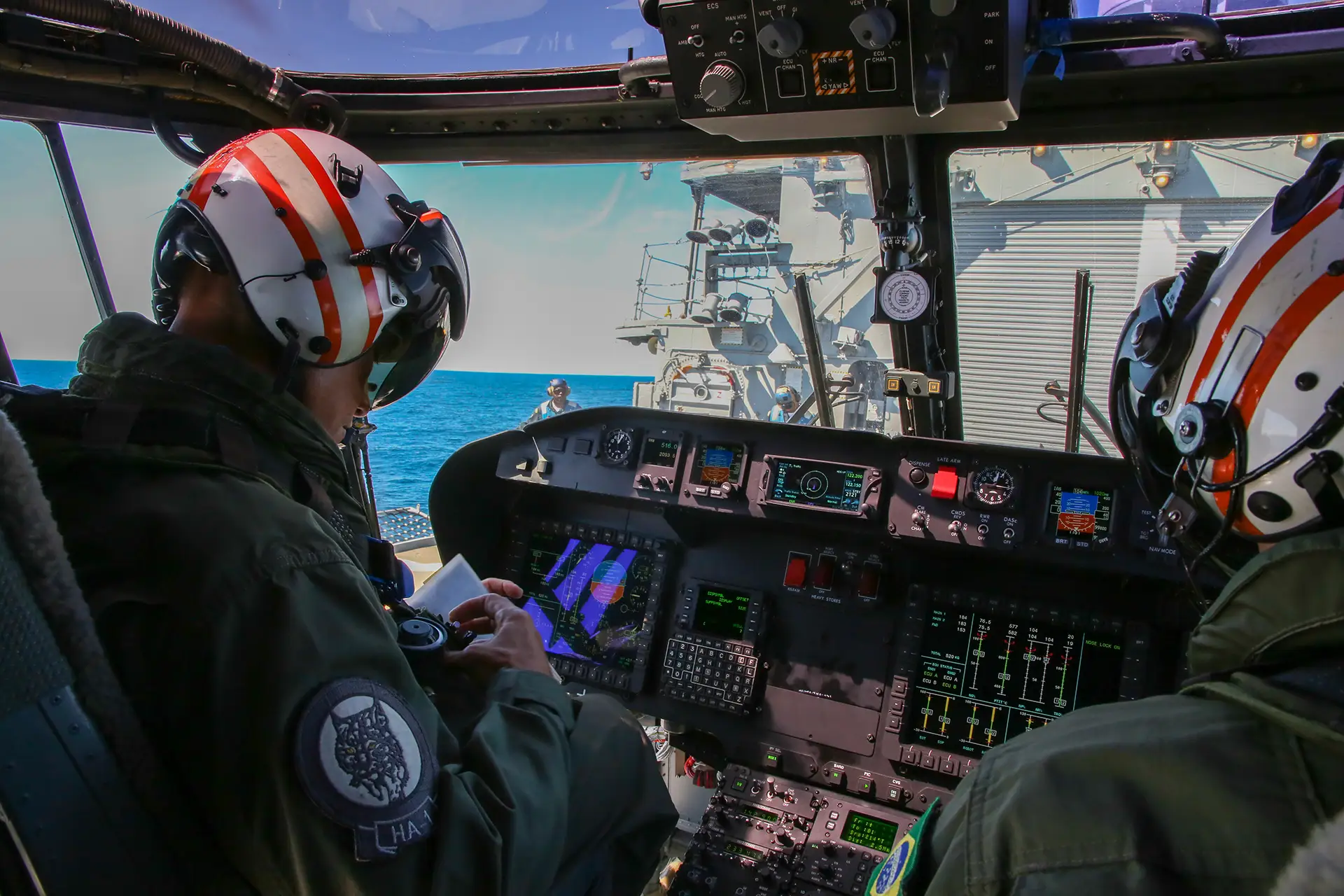
A full glass cockpit was added, featuring three large, NVG-compatible multifunction colour screens. This allowed the integration of the radar screen, which previously had a dedicated display. Also added were a GPS, IFF, a new tactical computer, a Finmeccanica ESM suite (Selex ES SAGE with chaff and flare dispensers), TCAS (Traffic Collision Avoidance System), ILS, ADS-B, an automatic identification system and a new electric rescue hoist with a 60-meter cable. In July of 2019, the AH-11Bs began operating on board the ships of the Brazilian Navy.
The modernization program also included a synthetic flight simulator for the AH-11B. The Navy is expected to adopt a new anti-ship missile
for the AH-11B, to replace the aging MBDA Sea Skua. Training for NVG operations began with the training of a pilot in the Royal Navy,
supported by the HS-1 squadron equipped with Seahawk helicopters, and the Força Aérea Brasileira. Finally, in April 2023, the first NVG
flights were carried out in the Super Lynx Mk21B.
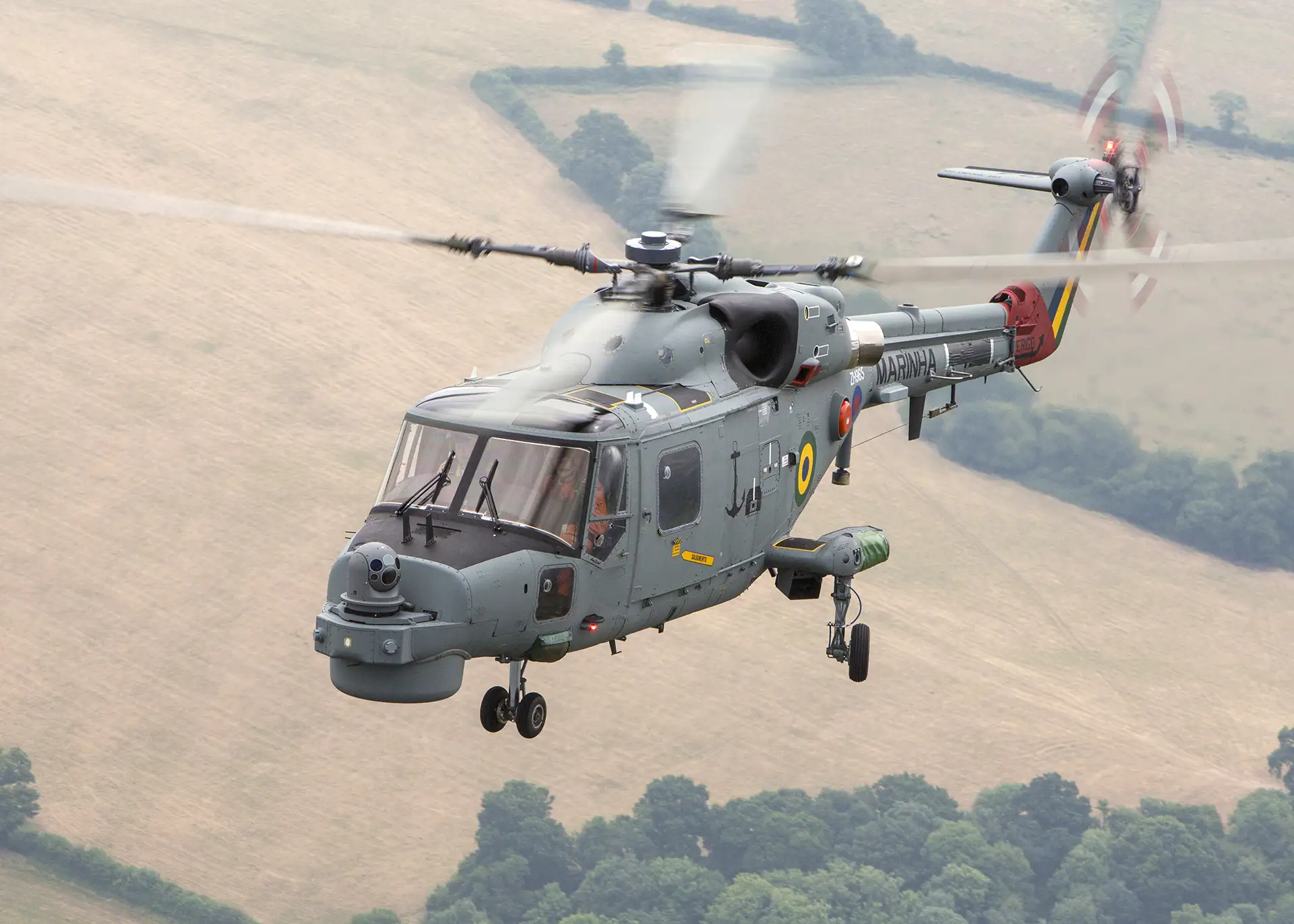
The HA-1 today
As explained by Lieutenant Commander Gouveia, second in command of the HA-1, the squadron relies on the Command of the Naval Air Force, which oversees all units based in São Pedro da Aldeia, the main base of the Brazilian Naval Aviation. Currently, the HA-1 is organised with a commander, a second-in-command, referred to as the immediate chief, and four departments. The Military Organization, operates the unit's facilities, while another is in charge of maintenance, another of operations and another of flight safety.
The unit's mission is to support the ships, expanding their capabilities through the aircraft sensors, such as radar, ESM and FLIR, and increasing the range of the ships' armament through target detection over the horizon. Secondary missions include personnel and cargo transport, SAR, aeromedical evacuation and logistical support. They have also added VBSS (Visit, Board, Search and Seizure, Visita, Abordaje, Registroy Captura) and MIO (Maritime Interdiction Operations).
The latter two types of operations are those carried out within UNIFIL in Lebanon for the United Nations, where they support the ship's mission, deploying marines by fast rope or rappelling methods. For these missions, the helicopters received mounts with 12.7 mm machine guns, which they also use in anti-piracy and anti-materiel missions. "In a hypothetical case of a merchant ship where it is perceived that it is on the verge of suffering or is already effectively suffering a piracy attack, it is not useful to use a missile, which could hit the merchant ship, so the 12.7 mm works very well. The 7.62 mm caliber machine guns are very small, so the 12.7 mm are ideal for these situations," explains Gouveia, who adds that "in Lebanon it was a UN force, where the enemy is not another state, it was a different preparation, where we felt the need to have the 12.7 mm machine gun. In anti-piracy employment as well." In these missions, he stresses that "What we were doing was collecting information on maritime traffic off the coast of Lebanon and passing that information on to the UNIFIL general staff. It was intelligence to know if there was a suspicious ship that shouldn't be there, and then they would give the orders to eventually inspect those vessels or just monitor or follow up."
The Brazilian Navy also conducts anti-piracy operations on the coasts of Africa, in combined operations with other navies. It also conducts
the Guinex exercises, improving the relationship with the navies of African countries. In 2025, the frigate Defensora was deployed with one
of the Lynx, for two months, carrying out anti-piracy operations, where the presence of the ship became a deterrent. "Pirates see a
gray ship and enough is enough for them," says
Gouveia.
.webp)
In regular operations, the Lynx operate from the decks of Niteroi-class frigates or Inhaúma and Barroso-class corvettes, and soon they will operate from Tamandaré-class frigates. Honoring its motto, "invenire hostem et delere", which means finding the enemy and destroying it, its function is to detect and destroy enemy ships, either with their own weapons or by guiding ships’ weapons. From the ship, a helicopter can be deployed to explore an area of interest, using its sensors, both active and passive. Normally, the tactic employed involves operating with the radar off and using the ESM system to detect enemy emissions. If a potential target is detected, it will be identified to determine the threat using the FLIR cameras. Should the target be an enemy, the fleet will be informed. The subsequent action would be according to the threat classification.
Action may involve monitoring or, alternatively, launching missiles from the ships at long range. This avoids the use of their sensors, which could reveal their position. The helicopter can datalink the information to the ship for loading into the missiles. Should the threat be a smaller vessel, the Lynx can make the attack, employing one or more helicopters, armed with Sea Skua missiles, which have a maximum range of 25kms and an explosive charge of 30 kilograms. The operational command is always held by the ship, which decides on the attack based on the rules of engagement.
For these missions they are currently analyzing different missile systems to replace the Sea Skua, which are now out of service. These include Rafael's Spike NLOS and MBDA's Sea Venom, among others.
In ASW, the Lynx do not have subsurface detection capabilities, such as sonobuoys, or a dipping sonar or Magnetic Anomaly Detector (MAD),
but can be vectored by frigates or corvettes or by other aircraft, such as the Seahawk to perform an attack launching torpedoes or depth
charges.
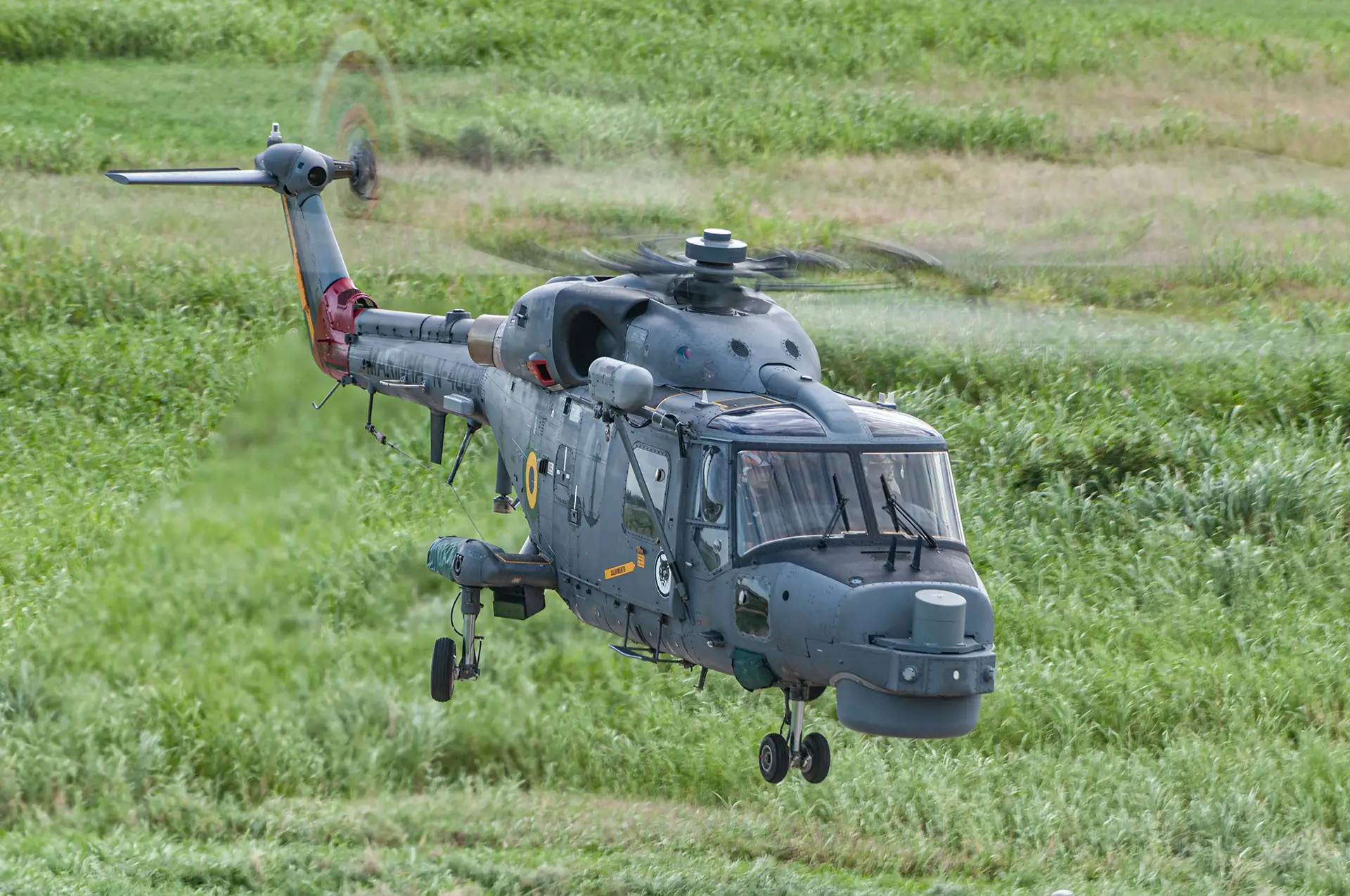
Normally, the crew is pilot, co-pilot and mechanic, who also operates the machine gun and winch. Only in some SAR missions can another crew member be taken to assist the search. "The two pilots can fly the aircraft and operate its systems, so normally the division of labor is that one flies the aircraft and the other operates the systems. The mechanic, meanwhile, controls the health of the aircraft, but in rescue operations he is the one who operates the crane, since normally no other crew member is added, except in specific situations," explains Gouveia.
For helicopter protection, it uses the ESM system, which detects and classifies enemy emissions. If it is a fire direction radar, it could mean they are about to be attacked. The aircraft is equipped with chaff launchers that can be configured to be activated automatically by the ESM system.
Operations carrying marines are rare, since aircraft such as the Cougar are prioritized. While the Lynx usually operate for out to sea, they do carry out infiltration missions with combat divers (tactical divers), deployed from the ships.