 HOME
HOME




The first aircraft back over La Guaira did not announce itself with ceremony; it arrived in the low Caribbean haze as a grey silhouette, rotors beating the humid air into a visible shimmer above the shattered coastline. An MV-22B Osprey crossed inland at altitude before dropping into conversion mode, nacelles tilting forward as the aircraft transitioned from fixed-wing cruise to rotary-wing descent; below it was Venezuela.
Friend not Foe
Six months earlier, the sight of American military aircraft over Venezuela would have signaled something entirely different.
In January 2026, American special operations forces had executed Operation Absolute Resolve, one of the most audacious raids in recent memory, extracting Venezuelan President Nicolás Maduro and his wife, Cilia Flores, during a lightning operation in Caracas. That operation had been surgical, brief, and politically seismic; now the mission set had inverted entirely: No objectives, no targets, no adversary, only survivors.
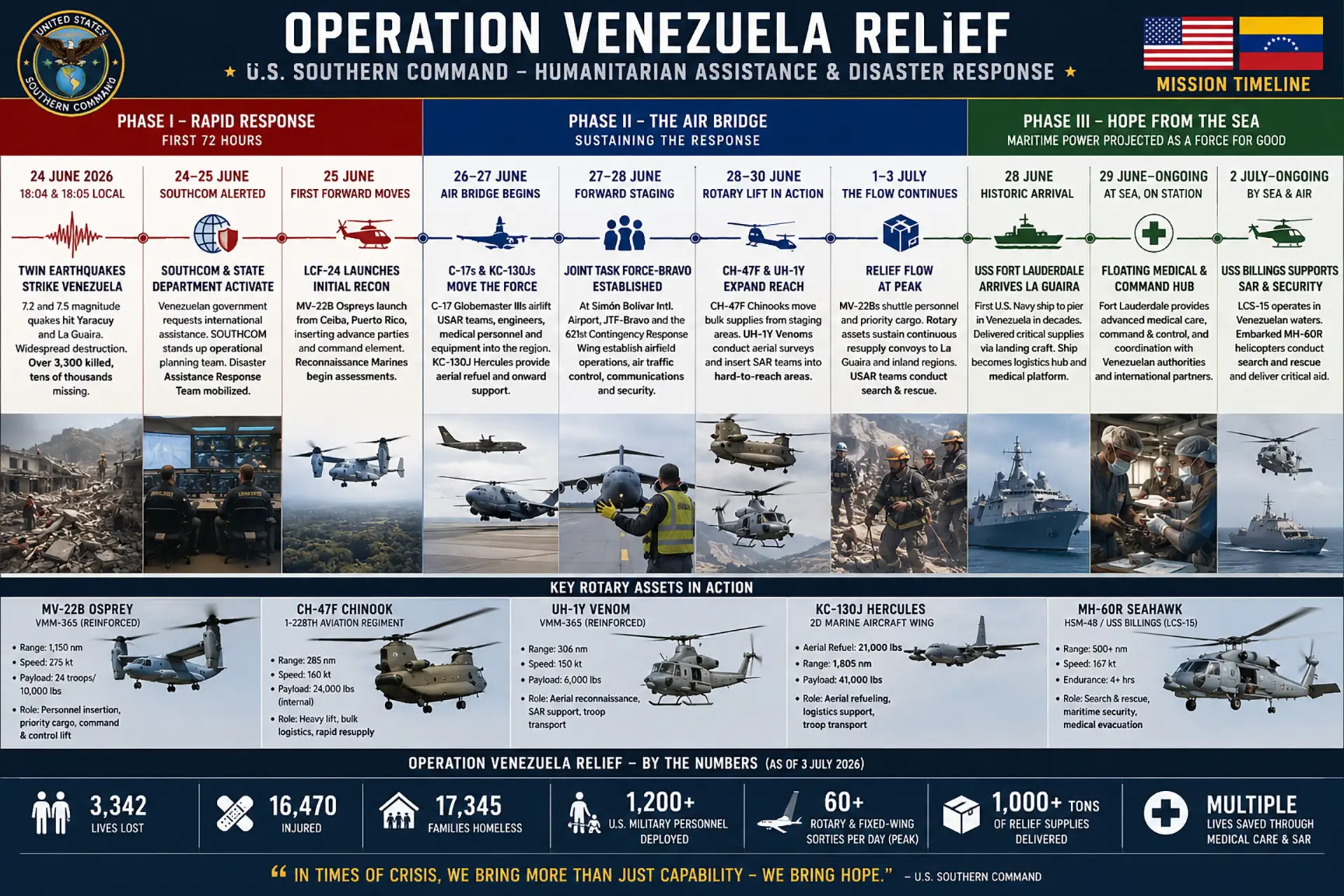
Now, in one of history's more remarkable twists of fate, many of those same armed forces were returning, not carrying assault teams, but water purification units, field hospitals, engineers, medical personnel and SAR specialists following an earthquake that struck at 18:04 local time on 24 June 2026, which changed the operational equation in seconds. A magnitude 7.2 foreshock was followed 39 seconds later by a 7.5 main shock, the strongest seismic event recorded in Venezuela in over a century. Entire districts of Caracas, La Guaira and Yaracuy collapsed into layered fields of concrete and steel.
Instead of fighting an enemy, the US Military was racing against time, and its opponent was nature itself. Rotary wing aviation would become the dominant instrument of access in the hours that followed, not because it was ideal but because it was the only thing that worked.
By nightfall, the scale of destruction was becoming clearer to Venezuelan authorities and international observers; infrastructure failure was immediate and total. Road networks fractured along fault lines and bridges separating coastal population centers from inland hospitals failed. Simón Bolívar International Airport sustained damage but remained partially serviceable under strict limitations.
In Caracas, collapsed residential blocks created vertical compression zones where survival depended on void spaces rather than structural resilience. The destruction stretched far beyond the epicenter, and emergency services were quickly overwhelmed; more than 3,300 people were confirmed dead within the first reporting cycle, and over 16,000 were injured, plus tens of thousands displaced.
Military organizations are built around the assumption that crises can emerge with little notice and nowhere is that philosophy more evident than within U.S. Southern Command (SOUTHCOM), headquartered in Doral, Florida. But for the rotary wing planners at SOUTHCOM, the key statistic was simpler: ground mobility had ceased to exist at scale; that single condition dictated everything that followed. Instead of building a relief force from scratch, SOUTHCOM redirected assets already deployed on routine regional missions. A decision would prove crucial.
Land, Sea and Air
SOUTHCOM’s disaster response model is built on pre-positioned expeditionary capability, but its real strength lies in aviation flexibility. Within hours of the earthquake, operational planners activated a rotary first access strategy.
Fixed wing heavy lift would move mass and personnel into the theatre and rotary wing assets would move everything after that and the operational construct quickly formed around three aviation pillars: MV-22B Osprey tiltrotor as transport, UH-1Y Venom as rotary command, liaison and provided an Intelligence, Surveillance and Reconnaissance (ISR) layer, while U.S. Army CH-47F Chinooks from 1st Battalion, 228th Aviation Regiment provided the heavy-lift.
Supporting these was a distributed aerial logistics network anchored by KC-130J tanker transports along with ship-based aviation support from amphibious platforms offshore. This ensured the center of gravity was not an airbase; it was mobility itself.
At the time of the earthquake, Littoral Combat Force-24 (LCF-24) was already operating across the Caribbean, conducting regional security missions from expeditionary bases in Puerto Rico and aboard the amphibious transport dock USS Fort Lauderdale. LCF-24 immediately transitioned from a routine regional operational presence into a full humanitarian expeditionary aviation node within hours. Its defining asset was VMM-365 (Reinforced), operating the MV-22B Osprey.
"In a disaster of this magnitude, the first 72 hours are a race against the clock. Roads are destroyed, airports are damaged, and infrastructure collapses. LCF-24 brings the ability to bypass those obstacles. Infrastructure failure removes conventional movement. Rotary aviation replaces it. That is the reality set we train for.” Said Colonel Ryan Lynch, commanding LCF-24.
Operating initially from José Aponte de la Torre Airport in Ceiba, Puerto Rico, VMM 365 quickly established an air bridge stretching hundreds of kilometers across the Caribbean.
The Osprey immediately demonstrated its value in Venezuela with road networks severed and airport throughput constrained. The Osprey became the primary connector between staging bases in Puerto Rico and Curaçao and forward landing zones inside Venezuela. One of its earliest missions was to carry senior SOUTHCOM leader Major General Kevin J. Jarrard, who was serving as the senior SOUTHCOM official on the ground, directly into Venezuela to establish a Humanitarian Assistance Coordination Center.
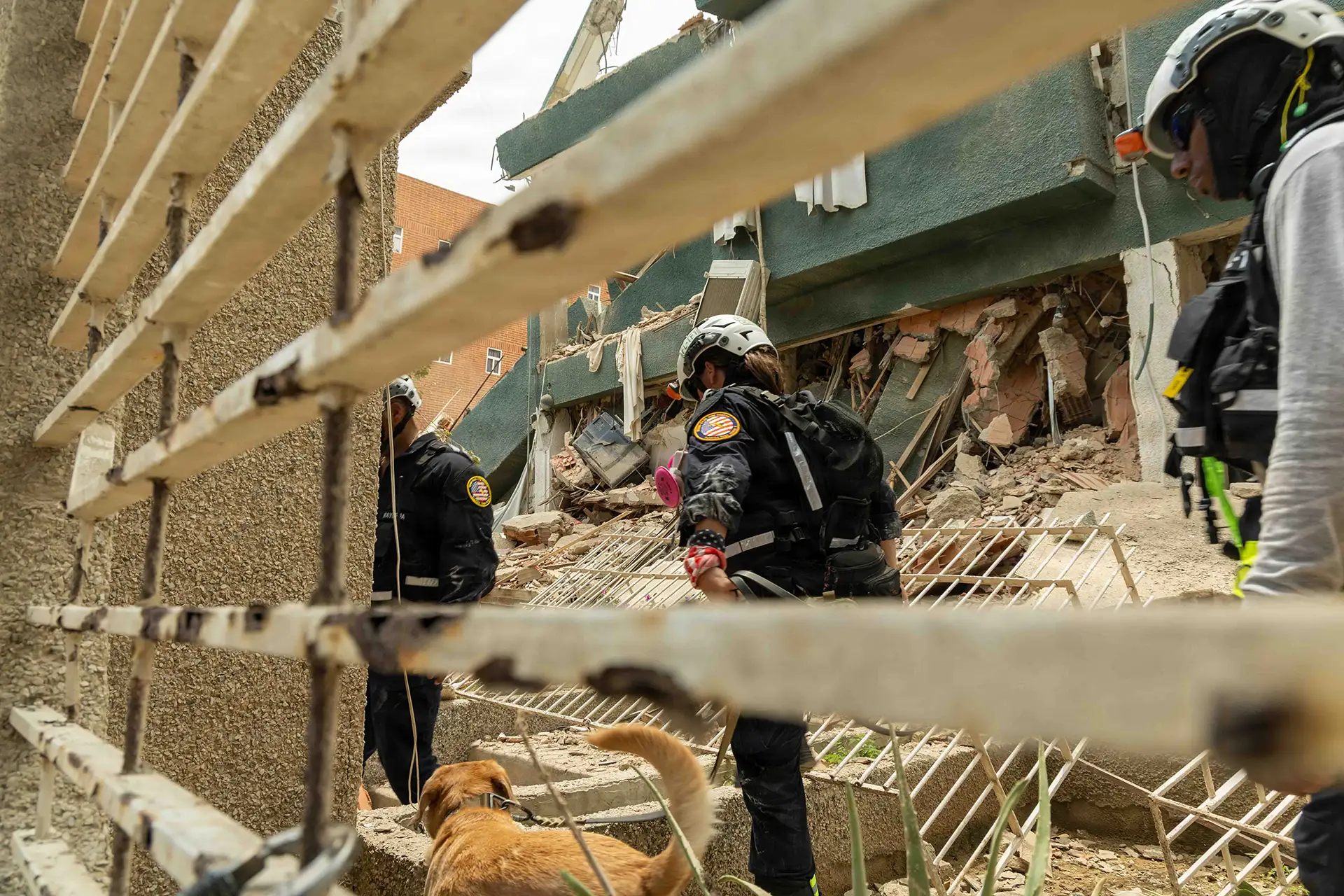
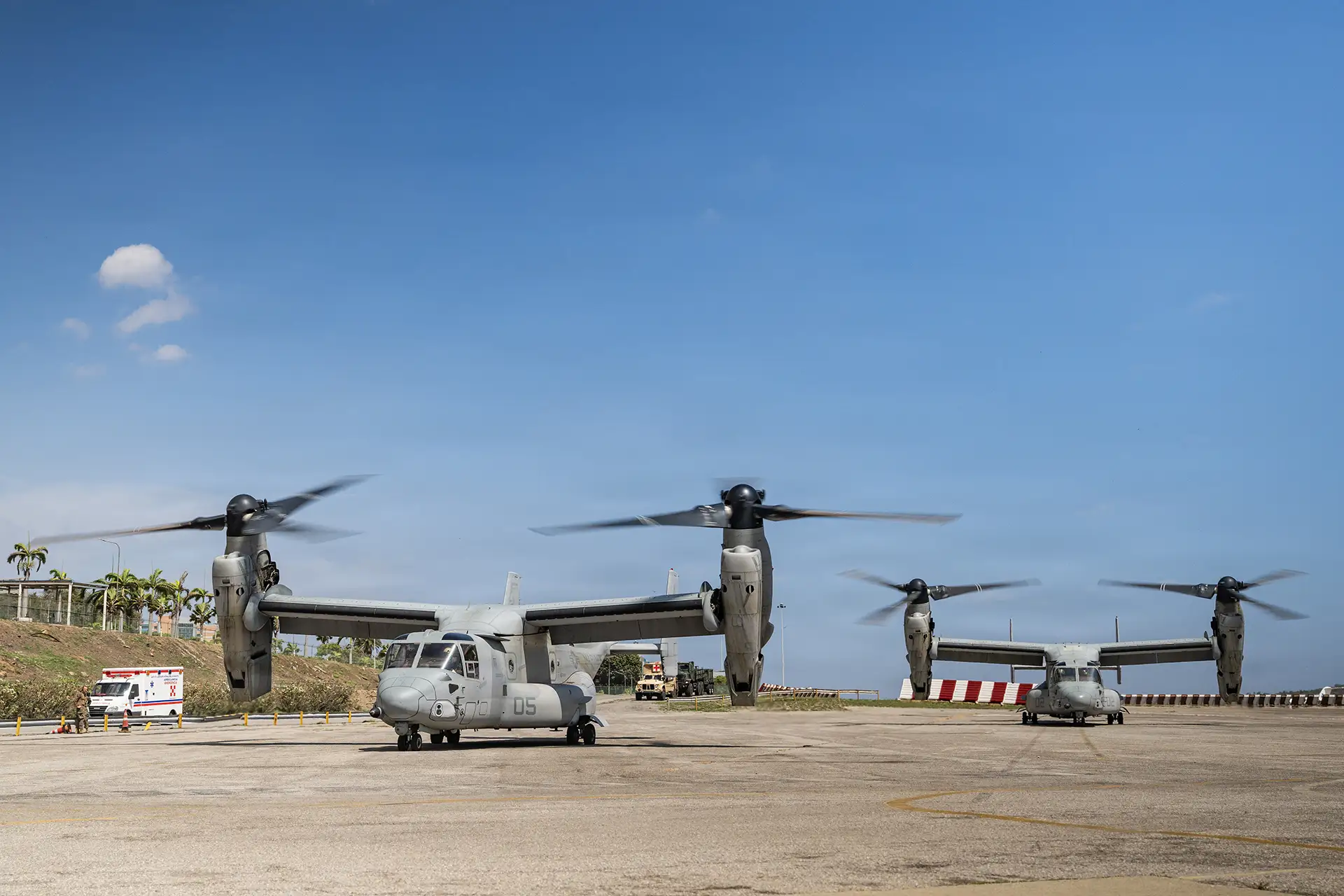
The Ospreys’ combination of speed, vertical lift capability, and payload flexibility makes it uniquely suited to dynamic disaster environments where landing zones were uncertain and the time windows narrow. They began inserting urban Search and Rescue teams directly into collapsed urban zones, cycling continuously through Simón Bolívar International Airport, Hato Airfield in Curaçao, as well as improvised landing zones set up by ground teams.
For those trapped beneath collapsed buildings, survival depended not simply on the courage of rescuers but on whether the right people and equipment could reach them before time ran out. But for the crews of VMM-365, the operation represented precisely the kind of mission for which the aircraft had been designed.
Damaged Hub
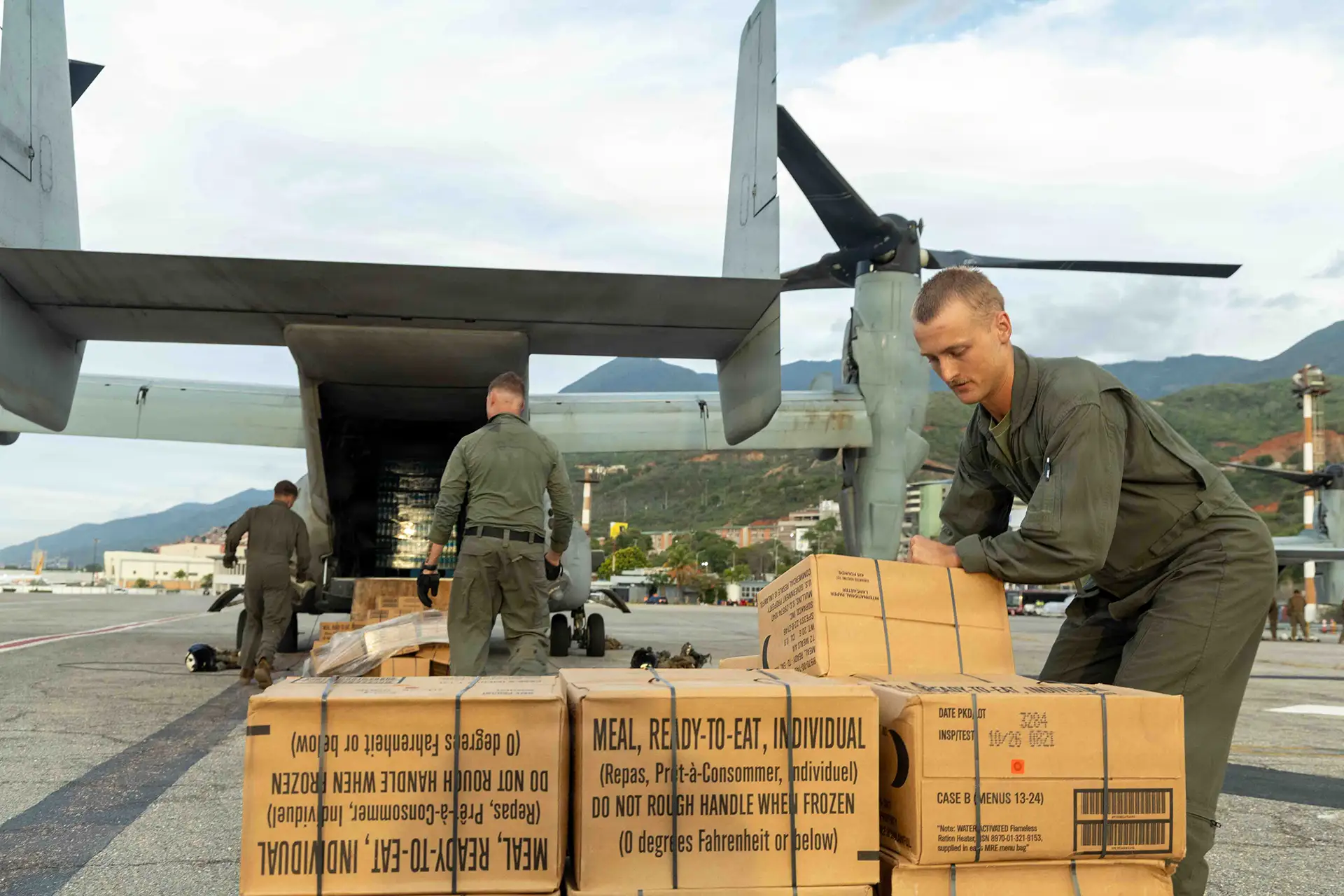
Although damaged, Simón Bolívar International Airport became the central rotary hub of the operation. US Air Force airmen from the 621st Contingency Response Wing, assigned to Joint Task Force-Bravo (JTF-Bravo) operating out of Soto Cano Air Base in Honduras, rapidly established airfield control procedures. JTF-Bravo has served as one of America’s premier rapid-response organizations throughout Latin America and the Caribbean.
MV-22Bs arrived in rapid succession, unloading SAR teams, engineers, and medical personnel. Among the first were specialists from the Miami Dade Urban SAR team, internationally recognized for their expertise in collapsed structure rescue following earthquakes around the world. Joining them were experienced teams from Fairfax County, Virginia, and Los Angeles County, California. UH-1Y Venoms immediately redistributed personnel to inland zones, and Chinooks began staging heavy relief loads for onward movement.
On the ground, the airport resembled a distributed rotary relay station rather than a conventional airfield with rotors that never stopped turning as aircraft rarely shut down fully and turnaround times were measured in minutes, not hours. While the MV-22B provided reach, the Chinook provided lift, and the UH-1Y Venom became the connective tissue of the entire rotary system. Operating in Venezuelan airspace under Marine Aviation Combat Element coordination.
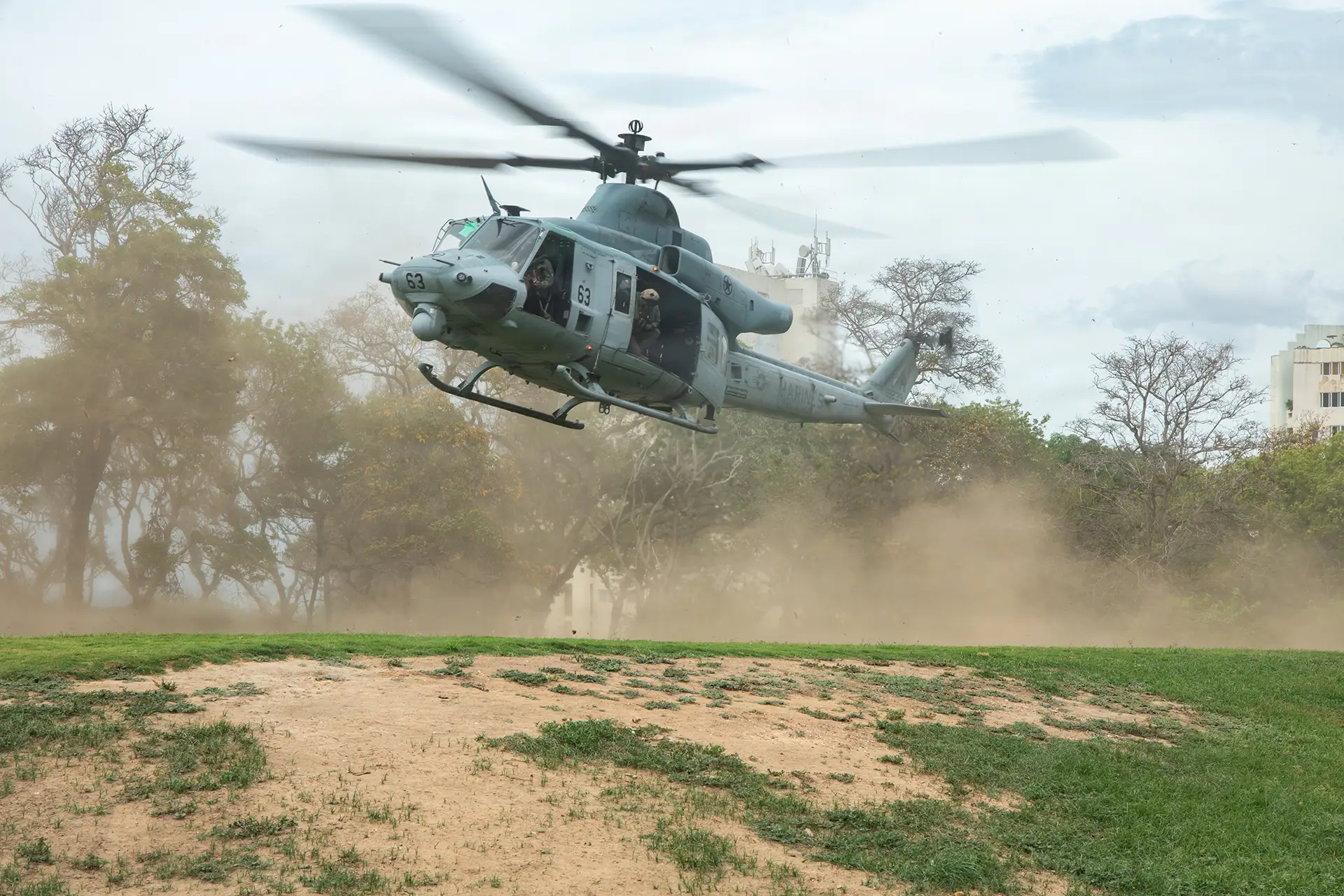
Venoms often performed roles that were too time-sensitive for heavier platforms; their missions included: Forward reconnaissance of collapsed infrastructure, liaison flights between multinational rescue teams, rapid personnel repositioning across urban clusters, and aerial damage assessment for planners aboard USS Fort Lauderdale positioned offshore.
The Venom’s agility allowed commanders to maintain situational awareness in a rapidly evolving disaster environment where ground reports were delayed or incomplete, in effect, they became the eyes and messenger of the rotary network.
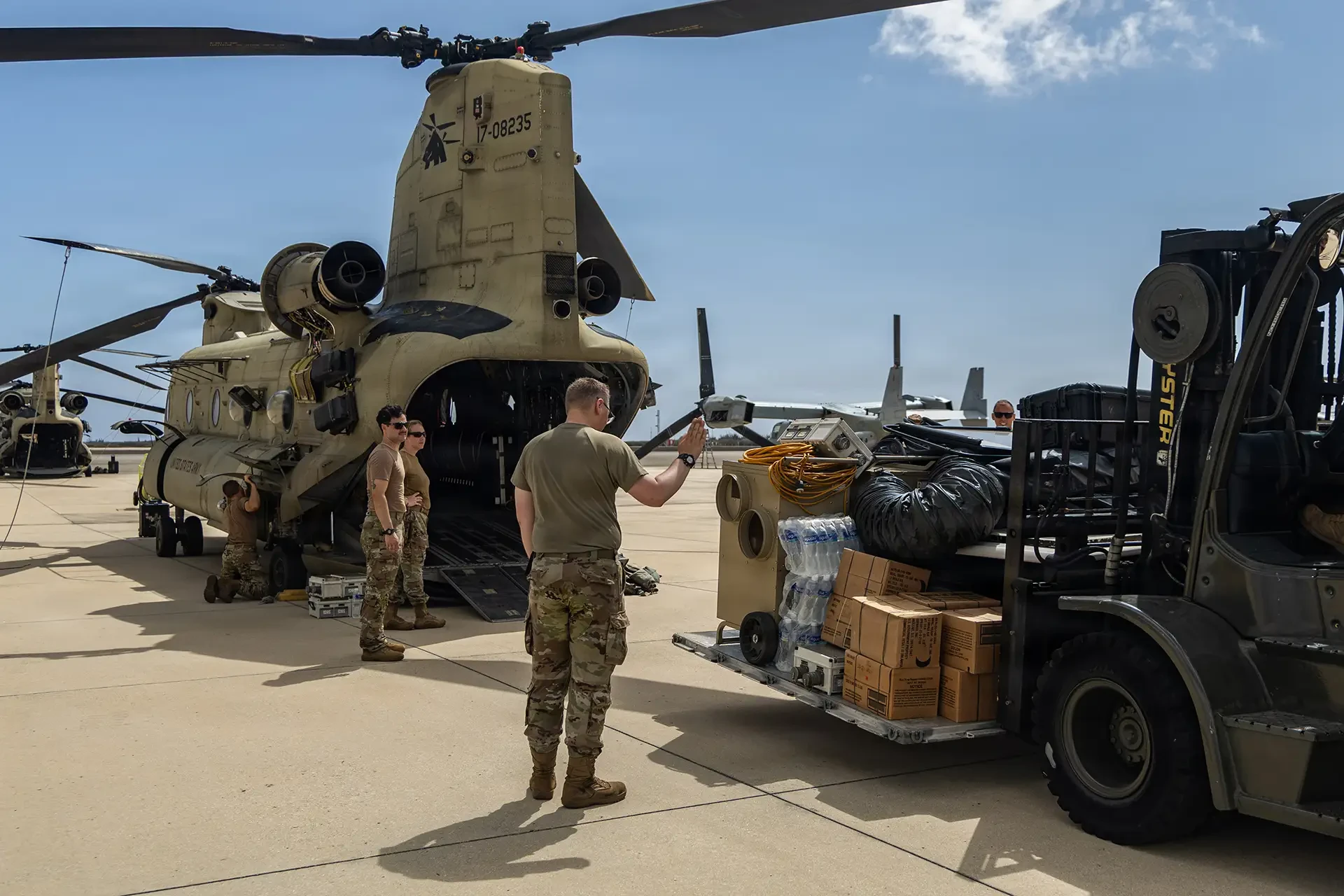
The CH-47F Chinooks entered the theatre once forward staging areas were established in Curaçao and along coastal locations. Its role was brutally simple: move weight into places nothing else could reach.
No Roads
Water pallets, generators, collapsible shelters, and engineering equipment were taken into inland zones where roads had vanished entirely. In La Guaira and Yaracuy, Chinooks became a lifeline for communities cut off by landslides and structural collapse. Their presence marked a transition from SAR to sustained humanitarian supply. Unlike tiltrotor operations, which emphasized speed and reach, Chinook sorties were deliberate and volume-focused; every sortie represented extra hours of endurance capability for isolated populations.
Fixed-wing, the KC-130J Hercules, provided by 2nd Marine Aircraft Wing, played a critical enabling role by sustaining the rotary aviation tempo. Its aerial refueling capability extended the MV-22B range across the Caribbean corridor, while its cargo capacity reduced pressure on strategic lift assets. In operational terms, the KC-130J ensured rotary wing aircraft remained forward rather than cycling back to distant bases for fuel or resupply. This compression of logistics was essential during the first critical 72 hours of response.
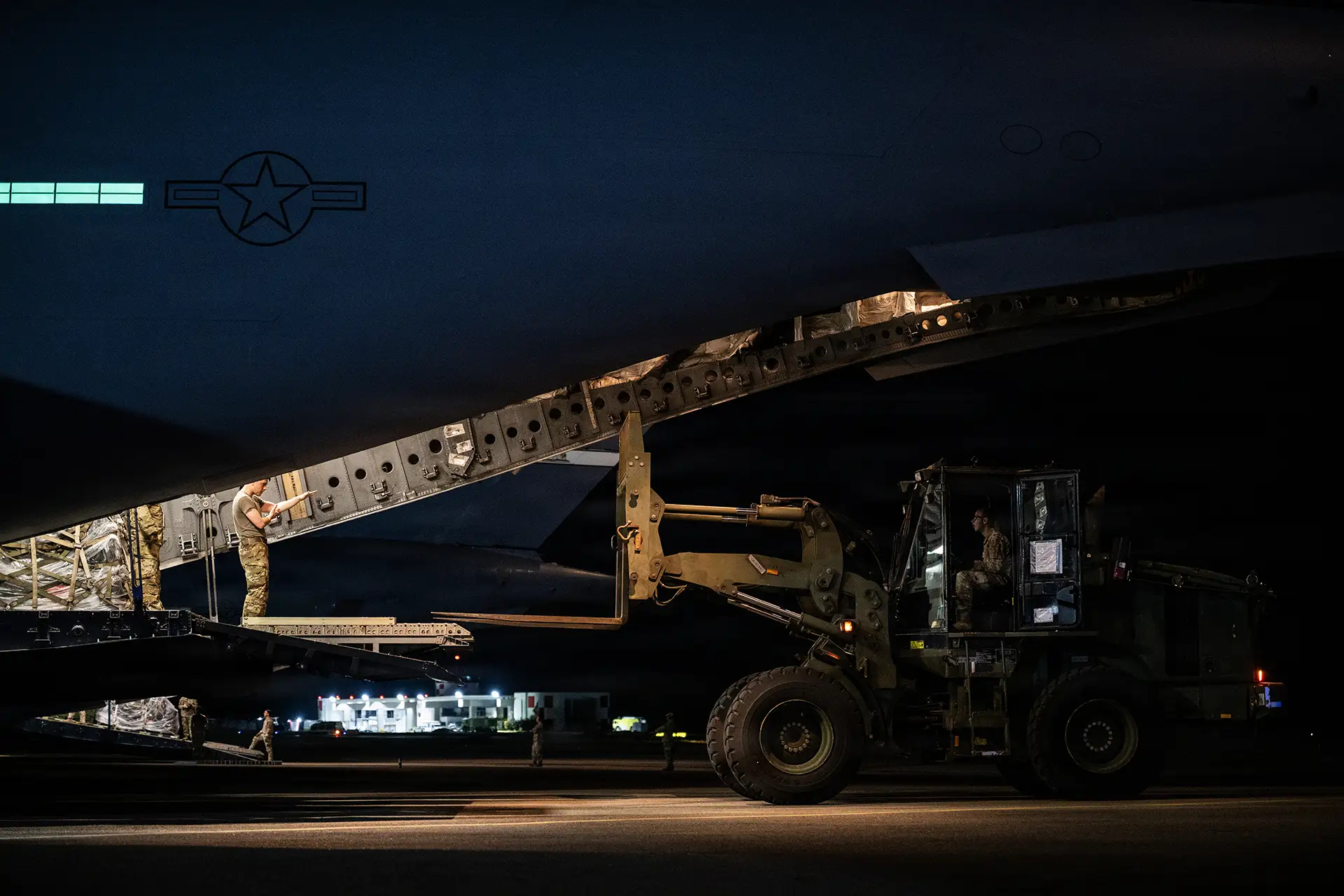
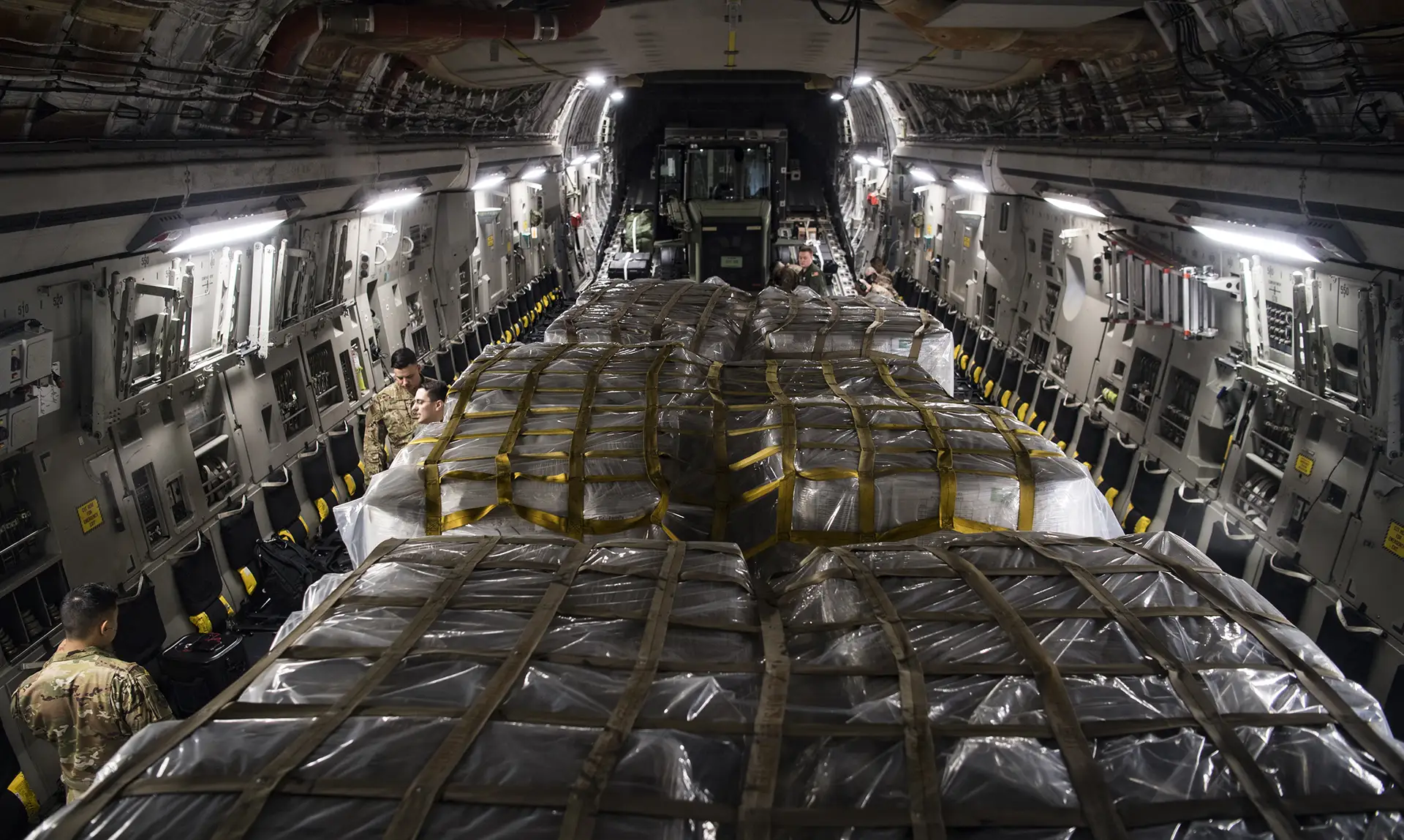
Also making an impact was the C-17 Globemaster III; purpose-built for strategic airlift, it combines enormous payload capacity with the ability to operate from relatively short and damaged runways. Those characteristics made it indispensable during the Venezuela relief operation. The C-17 linked continents to bring specialists and equipment from across America directly into the disaster zone. Each arrival represented far more than another transport flight; inside its cavernous cargo compartment were the people and equipment that would determine whether rescue operations succeeded.
Unlike commercial freight operations, disaster relief cargo is loaded according to operational priorities rather than destination alone. Every pallet had to be carefully planned and loaded before departure; equipment required immediately must be positioned for rapid unloading, while personnel often remain strapped into their seats beside the equipment they will begin using after arrival.
As the air bridge into Venezuela gathered momentum, another lifeline was quietly approaching from the Caribbean. Steaming steadily towards the shattered port of La Guaira was the San Antonio-class amphibious transport dock USS Fort Lauderdale (LPD 28). Unlike the aircraft arriving overhead, its arrival would be measured not in minutes but in days, yet its impact would prove just as significant.
The arrival of LPD 28 at La Guaira transformed the rotary architecture from expeditionary to sustainment. The ship functioned as a forward logistics node, a rotary wing flight deck hub, a medical coordination platform plus a command and control relay point.
"Being directed at a moment's notice to transit into Venezuela presented a vast number of unknowns, but the one absolute certainty was the unmatched professionalism and work ethic of the Fort Lauderdale team," said Capt. Jiwan Mack, commanding officer of USS Fort Lauderdale. "We were able to safely arrive pier side and deliver immediate assistance to the Venezuelan people.”
His comments highlighted something often overlooked about modern amphibious warships: although built for warfare, they are among the world's most capable humanitarian response platforms.
Independent Capability
Unlike civilian aid organizations, an amphibious ship requires almost nothing from the nation it is assisting. It generates its own electricity, produces its own fresh water, feeds its own crew and maintains its own communications. This self-sufficiency allowed LPD 28 to establish itself as a fully functioning logistics hub without placing additional strain on Venezuela's already overwhelmed infrastructure.
Its aviation facilities enabled continuous helicopter operations independent of shore infrastructure. From its deck, rotary wing aircraft headed inland carrying personnel and supplies, then returned to a fully self-contained support ecosystem. The ship effectively removed dependency on damaged ports or ground-based fuel systems, becoming a floating rotary sustainment base. The Freedom-class littoral combat ship USS Billings (LCS 15) also provided distributed maritime ISR support for rotary operations inland. Embarking helicopters to conduct coastal reconnaissance and damage mapping, feeding real-time data into SOUTHCOM coordination cells aboard the USS Fort Lauderdale.
This maritime-to-rotary data loop allowed planners flexibility to adjust helicopter routing dynamically as new hazards, blocked zones, or survivable access corridors were identified.
Joint Task Force-Bravo integrated into the rotary network as a regional enabler using its aviation liaison capability to ensure seamless coordination between U.S. Army, USMC and USAF assets all operating under different command structures but sharing one mission intent.
Interoperability
In Venezuela, interoperability was not theoretical; it was an operational necessity. Aircraft from multiple services shared landing zones, fuel points, and medical evacuation corridors without friction.
Urban Search and Rescue teams, inserted by MV-22B and UH-1Y crews, encountered collapsed buildings where survivors were trapped in void spaces. Chinooks delivered the heavy lifting equipment that allowed access to deep structural pockets. In multiple locations, Venoms would hover above narrow urban corridors directing ground movement while Ospreys extracted casualties to forward medical facilities. Every rotor system became part of a continuous rescue chain: find, reach, extract, transport, and treat. It was aviation as a survival mechanism.
The Venezuela earthquake response reinforced a developing doctrinal reality within expeditionary forces. Rotary wing aviation is no longer a supporting capability; it is a primary access system. The integration of these systems created a layered mobility architecture unmatched by any civilian disaster response framework.
By early July, operations began to stabilize, SAR transitioned into sustained relief distribution. Rotary aircraft continued cycling through Venezuela, but the mission focus shifted from extraction to endurance.
What emerged from the operation was not simply a humanitarian success; it was a demonstration of expeditionary aviation doctrine in its purest form. Where roads failed, helicopters replaced them; where ports were damaged, ships sustained them; and where airports were constrained, tiltrotors bypassed them.
For the people of Venezuela, the sound of approaching rotors came to represent something unexpected in the aftermath of catastrophe. Not intervention, not projection of force but access.
In disaster environments, access is the difference between life and death.
The 2026 Venezuela earthquake response ultimately reaffirmed a simple operational truth understood across expeditionary aviation communities: When everything on the ground stops working, the sky becomes the only terrain that still moves.