 HOME
HOME




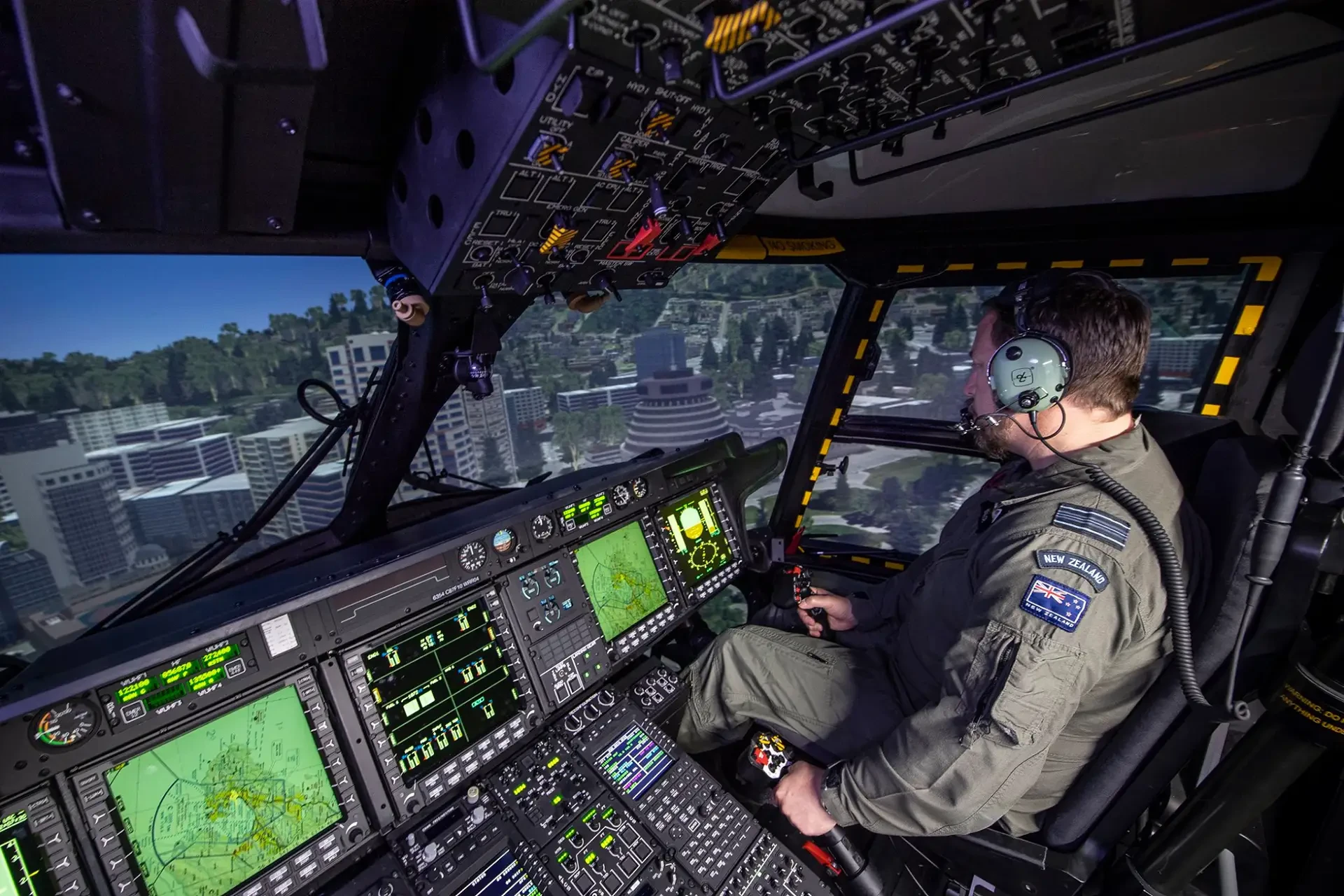
Military aviation simulation has long been recognized as a force multiplier. From Fast Jet and Rotary-Wing flight simulators to mission rehearsal and collective training environments, simulators allow aircrew to regularly train for complex, high-risk scenarios that would be prohibitively expensive or considered too high-risk to conduct 'live'. In particular, helicopter simulation, with its demanding handling qualities, perception, crew coordination requirements, and diverse mission sets, stands to benefit enormously from advances in digital technology. Yet despite this, military procurement systems across NATO and the Western world still tend to favour large, capital-intensive simulation programs that deliver strong initial capability, but then stagnate as funding and attention in subsequent years are prioritized elsewhere.
The Big Program Mindset and the ’80% Solution.’
Defence aviation simulators are typically procured as part of major platform or training system programs. These projects often deliver sophisticated, high-fidelity devices, ranging from full-mission simulators to cockpit procedure trainers, part-task devices, and rear-crew trainers. However, they are also constrained by long requirements-setting phases, rigid specifications, and conservative risk management. By the time a system enters service, whilst usually operationally credible, it is often already an ’80% solution’; the pursuit of the law of diminishing returns means that, as I found in my time in Test & Evaluation, acceptance, compliance and beyond, the perennial question posed by manufacturers and Defence Authorities alike was always “Yes, we know it’s not quite the same as the real thing, but is it good enough?”

Once the simulator is delivered and accepted, the program budget is largely spent. Upgrade paths may exist in theory; I believe 'Aircraft One' should always be the simulator for any modification or upgrade program. In practice, though, sims compete with frontline capability priorities such as aircraft sustainment, defensive aids, weapons, and avionic integration. Lazy procurement specification also plays its part: just writing “as per aircraft” because it’s easy and the Requirements Managers don’t really know what they are talking about can significantly increase time and expense. Rarely is the box you see in the simulator interchangeable with the box in the real aircraft. It may look the same at the top, but the signals behind it go to the simulator computers that drive the displays. So, does your new Mode 5 IFF control box really need to replicate the real aircraft in every single way, or can you get away with it looking right and responding correctly to the usual inputs? (We’re back at the 80% solution again…). Where are the demarcation lines between stimulating real equipment, emulating it, or just simulating it?
Inevitably, this leads to a divergence between the simulators and the real aircraft. As a result, aviation simulators that were cutting-edge at introduction quickly become outdated, particularly in ‘background’ areas like visual systems, image generation, user interfaces, and networking. Military Authorities then become increasingly uncomfortable about having to say that their expensive simulator no longer accurately simulates, and it is embarrassing to have an ever-increasing file of ‘accepted differences’.
UK Rotary-Wing Simulation: Capability Delivered, Then Frozen
The UK provides a useful illustration of this challenge. Rotary-wing training for aircraft such as AH-Mk2 Apache, CH-47 Chinook, and AW-159 Wildcat long relied on high-end synthetic training devices delivered through major contracts. These simulators generally offer excellent aircraft handling fidelity and system replication, enabling crews to practise emergencies, instrument flight, and mission procedures that would be impractical or unsafe to fly.

However, many of these systems are architecturally closed, incompatible with each other, and expensive to modify. While the aircraft they represent continue to evolve through software updates, new sensors, and revised tactics, the simulators often lag behind. Visual databases may age, networking standards change, and opportunities to integrate emerging technologies are missed because they fall outside the original contract scope. Indeed, one simulator I used to work with introduced a new operationally specific terrain database just in time for the Force to leave that theatre. Another steadfastly refused to fix issues because it was simply cheaper to accept the financial penalties than to remedy the faults; this is a commercial, rather than a technical or requirements failure.
The United States: Scale Meets Innovation — Uneasily
In the United States, aviation simulation is procured at enormous scale. Helicopter platforms such as the UH‑60 Black Hawk, AH‑64 Apache,
and CH‑47 Chinook are supported by extensive simulator fleets, many delivered as part of original aircraft acquisition programs. These
devices are often extremely high fidelity, but they are also expensive, geographically fixed, and slow to modernize.

Recognizing this, the U.S. Army’s Synthetic Training Environment (STE) has sought to adopt a more modular, open approach, allowing aviation simulators to connect with ground and joint environments in a shared virtual battlespace. For rotary-wing crews, this offers the promise of training not just aircraft handling, but true mission integration, operating alongside ground forces, unmanned systems, and other aircraft in a persistent synthetic environment.
However, STE also highlights the procurement tension: integrating legacy helicopter simulators into a modern, software-driven ecosystem is complex, costly, and occasionally, impossible! Meanwhile, commercial Virtual Reality (VR) based helicopter trainers are evolving rapidly, offering surprisingly high training value at a fraction of the cost, but often sit outside formal military acquisition pathways.
Australia and VR Helicopter Training

Australia has shown growing interest in leveraging emerging technology to complement traditional aviation simulation. The Australian Army’s exploration of VR-based training systems, including dismounted and aviation-relevant environments, reflects a recognition that not all training requires a full-motion, million-dollar simulator.
For helicopter crews, VR offers particular advantages. Crew coordination, spatial awareness, procedural rehearsal, and mission planning can all be trained effectively using immersive head-mounted displays and networked systems. VR-based crew trainers allow pilots and rear crew to practise communication, workload management, and decision-making without competing for scarce aircraft or high-end simulator availability.
Yet these systems often remain pilots or trials rather than enduring capabilities, precisely because procurement funding tends to prioritise large, platform-centric projects over smaller, iterative investments, leading to what was once a very promising product languishing in a dark room or forgotten corner of a hangar, covered in dust.
Why Aviation Simulation Suffers Disproportionately
Aviation simulators are especially vulnerable to obsolescence because they sit at the intersection of hardware-intensive procurement and
rapidly evolving software. Motion platforms, dome displays, and bespoke cockpits have long service lives, but the software that drives
visuals, threat models, and instructor tools evolves rapidly. When procurement does not include sustained funding for software refreshes and
technology insertion, the value of training erodes.

This is particularly problematic for helicopter operations, where mission profiles change frequently, and crews must adapt to new sensors, tactics, and joint operating concepts. A simulator that cannot be easily updated risks training crews for yesterday’s fight.
Towards a More Sustainable Model
The lesson across NATO and the West is clear: military aviation simulation, especially rotary-wing training, requires a shift away from one-off procurement toward continuous capability development. Modular architectures, open standards, and deliberate integration of commercial technologies such as VR and cloud networking offer a way forward.
Rather than viewing VR and low-cost networked simulators as competitors to high-fidelity devices, defense organizations should see them as force multipliers that extend training reach and preserve expensive assets for tasks that genuinely require them. Sustained investment, rather than episodic capital spend, is essential if aviation simulators are to remain relevant.
Without this shift, military forces will continue to field excellent simulators on day one, only to watch them slowly wither as technology, tactics, and operational demands move on.

An Industry Perspective: Shared Responsibility and Shared Risk
For industry, the challenge is not simply to deliver ever more sophisticated simulation systems, but to help defense customers think differently about how those systems are procured, sustained, and evolved. Military aviation simulators, particularly in the rotary-wing domain, must be treated as enduring capabilities rather than finite projects that end at contract acceptance. However, this shift cannot be driven by industry alone.
Defense procurement organisations play a critical role in enabling or constraining innovation. Long specification cycles, tightly scoped contracts, and rigid upgrade pathways make it difficult to exploit rapidly maturing technologies such as those offered by virtual reality or cloud networking. Even when industry is ready to offer modular, upgradable solutions, those options can only succeed if military customers are prepared to accept greater flexibility, incremental delivery, and managed risk.

For industry, this means proposing architectures that are open, interoperable, and deliberately designed for change. For defense, it requires a willingness to move away from the comfort of monolithic, one-off programs toward sustained investment models that prioritise relevance over perfection. The traditional pursuit of a fully defined end-state capability often results in simulators that are excellent on day one but increasingly disconnected from operational reality over time.
The most effective aviation simulation ecosystems will emerge where both sides share responsibility. The online gaming world has shown the way; Industry must provide adaptable technology and honest development roadmaps, while military customers commit to continuous capability development, spiral upgrades, and realistic funding for sustainment. High-end full mission simulators will always have a place, but they must be complemented and periodically refreshed by lower-cost, software-driven systems that can evolve at the pace of tactics and technology.
Ultimately, the success of military aviation simulation will be determined not by who leads innovation, but by whether procurement structures allow it to endure. Flexibility, trust, and long-term collaboration are no longer optional. They are prerequisites if simulation is to remain a credible training advantage rather than a slowly fading legacy asset.

Editor's note: The authors concerns are well known and familiar - we shared the 'lived experience' on the UK Chinook force of a simulator complex that suffered from being 'left behind' due to a multitude of Urgent Operational Requirements (UORs) being installed on the aircraft (by me as the Requirements Manager) with little to no agreed provision for the upgrade of the sim. The result was crews arriving in theatre to find a cockpit they were expected to fight in that varied wildly from the one they'd flown during their Pre-Deployment Training (PDT); some kit was new, while others had been moved. Eventually, I was able to campaign for a 'Sim UOR' to support an upgrade program, but the delay was measured in years, not months. Large, multi-year Sim contracts have their place given the cost of high-fidelity training devices, but the commercial reality must leave room for rapid upgrade and modification, or the exquisite Faberge egg risks becoming something of a curate's one...
