 HOME
HOME




Where’s the future in battlefield heavy lift? Paul Kennard, in this two-part series, takes the journey on where it may lie.
A Long and Distinguished Service
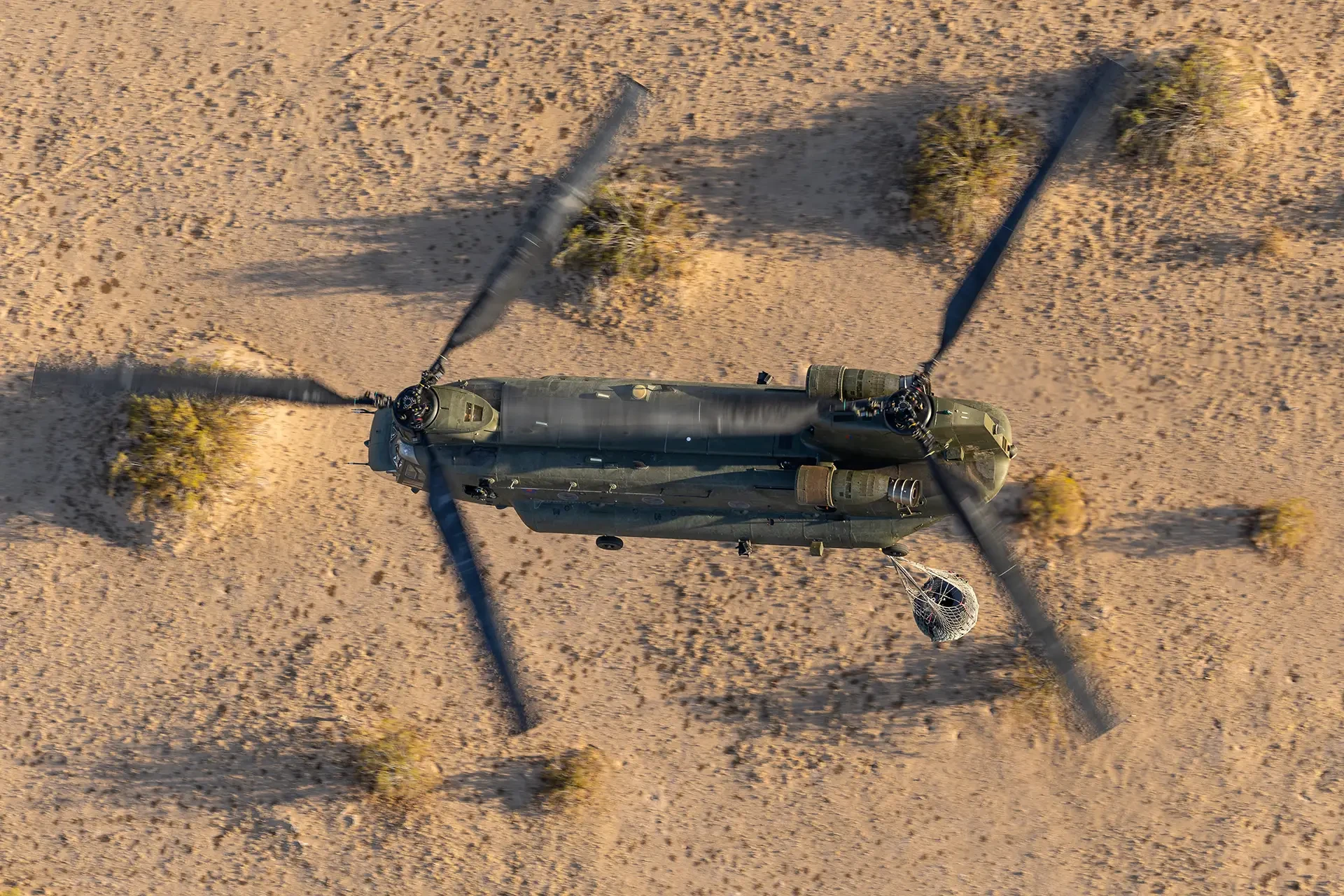
The mighty CH-47 Chinook has served the US military, her allies and, yes, even some enemies (who, in fairness, used to be allies...) for some six decades. The basic recipe has remained unchanged throughout that period - a large, broadly square, cabin, a ramp for easy access, and then everything else crucial for flight bolted to the outside - engines, rotor systems, cockpit, fuel tanks and undercarriage inter alia. The distinctive tandem rotor design allows for a broad Centre of Gravity (CoG) range for both internal and external loads, and endows the aircraft with a degree of wind tolerance that few if any conventional rotorcraft can claim - plus, as an added bonus, the aircraft does not have a traditional 'power pedal' that reduces lift potential, nor suffers from other 'half helicopter' curiosities such as tail rotor drift/roll nor a reduction of tail rotor effectiveness due to relative wind or main rotor interference. In other words, it's pretty simple to fly and very stable - at least with the, now Digital, Automatic Flight Control System (D/AFCS) engaged.
Much like it's fixed wing 'twin', the C130 Hercules, the Chinook’s external appearance has largely gone unchanged in the decades since it
entered service. The changes have mainly taken place under the skin. Engine power has increased dramatically; from the circa
2000hp of the T55-L5 that powered the CH-47A to the near 5000hp of the T55-GA-714A that is the standard fit for the CH-47F, while the
introduction of Full Authority Digital Engine Control (FADEC), despite a number of initial teething problems, has dramatically reduced the
engine handling burden on crews, offering almost carefree use of the collective (thrust lever in Chinook parlance) and greatly simplified
start/stop procedures.
The hydraulic system has been significantly modified, especially between the CH-47C and CH-47D models - the current system being far simpler
with fewer potential leak points than the original provision. In mission avionics the change has been nothing short of
transformational. The AFCS has been replaced by DAFCS, using the navigational precision of Integrated GPS and INS (IGIs) to enable
'tethered' hovering and any number of Flight Director controlled approach/departure and route navigation modes, all orchestrated by an
increasingly digital 'backbone' and controlled by a number of different glass cockpits - primarily the RTX Collins CAAS (Common Aviation
Architecture System) as used by the US Army CH-47F, but Honeywell and Thales, amongst others, have also seen their cockpits
employed. The increasing number of 'second life' ex-military CH-47s appearing in the civil world, as both heavy lift utility and
firefighting platforms, is seeing a new generation of civil certified cockpits further enhance the operating experience.
So, if the 'beauty' of the Chinook is patently more than skin deep, why are there an increasing number of voices suggesting that the US Army, as its primary customer, needs to think radically about the future of battlefield heavy lift? Moreover, what are the options available?
As with all acquisition processes, the first option is always 'Do Nothing'.
After all, as far as many in the Army are concerned, the Chinook, in its CH-47F, and now Block II guise, is amongst the youngest fleets in
terms of airframe life the Army possesses. Indeed, this is exactly the argument deployed by the Army when they were seeking to
effectively defund the CH-47F Block II program in 2019/20 - preferring instead to invest in Capability Sets (Cap Sets) of the Future
Vertical Lift (FVL) portfolio while reserving the Block II modifications exclusively for the specialised MH-47G SOCOM variant.
However, the political ramifications of essentially reducing the production facility at Ridley Park, Pennsylvania, from two lines (one
CH-47F for the US Army and Foreign Military Sales and one for the MH-47G plus bespoke export orders) were deemed unacceptable; there would
have been inevitable lay-offs for skilled workers and an unwelcome increase in the cost per airframe on a single line due to having to
switch between sub-versions of the aircraft as they rolled down. As a result, Congress continued to add, albeit modest, funding to the
Army's budget to keep the Block II supply chain alive - a decision that seems prudent now as the CH-47F Block II has been a major
beneficiary of the Army's culling of the Future Attack and Reconnaissance Aircraft (FARA) program.
FARA was a key pillar in the Army’s FVL modernization plan, representing Cap Set 1 or Joint Multi Role (JMR) Light. On a practical
note, FARA would, at last, deliver a replacement for the retired OH-58 Kiowa in the Scout/Light Attack roles. Ostensibly the Army
killed it off, agonisingly close to the first flights of both competing platforms, Bell's 360 Invictus and Sikorsky's Raider X, due to a
reappraisal of the contemporary battlefield in light of the ongoing conflict in Ukraine - especially the wide proliferation and apparent
combat effectiveness of Unmanned Aerial Systems (UAS). However, there had been rumours circulating for a while that the Army's program
was 'fiscally overheated', while politics, again, seemingly exercised its influence. The Army's selection of Bell's V-280 Valor
tiltrotor as the winner of the FVL Cap Set 3 (JMR-Medium) requirement, the Future Long Range Assault Aircraft (FLRAA), left both Boeing and
Sikorsky with yawning holes in their order books and, concomitantly, their production lines and broader supply chain hinterlands going
forward - representing literally dozens of Congressional districts. With FARA cancelled, the Army could both relieve the near term
financial pain and, in a move reminiscent of the cancellation of the RAH-66 Comanche some two decades ago, reapportion some of the funding
and technology into supporting their legacy platforms. Sikorsky got a new multi-year deal for the UH-60M Black Hawk (the updated
UH-60V program was also culled to save costs) and Boeing, finally, saw the CH-47F Block II move to a firmer production footing.
Ergo, the Army could just 'do nothing' by rolling out the Block II modifications across the circa 500 CH-47F fleet - opting to buy new
airframes when better value than updating older tail numbers. The Block II mods include a strengthened airframe, simplified fuel
system (with an additional 100 US gallons of capacity) and an improved drive train (providing a 10% increase in Max Torque) - all of which
provide improvements over the Block I in terms of payload (up to an additional 4000lbs) and a slight increase in combat radius.
However, one of the key initial components of the Block II package was the Advanced Chinook Rotor Blade (ACRB), and that has been firmly
dropped due to excessive vibration discovered during flight testing. These new composite blades were designed to replace the existing
fibreglass items (themselves, the replacement decades ago for the original metal blades) but the high levels of vibration caused increased
aircrew fatigue and was considered by the Army to be serious enough to pose a safety of flight risk. ACRB was going to offer another
2-2500lbs of lift performance, especially at high Density Altitudes. Combined with the other Block II enhancements, this would offer
broadly a 6000lb increase in payload over the Block I airframe - and this was important. Why? Because the Block I's design
improvements had made the aircraft much heavier than the legacy CH-47D, and the Army was keen to 'buy back' some of that loss. Without
ACRB those margins are not as great.
However, what if the Army decide that 'Doing Nothing' is not an option? The Army could be a bit more proactive and 'Do
Minimum'.
Doing minimum has several attractions. Firstly, the basic airframe would remain largely unchanged. This would not see a fundamental shift in airworthiness support, concepts and doctrine, nor crew and maintainer training - just an analysis of the deltas resulting from the modifications. There are some already some pieces of 'low hanging fruit' that the Army could go after.
Firstly, they could take a longer term view of the ACRB. Without any perceived rush to make a notional Block II deadline, Boeing and PM Cargo could work their way through the vibration issues in slow time as a research project. After all, the performance benefits of ACRB may well also prove backwards compatible with older Block I F-Models and even CH-47Ds, opening the door to existing FMS and DCS customers to retrofit them to gain some payload benefit. It may also prove acceptable to the FAA as they continue to work with the increasing number of civil operators of the Chinook as firefighting and utility platforms - and, in the near future, the Columbia 234SP civil 'reset' CH-47D is being certified in the Transport Category with OEM support. An extra 1500-2000lbs of fuel or water would make a significant difference to the 'water cycle' of the aerial attack business - more water on target or fewer refuels. A measured approach to Test & Evaluation could well see iterative modifications to the ACRB delivering a vibration free solution within a few years.
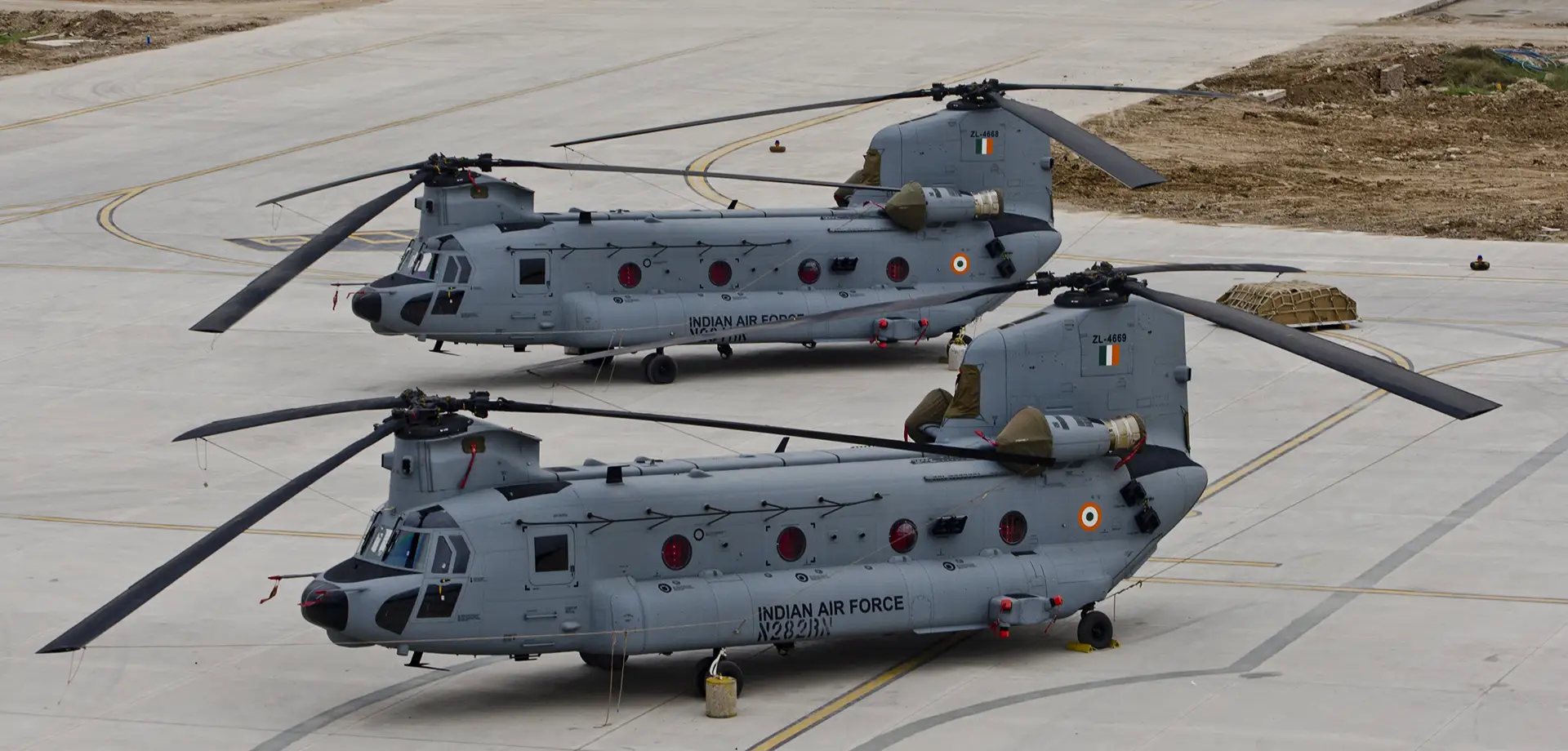
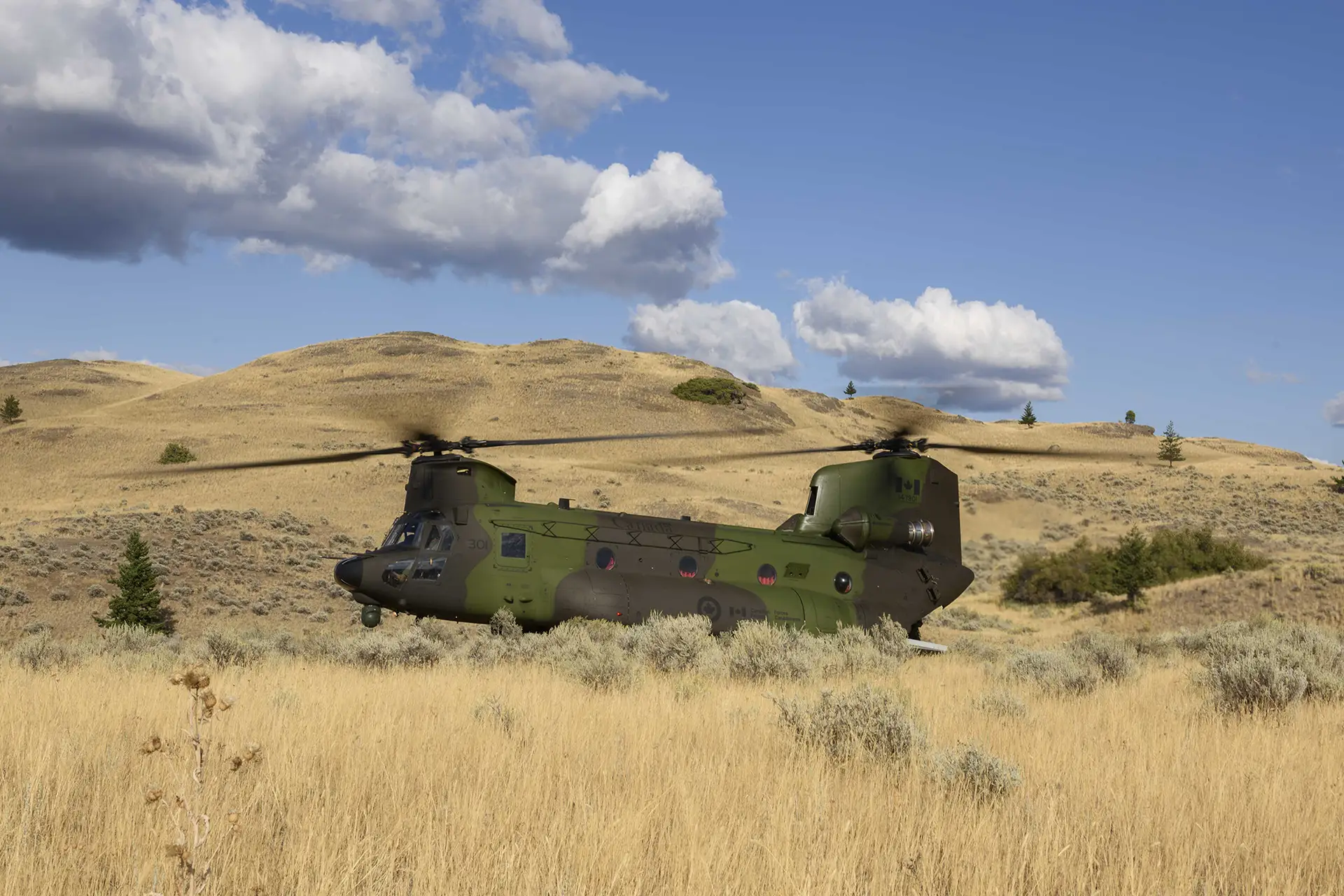
Secondly, the US Army could look at significantly increasing the engine power available. There are two credible options already on the table. The Army has contracted the incumbent, Honeywell, to develop a yet more powerful version of the current T55 engine. Designated the T55-714C, this uprated engine offers the Army a 20% increase in engine power (from the circa 5000hp of the -714A to 6000hp) as well as an anticipated 8% reduction in fuel burn. However, the Army has also funded General Electric to fit its T408 engine to an old Trials CH-47D. The T408 is a brand new engine, designed for the US Marine Corps latest heavy lift helicopter, the supremely powerful CH-53K King Stallion. Capable of delivering 7500hp, the T408 would offer a near 60% power hike over the current T55-714A, and 20% over even the new T55-714C. it would also break the 'vendor lock' on the aircraft that Honeywell currently enjoys. The Army completed ground tests for 18 months and completed multiple flight tests - albeit within a limited restricted flight envelope, though including speeds of up to 140kts, turns using 60 degrees of bank and altitudes of up to 4000ft.
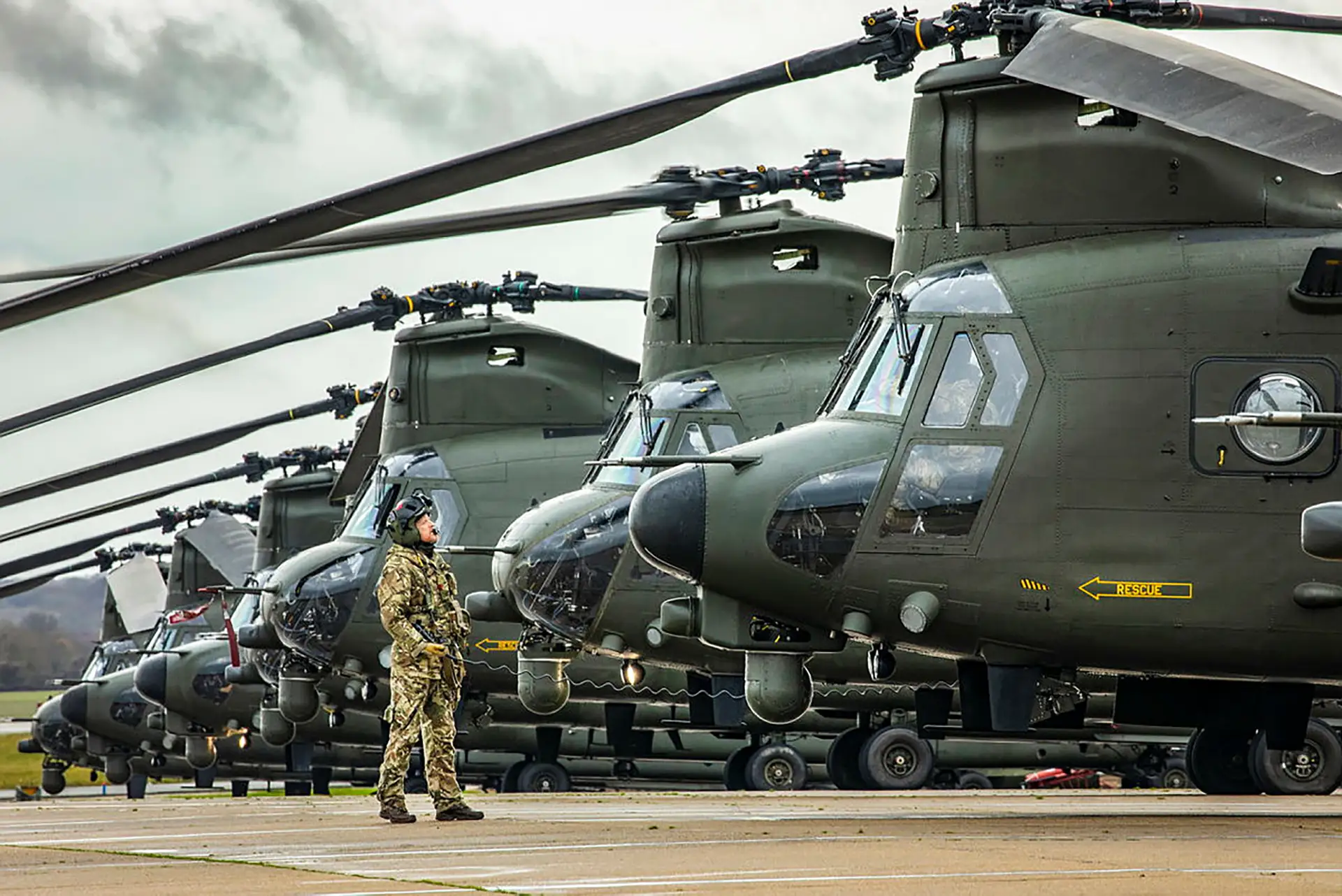
The issue with fitting either the -714C or T408 to the Chinook is that they offer more power than the transmissions and drivetrain have been
designed for. The Block II modifications do provide some modest improvements to both, enabling them to absorb more power, but not the
sort of increase that the T408 in particular offers. It's not, however, necessarily a show stopper. During my flight training,
my first multi-engined helicopter was the Westland Wessex HC2. The Wessex was a UK licence built version of the Sikorsky S-58 (H-34),
which replaced the Wright Cyclone piston engine with, initially, a single turbine - offering a significant power to weight ratio improvement
as well as greater mechanical simplicity. The HC2 that I flew had a twin-turbine fit, and the combined power output greatly exceeded
the rating of the transmission system. From memory, the torque limit for twin engined operation was 3200 ft lb, but a single engine
was able to provide 2800lb ft by itself. The benefit was, therefore, that there was little appreciable drop off in performance in a
One Engine Inoperative (OEI) situation.
The improved Chinook Block II transmission system, as is, could be similarly restricted - with the '100%' max continuous torque limit (and transient limits thereafter) recalibrated to the new engines - still presenting a useful increase in capability. However, given that such a huge increase in power would not cause the current Nr droop as excess torque is demanded, there would likely to have to be additional visual and aural warnings of exceedances, or an artificial limit imposed on output via FADEC, as there would be real danger that transmission integrity could be compromised by absorbing too much power. New engines would endow the aircraft with even more astonishing OEI capability than it currently has, as well as the potential to maintain max payload at high Density Altitude - an important consideration for export customers such as India and Canada, as well as areas of the USA. A colleague who formed part of the Army's T408 test team noted that the aircraft retained sea level performance at 4000ft, and that was with 'derated' engines to help protect the drivetrain.