 HOME
HOME




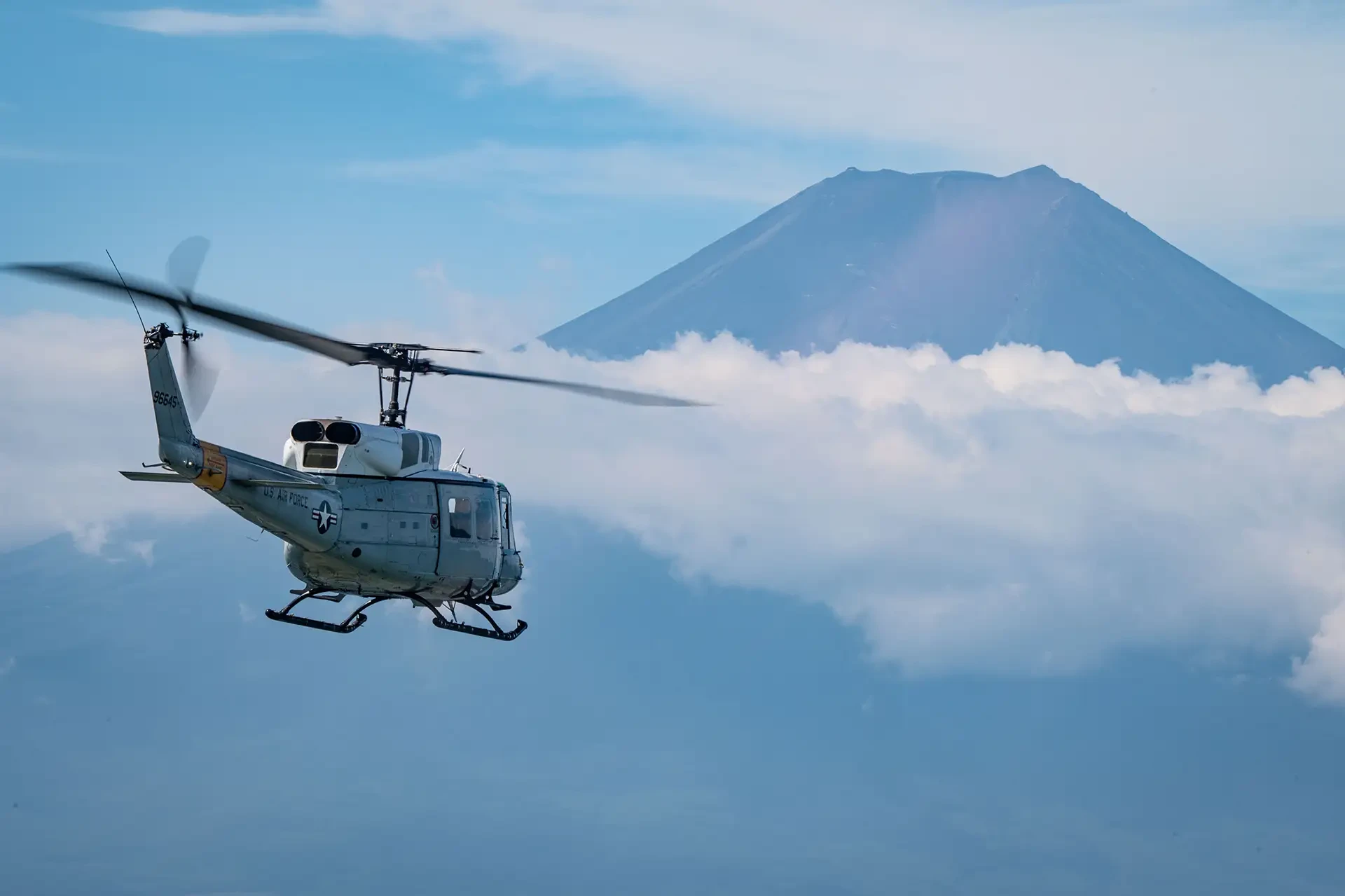
After more than 45 years of service, the U.S. Air Force has flown its last operational missions with the “November” variant of the Bell UH-1 in Japan as part of the Pacific Air Forces. Gone are the gray Hueys with the highly visible white tops and the Air Force tail flash that had become so familiar over the years. The men and women of the 374th Airlift Wing, 459th Airlift Squadron have employed the N-model Hueys to perform a variety of tasks from aeromedical evacuations, search and rescue missions when needed, to moving senior civilian government and military officials over the crowded streets of Tokyo Prefecture.
The first November models arrived in 1980, and began operations from Yokota Air Base, a U.S. Air Force installation that’s also home to U.S. Forces Japan and the Fifth Air Force. The air base is located approximately 28 miles west of Tokyo’s city center, and the unit’s four UH-1Ns were vital in moving distinguished visitors and those needing medical attention from the outskirts of the city to government buildings or trauma centers in the downtown area.
Although the 459th Airlift Squadron (AS) was not tasked as a frontline search and rescue (SAR) unit, they were equipped for, and could perform, the mission. Units of the Japanese Ground Self-Defense Force and the Japanese Air Self-Defense Force, which fly Hueys and other helicopter platforms, will continue to be the primary SAR units in the region.
In addition to the now-retired UH-1Ns, the 374th Airlift Wing’s 36th Airlift Squadron flies the Lockheed C-130J Super
Hercules and the 459th Airlift Squadron will continue its mission with the Beechcraft C-12J Huron; the Huron is similar to the
Beechcraft 1900 airliner and can be configured to move litter patients or fitted out with passenger seats.
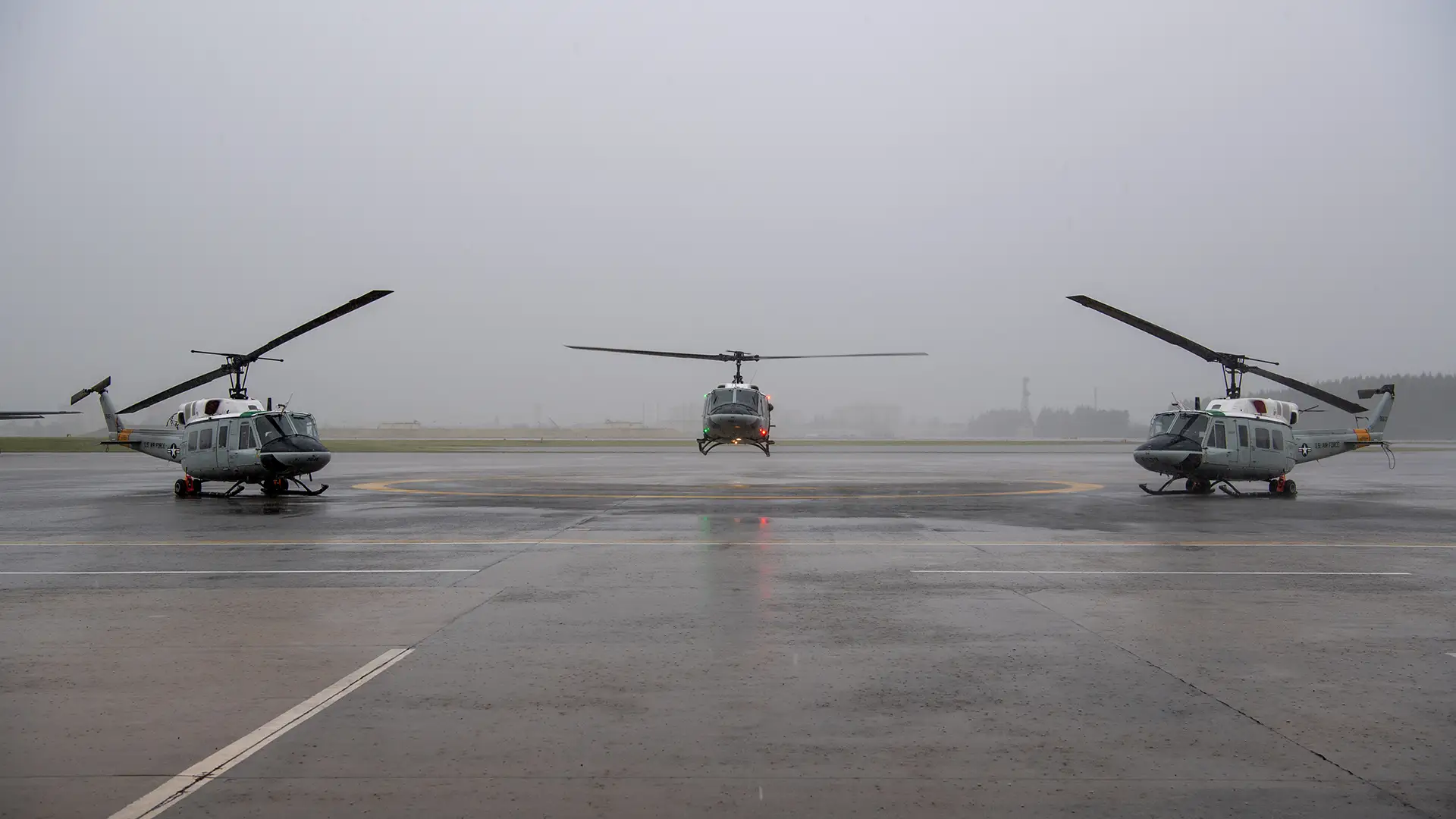
The 374th Airlift Wing was born out of a 1992 restructuring at Yokota Air Base that saw the 475th Air Base Wing and its subordinate units deactivated and the renamed 374th Airlift Wing established on April 1, 1992. The 374th Tactical Airlift Wing was part of the Air Mobility Command before being transferred to the Pacific Air Forces.
The 459th Airlift Squadron traces its lineage back to World War II as the 459th Bombardment Squadron that was tasked with training replacement heavy bomber crews. The unit converted to the Boeing B-29 Superfortress in the summer of 1944 and served as part of the strategic bombing campaign against Japan from January 1945 until the end of the war.
UH-1N Twin Hueys
The Royal Canadian Air Force (RCAF) was the first to order the UH-1N Twin Huey, which were fitted with Pratt & Whitney Canada PT-6T
turboshaft engines. The U.S. Air Force began taking delivery of November models in 1970, and the U.S. Navy and Marine Corps received their
-1Ns the following year. The success of the military Twin Huey led to the commercial Bell 212 and later 412 models. In September 2009, the
U.S. Marine Corps UH-1Ns began to be replaced by UH-1Ys, known as “Yankees,” that were fitted with a four-blade rotor and two 1,546 hp
General Electric T700-GE-401C turboshaft engines.
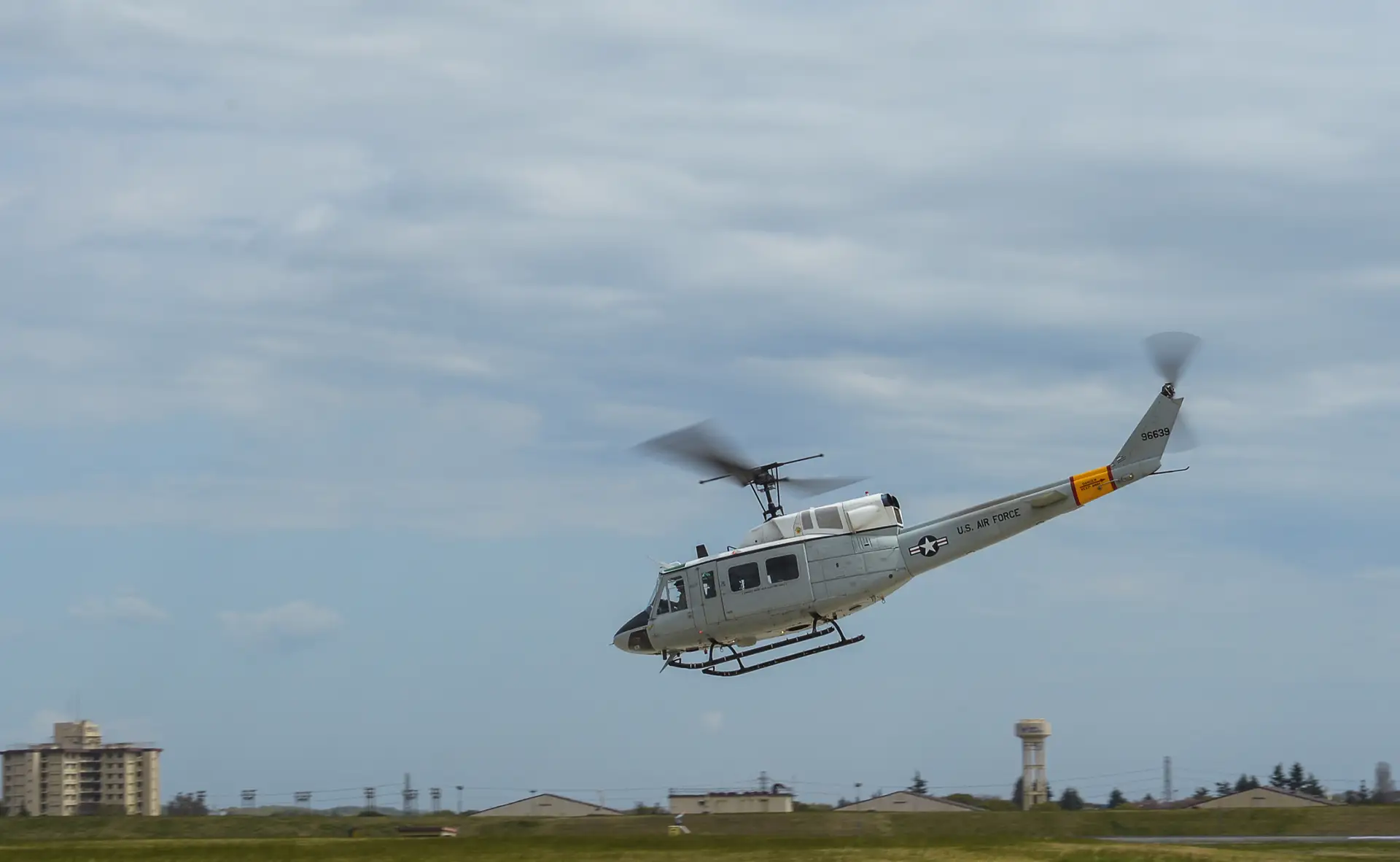
Of the four Novembers flying with the 459th Airlift Squadron, 69-6614 was the earliest of the batch. This airframe was delivered to the U.S. Air Force on Nov. 19, 1970, and assigned to the 20th Special Operations Squadron (20th SOS) at Cam Ranh Bay, Vietnam, three weeks later on Dec. 4. She served in-country until the draw-down of American forces began, returning stateside on March 13, 1972, and transferring to the 1st Special Operations Wing at Hurlburt Field, Fla. In November of that year, 69-6614 was sent to storage in the Arizona desert, where she remained, preserved, until Jan. 30, 1984. That date saw her sent for overhaul and then transferred to the 20th SOS, again operating from Hurlburt Field. She was later assigned to Detachment 1 of the 57th Fighter Weapons Wing at Indian Springs Air Force Auxiliary Field, today’s Creech AFB, in the Nevada desert. In January 1980, this aircraft was shipped to Yokota for service with the 459th Airlift Squadron.
The other three UH-1Ns serving with the 459th Airlift Squadron were 69-6636, -6645, and -6646.
The DV Mission
A big part of the 459th Airlift Squadron’s duties included distinguished visitor (DV) transportation from Yokota Air Base to
various locations throughout the region. “A typical duty mission is flying to Hardy Barracks, also known as the Akasaka Press Center, for a
DV drop off. We'll typically show about two to three hours before the sortie is planned to take off. We'll do the paperwork, get everything
ready to rock at two hours prior. We'll make a weather call to the customer, whether that's one of the generals on base or another big name
that's in town. And then we'll step to the helicopter, get turning and be ready to pick them up about 10 minutes early,” describes U.S. Air
Force Maj. Michael Girolami, 459th Airlift Squadron director of operations. “We then fly down to the Hardy Barracks along the Tama River
down toward the Noborito train station. We'll pass by Tachikawa Airfield and the Chōfu Airport. We then make a hard left and follow the
train tracks into downtown Tokyo, overfly Yoyogi Park, home to the Meiji Jingu shrine, and then hang a right around the Tokyo Dome and
follow on what we call the ‘Tree ILS’ to landing. There's a nice line of trees for a north-to-south approach that enables us to line up on
that and come in for landing at Hardy Barracks. It's always cool to land there. We pass over a little park, and there are always parents
and kids out there waving, playing in the playground.”
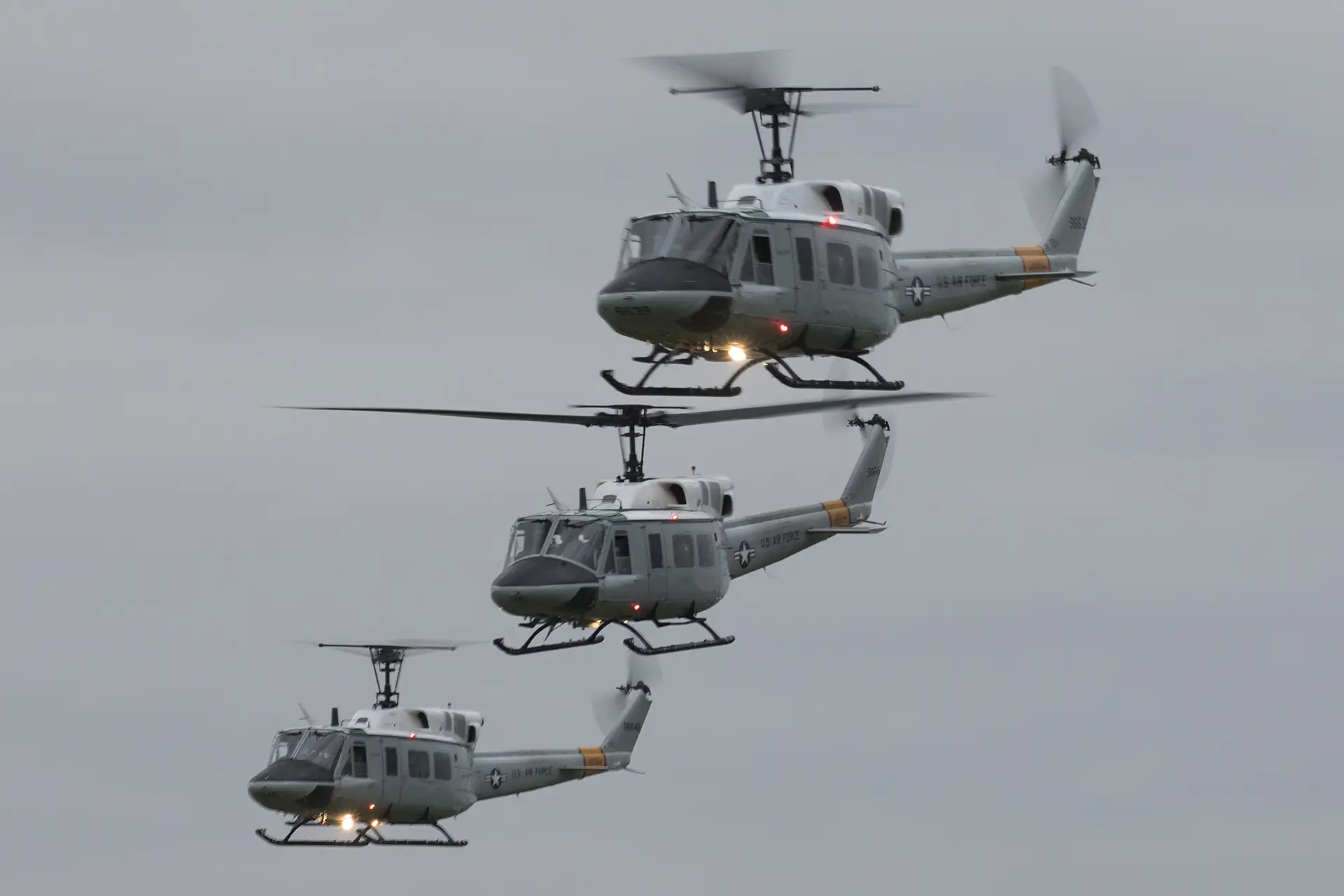
Hardy Barracks is right in the heart of downtown Roppongi, and the Akasaka Press Center is home to the Stars and Stripes newspaper, a heliport, and a small Navy Exchange as well. Maj. Girolami continued, “After we drop off our passengers, they will get picked up by their ground transportation, and we'll either turn and burn or shut down and wait for them to return for the flight back to Yokota. Then we’ll pick up another group of DVs and make the circuit to Hardy Barracks again. That's probably our bread and butter when it comes down to it – reducing transit time for DVs that need to be at meetings and be present for face-to-face interactions with their Japanese counterparts, whether they're going to the Ministry of Defense, any of the embassies, or another engagement.”
The 459th transports many high-level civilians as well. Most recently, the new U.S. Ambassador to Japan, George Glass, flew with
the 459th AS in August 2025. Congressional delegates will routinely visit Japan during the summer when the House and Senate are
on recess and they often rely on the squadron for transportation in the area. Other DVs include staffers working for the Secretary of
Defense and the Secretary of the Air Force, as well as staffers of the U.S. vice president and those of the president when required.
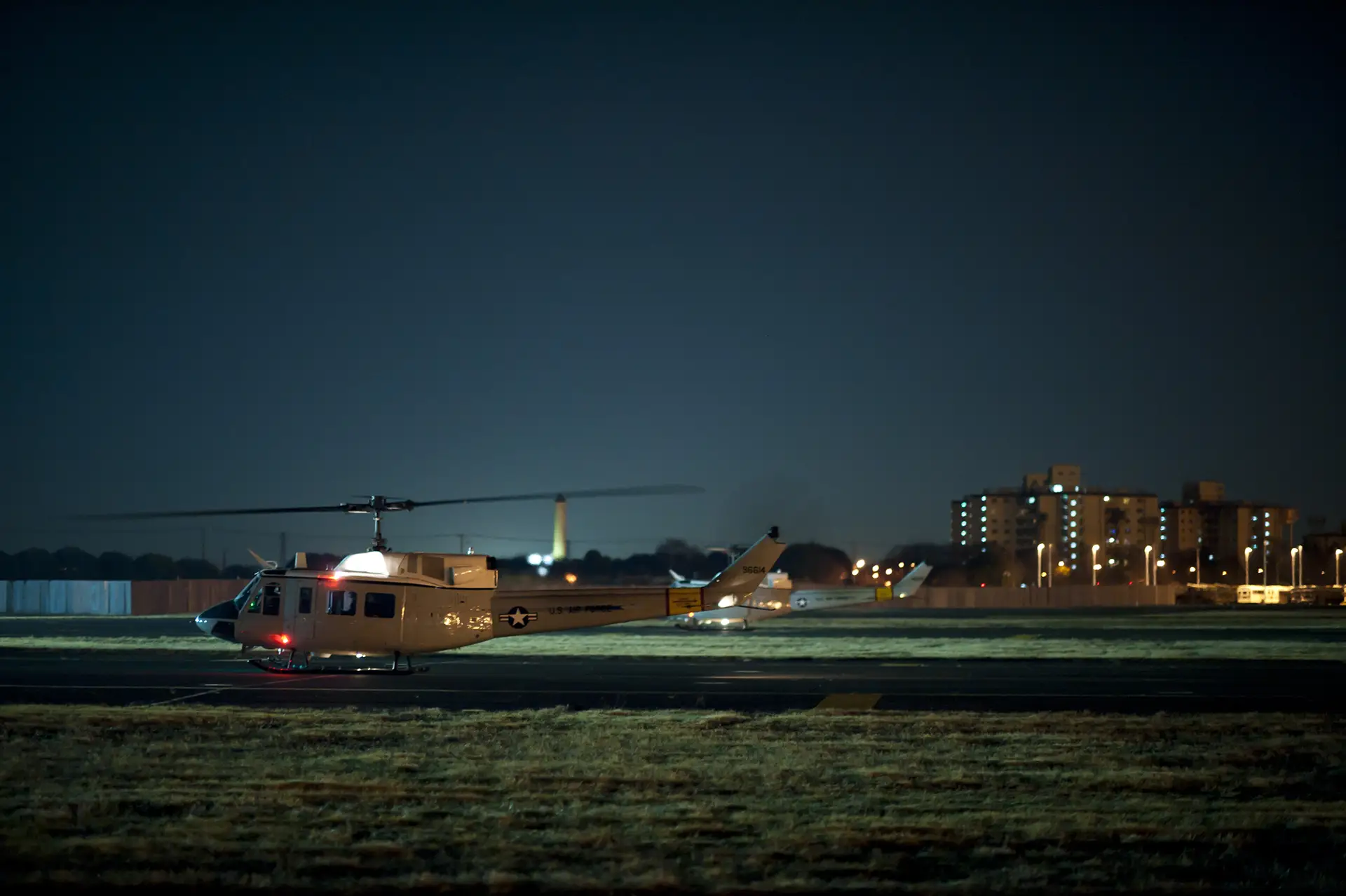
The phase out of the Hueys will see the U.S. Army UH-60s at Camp Zama, about 25 miles south of Tokyo in the Kanagawa Prefecture, assume a portion of the 459th Airlift Squadron’s airlift mission.
Aeromedical Mission
For the past 20 to 22 months, the 459th AS has been on 24-7, 365-day air ambulance alert for the region. “We have an urgent care medical facility here on base, but as far as a serious trauma center, the nearest one is going to be down in Yokohama at Yokosuka Navy base. Our squadron stood up the air ambulance mission to get those folks that are hurt or need immediate medical attention down to Yokosuka so they can be treated at a level one trauma center. To date, we've had 15 urgent case patients over the last 22 months,” said Girolami.
All of the transport missions have been single individuals, ranging from a severely broken arm, to a suspected case of meningitis, and a couple of acute appendicitis cases. “We’ll fly them all the way down to Yokosuka as fast as we can,” Girolami continued. “We're required to show up within 30 minutes of the alert and take off within an hour. Everyone had been on the hook for 30 minutes to respond.”
Operation Tomodachi
The Japanese word Tomodachi translates to “friend” in English, and on March 11, 2011, U.S. Forces in Japan came to the aid of America’s ally in response to the Tōhoku earthquake. Yokota Air Base became the operational command center and aviation hub for disaster relief efforts as Sendai Airport, in Miyagi Prefecture, was flooded from the earthquake’s resulting tsunami. Operation Tomodachi was in effect from March 12 to May 4, 2011, and involved 24,000 American servicemen and women, 189 aircraft, and 24 U.S. Naval ships. The rotary wing assets of the 459th Airlift Squadron played a vital role in the operation.
Addressing the needs of residents, where in many cases people needed to be evacuated from their homes in the quake and tsunami’s aftermath, was a priority, as was providing food and water to others. Simultaneously, the earthquake knocked out the electrical grid and the majority of the backup systems supplying the Fukushima Daiichi Nuclear Power Plant in Ōkuma, in the Fukushima Prefecture. Without electrical power, the plant was unable to cool its reactors following the shutdown sufficiently, and radioactive contaminants escaped into the atmosphere and surrounding areas. Radioactive contamination of the area required the total evacuation of all residents in the area. While some residents were allowed to return to Ōkuma for brief periods during daylight hours, it was not until April 2019, when major portions of the town were decontaminated and it was deemed safe to occupy.
“Working with the U.S. Department of Energy, we provided the capability to carry out both high- and low-level radiation mapping missions in
the wake of the Fukushima disaster,” said Lt. Col. Terry Martin, 374th Operations Group deputy commander, and pilot with the 459th
AS. “We did need to safeguard our people, but we were tasked with performing that mission for more than a year where we would fly and
provide mapping and inspections of the area from the air. We did that with the engagement of the Japanese government, who were performing
the same mission as well. We were shoulder-to-shoulder with that mission and whenever they needed humanitarian aid, the Hueys of the 459th
were there to provide it. We flew aid missions to Sendai, the capital city of the Miyagi Prefecture, and around the Tokyo area as well.
There's been earthquakes all over the Kantō Plains region and beyond, and when the Japanese needed our assistance, we provided that.”
Sun Sets on the UH-1N in the Pacific
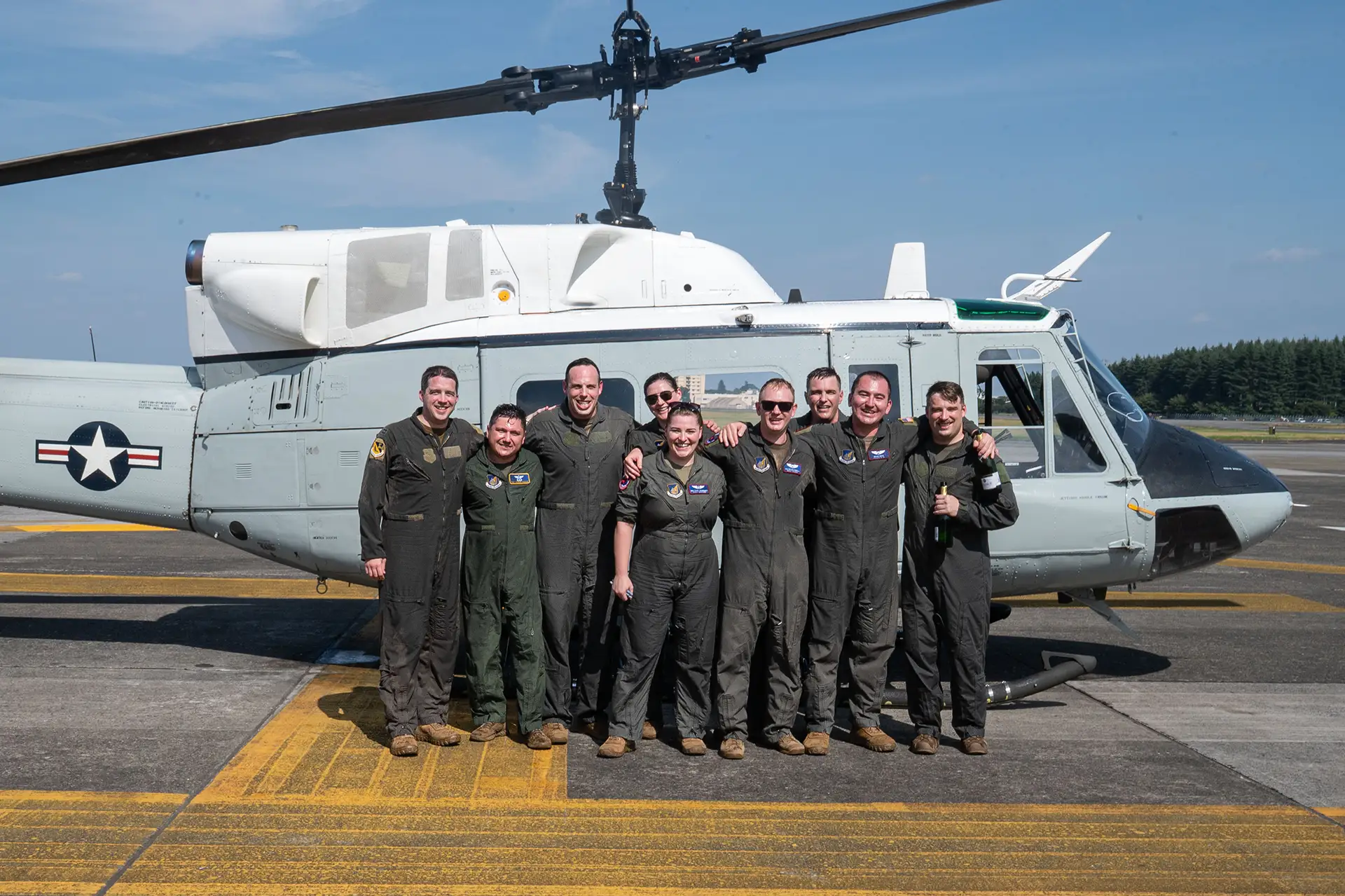
The crews of the 459th Airlift Squadron will miss the Huey. With that thought, the last word goes to Maj. Girolami: “I know it's
been a very emotional rollercoaster for a lot of us. It's been hard for me being one of the guys that's sticking behind because I've
watched all my friends now PCS (Permanent Change of Station) away. In the next month, the last eight or nine of us, me, Lt. Col. Martin, an
a few others, we’re all getting spread to the four winds. It is kind of emotional thinking that this could potentially be my last time
flying the Huey.
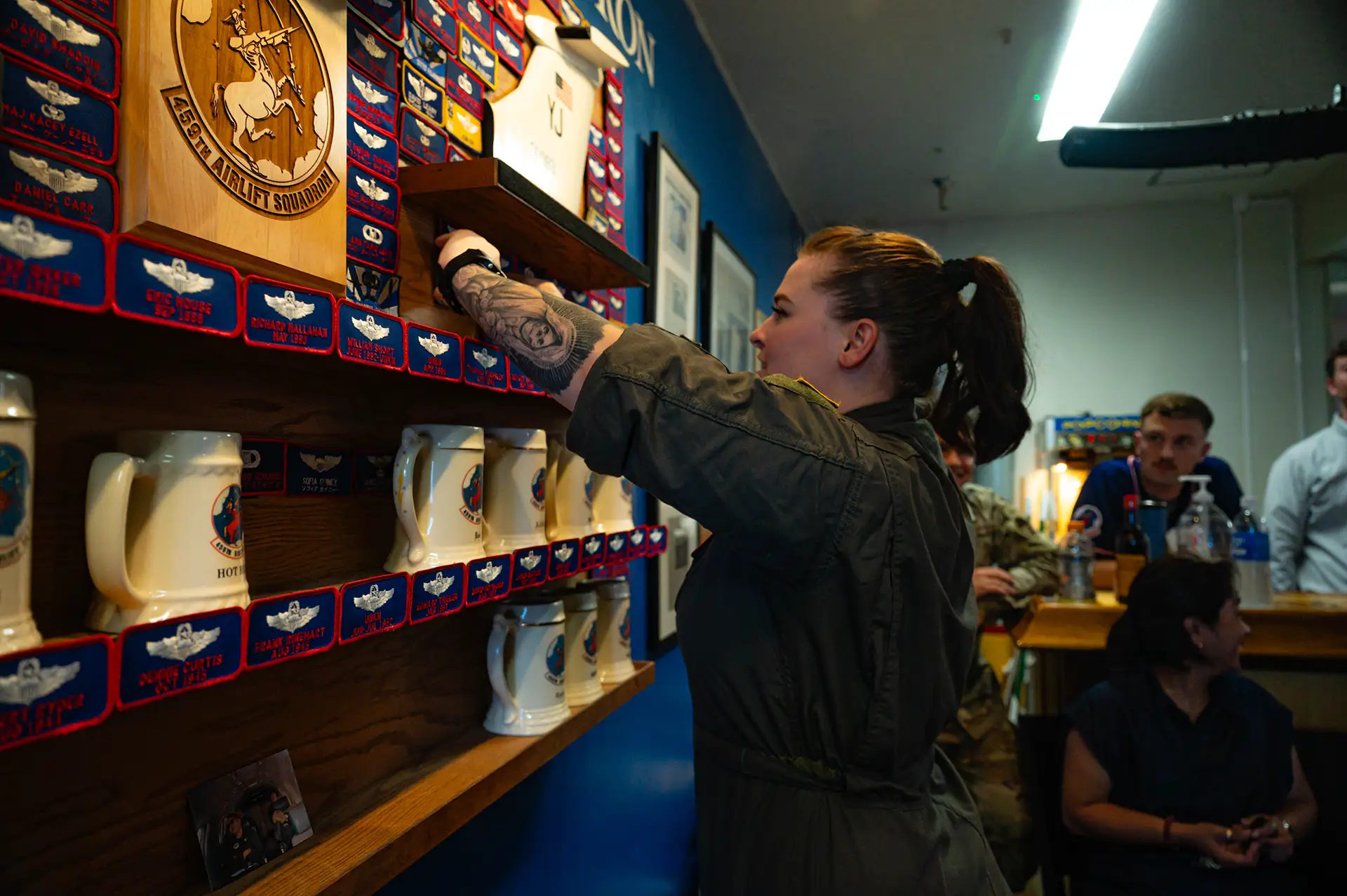
“Looking forward, we're excited to see the path to the C-12 continue to move forward. The C-12s have the larger lift capability and the longer legs to be able to do that niche airlift mission that’s needed here. And I'm personally excited to be able to get involved in that and see that side of how the unit operates a little bit more. I've been kind of an outsider ‘helicopter guy’ looking in from the periphery. The C-12s are going to carry the torch and they're going to keep working hard, supporting the exercises and the DVs, and anything that we’re called upon to do, but the unit isn't dying with the Huey leaving, we're just pivoting to a new normal. I'm really excited to see what else we're going to be capable of when all our resources are focused on one platform.”
Now that the end has come for the Novembers in the USAF Pacific Air Forces, Vietnam veteran UH-1N 69-6614 will be placed on static display at Yokota Air Base to commemorate the type’s more than 45 years of dedicated service in the skies over Japan. UH-1Ns 69-6639, -6645, and -6646 will soon be delivered to the 309th Aerospace Maintenance and Regeneration Group (AMARG) at Davis-Monthan AFB, Arizona. At AMARG, the Novembers will yield parts to keep other Hueys in the U.S. military fleet flying. So, in some small way, the 459th Airlift Wing’s Hueys will continue to fly on.